Penstemon Collection
Penstemon Collection
Penstemon (x) hybrida Evelyn, Apple Blossom, Blackbird
Beardtongue, Foxglove Beardtongue
Back-to-school special offer!
Get €10 off for every €50 you spend! And get up to €40 off on a single order.
How does it work?
1. Shop your favourites
Add your favourite plants to your basket. For every €50 you spend (excluding delivery charges, store credit and the plastic-free option), you’ll receive a €10 voucher.
€50 spent = €10 voucher
€100 spent = €20 voucher
€150 spent = €30 voucher
€200 spent = €40 voucher
2. Place your order
Once your basket reaches one of the spending thresholds, place your order. You can even choose your delivery date!
3. Receive your voucher
As soon as your order has been shipped, you’ll receive an email containing your personal voucher code and its value.
4. Use it on your next order
Your voucher is valid for 90 days from the date you receive it. It can be used once only, on a new order worth at least the value of the voucher, excluding delivery charges.
Please note: Vouchers can be combined with other offers, but cannot be split or refunded.
Home or relay delivery (depending on size and destination)
Important: You may be charged customs duties by your country’s customs authorities upon delivery.
Schedule delivery date,
and select date in basket
This plant carries a 12 months recovery warranty
More information
We guarantee the quality of our plants for a full growing cycle, and will replace at our expense any plant that fails to recover under normal climatic and planting conditions.
Would this plant suit my garden?
Set up your Plantfit profile →
Description
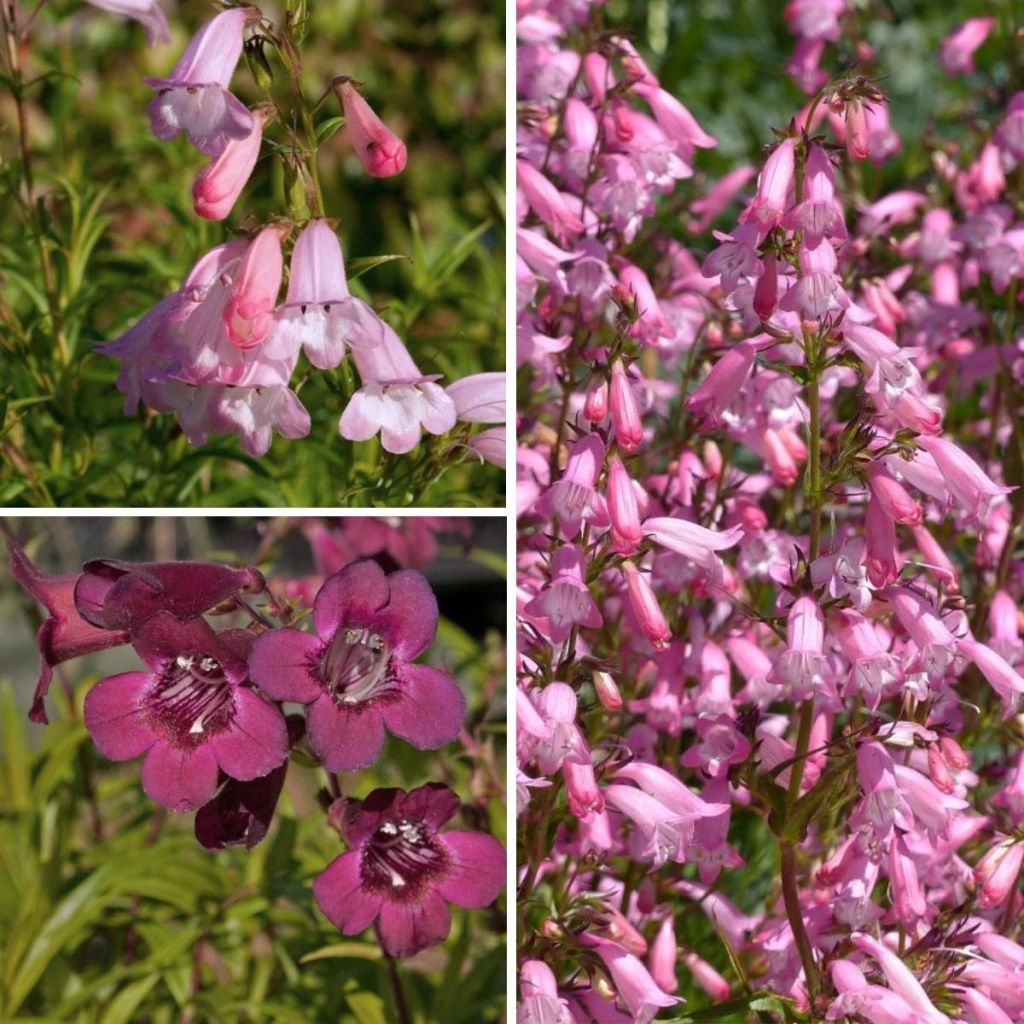
This collection of perennial penstemons brings together the 'Evelyn' with flowers in a delicate pink, 'Apple Blossom' in a fresher pink, and 'Blackbird', which is very different with its deep red colour. These are reliable varieties, renowned for their extraordinary floribundity. These bushy plants will bring grace, lightness, and lots of colour to your borders and containers. They will thrive in the sun in light, rich, well-drained, but not too dry soil in summer.
This collection consists of:
- 1 x Penstemon hybrid 'Evelyn': an old, not very tall (50 cm (20in)), and very bushy variety. Abundant and particularly long-lasting flowering with pastel pink flowers and a white throat, from June to October. Flowers are 2 cm (1in) long. Fine light green foliage, more or less evergreen in winter depending on the climate. Hardiness: down to -12 °C (10.4°F) in dry soil.
- 1 x Penstemon hybrid 'Apple Blossom': a variety that reaches a height of 70 cm (28in) when in bloom. Flowering from June to September-October. Small flowers, 2.5 cm (1in) long, with a pastel pink color washed with a slightly deeper pink at the tips of the lobes, and a pearly white throat marked with light crimson streaks. Fine medium-green foliage, more or less evergreen in winter. Hardiness: down to -9 °C (15.8°F) in dry soil.
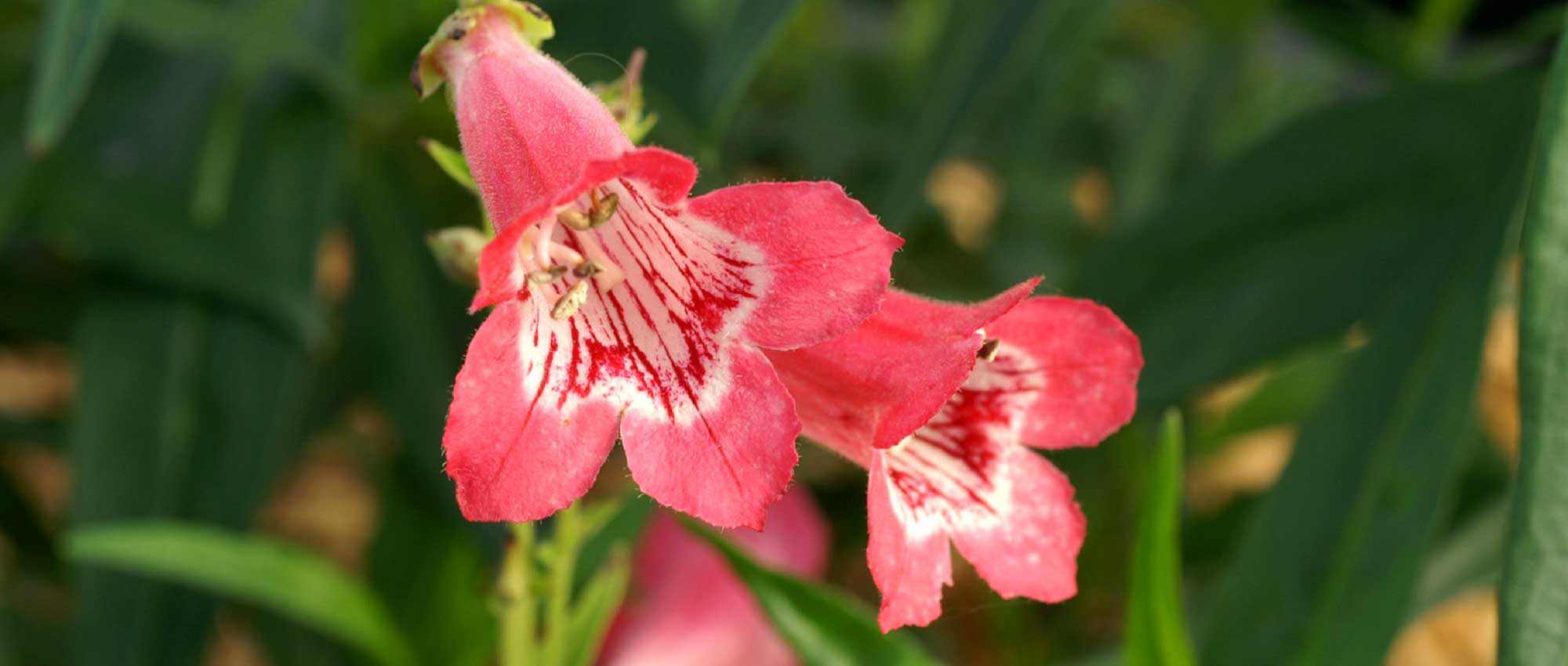
- 1 x Penstemon hybrid 'Blackbird': a variety that reaches a height of 65 cm (26in), flowering from June to October. Tubular, widely open, 4 cm (2in) long flowers in a deep red colour with a white throat. Fine light green foliage, more or less evergreen in winter. Hardiness: down to -15 °C (5°F) in dry soil.
Plant this penstemon collection in a sunny border or large flower bed, or in large pots on your balcony. They prefer to be planted in spring and thrive in rich, light, well-drained soil that is not too dry in summer but fairly dry in winter. Leave a spacing of 50 cm (20in) between plants. It is recommended to prune the faded flower stems so that the plants continue to flower generously from June to September-October. This long and abundant flowering can sometimes cause the stems to bend under the weight of the flowers. We recommend pinching the branches during the growing season. This will result in shorter and straighter flower stems, with a slightly delayed flowering.
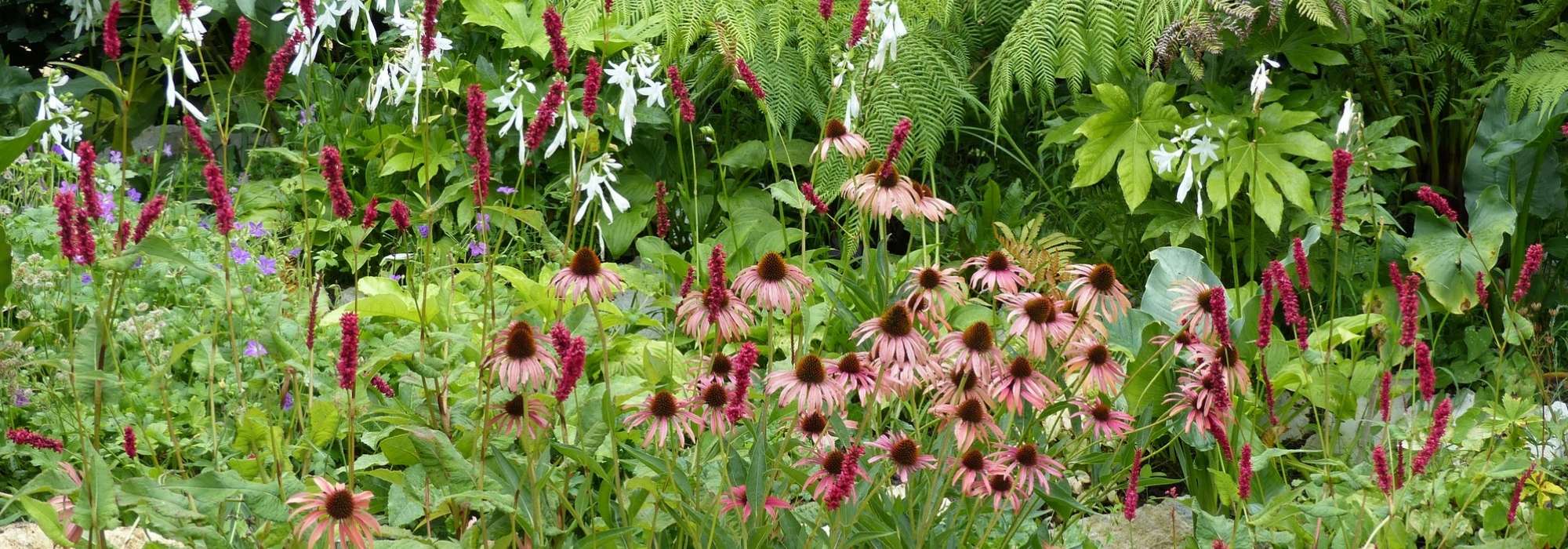
There are plenty of combination ideas to create a large flower bed with these perennials according to each gardener's taste. You can mix them with tall blue bellflowers, in front of white Bristol Fairy gypsophiles, and sow some love-in-a-mist among the different plants. Penstemons also make excellent companions for roses. You can plant them in a ribbon in front of rose bushes in an English-style garden, which will be very colourful for months. In a wilder setting, you can combine them with medium-sized grasses such as Muhlenbergia capillaris or Eragrostis spectabilis. Once well established, these Penstemons will only require regular pruning to remove faded flowers and a pruning of the stems to 10 cm (4in) above ground level in March-April.
Flowering
Foliage
Plant habit
Botanical data
Penstemon
(x) hybrida
Evelyn, Apple Blossom, Blackbird
Scrophulariaceae (Plantaginaceae)
Beardtongue, Foxglove Beardtongue
Cultivar or hybrid
Planting and care
Plant these Penstemons in a sunny location in well-prepared, light, rich, and well-drained soil, in early spring or early autumn in mild winter regions. You can also plant them in 30 cm (12in) diameter pots, which will protect them from severe frost and excess moisture in winter. In this case, they should be overwintered in a fairly bright but unheated room.
The Penstemon hybrid appreciates thin, rich, well-drained soil that is neither too wet in winter nor dries out too much in summer. It can tolerate a little limestone, and a slightly acidic to neutral soil suits it very well. These plants are easy to cultivate and only require some attention due to their low tolerance to winter moisture combined with severe frosts.
Do not prune the clump at the end of the season, as its semi-evergreen foliage plays a role in regulating soil moisture. You can protect the base with a mulch at the beginning of winter, using dry mulch (a bed of dead leaves) and/or sand and crushed gravel for better drainage, thus avoiding collar rot caused by excess moisture. Light fertilisation at planting is beneficial, but should be avoided afterwards, as it may result in thin and loose cep stems. Fairly resistant to diseases, Penstemons can however be prone to powdery mildew, downy mildew, and to being attacked by snails, slugs, and chrysanthemum nematodes.
Planting period
Intended location
Care
Planting & care advice
-
-
-

-
-
-
-

-
This item has not been reviewed yet - be the first to leave a review about it.
Recently viewed products
Haven't found what you were looking for?
Hardiness is the lowest winter temperature a plant can endure without suffering serious damage or even dying. However, hardiness is affected by location (a sheltered area, such as a patio), protection (winter cover) and soil type (hardiness is improved by well-drained soil).

The flowering period indicated on our website applies to countries and regions located in USDA zone 8 (France, the United Kingdom, Ireland, the Netherlands, etc.)
It will vary according to where you live:- In zones 9 to 10 (Italy, Spain, Greece, etc.), flowering will occur about 2 to 4 weeks earlier.
- In zones 6 to 7 (Germany, Poland, Slovenia, and lower mountainous regions), flowering will be delayed by 2 to 3 weeks.
- In zone 5 (Central Europe, Scandinavia), blooming will be delayed by 3 to 5 weeks.
In temperate climates, pruning of spring-flowering shrubs (forsythia, spireas, etc.) should be done just after flowering.
Pruning of summer-flowering shrubs (Indian Lilac, Perovskia, etc.) can be done in winter or spring.
In cold regions as well as with frost-sensitive plants, avoid pruning too early when severe frosts may still occur.
The planting period indicated on our website applies to countries and regions located in USDA zone 8 (France, United Kingdom, Ireland, Netherlands).
It will vary according to where you live:
- In Mediterranean zones (Marseille, Madrid, Milan, etc.), autumn and winter are the best planting periods.
- In continental zones (Strasbourg, Munich, Vienna, etc.), delay planting by 2 to 3 weeks in spring and bring it forward by 2 to 4 weeks in autumn.
- In mountainous regions (the Alps, Pyrenees, Carpathians, etc.), it is best to plant in late spring (May-June) or late summer (August-September).
The harvesting period indicated on our website applies to countries and regions in USDA zone 8 (France, England, Ireland, the Netherlands).
In colder areas (Scandinavia, Poland, Austria...) fruit and vegetable harvests are likely to be delayed by 3-4 weeks.
In warmer areas (Italy, Spain, Greece, etc.), harvesting will probably take place earlier, depending on weather conditions.
The sowing periods indicated on our website apply to countries and regions within USDA Zone 8 (France, UK, Ireland, Netherlands).
In colder areas (Scandinavia, Poland, Austria...), delay any outdoor sowing by 3-4 weeks, or sow under glass.
In warmer climes (Italy, Spain, Greece, etc.), bring outdoor sowing forward by a few weeks.
Shipping country and language
Your country of residence may be:
Your country of residence is:
For a better user experience on our website, you can select:
Your shipping country:
-
 Austria
-
 Belgium
-
 Bosnia & Herzegovina
-
 Bulgaria
-
 Croatia
-
 Cyprus
-
 Czechia
-
 Denmark
-
 Estonia
-
 Finland
-
 France
-
 Germany
-
 Greece
-
 Hungary
-
 Iceland
-
 Ireland
-
 Italy
Italy
-
 Latvia
-
 Liechtenstein
-
 Lithuania
-
 Luxembourg
-
 Malta
Malta
-
 Netherlands
-
 Poland
-
 Portugal
-
 Romania
-
 Serbia
-
 Slovakia
-
 Slovenia
-
 Spain
Spain
-
 Sweden
-
 Switzerland
Language:
-
French
-
 English
-
Spanish
-
Italian
-
German
-
Portuguese
-
Dutch
-
Finnish
My Account
Hello
My wish lists
My cart
Log in / Register
Existing customer?
This form is protected by reCAPTCHA - the Google Privacy Policy and Terms of Service apply.
New customer?
Create an account to track your orders, access our customer service and, if you wish, make the most of our upcoming offers.