Nymphaea Marian Strawn - Waterlily
Nymphaea Marian Strawn - Waterlily
Nymphaea Marian Strawn
Water Lily, Waterlily
Back-to-school special offer!
Get €10 off for every €50 you spend! And get up to €40 off on a single order.
How does it work?
1. Shop your favourites
Add your favourite plants to your basket. For every €50 you spend (excluding delivery charges, store credit and the plastic-free option), you’ll receive a €10 voucher.
€50 spent = €10 voucher
€100 spent = €20 voucher
€150 spent = €30 voucher
€200 spent = €40 voucher
2. Place your order
Once your basket reaches one of the spending thresholds, place your order. You can even choose your delivery date!
3. Receive your voucher
As soon as your order has been shipped, you’ll receive an email containing your personal voucher code and its value.
4. Use it on your next order
Your voucher is valid for 90 days from the date you receive it. It can be used once only, on a new order worth at least the value of the voucher, excluding delivery charges.
Please note: Vouchers can be combined with other offers, but cannot be split or refunded.
Home or relay delivery (depending on size and destination)
Important: You may be charged customs duties by your country’s customs authorities upon delivery.
Schedule delivery date
and select date in basket
This plant carries a 6 months recovery warranty
More information
We guarantee the quality of our plants for a full growing cycle, and will replace at our expense any plant that fails to recover under normal climatic and planting conditions.
Description
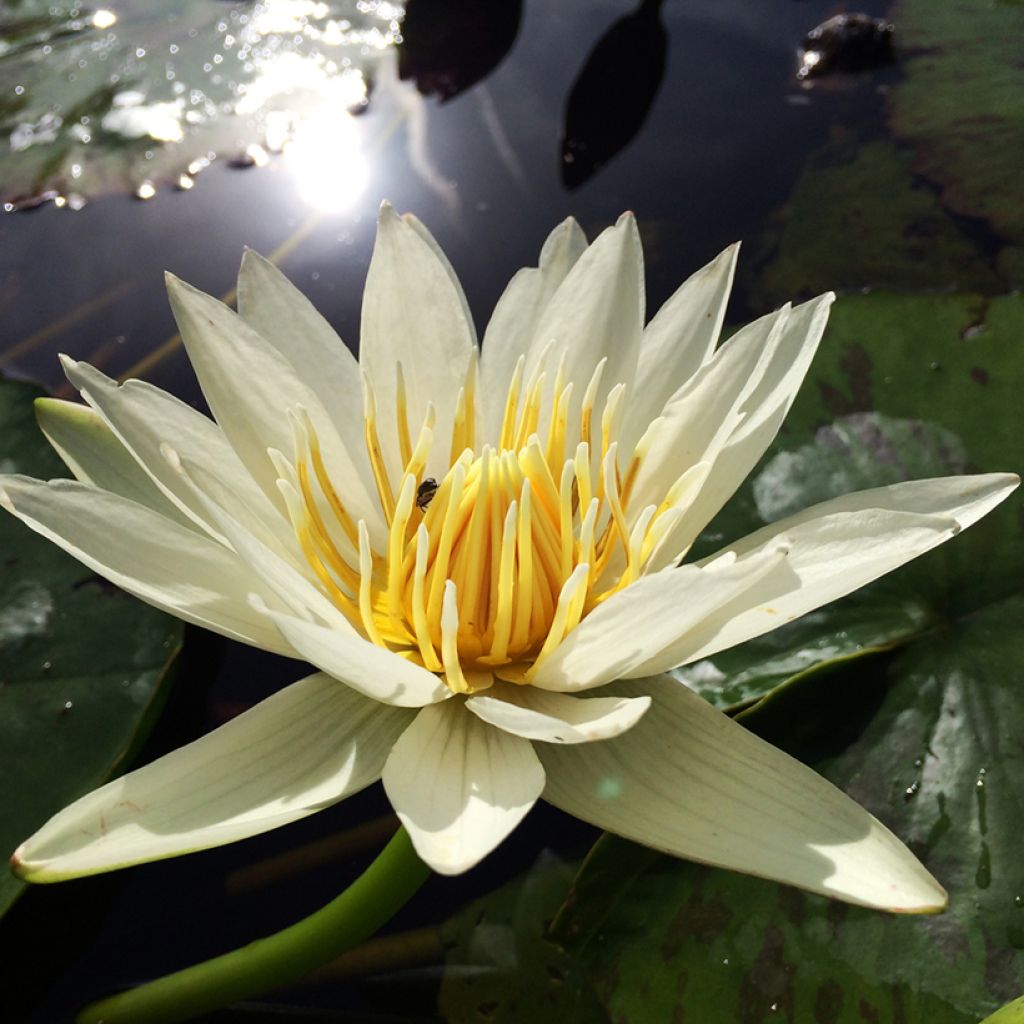
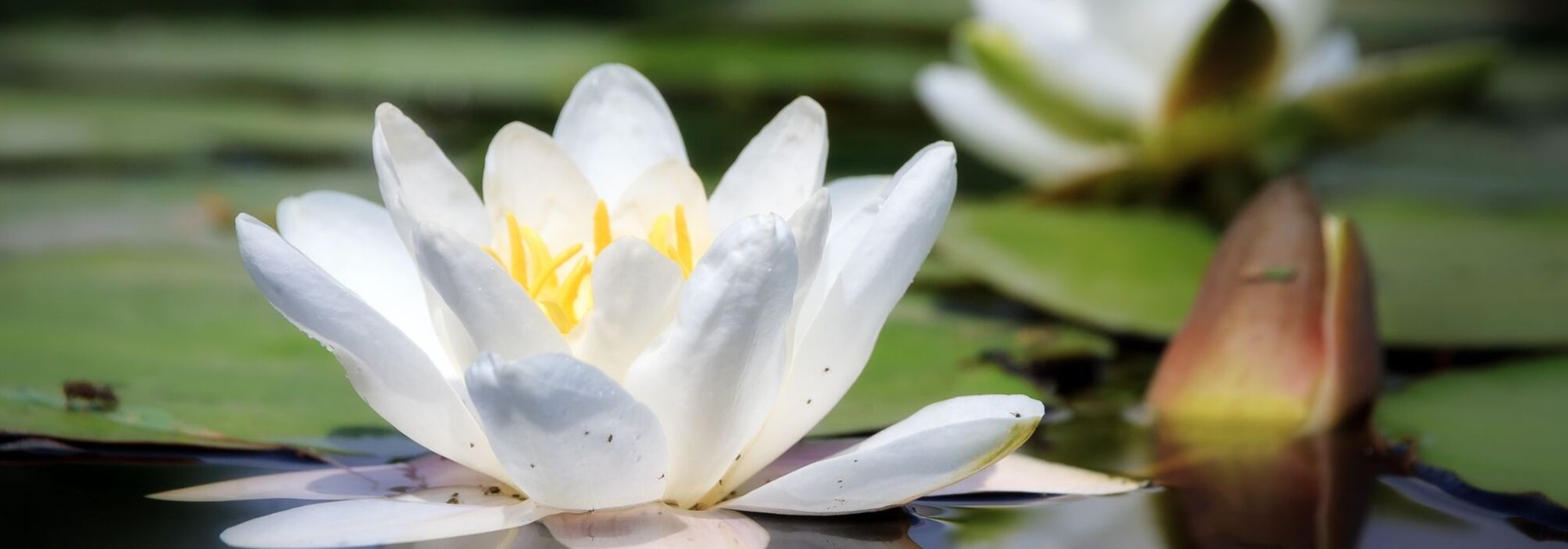
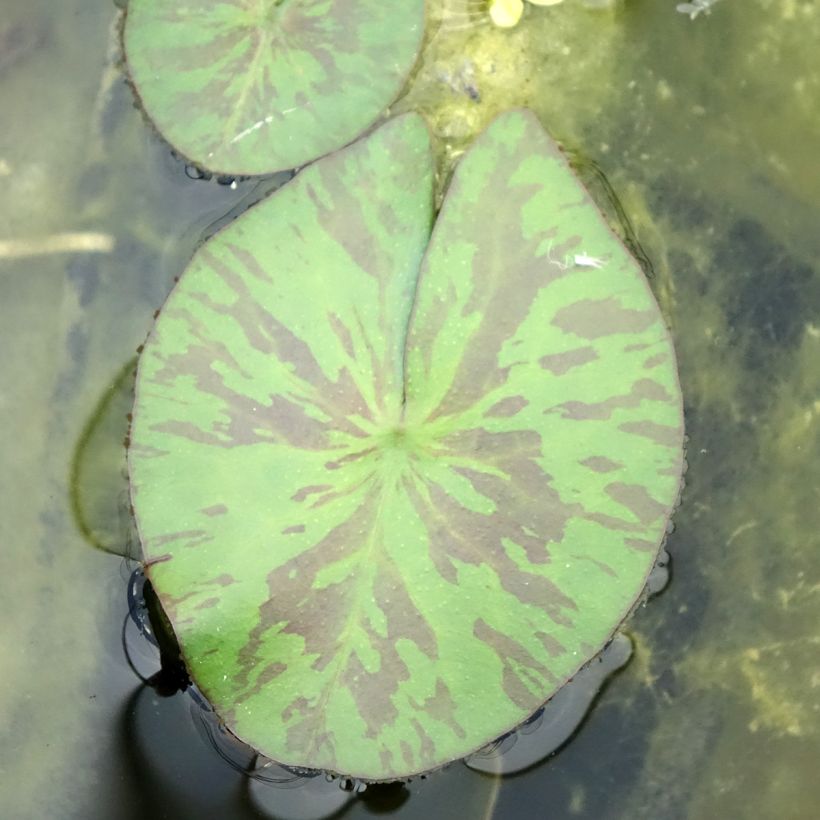
The Nymphaea 'Marian Strawn' is a variety of tropical water lily sought after for its particularly large and fragrant white flowers. Star-shaped flowers that proudly rise above the water to be admired. The leaves of this water lily are wide and round and adorned with purple-brown spots that fade over the season. The plant is vigorous, floriferous, and tolerates partial shade in hot climates. It is a tender variety that will spend the summer outdoors, on the terrace or in a container submerged in a pond. The container will be brought indoors before the first frost in a room between 12 and 15 °C.
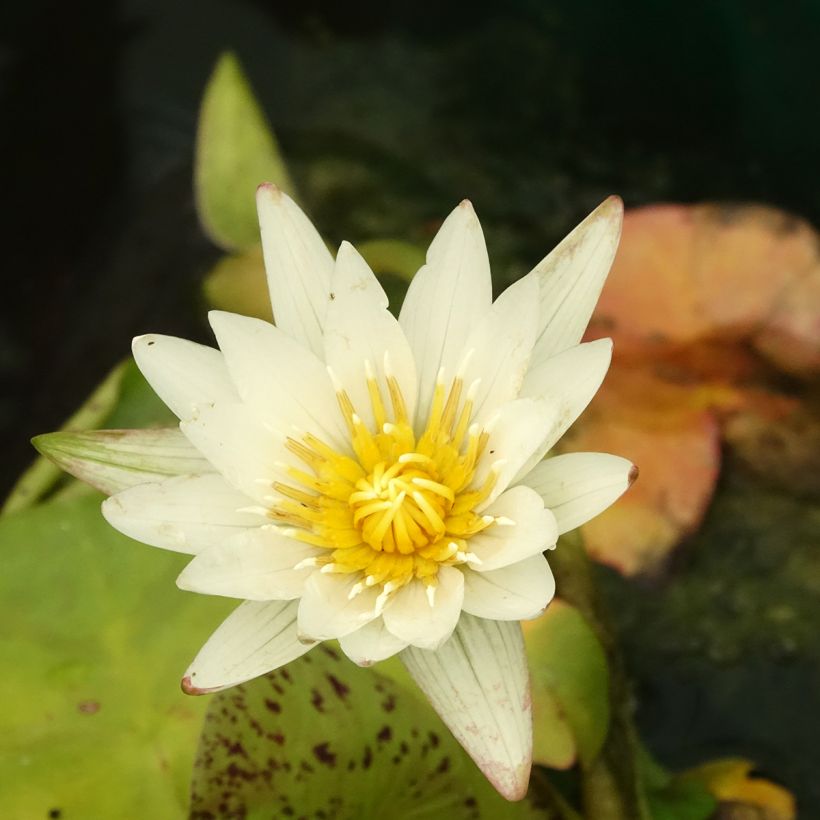
The Water Lily 'Marian Strawn' is a horticultural creation by Strawn (U.S.A) dating back to 1969. It is a perennial with deciduous foliage belonging to the Nymphaeaceae family. Starting from spring, this plant develops numerous floating leaves measuring 30 to 50 cm in diameter on a mature plant. They are round and glossy on the top, with an undulated and dentate edge. The young leaves are heavily speckled with purple-brown, then turn more or less speckled dark green. The plant, of good vigour, will reach 30 cm in height when flowering and spread over 80 cm to 1 m. The abundant and prolonged flowering begins in May and lasts until October. The solitary flowers, measuring 15 to 25 cm in diameter, can easily rise 30 cm above the water surface. The corollas are composed of thin, pure white petals with a beautiful yellow heart adorned with stamens. They open around 10 a.m. and close around 5 p.m. Each flower lives for 4 to 5 days before withering; it returns underwater and is replaced by another flower. The flowering is followed by the formation of fruits containing numerous seeds. The fruit ripens underwater and releases floating seeds that eventually sink and germinate in the mud. Tropical water lilies cannot survive the winter outdoors in our climates. They must be planted in a manageable container and easily moved in spring and autumn.
Plant a single rhizome of the water lily 'Marian Strawn' per container of 14 to 20 litres, under 20 to 60 cm of water. More exotic than hardy water lilies, often highly fragrant, including blue in their colour palette, tropical water lilies deserve some attention. They are collectable aquatic plants that are among the most beautiful pond plants. Most of them bloom longer than hardy varieties until early autumn. To bloom abundantly, tropical species need at least 6 to 7 hours of direct sunlight per day and water around 20°C during the growing season. They are also heavy feeders that require regular fertilisation.
The genus name comes from the Greek nymphaia and the Latin name nymphaea, which means "water lily". The nymphs of Greek and Latin mythology inspired them. Nymphaea bears flowers that are sometimes diurnal, sometimes nocturnal, and occasionally fragrant.
Nymphaea Marian Strawn - Waterlily in pictures
Flowering
Foliage
Plant habit
Botanical data
Nymphaea
Marian Strawn
Nymphaeaceae
Water Lily, Waterlily
Nymphaea 'Marian Strawn'
Cultivar or hybrid
Planting and care
Tropical water lilies love warmth and cannot tolerate our winters, so they must be protected from the cold. Each rhizome of the 'Marian Strawn' water lily should be planted in a container of 14 to 20 litres, under 20 to 60 cm of water. Choose a lightweight and easy-to-move model (such as a plastic pot with drainage holes). When the water temperature reaches around 20 °C, the container will be moved outside and submerged in a pond, a tub, a barrel... Plant the rhizomes in loamy soil, rich in clay, sticky, and free of stones (never use horticultural compost, as it is too light and promotes algae growth). The use of open baskets is strongly discouraged. Fill your container up to 5-8 cm from the edge. Plant your rhizomes vertically, burying them in the soil up to the neck. Place 2 to 3 Osmocote cones (NPK formula: 10-11-18+2MgO+TE) around the rhizome, burying them 5 or 10 cm into the soil. Place a layer of pumice 2-3 cm thick to secure everything. Water the whole thing with the watering can to saturate the substrate. Place the container at the correct depth in the pond or tub. Provide these tropical water lilies with a very sunny location where they will receive a minimum of 6 to 7 hours of full sun daily. Each rhizome should have about 1 m² of water surface to develop properly. Renew the fertiliser supply two to three times between April and August.
To help the vegetation start, place the containers against a south-facing wall around April (depending on the region). Then, they are positioned in their final location (for the season) when frost is no longer a concern and temperatures reach 20 °C. Ensure that the water level remains relatively stable and that the water is neither too acidic nor too alkaline (desirable pH between 6.5 and 7.5).
Wintering: Tropical water lilies must be overwintered if not grown year-round indoors in a heated room. Outside, leave them in place until real frosts are announced. The natural decrease in water temperature is favourable for the formation of bulblets around the mother rhizome and for the plants to enter dormancy. Overwinter your tropical water lilies in their container, which you will place in a 100 to 200-litre container, ensuring the water temperature is maintained between 12 and 15 °C. Place everything in a bright room, such as a cold greenhouse or conservatory. In March, the rhizomes start to grow. This is the time to divide and replant them for placement at the end of April or early May.
You can also remove the rhizome and bulblets from the water at the end of November, rinse them thoroughly, and store them in sphagnum or blonde peat enclosed in a "zip" bag. Place everything in a room maintained at 20°C out of the water. Replant your rhizomes and bulblets in spring when the water temperature reaches 20°C again. Start the culture in a small volume of water that heats up well during the day, for example, in a small basin exposed against a south-facing wall. Place them in their final location as soon as growth is well underway.
Never leave Nymphaea's rhizomes exposed to the sun or air to prevent them from drying out; plant them as soon as you receive or purchase them.
If you have fish in your pond, it is preferable to spread a thick layer of large gravel on the surface of the planted pot to discourage them from digging in the soil, nibbling on the rhizomes, and thus soiling the water. During the summer, remove excessive leaves that grow in the centre of the clump and keep only the most vigorous ones. Also, remove any yellowed or stained leaves and emergent aquatic "weeds" from the surface.
Planting period
Intended location
Care
Planting & care advice
-

-
-
-
-

-

-
-
This item has not been reviewed yet - be the first to leave a review about it.
Recently viewed products
Haven't found what you were looking for?
Hardiness is the lowest winter temperature a plant can endure without suffering serious damage or even dying. However, hardiness is affected by location (a sheltered area, such as a patio), protection (winter cover) and soil type (hardiness is improved by well-drained soil).

The flowering period indicated on our website applies to countries and regions located in USDA zone 8 (France, the United Kingdom, Ireland, the Netherlands, etc.)
It will vary according to where you live:- In zones 9 to 10 (Italy, Spain, Greece, etc.), flowering will occur about 2 to 4 weeks earlier.
- In zones 6 to 7 (Germany, Poland, Slovenia, and lower mountainous regions), flowering will be delayed by 2 to 3 weeks.
- In zone 5 (Central Europe, Scandinavia), blooming will be delayed by 3 to 5 weeks.
In temperate climates, pruning of spring-flowering shrubs (forsythia, spireas, etc.) should be done just after flowering.
Pruning of summer-flowering shrubs (Indian Lilac, Perovskia, etc.) can be done in winter or spring.
In cold regions as well as with frost-sensitive plants, avoid pruning too early when severe frosts may still occur.
The planting period indicated on our website applies to countries and regions located in USDA zone 8 (France, United Kingdom, Ireland, Netherlands).
It will vary according to where you live:
- In Mediterranean zones (Marseille, Madrid, Milan, etc.), autumn and winter are the best planting periods.
- In continental zones (Strasbourg, Munich, Vienna, etc.), delay planting by 2 to 3 weeks in spring and bring it forward by 2 to 4 weeks in autumn.
- In mountainous regions (the Alps, Pyrenees, Carpathians, etc.), it is best to plant in late spring (May-June) or late summer (August-September).
The harvesting period indicated on our website applies to countries and regions in USDA zone 8 (France, England, Ireland, the Netherlands).
In colder areas (Scandinavia, Poland, Austria...) fruit and vegetable harvests are likely to be delayed by 3-4 weeks.
In warmer areas (Italy, Spain, Greece, etc.), harvesting will probably take place earlier, depending on weather conditions.
The sowing periods indicated on our website apply to countries and regions within USDA Zone 8 (France, UK, Ireland, Netherlands).
In colder areas (Scandinavia, Poland, Austria...), delay any outdoor sowing by 3-4 weeks, or sow under glass.
In warmer climes (Italy, Spain, Greece, etc.), bring outdoor sowing forward by a few weeks.
Shipping country and language
Your country of residence may be:
Your country of residence is:
For a better user experience on our website, you can select:
Your shipping country:
-
 Austria
-
 Belgium
-
 Bosnia & Herzegovina
-
 Bulgaria
-
 Croatia
-
 Cyprus
-
 Czechia
-
 Denmark
-
 Estonia
-
 Finland
-
 France
-
 Germany
-
 Greece
-
 Hungary
-
 Iceland
-
 Ireland
-
 Italy
Italy
-
 Latvia
-
 Liechtenstein
-
 Lithuania
-
 Luxembourg
-
 Malta
Malta
-
 Netherlands
-
 Poland
-
 Portugal
-
 Romania
-
 Serbia
-
 Slovakia
-
 Slovenia
-
 Spain
Spain
-
 Sweden
-
 Switzerland
Language:
-
French
-
 English
-
Spanish
-
Italian
-
German
-
Portuguese
-
Dutch
-
Finnish
My Account
Hello
My wish lists
My cart
Log in / Register
Existing customer?
This form is protected by reCAPTCHA - the Google Privacy Policy and Terms of Service apply.
New customer?
Create an account to track your orders, access our customer service and, if you wish, make the most of our upcoming offers.