





























The exotic-style garden is attracting an increasing number of gardeners. Bamboo, palm trees, and banana plants are among the most popular plants for creating scenes that evoke the tropical jungle, but there are many others! To make this dream accessible and sustainable, both outdoors and even in cold climates, there is only one option: to choose truly hardy plants that can withstand winter's harshness. Here is a small selection of our favourite plants (bushes and perennials)!
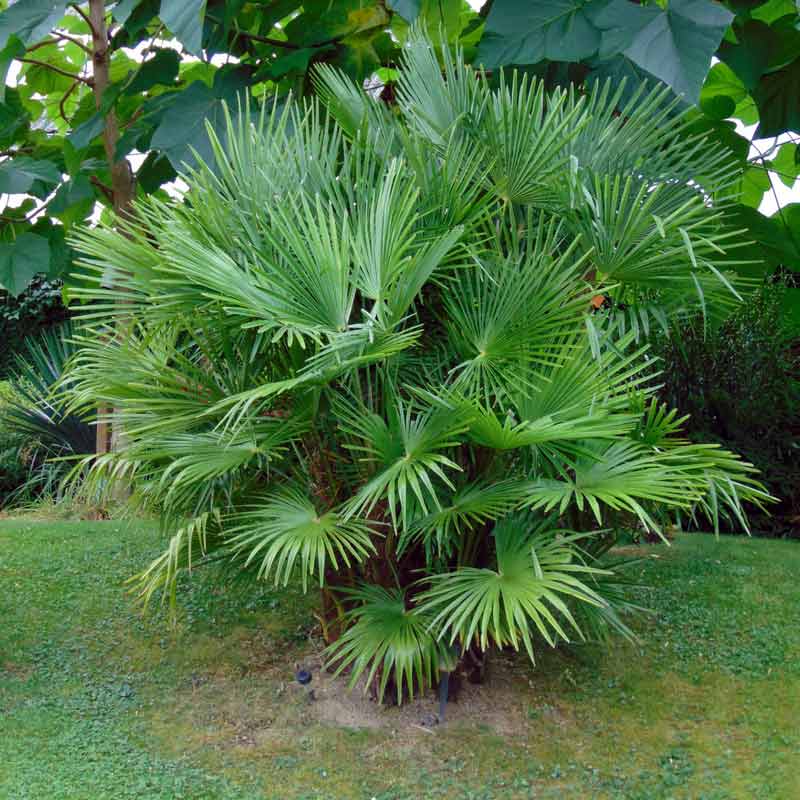
1) Trachycarpus fortunei, known as "Hemp Palm" - Hardiness: -18 °C
No, palm trees are not just on the Croisette… they can also be found in northern France, for example, with the Trachycarpus fortunei, which can withstand temperatures down to -18 °C. This ability to face the cold comes from its mountainous origins (China and Japan) as well as the thick fibre that protects its trunk. It can reach heights of 8 to 10 metres and prefers rich, light soil, thriving in full sun or partial shade.
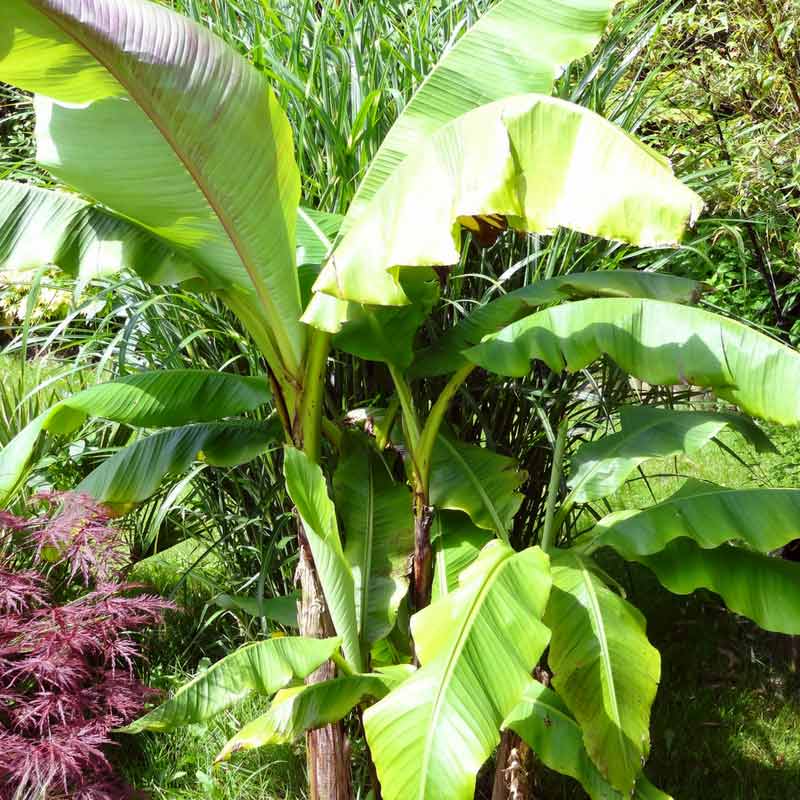
2) The Banana plant or Musa basjoo - Hardiness: -12 °C to -15 °C
The Musa basjoo is an outdoor banana plant, hardy, also known as the "Japanese Banana". It is a valiant plant that generally does not produce fruit but displays its large decorative leaves each year. It can grow over 2 metres tall, and even more if you ensure it receives what it needs: regular watering and rich soil. Its only weakness lies in poor wind resistance. If you don’t want its leaves to be turned into sad little brooms, it is essential to protect it by planting it in a sheltered area or a walled space.
Slightly less hardy but still quite resilient, also discover the Sikkim banana (or Sikkim Banana) Red Tiger, a variety with graphic leaves, light green with a purple underside, elegantly striped with burgundy.
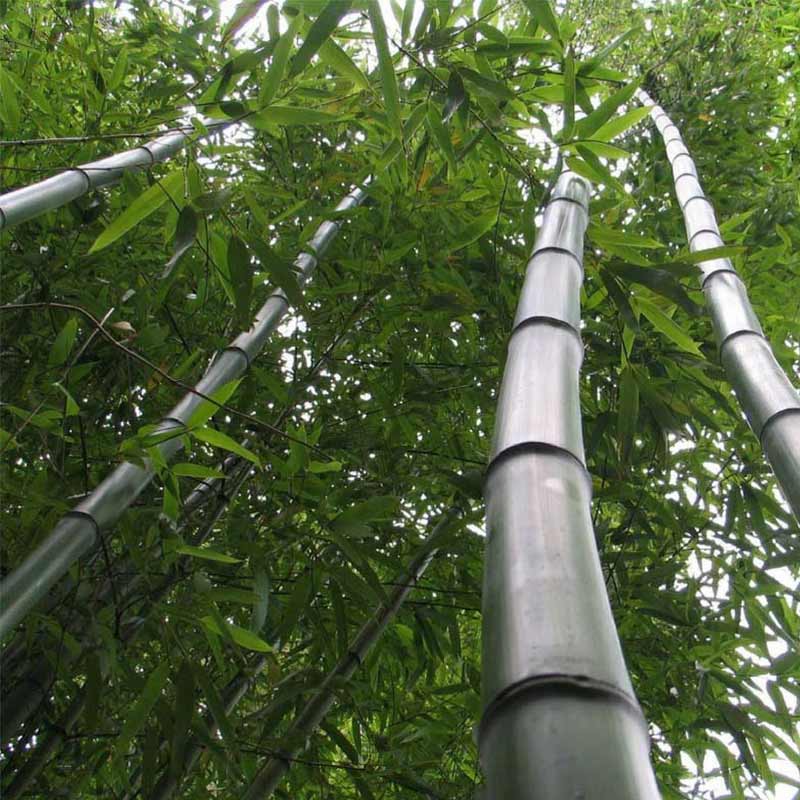
3) Bamboos: Phyllostachys vivax and Fargesia robusta - Hardiness: -20 °C and -15 °C
Bamboos are among the classics of exotic gardens, but their hardiness varies greatly depending on the species and varieties. Among the most spectacular, we particularly like the Phyllostachys vivax 'Huangwenzhu', a giant bamboo (running… plan for a rhizome barrier) that can grow its green canes striped with yellow to over 10 metres tall. Fast-growing, it will quickly form a small forest. Relatively smaller in size (4 to 5 metres tall) and non-running, the Fargesia robusta is better suited for small gardens. It features long green leaves and bright green culms.
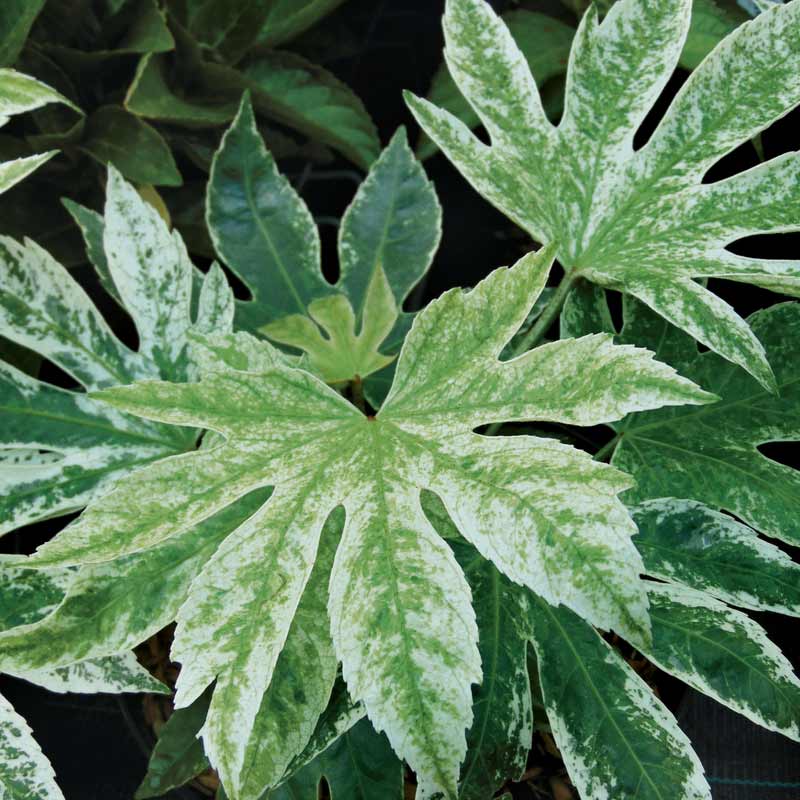
4) Fatsia japonica Spider's Web - Hardiness: -15 °C
The Fatsia japonica 'Spider's Web' is a shrub with a unique personality! About 2 metres tall, this Aralia showcases dark green, evergreen foliage splashed with cream-white. Its palmate leaves can reach up to 20 cm in diameter. In summer, they are topped with round white flowers that later turn into decorative black berries. This shrub thrives in shade or partial shade, in cool soil.
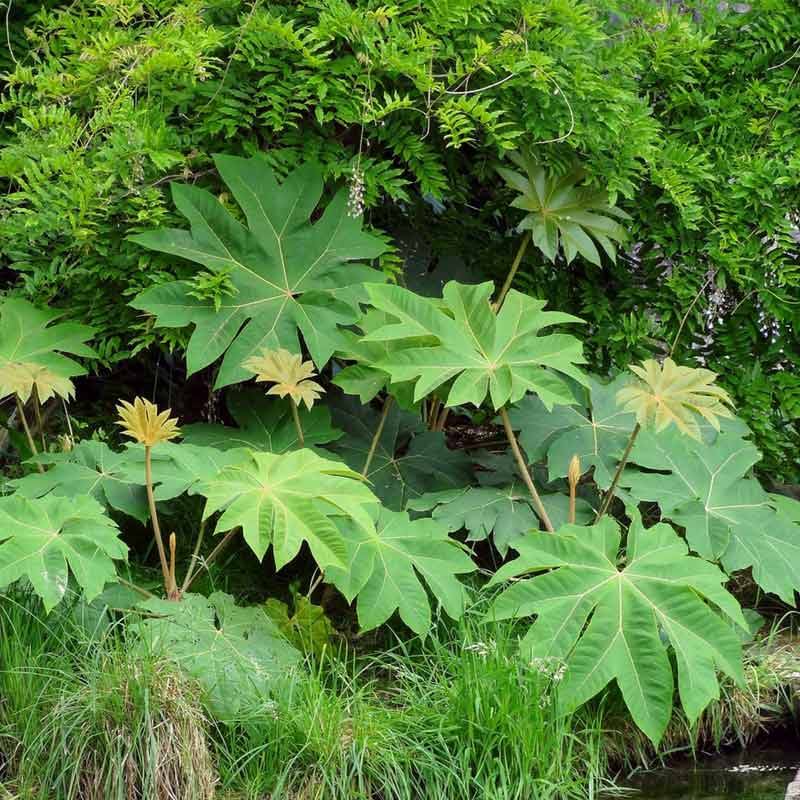
5) Tetrapanax papyrifera Rex, Rice Paper Plant - Hardiness: -10 °C
Halfway between a shrub and a perennial, Tetrapanax papyrifera 'Rex' is an exuberant plant that captivates with the XXL size and cut shape of its leaves that spread out like a parasol. Native to China and Japan, it is a rhizomatous plant, like bamboo, that tends to spread and may require a rhizome barrier. It grows in non-burning sun or partial shade, in fertile and rather cool soil. Its loose habit and Asian charm make this plant a perfect complement to bamboos.
Note that the aerial parts of this plant are destroyed at -5 °C, but it will regrow from the rootstock above -10 °C, once well established.
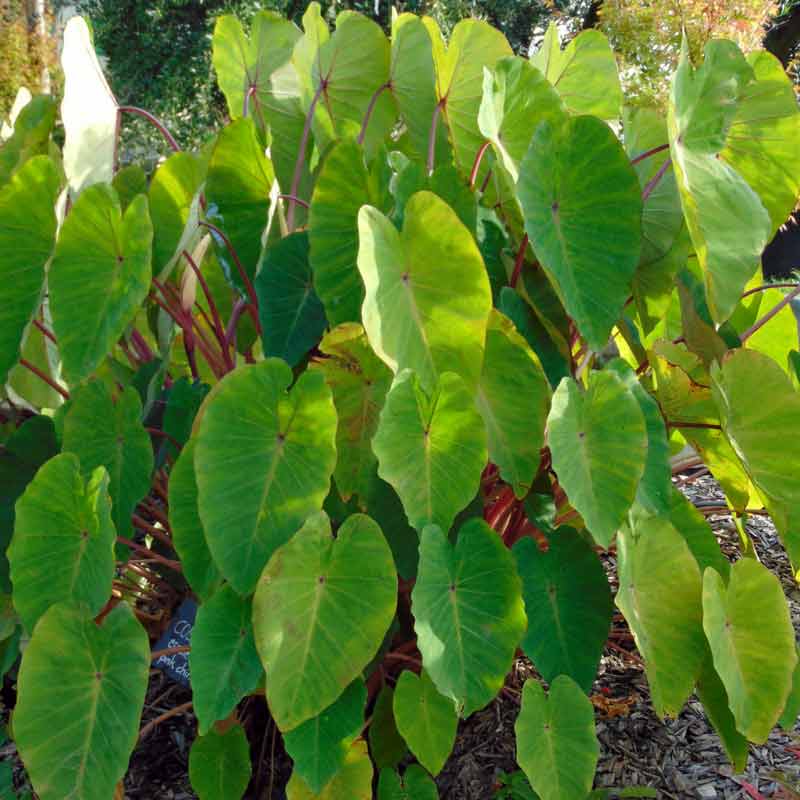
6) Colocasia Pink China - Elephant Ear - Hardiness: -10 °C to -12 °C
Lush, the Colocasia 'Pink China' stands out for the heart-shaped form and the colour of its large foliage: a lovely soft blue-green that contrasts with the pink of its petioles. Well known to houseplant enthusiasts, this colocasia can be grown in the garden, provided you mulch it to protect it during winter. It is planted in full sun or partial shade, in cool, humus-rich soil, and appreciates regular watering in summer.
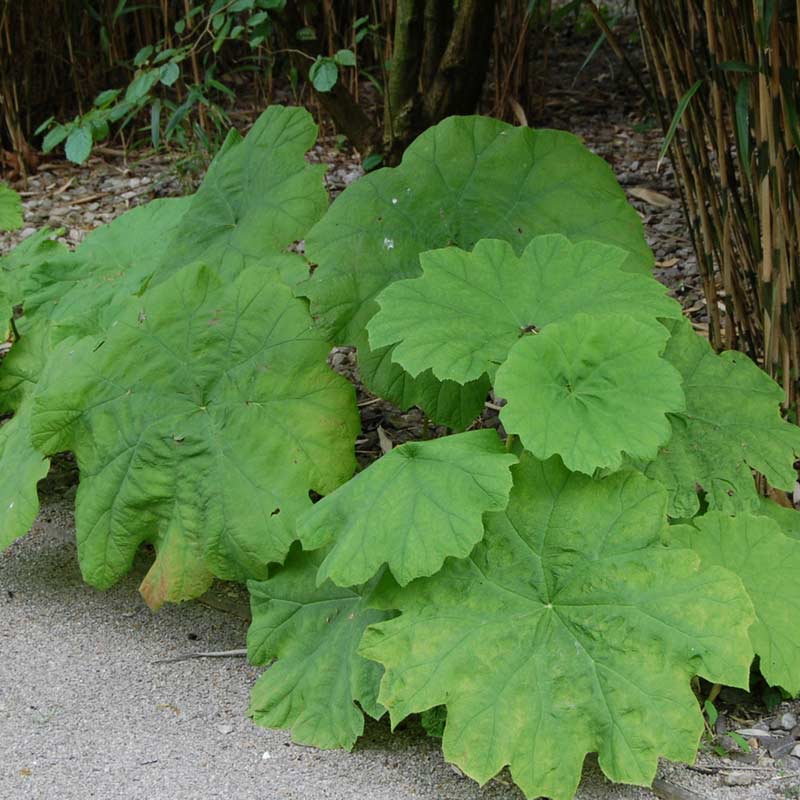
7) Astilboides tabularis - Hardiness: -20 °C
The Astilboides tabularis (sometimes called Rodgersia tabularis) is a spectacular woodland plant that stands out for its large, entire, rounded leaves, about 60 cm in diameter. It quickly forms a clump that can reach 1 metre high and 70 cm wide, or even more if the soil suits it. Its generous foliage is accompanied, in early summer, by light, creamy-white spikes of flowers. It is an ideal perennial for shade, thriving in rich, cool, but well-drained soils.
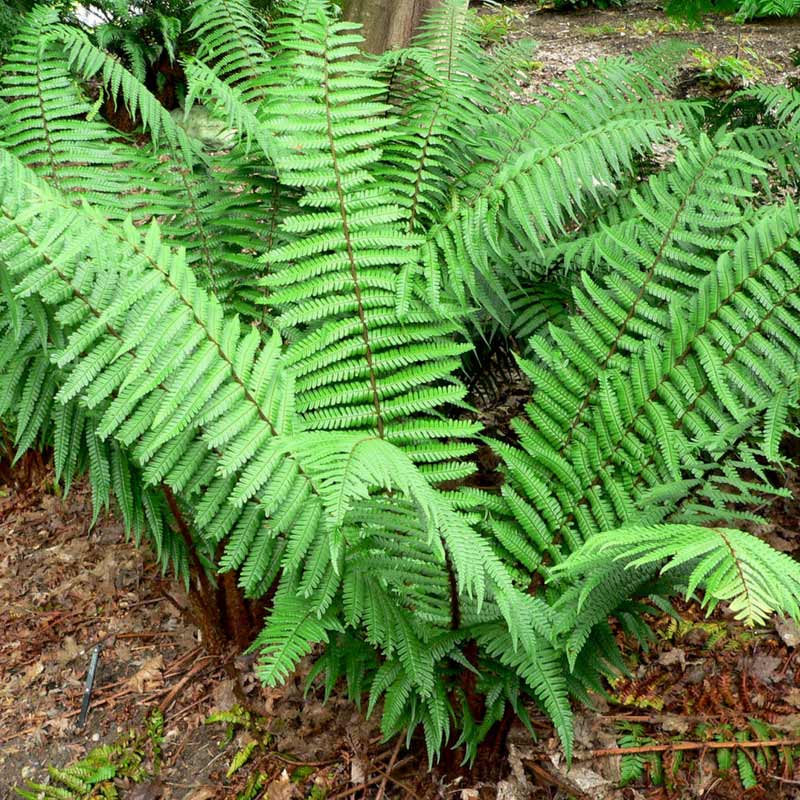
8) Dryopteris wallichiana, Large golden-scaled fern - Hardiness: -15 °C
Majestic, Dryopteris wallichiana is a large fern that unfurls a remarkable cut foliage highlighted by a black vein in spring. Of tall stature (1 to 1.5 metres high) and beautiful appearance, it somewhat resembles tree ferns, especially as its short basal trunk develops with age. It is a variety that is quite easy to cultivate, thriving in deep, very rich humus soil. It will look stunning in a border and can be accompanied by another hardy fern: the Eastern Ostrich Fern (Matteuccia orientalis).
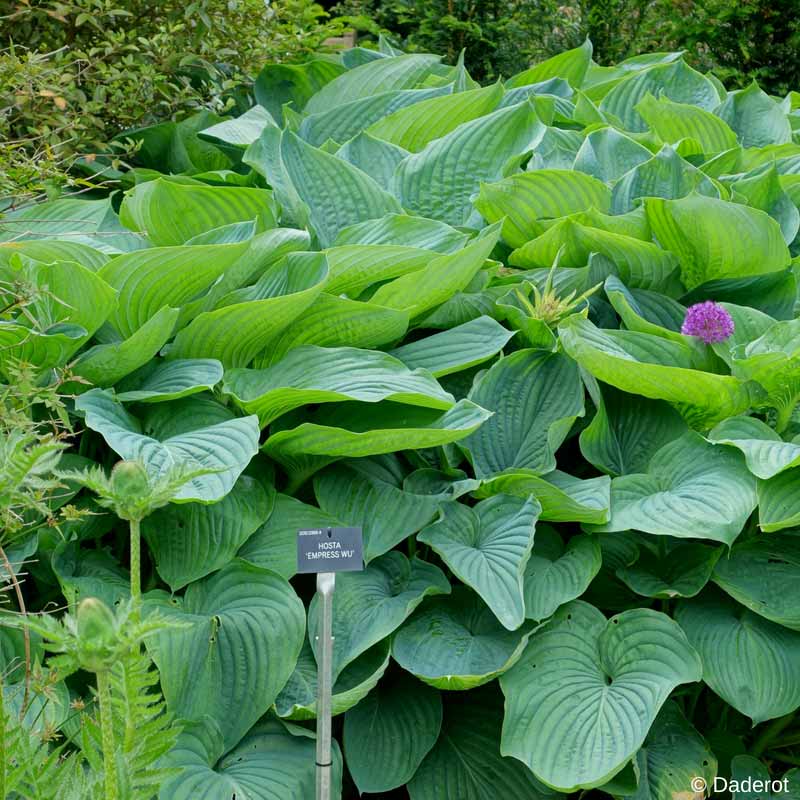
9) Hosta Empress Wu
Hostas are well known for their hardiness and ability to grow in shade or partial shade. While some fit easily into classic borders, others offer such abundant foliage that they easily find their place in a tropical-looking garden. This is the case for the giant Hosta 'Empress Wu', certainly the largest variety that can reach 1.3 metres in all directions in just a few years and displays magnificent blue-green foliage. It is a perennial that requires nourishment and water to express its full potential.
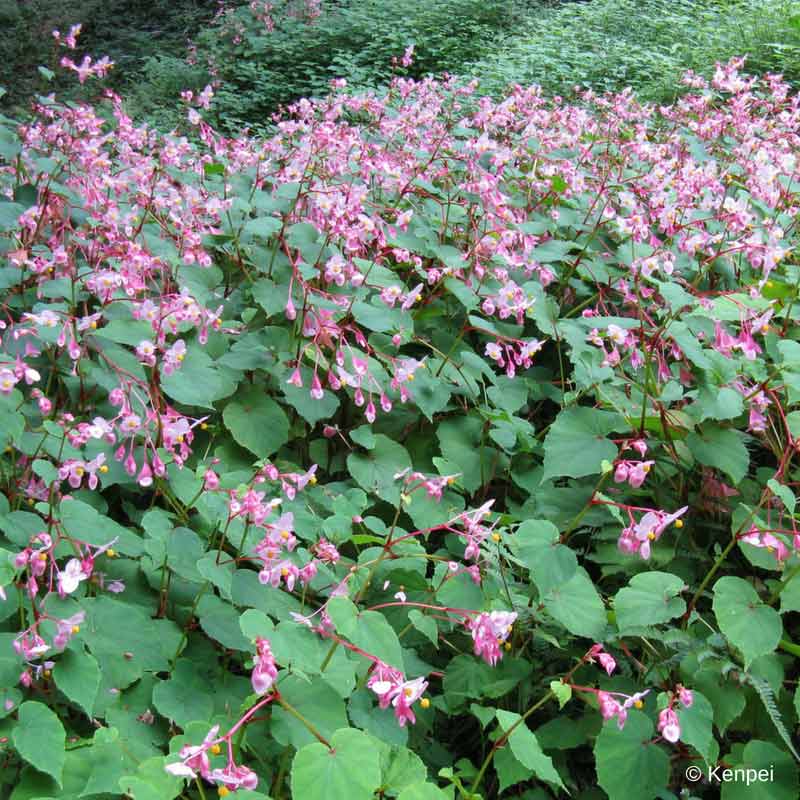
10) Begonia grandis evansiana - Hardiness: -15 °C
Begonias are not just for window boxes: Begonia grandis evansiana, a botanical species, perennial and resistant down to -18 °C here is proof! Its heart-shaped green foliage forms a beautiful bushy clump about 80 cm high and 50 cm wide, adorned throughout the summer with numerous small pink flowers borne on reddish stems. It can be grown in the ground or in pots, ideally in partial shade and in rich, cool soil.
The exotic-style garden is attracting an increasing number of gardeners. Bamboo, palm trees, and banana plants are among the most popular plants for creating scenes that evoke the tropical jungle, but there are many others! To make this dream accessible and sustainable, both outdoors and even in cold climates, there is only one option: to […]
The question may seem odd, but at a time when we seek to limit the time spent in the garden and avoid heavy gardening chores, one might wonder: should we still plant bamboo in our gardens?
On the side of its detractors, criticism abounds, and they see this plant as a hindrance to gardening, an invader that colonises flowerbeds, a conqueror that takes advantage of absence to impose its dominance over the rest of the garden. According to these same detractors, bamboo grows too quickly, constantly sheds its leaves, and grows in a disorderly manner. In short, it is a mundane bush that grows too much and requires constant pruning.
Its admirers, on the other hand, are full of praise and see bamboo as an excellent evergreen plant that does not lose its foliage in winter and is perfect as a privacy screen or windbreak. An exotic plant with a Japanese aesthetic and a graceful, lightweight silhouette that rustles and undulates with the slightest breeze. An architectural plant with stiff, colourful culms and elegant branching.
Not just one bamboo, but many bamboos
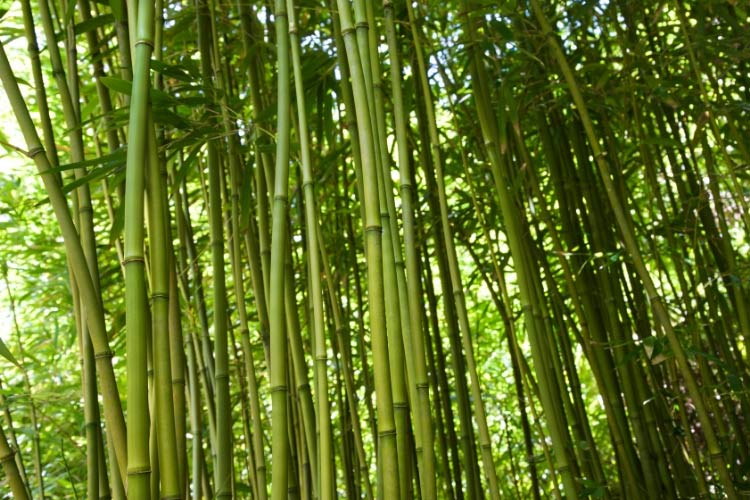
Generally, people think of bamboo as if there were only one variety. However, bamboos are highly diverse, ranging from the small Arundinaria pumila, barely 20 cm tall, to the monstrous Phyllostachys edulis, which reaches over 20 m. Bamboos comprise several hundred species and varieties. To clarify, horticulturists have grouped them into two subfamilies: the running types, which spread and colonise if not contained, and the clumping or cespitose types, which thicken from the base and grow more modestly.
In the running family, we find the star of them all, Phyllostachys, followed by Semiarundinaria, Pleioblastus, Sasa, Chimonobambusa, Shibatea...
In the clumping (non-running) family, the most famous is Fargesia, followed by Yushania, Chusquea, Thamnocalamus, Indocalamus...
How to choose?
It’s child’s play, and the determining question boils down to are you ready to arm yourself with a spade to dig a trench 50 cm deep?
If the answer is yes, digging a trench is the necessary chore that allows you to install a rhizome barrier and thus stop the growing expansion of running bamboos. This "barrier" is simply a sufficiently thick PVC film to stop underground rhizomes and contain them. How to install this famous BAR (rhizome barrier)? It’s simple: dig a trench all around your bamboo, in the desired shape and length. Place your BAR slanted outward so that the rhizomes are guided and slide upwards. Leave it protruding by 10 cm, then backfill while compacting.
This is an essential chore if you wish to create a hedge of Phyllostachys or if you want to plant large bamboos in isolation or in a flowerbed. This way, you will access a great diversity of bamboos.
My favourites: Phyllostachys aureosulcata 'Aureocaulis' for its fluorescent yellow culms, Semiarundinaria fastuosa 'Viridis' for its spectacular and exotic appearance, and Sasa tessellata for its exotic foliage that reminds me of Asia.
If the answer is no, one word of advice: plant clumping bamboos! In other words, non-running bamboos that are unlikely to wander into your neighbour's garden and turn yours into a wild forest. Fargesias, which are increasingly available in the market, are the best candidates! They are perfect for pot cultivation, especially all varieties of Fargesia murielae and are interesting in small gardens where space is limited. However, they do have some drawbacks: they are more expensive, grow much slower (count at least 5 years to obtain a well-furnished plant), are smaller (measuring between 1.5 and 3 m), and do not offer the same diversity of shape and colour as running species.
My favourites: Fargesia murielae 'Jumbo' for its dense and compact habit, Fargesia robusta for its impressive size, and Fargesia nitida Great Wall for the unique colour of its culms.
In summary, if you are a fan of cool and relaxing gardening and digging a trench seems like an insurmountable chore, opt for non-running bamboos. For others, don’t hesitate for a second to plant and mix running and non-running bamboos. Finally, know that there are forums dedicated to bamboos where experts and enthusiasts share valuable advice on "Boo": http://lesbambous.fr/forum/
The question may seem odd, but at a time when we seek to limit the time spent in the garden and avoid heavy gardening chores, one might wonder: should we still plant bamboo in our gardens? On the side of its detractors, criticism abounds, and they see this plant as a hindrance to gardening, an […]