Agave pygmae Dragon Toes
Agave pygmae Dragon Toes
Agave pygmae Dragon Toes
Back-to-school special offer!
Get €10 off for every €50 you spend! And get up to €40 off on a single order.
How does it work?
1. Shop your favourites
Add your favourite plants to your basket. For every €50 you spend (excluding delivery charges, store credit and the plastic-free option), you’ll receive a €10 voucher.
€50 spent = €10 voucher
€100 spent = €20 voucher
€150 spent = €30 voucher
€200 spent = €40 voucher
2. Place your order
Once your basket reaches one of the spending thresholds, place your order. You can even choose your delivery date!
3. Receive your voucher
As soon as your order has been shipped, you’ll receive an email containing your personal voucher code and its value.
4. Use it on your next order
Your voucher is valid for 90 days from the date you receive it. It can be used once only, on a new order worth at least the value of the voucher, excluding delivery charges.
Please note: Vouchers can be combined with other offers, but cannot be split or refunded.
Home or relay delivery (depending on size and destination)
Important: You may be charged customs duties by your country’s customs authorities upon delivery.
Schedule delivery date,
and select date in basket
This plant carries a 12 months recovery warranty
More information
We guarantee the quality of our plants for a full growing cycle, and will replace at our expense any plant that fails to recover under normal climatic and planting conditions.
Would this plant suit my garden?
Set up your Plantfit profile →
Description
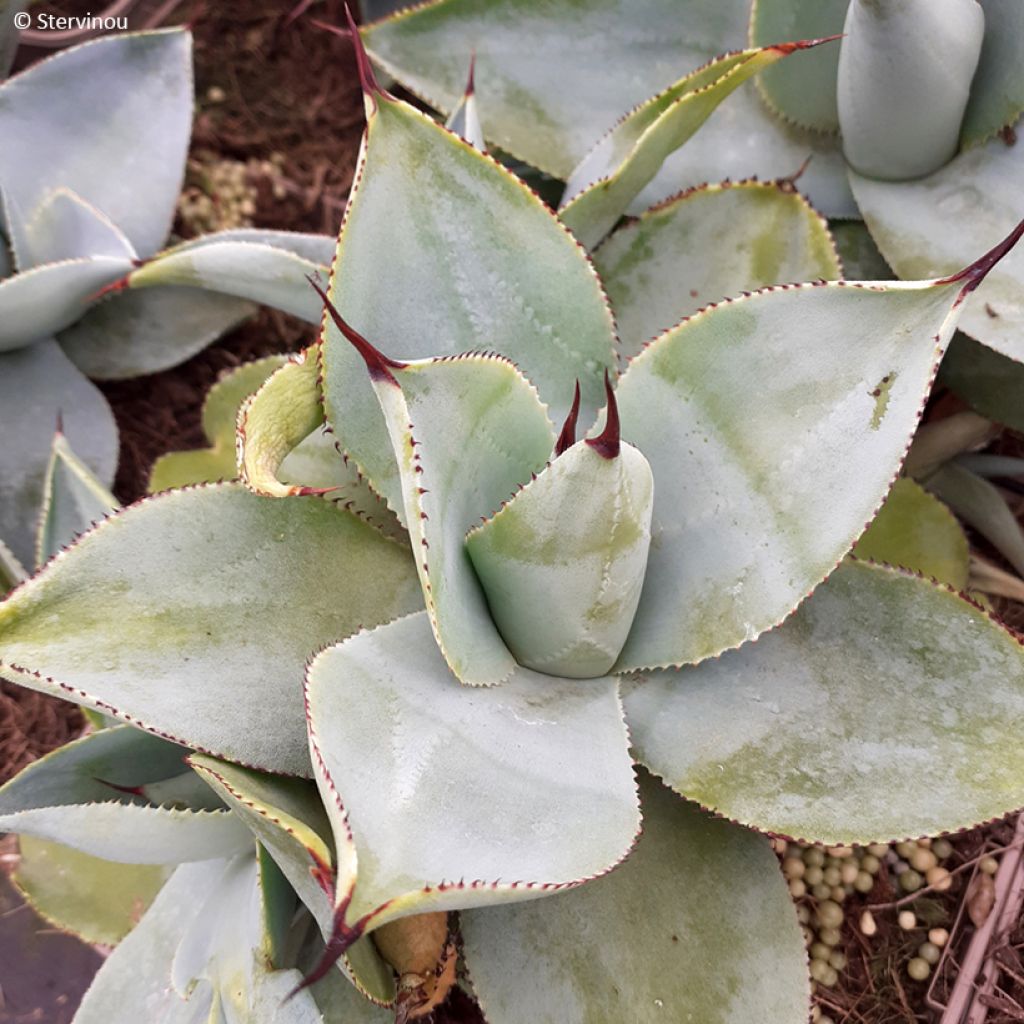
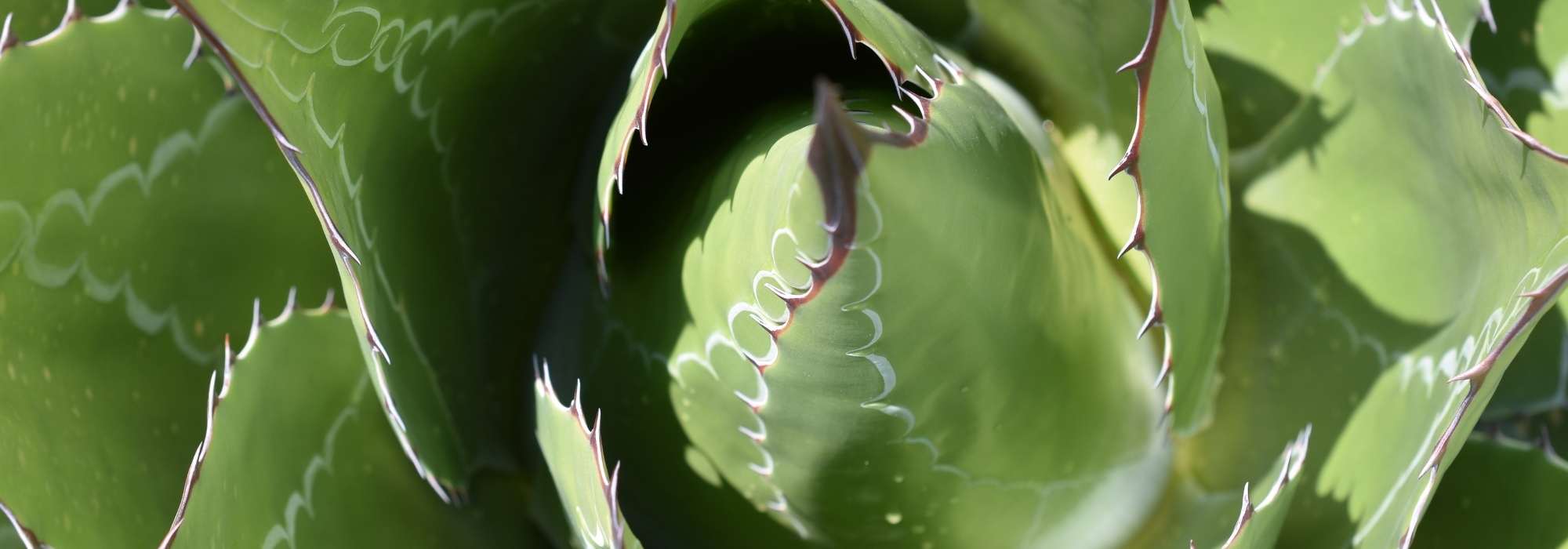
The Agave pygmae 'Dragon Toes' is a horticultural species with a compact size and slow growth. It forms a regular rosette composed of wide, imbricate leaves that immediately catch the eye with their superb bluish colour. Their very graphic shape is accentuated by the dark red thorns that spread out around the perimeter to a long, thin terminal spine. This hardy succulent plant will perfectly withstand the summer drought on the French Riviera. Elsewhere, it will be grown in a pot to overwinter away from frost and humidity. Unlike many Agaves, this species tolerates a semi-shaded exposure quite well.
Agave is now classified in the Asparagaceae family, alongside the astonishing Eucomis (pineapple flower) and the charming Peruvian Scilla. The Agave genus is very prolific with around 270 species, some almost dwarf-sized, while others exhibit leaves several meters long. The Agave pygmae is native to the extreme south of Mexico, near the border with Guatemala, where it grows between 900 and 1000 meters above sea level. It is a tropical species, tolerating light frosts (down to -4°C) and in its native habitat, it is exposed to fairly abundant rainfall (1000 mm/year).
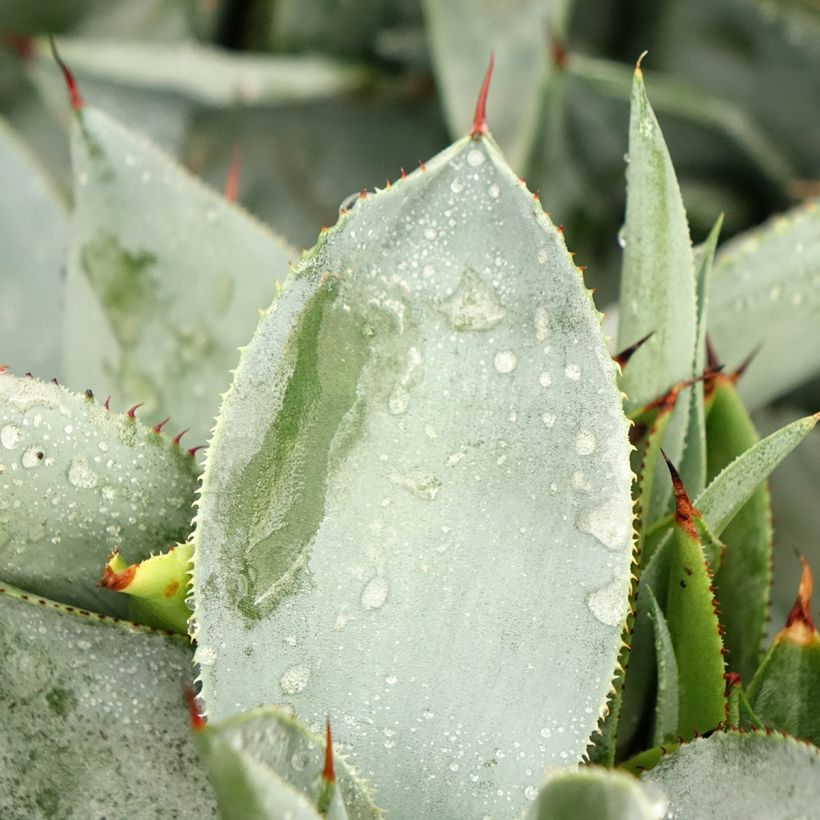
'Dragon Toes' is a horticultural selection that captivates with its incredible bluish colour. This slow-growing compact variety eventually forms a rosette 30 to 35 cm in diameter and height, with a perfect geometric shape that enhances its ornamental interest. The succulent leaves are obovate in shape, with a narrow base that widens significantly in the upper third, then narrows sharply to form a sort of wedge, extended by an extremely sharp and prickly rigid spine, approximately 2 cm long. The entire leaf margin is armed with short, sharp spines, dark red in colour, like the terminal spine. The leaves are so compressed vertically against each other before gradually opening to expand the rosette, that they bear, as if printed on their surface, the outlines of neighboring leaves. The patterns of these "Dragon Toes" armed with their claws further enhance the decorative and somewhat fantastical appearance of the plant. The rosette, dense and regular, very open when the plant is in full sun, will be more compact in a subject exposed to semi-shade. As with other species, this Agave eventually flowers after many years of cultivation (10 to 20 years), producing a spike adorned with small yellow-green tubular flowers. The rosette, classified as semelparous, dies after flowering which lasts several months, usually giving off shoots that regenerate a new plant.
Tolerating light frosts, down to -4/-5°C, the Agave pygmae 'Dragon Toes' can reasonably be planted in the open ground only on the coastal strip of the French Riviera, where it will acclimatize very well to the Mediterranean climate. Its small size will allow you to find a place for it even in the smallest gardens, where you can plant it alongside other succulent plants with various shapes, like the Cylindropuntia tunicata. This compact Cactus also forms a dense clump that intrigues with its countless white spines covering it completely. For an aesthetic contrast with these compact silhouettes, you can opt for finesse with the "Red Yucca" (Hesperaloe parviflora 'Rubra') with its long, very fine leaves gathered in a rosette, producing an airy and spectacular summer flowering in salmon pink. In other regions, you will need to overwinter your Agave away from frost and winter humidity, but you can enjoy it on your balcony or terrace for much of the year.
Agave pygmae Dragon Toes in pictures
Flowering
Foliage
Plant habit
Botanical data
Agave
pygmae
Dragon Toes
Asparagaceae
Agave potatorum 'Dragon Toes' (erroné)
Cultivar or hybrid
Planting and care
Plant Agave pygmae Dragon Toes in full sun or even possibly in partial shade. Its low hardiness (around -5°C in good conditions) allows planting it in the ground practically only on the French Riviera. In this case, plant it in a preferably poor soil, even rocky, limestone, sandy, but very well-drained. It tolerates winter humidity and cold poorly, but much better dry cold, in a dry soil. Ideally, position it on a mound, slightly inclined, so that rainwater cannot stagnate in the rosette.
As the plant has modest growth, it can be grown in a pot on the terrace or balcony, in a light substrate such as cactus soil, with careful drainage, preferably in terracotta. Water regularly in summer, but let the substrate dry between waterings. It will then be easy to store the pot away from frost and humidity, in a bright, airy, lightly or not heated room. Reduce or even stop watering in winter. The plant can spend the nice season, from April to October, outdoors.
Be sure to wear protective gloves when handling this plant and be very careful of the thorn tips of the leaves, which can be harmful to the eyes!
Planting period
Intended location
Care
Planting & care advice






This item has not been reviewed yet - be the first to leave a review about it.
Recently viewed products
Haven't found what you were looking for?
Hardiness is the lowest winter temperature a plant can endure without suffering serious damage or even dying. However, hardiness is affected by location (a sheltered area, such as a patio), protection (winter cover) and soil type (hardiness is improved by well-drained soil).

The flowering period indicated on our website applies to countries and regions located in USDA zone 8 (France, the United Kingdom, Ireland, the Netherlands, etc.)
It will vary according to where you live:- In zones 9 to 10 (Italy, Spain, Greece, etc.), flowering will occur about 2 to 4 weeks earlier.
- In zones 6 to 7 (Germany, Poland, Slovenia, and lower mountainous regions), flowering will be delayed by 2 to 3 weeks.
- In zone 5 (Central Europe, Scandinavia), blooming will be delayed by 3 to 5 weeks.
In temperate climates, pruning of spring-flowering shrubs (forsythia, spireas, etc.) should be done just after flowering.
Pruning of summer-flowering shrubs (Indian Lilac, Perovskia, etc.) can be done in winter or spring.
In cold regions as well as with frost-sensitive plants, avoid pruning too early when severe frosts may still occur.
The planting period indicated on our website applies to countries and regions located in USDA zone 8 (France, United Kingdom, Ireland, Netherlands).
It will vary according to where you live:
- In Mediterranean zones (Marseille, Madrid, Milan, etc.), autumn and winter are the best planting periods.
- In continental zones (Strasbourg, Munich, Vienna, etc.), delay planting by 2 to 3 weeks in spring and bring it forward by 2 to 4 weeks in autumn.
- In mountainous regions (the Alps, Pyrenees, Carpathians, etc.), it is best to plant in late spring (May-June) or late summer (August-September).
The harvesting period indicated on our website applies to countries and regions in USDA zone 8 (France, England, Ireland, the Netherlands).
In colder areas (Scandinavia, Poland, Austria...) fruit and vegetable harvests are likely to be delayed by 3-4 weeks.
In warmer areas (Italy, Spain, Greece, etc.), harvesting will probably take place earlier, depending on weather conditions.
The sowing periods indicated on our website apply to countries and regions within USDA Zone 8 (France, UK, Ireland, Netherlands).
In colder areas (Scandinavia, Poland, Austria...), delay any outdoor sowing by 3-4 weeks, or sow under glass.
In warmer climes (Italy, Spain, Greece, etc.), bring outdoor sowing forward by a few weeks.
Shipping country and language
Your country of residence may be:
Your country of residence is:
For a better user experience on our website, you can select:
Your shipping country:
-
 Austria
-
 Belgium
-
 Bosnia & Herzegovina
-
 Bulgaria
-
 Croatia
-
 Cyprus
-
 Czechia
-
 Denmark
-
 Estonia
-
 Finland
-
 France
-
 Germany
-
 Greece
-
 Hungary
-
 Iceland
-
 Ireland
-
 Italy
Italy
-
 Latvia
-
 Liechtenstein
-
 Lithuania
-
 Luxembourg
-
 Malta
Malta
-
 Netherlands
-
 Poland
-
 Portugal
-
 Romania
-
 Serbia
-
 Slovakia
-
 Slovenia
-
 Spain
Spain
-
 Sweden
-
 Switzerland
Language:
-
French
-
 English
-
Spanish
-
Italian
-
German
-
Portuguese
-
Dutch
-
Finnish
My Account
Hello
My wish lists
My cart
Log in / Register
Existing customer?
This form is protected by reCAPTCHA - the Google Privacy Policy and Terms of Service apply.
New customer?
Create an account to track your orders, access our customer service and, if you wish, make the most of our upcoming offers.