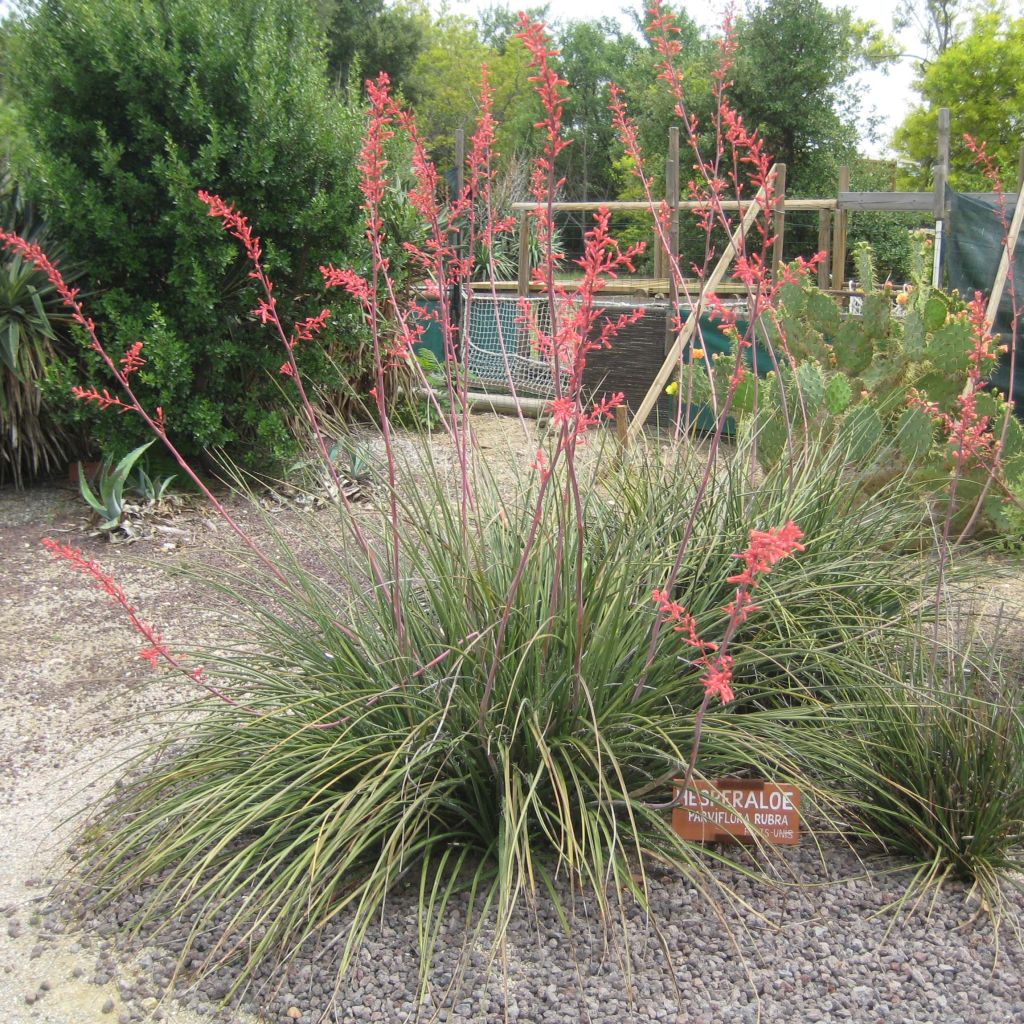
Hesperaloe parviflora Rubra - Red Yucca
Hesperaloe parviflora Rubra - Red Yucca
Hesperaloe parviflora Rubra
Small-flowered Hesperaloe, Red Yucca
The two young plants arrived in good condition, however one of the two has noticeably fewer roots than the other and its base is a bit yellow. I planted both of them anyway, hoping they will establish well. (Unfortunately, I cannot attach photos to this review to illustrate my comments.)
Sonia, 14/10/2025
Back-to-school special offer!
Get €10 off for every €50 you spend! And get up to €40 off on a single order.
How does it work?
1. Shop your favourites
Add your favourite plants to your basket. For every €50 you spend (excluding delivery charges, store credit and the plastic-free option), you’ll receive a €10 voucher.
€50 spent = €10 voucher
€100 spent = €20 voucher
€150 spent = €30 voucher
€200 spent = €40 voucher
2. Place your order
Once your basket reaches one of the spending thresholds, place your order. You can even choose your delivery date!
3. Receive your voucher
As soon as your order has been shipped, you’ll receive an email containing your personal voucher code and its value.
4. Use it on your next order
Your voucher is valid for 90 days from the date you receive it. It can be used once only, on a new order worth at least the value of the voucher, excluding delivery charges.
Please note: Vouchers can be combined with other offers, but cannot be split or refunded.
Home or relay delivery (depending on size and destination)
Important: You may be charged customs duties by your country’s customs authorities upon delivery.
Schedule delivery date,
and select date in basket
This plant carries a 12 months recovery warranty
More information
We guarantee the quality of our plants for a full growing cycle, and will replace at our expense any plant that fails to recover under normal climatic and planting conditions.
Would this plant suit my garden?
Set up your Plantfit profile →
Description
The Hesperaloe parviflora Rubra, sometimes called Red Yucca, is one of the most beautiful plants in the Agave family and one of the easiest to acclimate in gardens. It grows in dense rosettes, composed of long, evergreen, slender leaves, beautifully tinged with purple. From the centre of the rosettes emerges a long, graceful flower spike in summer, loaded with small, tubular flowers in a vibrant salmon red, which contrasts with the somewhat austere appearance of the rosettes. In New Mexico and Arizona, this extremely drought-resistant perennial is commonly used by landscape professionals as a large ground cover to replace the demanding lawn. Surprisingly, this very exotic-looking Hesperaloe is a plant of extreme climates, capable of withstanding our wet and cold winters and snow in well-drained soil. A must have to discover!
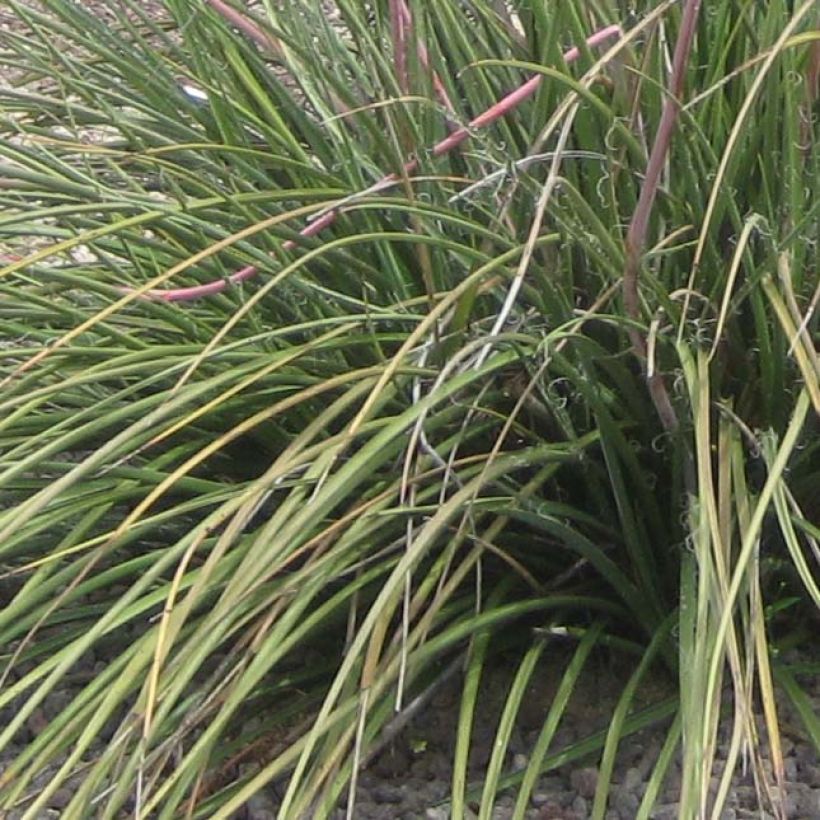
Native to the Chihuahua desert, spanning from Texas to Mexico, reaching up to the Texas mountains, which regularly experience freezing temperatures and snow in winter, and arid summers, the Hesperaloe parviflora is a plant adapted to extreme weather conditions. Yet it is an elegant and generous plant, with the ability to bloom under scorching heat, without water, as if it were unaffected by its surroundings. The 'Rubra' variety is distinguished by its purple-tinged leaves. This herbaceous succulent plant has rhizomes capable of producing suckers, but it lacks aerial stems. It forms a basal rosette, 40 to 60 cm (15.7 to 23.6 in) high and at least 60 m (196 ft 11 in) wide, expanding laterally over the years to form a thick ground cover. The pointed leaves are evergreen, narrow, linear, and rigid, shaped like gutters, with prickly tips and twisted filaments along the edges. The spectacular flowering occurs from June to August. A branched flower spike, 1.20m (3 ft 11 in) high, slightly arched at the ends, emerges from each rosette. It carries numerous small, trailing tubular flowers in a beautiful shade of salmon red to coral. This highly nectar-rich and nectariferous flowering attracts many pollinating insects. The plant is hardy down to -15°C (5 °F) in well-drained soil, even more so in dry soil during winter.
The Hesperaloe parviflora Rubra is a unique plant for its remarkable architectural silhouette and robustness. It is perfect for rocky or sandy gardens, where soil is scarce, and ideal for creating large flowered borders throughout the summer, structuring a large rockery or exotic bed, or brilliantly occupying a difficult area of the garden. It can be planted alone alongside ground-covering plants (Teucrium, Thymus, Sedum, Sempervivum) or combined on a dry slope with small, dry-soil shrubs (Hertia cheirifolia, Hypericum olympicum), light grasses (Stipa tenuissima or barbata), Agave americana, prickly pear, giant fennel, and quite hardy candelabra cacti (Cleistocactus strausii, Cylindropuntia imbricata) - all equally hardy and undemanding. Highly floriferous plants like Gaura, Nepeta racemosa, or the indestructible Erigeron karvinskianus will accompany its flowering throughout the summer.
Hesperaloe parviflora Rubra - Red Yucca in pictures
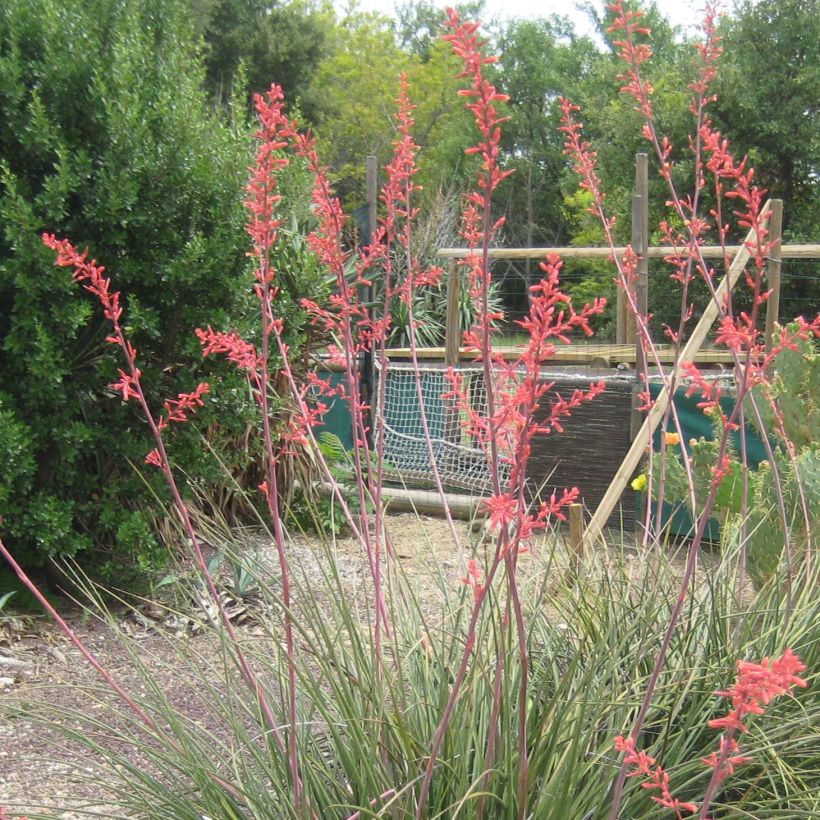
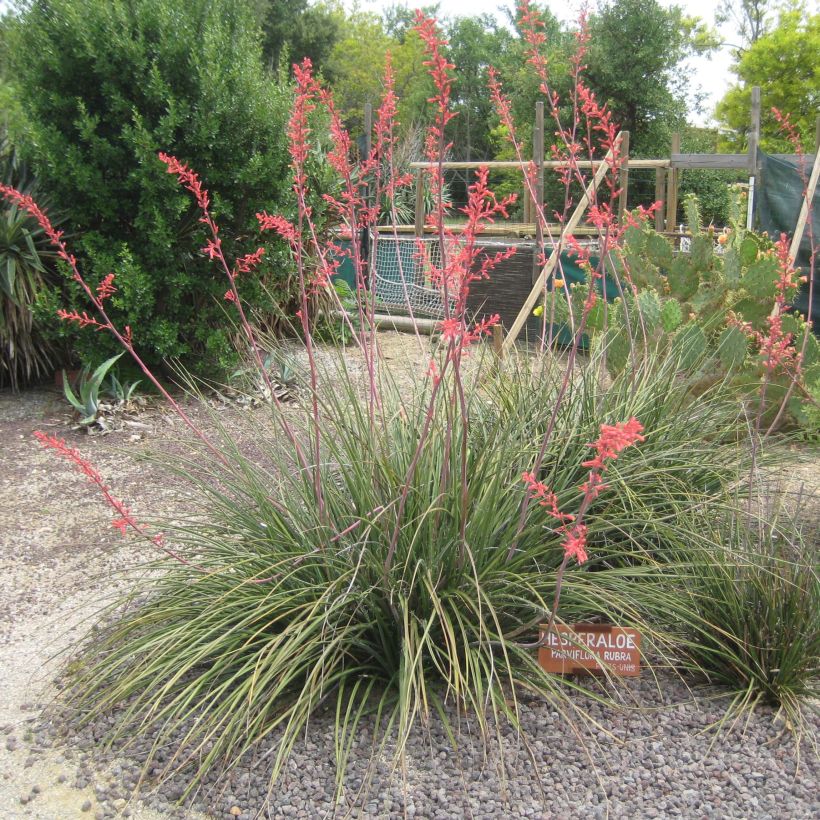
Flowering
Foliage
Plant habit
Botanical data
Hesperaloe
parviflora
Rubra
Agavaceae
Small-flowered Hesperaloe, Red Yucca
North America
Planting and care
Plant the Hesperaloe parviflora in full sun and well-drained soil for optimal growth. The soil can be slightly acidic, rocky, sandy or poor, but it should not be too heavy. If your soil is clayey, plant the Hesperaloe parviflora on a raised border or mound, about 20-30 cm (7.9-11.8 in) above ground level and enriched with coarse sand and gravel. This will help to improve its cold resistance. This plant can tolerate winter humidity, cold, dry soils in summer, and arid conditions. It can also withstand short-lived frosts up to around -15°C (5°F), and snow is not an issue in well-drained, rocky soil.
The Hesperaloe parviflora requires very little attention, with the only maintenance required being the removal of faded flower stalks. To propagate the plant, sow seeds in autumn.
Planting period
Intended location
Care
Planting & care advice
-
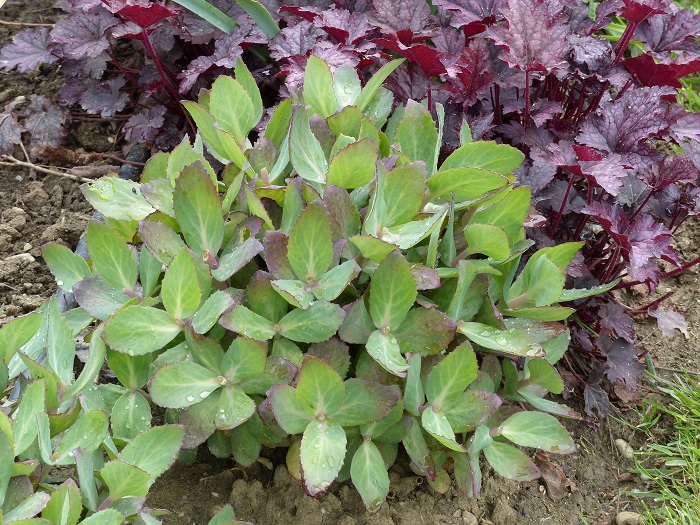
-
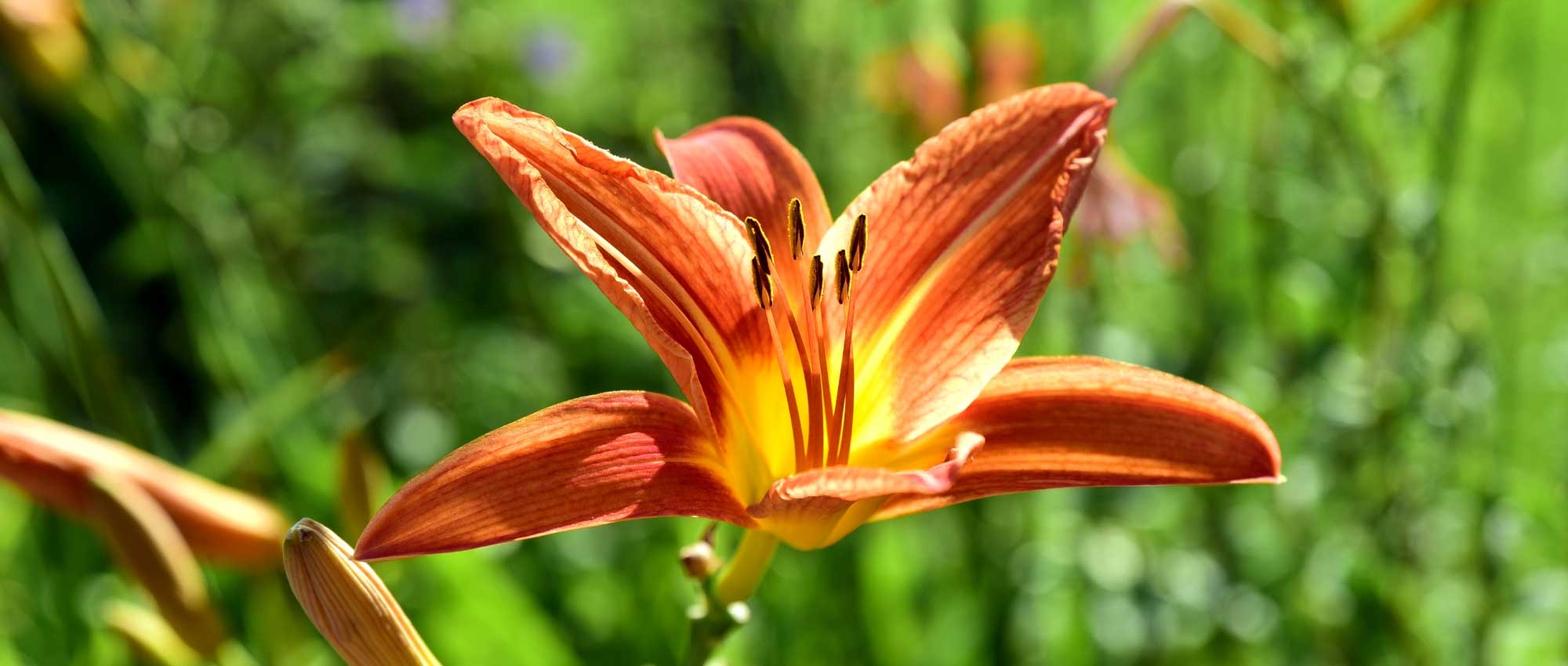
-
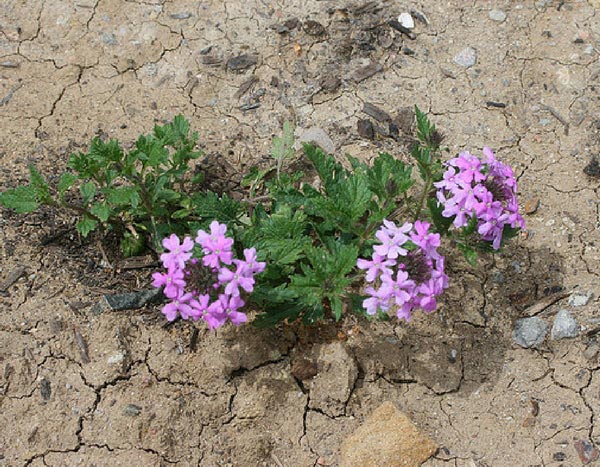
-
-

-
-
-
-
, onOrder confirmed
Reply from on Promesse de fleurs
Recently viewed products
Haven't found what you were looking for?
Hardiness is the lowest winter temperature a plant can endure without suffering serious damage or even dying. However, hardiness is affected by location (a sheltered area, such as a patio), protection (winter cover) and soil type (hardiness is improved by well-drained soil).

The flowering period indicated on our website applies to countries and regions located in USDA zone 8 (France, the United Kingdom, Ireland, the Netherlands, etc.)
It will vary according to where you live:- In zones 9 to 10 (Italy, Spain, Greece, etc.), flowering will occur about 2 to 4 weeks earlier.
- In zones 6 to 7 (Germany, Poland, Slovenia, and lower mountainous regions), flowering will be delayed by 2 to 3 weeks.
- In zone 5 (Central Europe, Scandinavia), blooming will be delayed by 3 to 5 weeks.
In temperate climates, pruning of spring-flowering shrubs (forsythia, spireas, etc.) should be done just after flowering.
Pruning of summer-flowering shrubs (Indian Lilac, Perovskia, etc.) can be done in winter or spring.
In cold regions as well as with frost-sensitive plants, avoid pruning too early when severe frosts may still occur.
The planting period indicated on our website applies to countries and regions located in USDA zone 8 (France, United Kingdom, Ireland, Netherlands).
It will vary according to where you live:
- In Mediterranean zones (Marseille, Madrid, Milan, etc.), autumn and winter are the best planting periods.
- In continental zones (Strasbourg, Munich, Vienna, etc.), delay planting by 2 to 3 weeks in spring and bring it forward by 2 to 4 weeks in autumn.
- In mountainous regions (the Alps, Pyrenees, Carpathians, etc.), it is best to plant in late spring (May-June) or late summer (August-September).
The harvesting period indicated on our website applies to countries and regions in USDA zone 8 (France, England, Ireland, the Netherlands).
In colder areas (Scandinavia, Poland, Austria...) fruit and vegetable harvests are likely to be delayed by 3-4 weeks.
In warmer areas (Italy, Spain, Greece, etc.), harvesting will probably take place earlier, depending on weather conditions.
The sowing periods indicated on our website apply to countries and regions within USDA Zone 8 (France, UK, Ireland, Netherlands).
In colder areas (Scandinavia, Poland, Austria...), delay any outdoor sowing by 3-4 weeks, or sow under glass.
In warmer climes (Italy, Spain, Greece, etc.), bring outdoor sowing forward by a few weeks.
Shipping country and language
Your country of residence may be:
Your country of residence is:
For a better user experience on our website, you can select:
Your shipping country:
-
 Austria
-
 Belgium
-
 Bosnia & Herzegovina
-
 Bulgaria
-
 Croatia
-
 Cyprus
-
 Czechia
-
 Denmark
-
 Estonia
-
 Finland
-
 France
-
 Germany
-
 Greece
-
 Hungary
-
 Iceland
-
 Ireland
-
 Italy
Italy
-
 Latvia
-
 Liechtenstein
-
 Lithuania
-
 Luxembourg
-
 Malta
Malta
-
 Netherlands
-
 Poland
-
 Portugal
-
 Romania
-
 Serbia
-
 Slovakia
-
 Slovenia
-
 Spain
Spain
-
 Sweden
-
 Switzerland
Language:
-
French
-
 English
-
Spanish
-
Italian
-
German
-
Portuguese
-
Dutch
-
Finnish
My Account
Hello
My wish lists
My cart
Log in / Register
Existing customer?
This form is protected by reCAPTCHA - the Google Privacy Policy and Terms of Service apply.
New customer?
Create an account to track your orders, access our customer service and, if you wish, make the most of our upcoming offers.