





























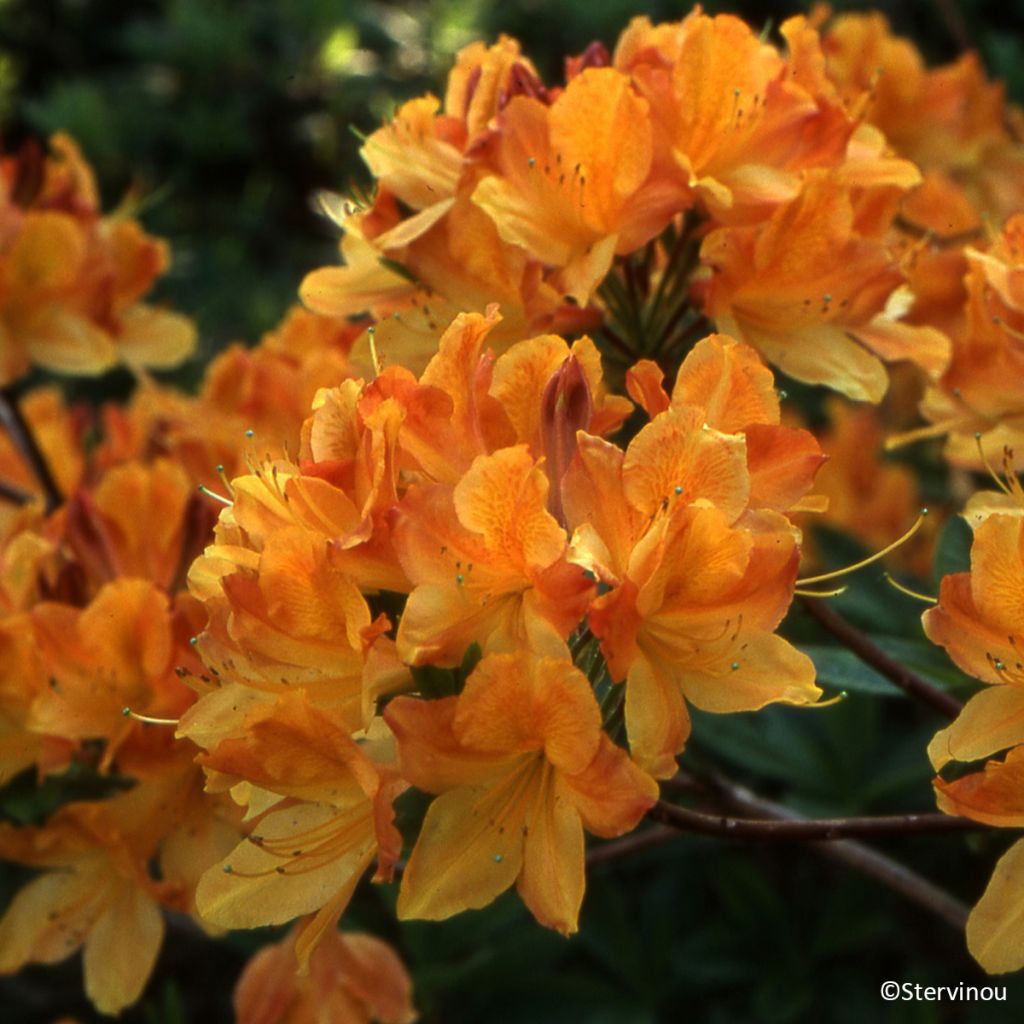
Rhododendron 'Hortulanus H Witte' - Deciduous azalea
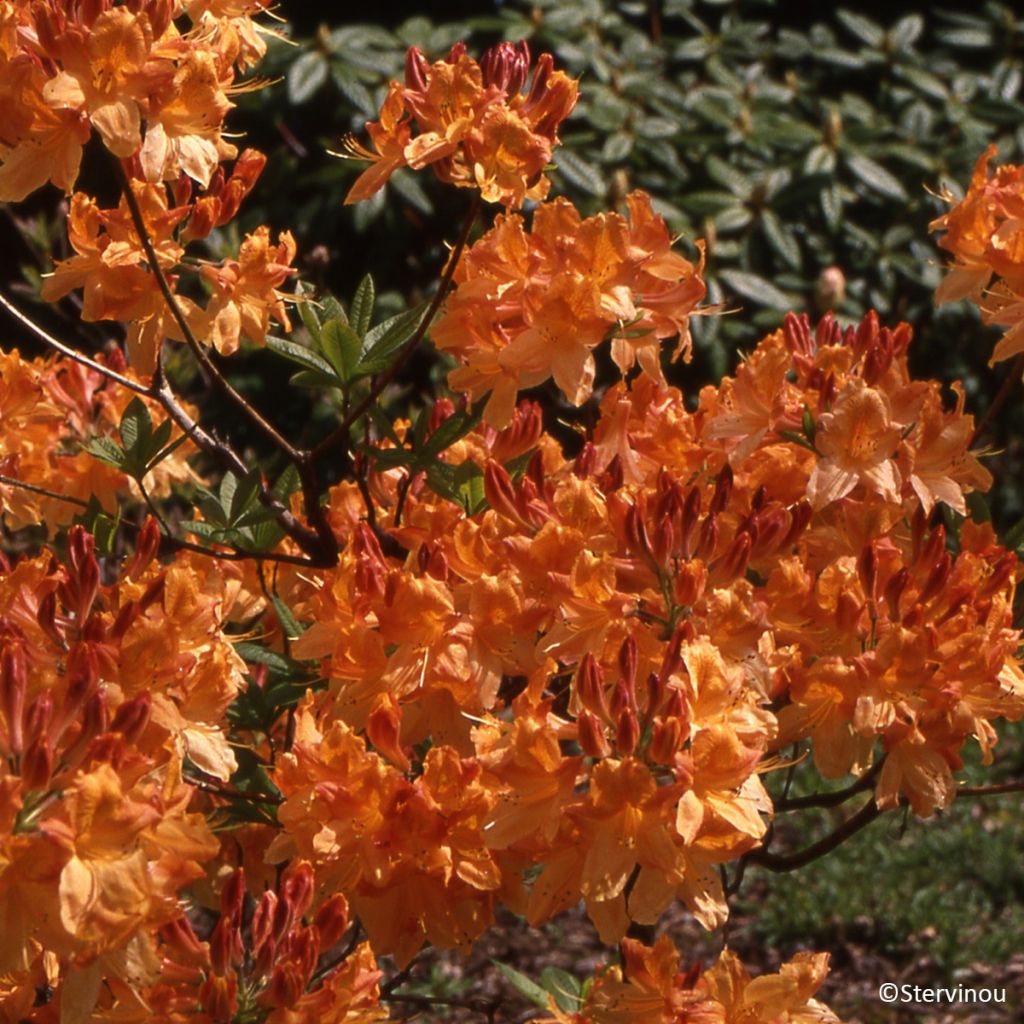
Rhododendron 'Hortulanus H Witte' - Deciduous azalea
Rhododendron Hortulanus H Witte
Rhododendron 'Hortulanus H Witte'
Rhododendron
Special offer!
Receive a €20 voucher for any order over €90 (excluding delivery costs, credit notes, and plastic-free options)!
1- Add your favorite plants to your cart.
2- Once you have reached €90, confirm your order (you can even choose the delivery date!).
3- As soon as your order is shipped, you will receive an email containing your voucher code, valid for 3 months (90 days).
Your voucher is unique and can only be used once, for any order with a minimum value of €20, excluding delivery costs.
Can be combined with other current offers, non-divisible and non-refundable.
Home or relay delivery (depending on size and destination)
Schedule delivery date,
and select date in basket
This plant carries a 24 months recovery warranty
More information
We guarantee the quality of our plants for a full growing cycle, and will replace at our expense any plant that fails to recover under normal climatic and planting conditions.
Would this plant suit my garden?
Set up your Plantfit profile →
Description
Rhododendron (Mollis Group) ‘Hortulanus H. Witte’, often sold under the name Chinese Azalea ‘Hortulanus H. Witte’, offers beautiful orange and yellow trumpets with a delicate fragrance in spring, before or at the same time as the foliage appears. It is a reliable choice for partially shaded areas of the garden, acid soil beds, and cultivation in a large container. Its deciduous foliage takes on warm red hues in autumn.
Belonging to the Ericaceae family, this cultivar is part of the Mollis Azaleas, derived from old European cross-breeding. Common synonyms are Azalea mollis ‘Hortulanus H. Witte’ and Rhododendron ‘Hortulanus H. Witte’ (Mollis). It was bred by the Koster M. & Sons nursery in Boskoop (Netherlands) in 1892. Its parents are Rhododendron molle subsp. molle and R. molle subsp. japonicum. The name "Hortulanus" means "head gardener"; it most likely pays tribute to Heinrich (H.) Witte, a horticulturist who worked at the Hortus botanicus in Leiden in the 19th century.
The R. molle species (formerly Azalea sinensis) is native to eastern China and the japonicum subspecies to Japan; the hybrids in this group show good hardiness and early spring flowering.
This shrub is bushy, upright then spreading, with moderate growth. In the ground, ‘Hortulanus H. Witte’ reaches 1.50–2 m in all directions at maturity (about 1 m in a pot at 10 years). The deciduous leaves are ovate to elliptical, and they turn orange and red in autumn. The funnel-shaped flowers open in April-May and are gathered in short corymbs; each corolla, 5–6 cm in diameter, displays a golden orange colour with a darker spot. The flowering is lightly scented. This cultivar is hardy down to -20°C.
The Mollis line is emblematic of Belgian-Dutch selections from the 19th century; the Koster introductions marked European gardens with their yellow and orange tones, derived from the aforementioned Asian species.
Deciduous Chinese azaleas are easier to grow than Japanese azaleas, which are evergreen: they are very hardy, tolerating sunnier exposures and heat better. They will perform best in a cool climate, with distinct winters, planted in a humus-bearing and fertile, lime-free soil.
Plant Azalea Hortulanus H. Witte in a bed, place it in front of a large rhododendron, or on the edge of the bed with Japanese maples and Pieris. In a continental climate, position it in light woodland and water during dry periods. It will be superb in a large container on a terrace facing east or south-east. You can pair it with Chinese azaleas 'Demoiselles de Boutiguery Nella' or ‘Glowing Embers' to create an orange-yellow colour scheme. Add, for example, a dwarf Rhododendron ‘Percy Wiseman’ and a Pieris japonica ‘Forest Flame’ to extend the season of colour in the garden.
Report an error about the product description
Rhododendron Hortulanus H Witte in pictures
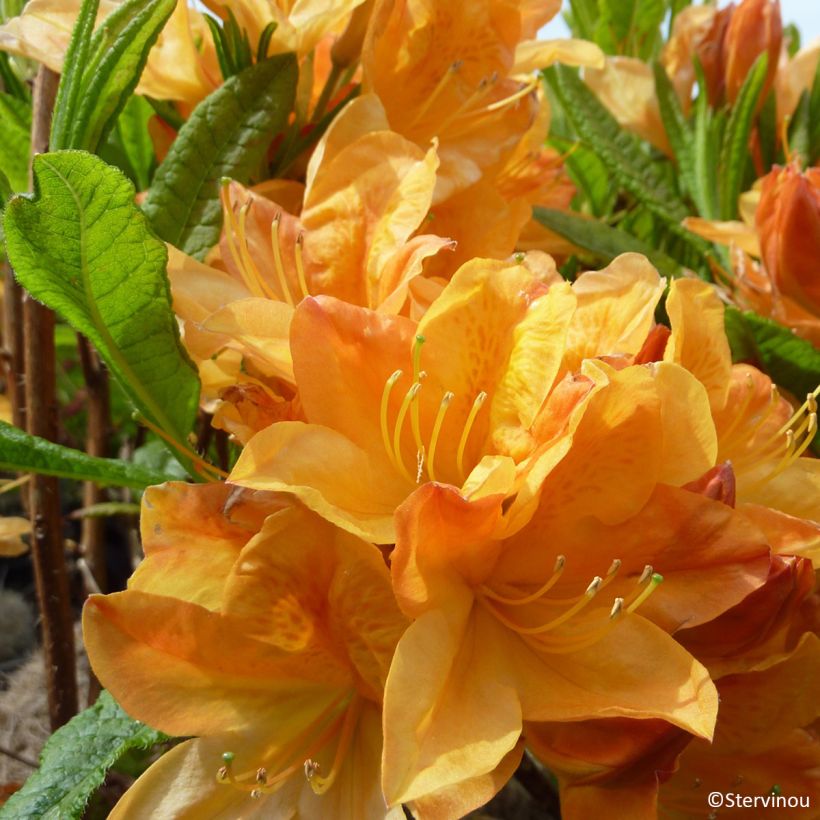
Plant habit
Flowering
Foliage
Botanical data
Rhododendron
'Hortulanus H Witte'
Ericaceae
Rhododendron
Rhododendron 'Hortulanus H Witte', Azalea 'Hortulanus H Witte', Azalea mollis 'Hortulanus H Witte'
Cultivar or hybrid
Planting and care
Chinese Azalea Hortulanus H Witte enjoys a sunny spot, unlike the Japanese Azalea, but its favourite exposure is partial shade, or morning sun, especially in very sunny and warm regions. Plant it in a well-drained, non-calcareous, humus-bearing or enriched ericaceous soil that does not dry out too much in summer.
When planting, ensure not to bury the root ball too deeply; it should be level with the soil. Water generously during dry periods, at least once a week in the first year. In spring, apply fertiliser for ericaceous plants. You can prune lightly after flowering to keep the plant tidy, but this is not essential. Remove faded flowers to encourage the emergence of new shoots. Azalea has few diseases when well-established outdoors. It can be attacked by vine weevils, which eat the edges of leaves and rootlets, as well as by the notorious 'rhododendron leafhopper', which often does not cause significant damage. If the soil is calcareous or poorly drained, and if the plant is planted too deeply, the leaves may turn yellow.
Some cultivars are quite sensitive to powdery mildew.

Planting period
Intended location
Care
This item has not been reviewed yet - be the first to leave a review about it.
Similar products
Available in 1 sizes

Available in 2 sizes
Available in 1 sizes
Available in 1 sizes
Available in 1 sizes

Available in 1 sizes
Available in 1 sizes
Available in 2 sizes
Haven't found what you were looking for?
Hardiness is the lowest winter temperature a plant can endure without suffering serious damage or even dying. However, hardiness is affected by location (a sheltered area, such as a patio), protection (winter cover) and soil type (hardiness is improved by well-drained soil).

Photo Sharing Terms & Conditions
In order to encourage gardeners to interact and share their experiences, Promesse de fleurs offers various media enabling content to be uploaded onto its Site - in particular via the ‘Photo sharing’ module.
The User agrees to refrain from:
- Posting any content that is illegal, prejudicial, insulting, racist, inciteful to hatred, revisionist, contrary to public decency, that infringes on privacy or on the privacy rights of third parties, in particular the publicity rights of persons and goods, intellectual property rights, or the right to privacy.
- Submitting content on behalf of a third party;
- Impersonate the identity of a third party and/or publish any personal information about a third party;
In general, the User undertakes to refrain from any unethical behaviour.
All Content (in particular text, comments, files, images, photos, videos, creative works, etc.), which may be subject to property or intellectual property rights, image or other private rights, shall remain the property of the User, subject to the limited rights granted by the terms of the licence granted by Promesse de fleurs as stated below. Users are at liberty to publish or not to publish such Content on the Site, notably via the ‘Photo Sharing’ facility, and accept that this Content shall be made public and freely accessible, notably on the Internet.
Users further acknowledge, undertake to have ,and guarantee that they hold all necessary rights and permissions to publish such material on the Site, in particular with regard to the legislation in force pertaining to any privacy, property, intellectual property, image, or contractual rights, or rights of any other nature. By publishing such Content on the Site, Users acknowledge accepting full liability as publishers of the Content within the meaning of the law, and grant Promesse de fleurs, free of charge, an inclusive, worldwide licence for the said Content for the entire duration of its publication, including all reproduction, representation, up/downloading, displaying, performing, transmission, and storage rights.
Users also grant permission for their name to be linked to the Content and accept that this link may not always be made available.
By engaging in posting material, Users consent to their Content becoming automatically accessible on the Internet, in particular on other sites and/or blogs and/or web pages of the Promesse de fleurs site, including in particular social pages and the Promesse de fleurs catalogue.
Users may secure the removal of entrusted content free of charge by issuing a simple request via our contact form.
The flowering period indicated on our website applies to countries and regions located in USDA zone 8 (France, the United Kingdom, Ireland, the Netherlands, etc.)
It will vary according to where you live:
- In zones 9 to 10 (Italy, Spain, Greece, etc.), flowering will occur about 2 to 4 weeks earlier.
- In zones 6 to 7 (Germany, Poland, Slovenia, and lower mountainous regions), flowering will be delayed by 2 to 3 weeks.
- In zone 5 (Central Europe, Scandinavia), blooming will be delayed by 3 to 5 weeks.
In temperate climates, pruning of spring-flowering shrubs (forsythia, spireas, etc.) should be done just after flowering.
Pruning of summer-flowering shrubs (Indian Lilac, Perovskia, etc.) can be done in winter or spring.
In cold regions as well as with frost-sensitive plants, avoid pruning too early when severe frosts may still occur.
The planting period indicated on our website applies to countries and regions located in USDA zone 8 (France, United Kingdom, Ireland, Netherlands).
It will vary according to where you live:
- In Mediterranean zones (Marseille, Madrid, Milan, etc.), autumn and winter are the best planting periods.
- In continental zones (Strasbourg, Munich, Vienna, etc.), delay planting by 2 to 3 weeks in spring and bring it forward by 2 to 4 weeks in autumn.
- In mountainous regions (the Alps, Pyrenees, Carpathians, etc.), it is best to plant in late spring (May-June) or late summer (August-September).
The harvesting period indicated on our website applies to countries and regions in USDA zone 8 (France, England, Ireland, the Netherlands).
In colder areas (Scandinavia, Poland, Austria...) fruit and vegetable harvests are likely to be delayed by 3-4 weeks.
In warmer areas (Italy, Spain, Greece, etc.), harvesting will probably take place earlier, depending on weather conditions.
The sowing periods indicated on our website apply to countries and regions within USDA Zone 8 (France, UK, Ireland, Netherlands).
In colder areas (Scandinavia, Poland, Austria...), delay any outdoor sowing by 3-4 weeks, or sow under glass.
In warmer climes (Italy, Spain, Greece, etc.), bring outdoor sowing forward by a few weeks.