





























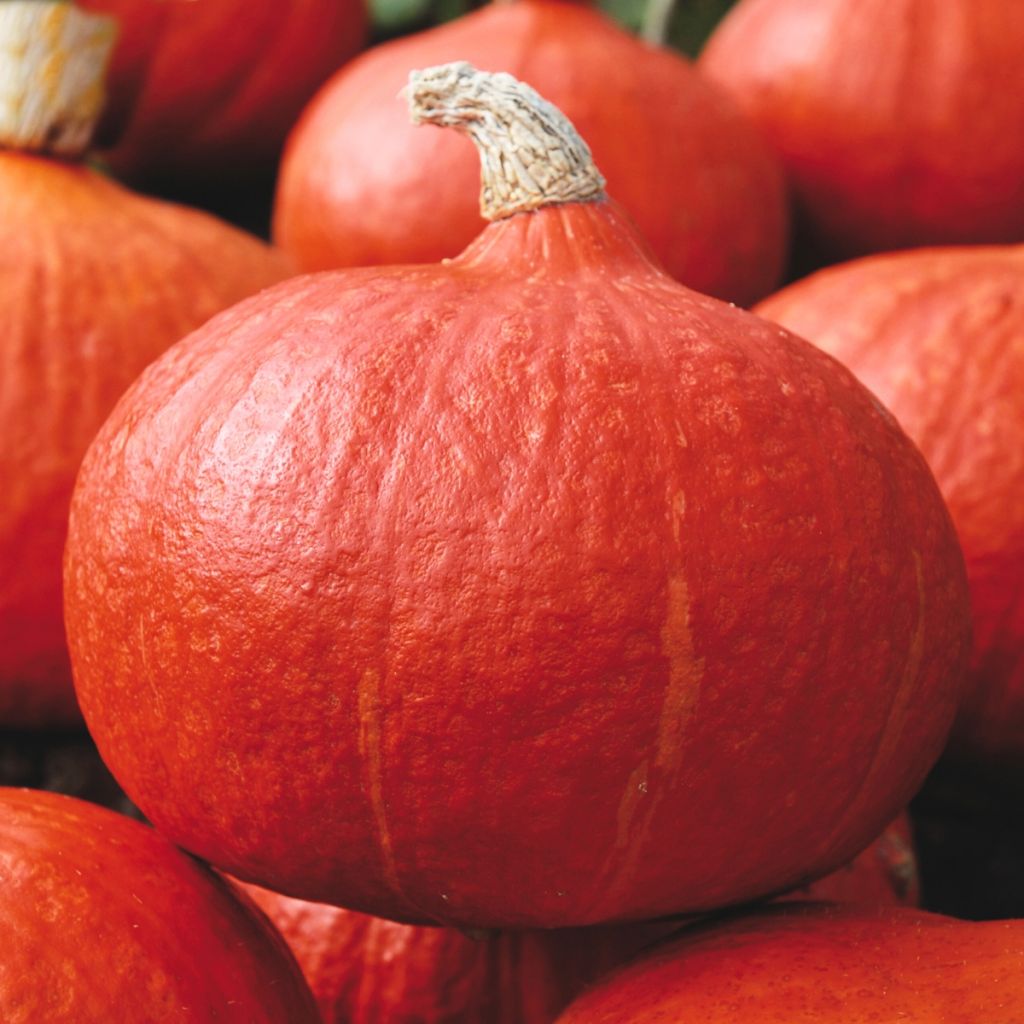
Cucurbita maxima Orange Summer F1 seeds - Uchiki Kuri type squash
Kabocha squash Orange Summer F1
Cucurbita maxima Orange Summer F1
Kabocha squash, Red Hokkaïdo, Okkaido, Onion squash, Potimarron
Special offer!
Receive a €20 voucher for any order over €90 (excluding delivery costs, credit notes, and plastic-free options)!
1- Add your favorite plants to your cart.
2- Once you have reached €90, confirm your order (you can even choose the delivery date!).
3- As soon as your order is shipped, you will receive an email containing your voucher code, valid for 3 months (90 days).
Your voucher is unique and can only be used once, for any order with a minimum value of €20, excluding delivery costs.
Can be combined with other current offers, non-divisible and non-refundable.
Home or relay delivery (depending on size and destination)
Schedule delivery date,
and select date in basket
This plant carries a 6 months recovery warranty
More information
We guarantee the quality of our plants for a full growing cycle, and will replace at our expense any plant that fails to recover under normal climatic and planting conditions.
Description
The Orange Summer F1 squashis a premium hybrid variety, renowned for its great uniformity, yield, earliness, and resistance to powdery mildew. Its semi-bushy habit, more compact than that of trailing varieties, allows it to be grown even in raised vegetable beds. Its cultivation is suitable for market gardeners.
Each Orange Summer F1 squash plant produces several regular fruits, weighing 1.2 to 1.6 kg. Their smooth, shiny, bright orange skin protects thick, fine, and melting flesh. Sweet and sugary, it recalls the delicate flavour of chestnuts and lends itself to many culinary preparations.
Orange Summer F1 has a short cycle (85 to 90 days) and good resistance to powdery mildew. Its fruits can be harvested from the end of summer, well before the first frosts. And they can be stored for up to four months after harvest while retaining their flavour. This squash is very versatile in the kitchen, suitable for both savoury dishes and sweet recipes. Its creamy flesh adds sweetness and body to soups, pairs perfectly with spices in curries, and is ideal for gratins, tarts, or even cakes. Nutritionally, it is rich in beta-carotin (provitamin A), vitamin C, fibre, and minerals such as potassium and magnesium. It is low in calories and rich in antioxidants.
Orange Summer F1 squash belongs to the Cucurbita maxima group, a species native to South America introduced to Europe in the 16th century. This modern hybrid has been selected as an improvement on the famous Japanese 'Uchiki Kuri', retaining its delicate flavour while providing more regular production and simplified cultivation. Like all cucurbits, it is an annual herbaceous and monoecious plant, bearing both male and female flowers pollinated by insects to produce fruit.
Harvest squashes as late as possible, when the stalk becomes corky, and the foliage dries out. It is advisable to keep a thick stem to improve the fruit's keeping quality. Stored in a temperate room (10 to 15 °C), dry and without direct contact with each other, they can easily be kept for up to four months.
Orange Summer F1 squash likes rich, well-drained soil and a sunny position. Respecting a spacing of about 40 cm between two young plants in the row and 2.50 m between rows promotes good aeration and optimal fruit development.
As with all cucurbits, burying the stems at the node level stimulates rooting and strengthens the vigour of the young plants.
A thick organic mulch helps maintain moisture and limit weeds. To protect the fruits, it is recommended to keep them off the surface of the soil using a tile or a board to avoid any risk of rot.
The designation F1 indicates that it is a first-generation hybrid, resulting from the cross-breeding of two lines carefully selected for their complementary qualities. This produces plants with enhanced performance.
However, it is not advisable to harvest the seeds for resowing the following year: they would not produce young plants identical to the original variety, but very variable and generally less interesting subjects.
Report an error about the product description
Harvest
Plant habit
Foliage
Botanical data
Cucurbita
maxima
Orange Summer F1
Cucurbitaceae
Kabocha squash, Red Hokkaïdo, Okkaido, Onion squash, Potimarron
Cultivar or hybrid
Annual
Planting and care
Orange Summer F1 Squash prefer loose, rich, and deep soil. Dig a hole at least 40 cm in all directions and fill it with well-rotted manure and/or compost. In addition to good fertilisation, they will need plenty of water and warmth and a lot of space (at least 1 square metre).
Sowing:
Before sowing, you can soak the seeds for 24 hours in a little water to stimulate germination.
Either - 3 weeks before transplanting, under a cold frame or in a warm place (16 to 30°C), from March, sow 2 or 3 seeds per pot or container large enough for root development. Germination will occur 3 to 5 days later. Then keep only the most vigorous young plant. Plant out in the open ground after mid-May, once all risk of frost has passed. It is important not to sow too far in advance, as the young plants could become leggy and/or their overly developed root system might not withstand transplantation.
Or - from mid-May, directly in their final position, in stations of 3 seeds, as soon as frosts are no longer a concern and the soil is well warmed. Thin out after 2 to 3 weeks to keep only the most vigorous young plant. Cover the soil with organic matter (compost, grass clippings, leaves...), which will help keep the soil moist.
Watering:
From sowing or planting, water copiously, taking care not to displace the seeds, then regularly during fruit formation. However, once the fruits have formed, during ripening, limit watering.

Seedlings
Care
Intended location
This item has not been reviewed yet - be the first to leave a review about it.
Similar products
Available in 1 sizes
Available in 1 sizes
Available in 1 sizes
Available in 1 sizes
Available in 1 sizes
Available in 1 sizes
Available in 1 sizes
Available in 1 sizes
Haven't found what you were looking for?
Hardiness is the lowest winter temperature a plant can endure without suffering serious damage or even dying. However, hardiness is affected by location (a sheltered area, such as a patio), protection (winter cover) and soil type (hardiness is improved by well-drained soil).

Photo Sharing Terms & Conditions
In order to encourage gardeners to interact and share their experiences, Promesse de fleurs offers various media enabling content to be uploaded onto its Site - in particular via the ‘Photo sharing’ module.
The User agrees to refrain from:
- Posting any content that is illegal, prejudicial, insulting, racist, inciteful to hatred, revisionist, contrary to public decency, that infringes on privacy or on the privacy rights of third parties, in particular the publicity rights of persons and goods, intellectual property rights, or the right to privacy.
- Submitting content on behalf of a third party;
- Impersonate the identity of a third party and/or publish any personal information about a third party;
In general, the User undertakes to refrain from any unethical behaviour.
All Content (in particular text, comments, files, images, photos, videos, creative works, etc.), which may be subject to property or intellectual property rights, image or other private rights, shall remain the property of the User, subject to the limited rights granted by the terms of the licence granted by Promesse de fleurs as stated below. Users are at liberty to publish or not to publish such Content on the Site, notably via the ‘Photo Sharing’ facility, and accept that this Content shall be made public and freely accessible, notably on the Internet.
Users further acknowledge, undertake to have ,and guarantee that they hold all necessary rights and permissions to publish such material on the Site, in particular with regard to the legislation in force pertaining to any privacy, property, intellectual property, image, or contractual rights, or rights of any other nature. By publishing such Content on the Site, Users acknowledge accepting full liability as publishers of the Content within the meaning of the law, and grant Promesse de fleurs, free of charge, an inclusive, worldwide licence for the said Content for the entire duration of its publication, including all reproduction, representation, up/downloading, displaying, performing, transmission, and storage rights.
Users also grant permission for their name to be linked to the Content and accept that this link may not always be made available.
By engaging in posting material, Users consent to their Content becoming automatically accessible on the Internet, in particular on other sites and/or blogs and/or web pages of the Promesse de fleurs site, including in particular social pages and the Promesse de fleurs catalogue.
Users may secure the removal of entrusted content free of charge by issuing a simple request via our contact form.
The flowering period indicated on our website applies to countries and regions located in USDA zone 8 (France, the United Kingdom, Ireland, the Netherlands, etc.)
It will vary according to where you live:
- In zones 9 to 10 (Italy, Spain, Greece, etc.), flowering will occur about 2 to 4 weeks earlier.
- In zones 6 to 7 (Germany, Poland, Slovenia, and lower mountainous regions), flowering will be delayed by 2 to 3 weeks.
- In zone 5 (Central Europe, Scandinavia), blooming will be delayed by 3 to 5 weeks.
In temperate climates, pruning of spring-flowering shrubs (forsythia, spireas, etc.) should be done just after flowering.
Pruning of summer-flowering shrubs (Indian Lilac, Perovskia, etc.) can be done in winter or spring.
In cold regions as well as with frost-sensitive plants, avoid pruning too early when severe frosts may still occur.
The planting period indicated on our website applies to countries and regions located in USDA zone 8 (France, United Kingdom, Ireland, Netherlands).
It will vary according to where you live:
- In Mediterranean zones (Marseille, Madrid, Milan, etc.), autumn and winter are the best planting periods.
- In continental zones (Strasbourg, Munich, Vienna, etc.), delay planting by 2 to 3 weeks in spring and bring it forward by 2 to 4 weeks in autumn.
- In mountainous regions (the Alps, Pyrenees, Carpathians, etc.), it is best to plant in late spring (May-June) or late summer (August-September).
The harvesting period indicated on our website applies to countries and regions in USDA zone 8 (France, England, Ireland, the Netherlands).
In colder areas (Scandinavia, Poland, Austria...) fruit and vegetable harvests are likely to be delayed by 3-4 weeks.
In warmer areas (Italy, Spain, Greece, etc.), harvesting will probably take place earlier, depending on weather conditions.
The sowing periods indicated on our website apply to countries and regions within USDA Zone 8 (France, UK, Ireland, Netherlands).
In colder areas (Scandinavia, Poland, Austria...), delay any outdoor sowing by 3-4 weeks, or sow under glass.
In warmer climes (Italy, Spain, Greece, etc.), bring outdoor sowing forward by a few weeks.