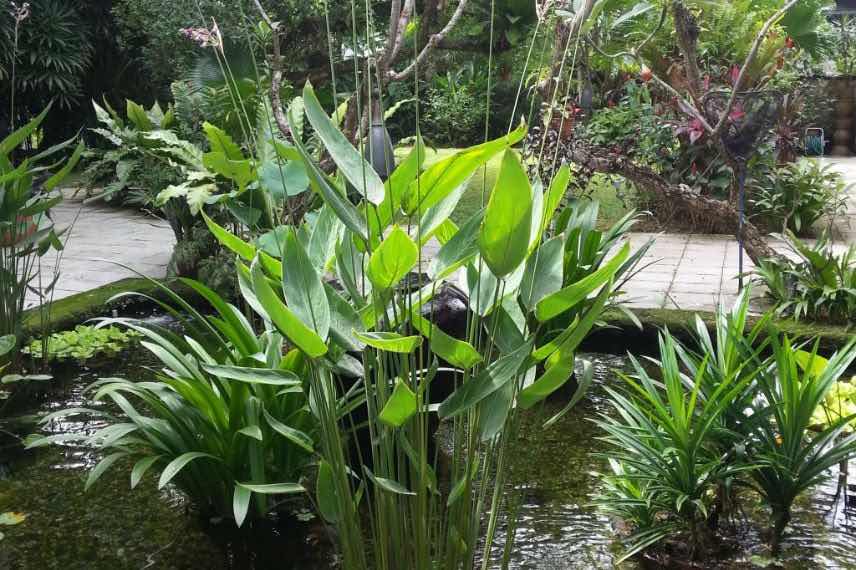
The Thalia dealbata, also known as white Thalia or water canna, is an aquatic or semi-aquatic perennial, often evergreen, distinguished by its large size and mauve flower spikes in summer. It is ideal for ponds, offering a vertical and exotic touch to the garden. In fertile soil and under a mild climate, it can reach large dimensions, though its hardiness is limited.
Belonging to the Marantaceae family, the Thalia dealbata is native to the southern United States, where it grows in marshes and sunlit wetlands. This plant spreads thanks to large underground rootstocks. In summer, it produces tall flowering spikes with waxy flowers in shades ranging from white to mauve. The flowers, nectar-rich, attract bees and are followed by purple seeds. Its large oval leaves, bluish-green and covered with a whitish tomentum, appear in spring. Although evergreen in its natural habitat, Thalia dealbata becomes deciduous in colder climates.
This plant is perfect for large ornamental ponds, planted directly in the mud or in a submerged basket. It adds a unique exotic charm. Its creeping habit allows it to be used as groundcover, even in a damp rockery, provided it has enough space. It requires full sun to thrive. The Thalia dealbata can also be grown in a large tub on a terrace, with its feet in the water, and should be protected from cold in winter.
The rootstocks settle at depths of 0 to 50 cm below the water surface. Planting depth can be adjusted according to the minimum winter temperatures. The rootstocks are protected by the water depth, and withstand temperatures down to -17°C, but conversely, deeper spring coolness results in a later restart of vegetation in spring.
































Comments