





























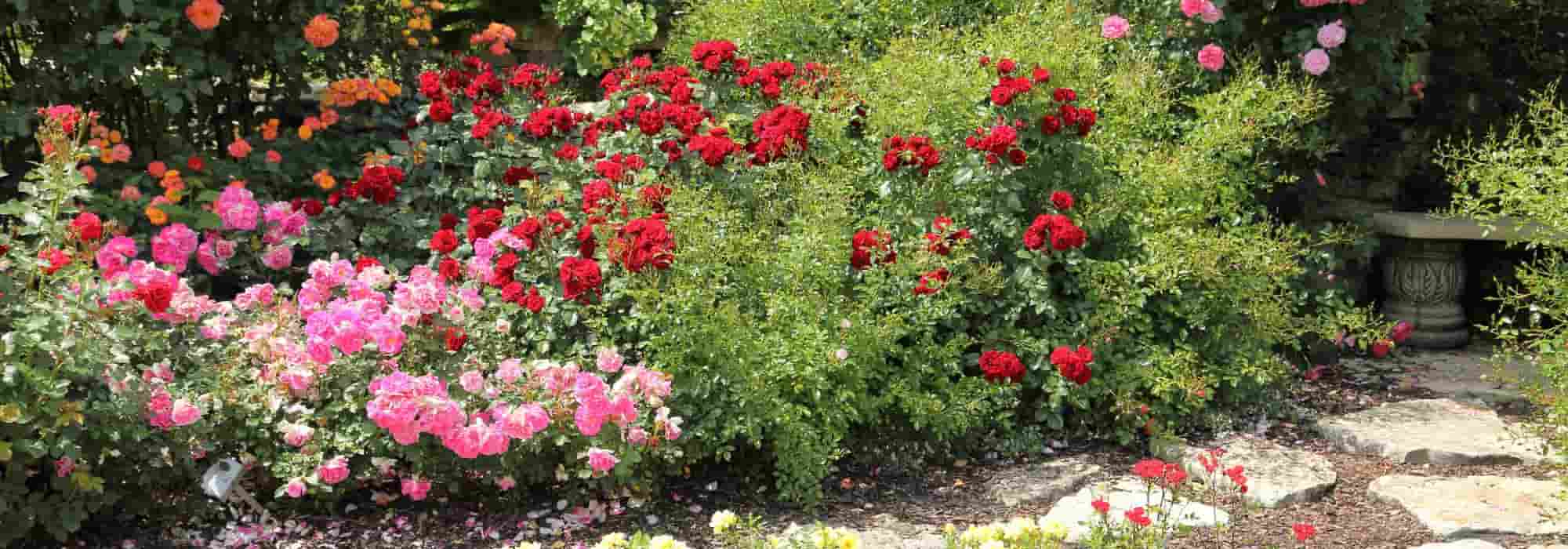
5 rose bushes to border a path
Our selection of five rose bushes to accompany you as you stroll along the garden paths.
Contents
In a garden, whatever its style, paths structure the space in harmony while delimiting movement. They are often essential routes to connect one part of the garden to another. Sinuous or straight, paved, slabbed, gravelled, or clad with wooden boards, paths will inevitably be enhanced and highlighted by planting. Nevertheless, to border a path, the selected plants must not be too invasive nor too discreet, and must possess a defined habit that will prevent them from encroaching too much on the path (and incidentally will spare you pruning!). Beyond simply integrating with the style of your garden, these path-bordering plants have the merit of accompanying your walks throughout the year, with their foliage or flowering. And why not release a few pleasant aromas as you walk along?
In this regard, roses are ideal plants for bordering a path. I invite you to discover our selection of five roses, perfectly suited for path borders by their size, habit and resilience.

Roses from the Bees Paradise series
The bees’ paradise! The Bees Paradise® roses series, a recent release from the German rosarian Tantau, is highly appreciated by foraging insects and pollinators thanks to its generous flowering that lasts from June to October. In addition, all the flowers on these roses are single or semi-double, making them very accessible to bees. Gathered in terminal bouquets, these flowers are also rich in nectar and pollen. The different varieties in the series cover a beautiful colour palette, from ivory white (‘Bees Paradise Ivory’) to yellow (‘Bees Paradise Yellow’), from bright pink (‘Bees Paradise Pink’) to red (‘Bees Paradise Light Red’), with special mention for the extraordinary ‘Bees Paradise Fruity’ whose flowers mix orange tones enhanced with red highlights, between mango, mandarin and raspberry. Once faded, these flowers drop off on their own without pruning.
Beyond their colourful and generous flowering, the roses in this series are very well suited to a border along a path thanks to their habit. Very bushy, compact and shrubby, these roses adopt a low, dense habit and form very floriferous cushions. The flowers are moreover highlighted by foliage that is dark and glossy. As regards their development, it is relatively limited since the height and spread of these roses do not exceed 40–60 cm.
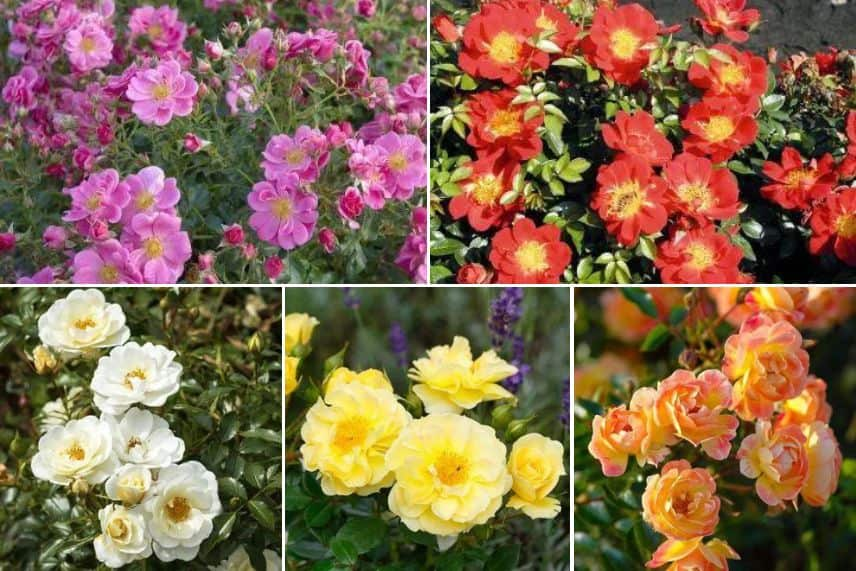
5 roses of the Bees Paradise series
Finally, these roses are perfectly hardy, robust and particularly resistant to diseases. These roses are planted in fertile, deep soil not too dry. It is possible to combine all the roses in the series to obtain a beautiful colour border, but pairing them with hardy geraniums or Dianthus would be particularly effective.
Rose 'Mainaufeuer'
To edge a path, groundcover roses are just the thing! Their advantages lie, of course, in their compact size, but also in their floribundity, their robustness and their low maintenance. Perfect for a path, isn’t it? The variety ‘Mainaufeuer’ sits squarely in this category of roses. This rose, which pays homage to Mainau Island, located near Lake Constance, was bred by the German rosarian Kordes. And its name holds all its promises as its semi-double flowers, grouped in dense umbels, display a blood-red that is very flamboyant and very luminous, enhanced by yellow stamens, on glossy light-green foliage, very striking. This colour will beautifully enhance your paths. Very repeat-flowering, this rose offers a long and generous flowering, slightly scented, from May to the first frosts.
This rose adopts a spreading and compact habit, with shoots that are very slightly pendulous, making it an ideal candidate for edging a path. It reaches a height and spread of no more than 50 cm. Its foliage displays excellent disease resistance. Obviously, to fully enjoy its vibrant colour, full sun is essential. Very tolerant, this rose accepts all soil types, except chalk. It will need watering during the first summer, but pruning is unnecessary.
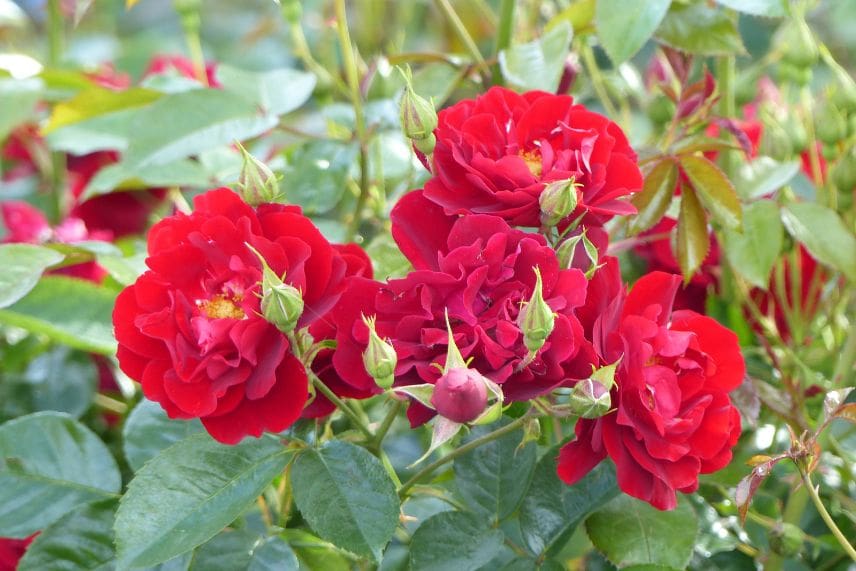
The rose ‘Mainaufeuer’
Décorosier® ‘Opalia’
This rose, from the Décorosiers® collection, is best planted along border paths for its semi-double flowering in pure white, highlighted by bright yellow stamens. Indeed, this colour will provide a striking contrast with all the other flowers in the garden. To border a path, it will pair wonderfully with lavender or delphiniums. But it can also stand alone, as its flowers find in the very glossy dark green foliage a fine backdrop.
Opalia® is the earliest variety of Décorosiers® since the first flowers, gathered in small clusters of ten, open from May. And this flowering, opulent and durable, continues without interruption until October, or even longer if you live in a region little affected by frosts. As for the rose, it forms a shrub that is very densely foliaged and provides dense cover. One cannot help but yield to temptation, all the more since this rose requires no particular care, proves resistant to diseases and adapts to all soil types, in sunny or semi-shaded positions. As for its decorative value, it is undeniable. At maturity, it reaches a height of 70 cm with a spread of 40 cm.
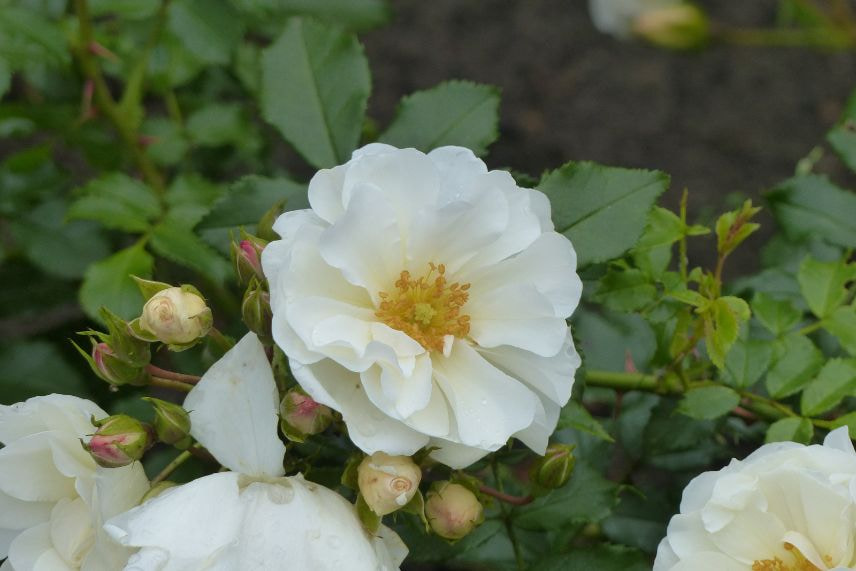
The rose Opalia®
Read also
8 dwarf roses with pink flowersDwarf rose 'Mother's Day'
Imagine clusters of small roses, double and globular, bearing a magnificent cherry-red bloom. Don’t look any further—you’ve found them to edge your garden path. These flowers are from the variety ‘Mother’s Day‘, officially named ‘Morsdag’ as it was bred in the Netherlands in 1949.
This compact rose variety, with an extremely generous, continually renewed flowering, is ideal for a border. Indeed, when grown as a free-standing plant, it hardly exceeds 30–40 cm in height, with a corresponding spread. Nevertheless, it does not go unnoticed, as its flowering is abundant from June to October, in a magenta-red that lightens as it matures. The blooms are relatively small (3–4 cm in diameter), but the 26 to 40 petals that make them up and their concave shape lend them a certain opulence. By contrast, they are only faintly scented. The colour is highlighted by abundant, glossy foliage in a medium green. This variety of roses is very lightly thorned.
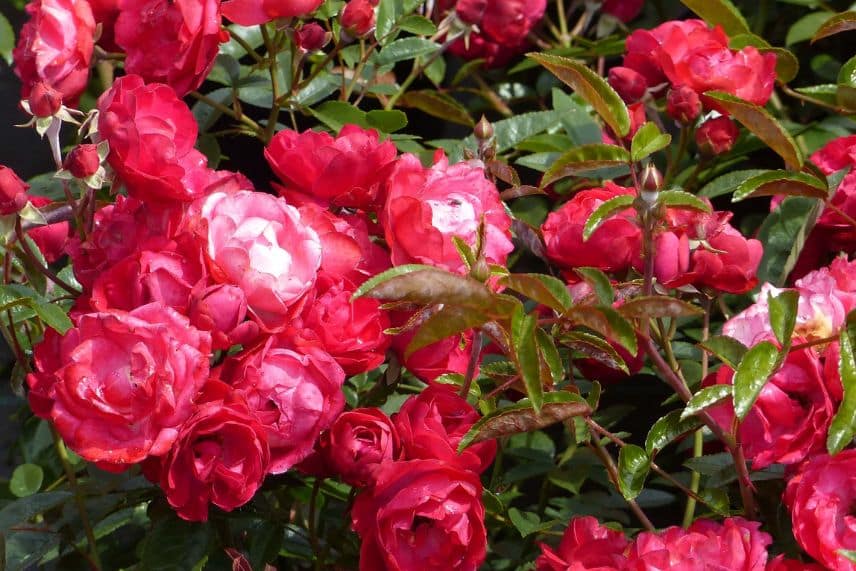 The rose ‘Mother’s Day‘
In a border, it is enjoyed alongside Diascias or Lobelias. This rose also has its masculine counterpart, the variety Father’s Day, with pretty orange blooms that pale to salmon as they mature.
Roses from the Bordure® series.
There is hardly a more explicit description for this series of dwarf roses, named ‘Bordure®’, bred by the French rosarian Delbard. These dwarf roses, certainly among the smallest of the polyantha hybrids, indeed display a very compact habit, ideal for borders. They barely exceed 40 cm in all directions. Moreover, they form plants with a compact, bushy, dome-shaped habit, as wide as tall. Very floriferous, these small-flowered roses (4 cm in diameter) open in pyramid-shaped clusters and gently reveal their yellow stamens. The flowering lasts from May to September on dark green, matte foliage, borne on very thorny stems.
The colour range of this series is fairly wide. We begin with the pure white of ‘Bordure® Blanche’, which offers a true snow carpet. ‘Bordure® Nacrée’ produces flowers that colour the garden in a range of shades all on their own. The flowers range from soft apricot yellow to almost white, sprinkled with pink, and passing through salmon and pink. The flowers of ‘Bordure® Rose’ display a very fresh pink, while ‘Bordure® Vive’ produces inflorescences in a much deeper and more vibrant pink. As for ‘Bordure® Camaïeu’, it stands out with flowers in varying shades of orange, yellow and pink, three colours that follow one another as the roses bloom.
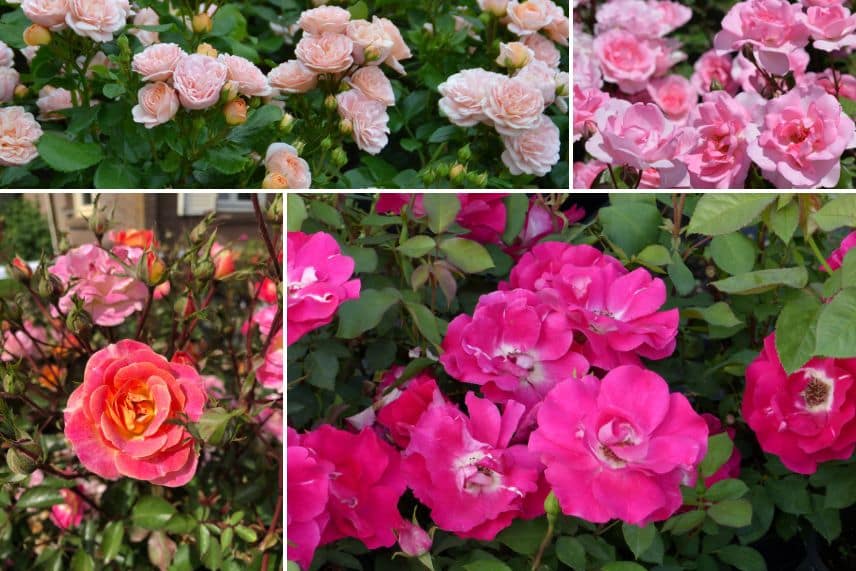
The Bordure® series roses
These roses particularly prefer sunny exposures and fertile, cool and deep soils. A soil that remains cool in summer is, moreover, the guarantee of prolonged flowering. Thanks to their size, these roses will thrive alongside hardy geraniums, Phlox, Lychnis, Hesperis or Campanulas.
- Subscribe!
- Contents

Comments