





























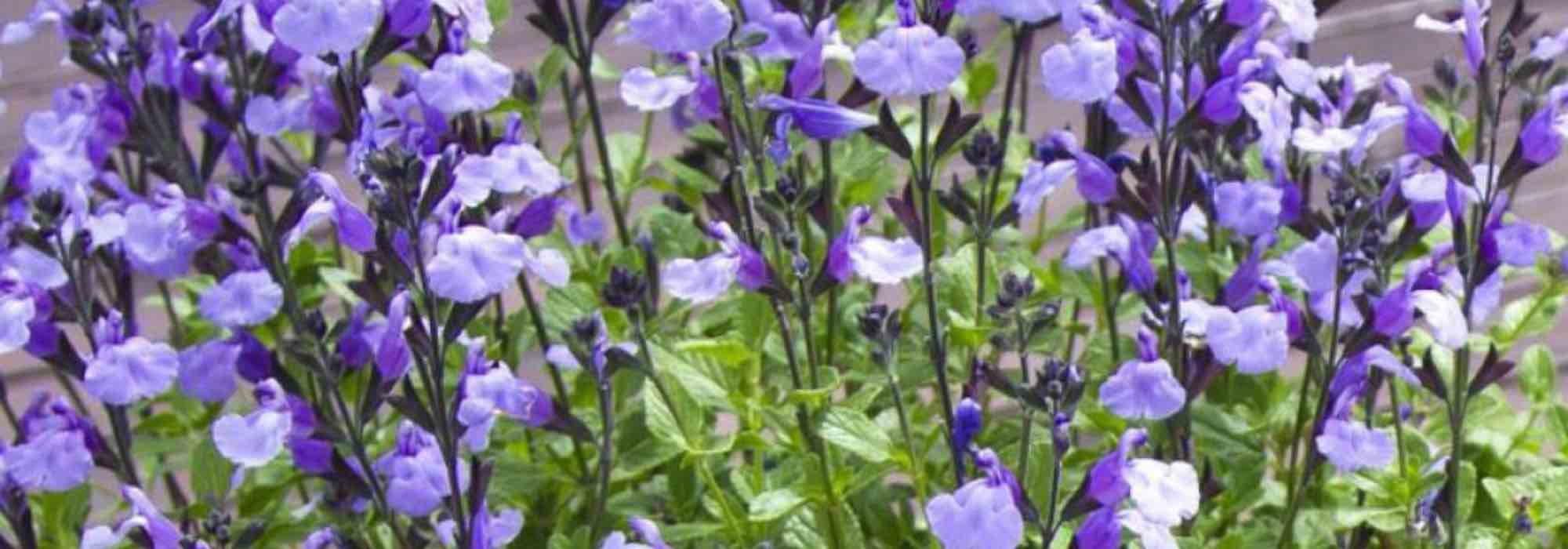
5 salvias for dry soil
For long-lasting, colourful flowering
Contents
Light and decorative, shrubby salvias salvias offer long-lasting, colourful flowering that extends for many months from spring to the first frosts, depending on the species. They take the form of shrubs of varying habit and bear spikes of flowers with five petals, with an upper lip galea-shaped and a smaller, flattened lower lip. The flowering displays colours as varied as they are striking, from deep red to blue, including purple, pink, violet and white. The foliage is aromatic and made up of small green leaves. Easy to grow and hardy, they enjoy sun and well-drained soil. Hardy, they have a weakness: humidity. They are therefore ideal plants to grow in dry substrate. Discover our selection of salvias suitable for growing in a dry substrate, from the sage ‘Amethyst Lips’ with purple-and-white bi-colour flowers to the shrub sage ‘Reve Rouge’, via the ‘Blue Note’ sage with an intense and remarkable blue.

Shrub sage 'Amethyst Lips' - Salvia greggii
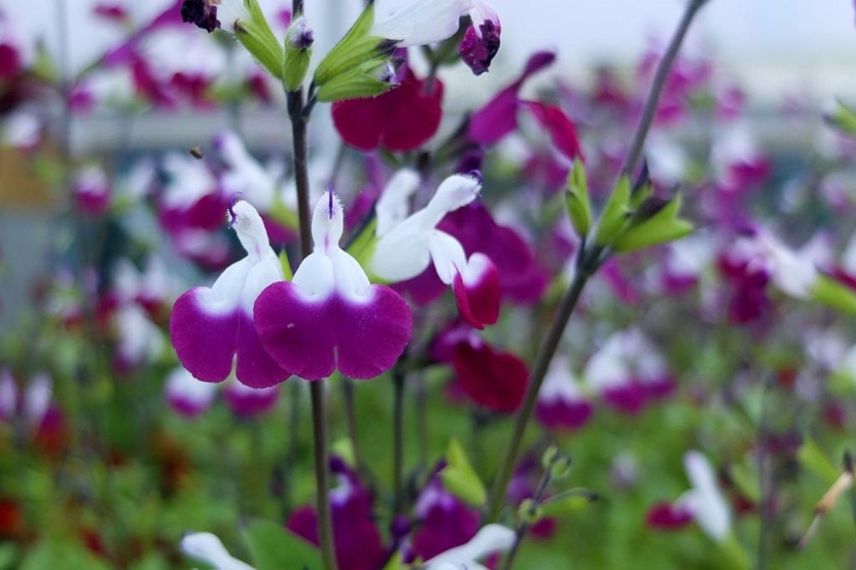
The Salvia greggii ‘Amethyst Lips’ is a relatively recent shrub sage variety that stands out for its bi-colour flowers, violet and white. This perennial offers abundant flowering from May to October, which changes colour with temperature. At first white, the flowers become bi-colour, white and violet, then colour completely purple. It takes the form of a shrub 70 cm tall by 50 cm wide, covered with confetti-like flowers. Its small oval leaves, edged with rounded teeth, are dark green and aromatic. They are semi-evergreen. It is a plant for well-drained soil that can be planted in rocky, calcareous ground. It exhibits hardiness down to -10°C in almost-dry soil over winter. This sage appreciates well-drained soil and a few waterings in summer. It establishes itself in sun or partial shade.
It thrives in flowering borders, on terraces, and in varied planting combinations. It pairs well with rockroses (Cistus), garden irises and peonies. Its foliage is used in Mexico to prepare an aromatic tea, known as ‘mountain myrtle’.
Shrub sage 'Reve Rouge' - Salvia jamensis
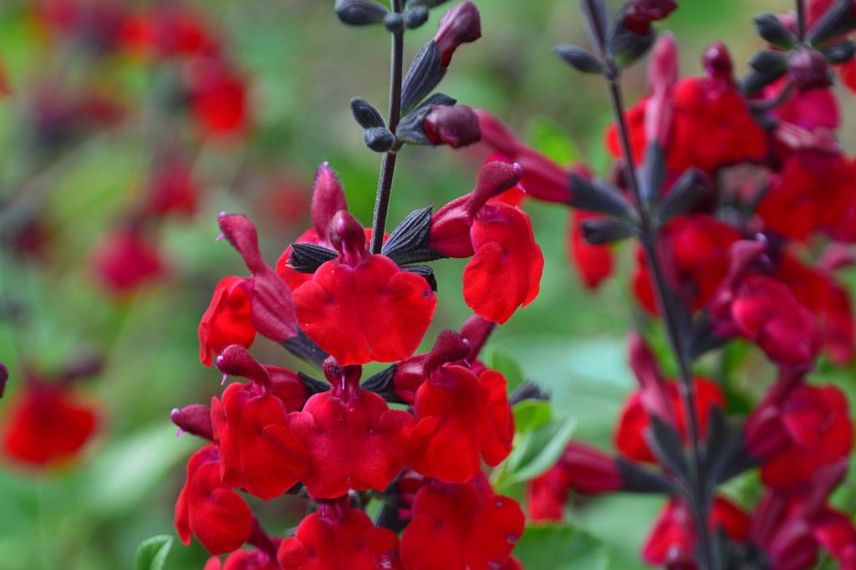
Here’s a shrub sage with a colour that certainly catches the eye! The shrubby sage ‘Rêve Rouge’ – Salvia jamensis adds touches of pure, deep red to a garden. It bears clusters of velvety, well-filled flowers from May to June, and again from August to November. The intense red of the flowers is enhanced by the brown of the bracts. Slightly scented, these flowers attract pollinating insects. Its semi-evergreen foliage is dark green and aromatic. It forms a 60 cm spread and, to thrive, needs a very well-drained soil, even poor and calcareous, and a site in partial shade to full sun. It is also easily grown in a pot.
In a border, it pairs nicely with rosemary and rock garden campanulas. To temper the brightness of its colour, it can also be paired with dusty miller. On a terrace, pair it with Cape leadwort ‘Dark Blue’ for a boldly striking colour combination.
Shrub sage 'Blue Note' - Salvia microphylla
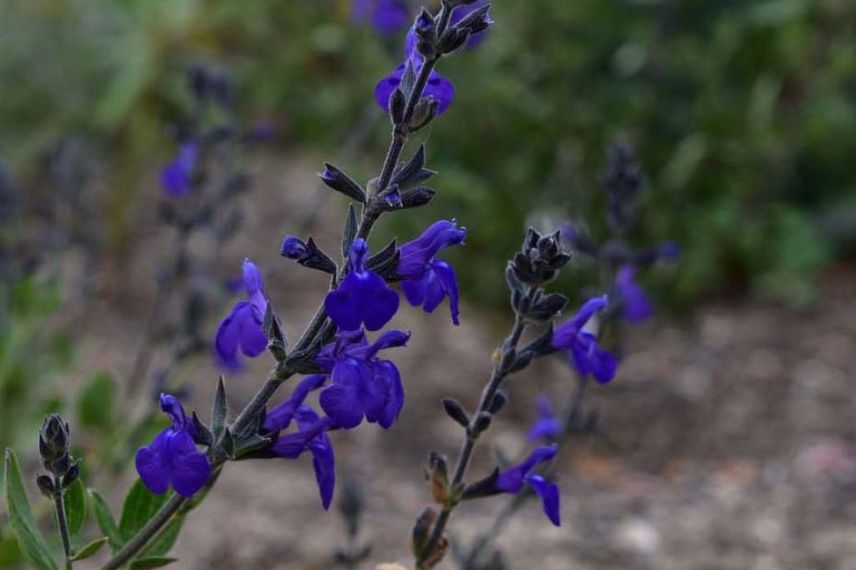
The Salvia ‘Blue Note’ is a shrub sage variety, awarded in 2010 for its striking flowering in a deep royal blue, enhanced by navy blue and purple bracts. This plant bears small dark-green aromatic leaves and offers a slightly upright, bushy habit. It enjoys continuous flowering from summer through to frosts, especially if provided with regular watering during dry periods. It grows up to 60 cm tall and spreads to 60 cm wide. Suitable for pot culture, this variety in the Lamiaceae family has low water requirements and is hardy. Plant it in very well-drained soil, even mediocre, in full sun or partial shade. It is moderately hardy, down to -10°C.
To create a colourful floral display, try pairing this sage with deep-blue flowers and red Penstemons, or shrub salvias ‘Rêve Rouge’.
Read also
Blue salvias: the five best varietiesShrubby sage 'Violette de Loire' - Salvia jamensis
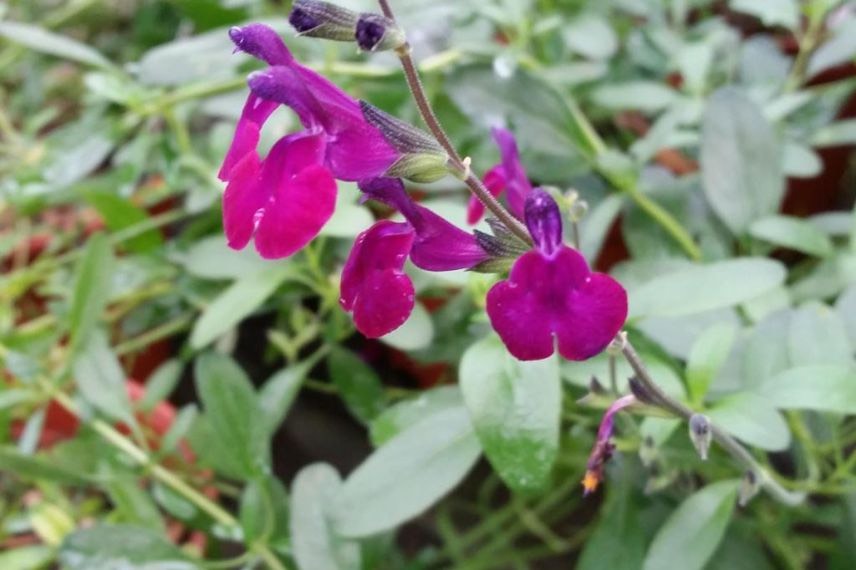
The shrub sage ‘Violette de Loire’ – Salvia jamensis is a recent cultivar with a proven track record. This woody perennial with semi-evergreen foliage is cloaked in spikes of small flowers in a deep violet, slightly tinged with blue. It features a flowering period lasting many months, from May to November. The leaves are small and ovate, dark green and a little sticky. They release, in warmth, a tangy scent caused by the essential oil they contain. Moderately hardy to -15°C, it establishes itself in well-drained soil, even mediocre, and tolerates full sun or partial shade. At maturity it reaches 60 cm tall by 60 cm wide, making it suitable for pot culture.
It pairs harmoniously in a border with autumn asters, shrubby cinquefoils and gaura.
Shrub sage 'So Cool Pale Blue' - Salvia microphylla
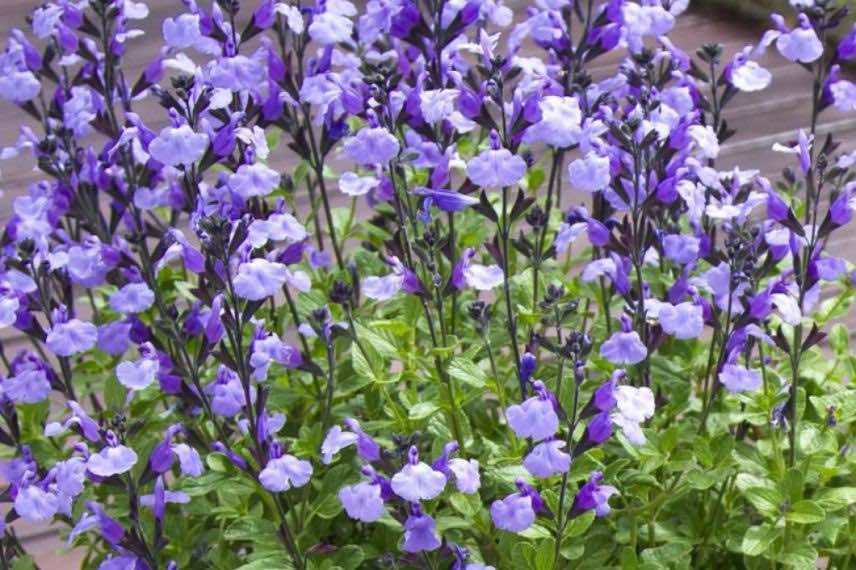
The Salvia microphylla ‘So Cool Pale Blue’ is a shrub sage adorned with unusually bright mauve-blue flowers. It flowers continually from May to October, attracting bees and delighting gardeners, as long as the soil isn’t too dry. It bears small, ovate, aromatic leaves, light green, semi-evergreen in winter and exuding a mentholated and lemon-scented fragrance. This plant forms a small, dense, rounded shrub 70 cm high by 70 cm wide. It is hardy to -10°C and needs protection in cold regions. This sage thrives in dry, sunny soils, including calcareous and stony soils. It is suited to mild climates, but in cold regions, pot culture is advised to protect it from frost. Plant it in a sheltered position away from cold winds.
In a rock garden or border, it pairs well with other salvias such as ‘Mirage Violet’, or with perennials such as common oregano, the sea holly ‘Tiny Jackpot’, and grasses. This plant is ideal for gardeners looking to add colour and fragrance to their gardens.
Further reading
Additionally, discover our full range of salvias, as well as our guide to the cultivation and planting of salvias.
- Subscribe!
- Contents
Comments