





























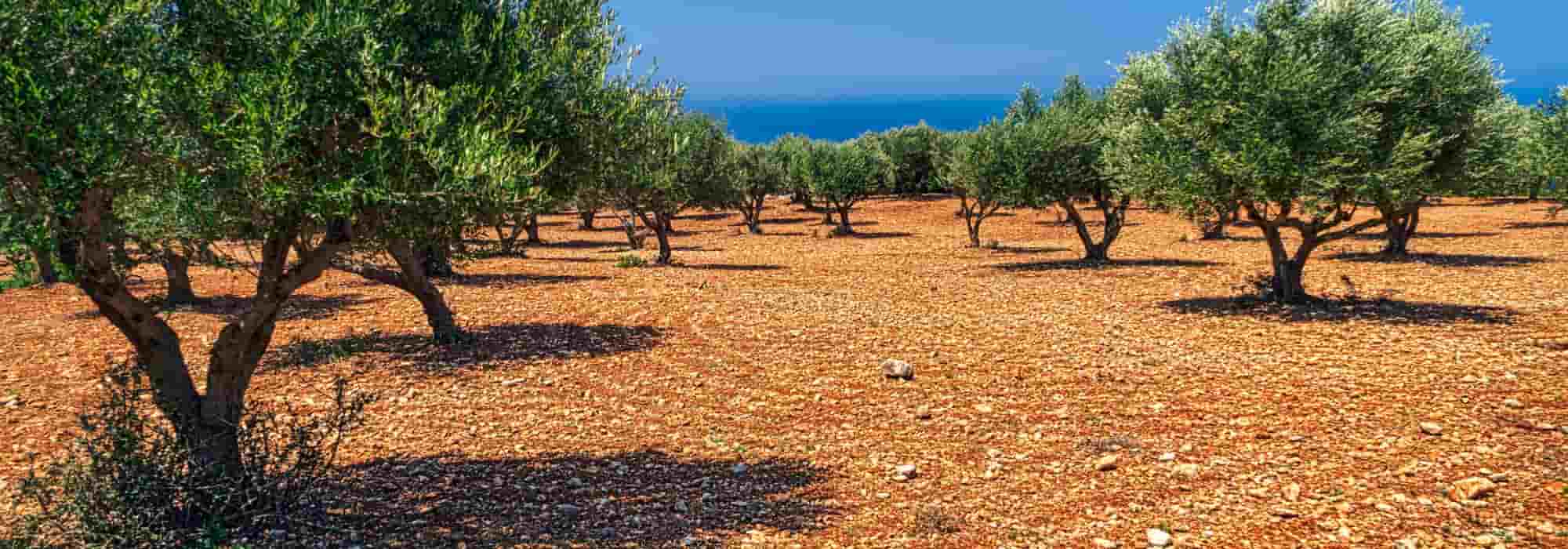
5 trees for rocky soil
Ideas for trees to plant in stony soil.
Contents
Is your garden soil stony? Don’t despair if you find yourself slumped miserably over your garden fork! A stony soil is certainly restrictive, but some trees will appreciate this tough ground to work with, often calcareous and retaining little or no water. By contrast, a stony soil must accommodate trees that are sufficiently drought-tolerant. Indeed, in a soil full of stones, the roots have more difficulty reaching deeper. The roots tend to stay closer to the surface, which makes the tree more vulnerable to drought. A stony soil absorbs heat during the day and releases it at night.
Some trees will thrive in this type of soil and may even benefit from it. Discover our selection of five trees perfect for stony soils.

The olive tree, the king of Mediterranean gardens
If there is a tree typical of Mediterranean landscapes on calcareous soil, it is certainly the olive tree. Indeed, the olive tree fundamentally dislikes waterlogged soil and thrives in soils where water drains away from its roots. Soils rich in stones and gravel, often nutrient-poor, suit it perfectly because they are well-draining and never waterlogged. Moreover, the root system, comprising a taproot that seeks water deep in the soil and a network of very shallow secondary roots, adapts perfectly to a stony soil.
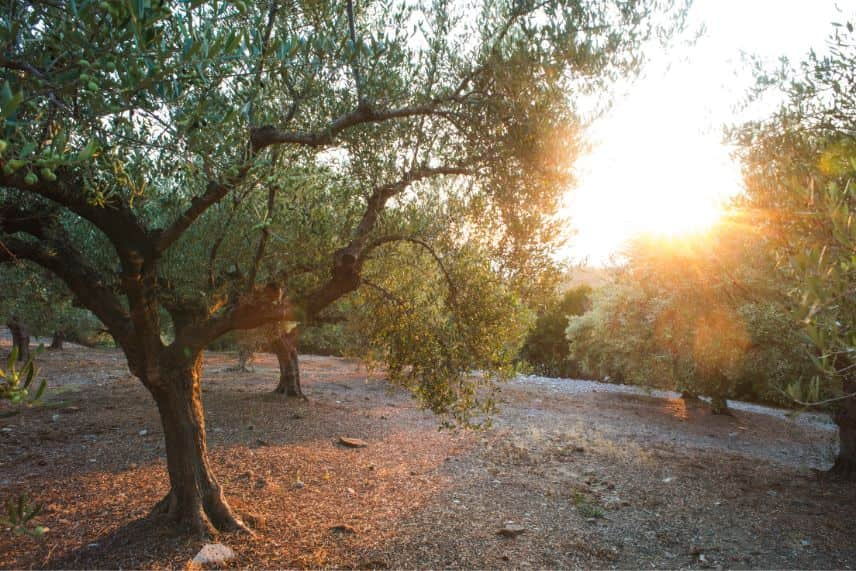
The olive tree loves stony soils
The olive tree is therefore a strategic choice for stony soil, provided, of course, that you live in a region with a relatively mild winter climate. Because the olive tree, due to its Mediterranean origins, is frost-prone. Even though, planted in the ground, it can tolerate very occasional and short-lived frosts, around -12°C to -15°C, provided it is situated in a south-facing position, well sheltered from winds and cold air currents.
If you don’t live around the Mediterranean basin, choose a hardier variety such as ‘Lucques’, slightly less sensitive to cold. In the years following its planting, you may need to provide protection such as a winter veil, and above all water it regularly once or twice a month.
For more information:
The Great Pine Family
Scots pine, Maritime pine, Black pine… Generally, pines (Pinus) thrive in rocky soils, as they are not particular about soil, provided it is well-drained. Thus, a pine can grow on poor and inhospitable land, on shallow, rocky or sandy soils. But it mainly dislikes soils that are too damp and not sufficiently drained, especially in winter. Moreover, pines are particularly resistant to heat and drought. However, you should avoid the Himalayan weeping pine (Pinus griffithi) with fine, trailing needles which prefers cool, deep soils, just like the Monterey pine (Pinus insignis syn. radiata) which favours acidic, well-drained but still cool soils in summer.
Otherwise, in rocky soil, you can indulge by planting a pine variety that stands out for its foliage, silhouette or size. Thus, in a large garden, the umbrella pine (Pinus pinea) adapts perfectly to rocky soil provided it is in full sun. You will surely appreciate it for its venerable silhouette and edible pine nuts. The Scots pine (Pinus sylvestris) is recognisable by its slender and irregular habit, bluish-grey foliage and salmon-coloured bark. It also adapts very well to rocky soils. But be sure of their hardiness!
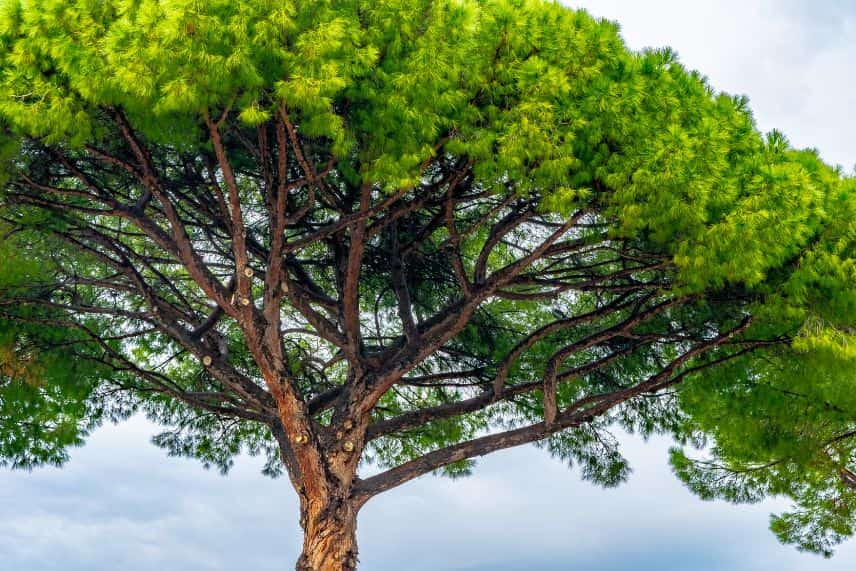
The umbrella pine adapts easily to rocky soils
For more information: Pines: planting, pruning and care
field maple (Acer campestre)
Very common in our countryside, field maple (Acer campestre) also has its place in this type of garden. Not least because it is relatively modest in size (8 m tall by 4 m across). Very adaptable to soils, the field maple will tolerate ordinary soils, including calcareous and stony soils, provided they are deep and well-drained. It will be right at home there, offering its best attributes: lobed, bright green and slightly satin-finished foliage, which takes on splendid yellow hues, ranging from bronze to copper in autumn, a discreet flowering, and winged, reddish fruits.

The pretty autumn foliage of the field maple
The Carnival variety (Carnival) displays a smaller size (5 m across) but above all an astonishing pale green foliage, edged with cream.
To highlight it and, above all, enjoy its handsome bark, it will be planted at the centre of a bed, surrounded by flowering perennials such as hardy geraniums, the lamiums or the epimediums. A hedge planting also suits it in company with spindle trees (Euonymus), hazel trees and hawthorns (Cratægus).
Read also
10 good reasons to plant a treeThe laburnum with clusters (Laburnum anagyroides)
Also known as false acacia or aubour, the laburnum (Laburnum anagyroides) is a tree that can reach 7–8 m in height with an equally wide spread. With a fastigiate habit and few branches, this laburnum has a preference for poor, relatively dry and calcareous, well-drained soils, because it does not tolerate damp, heavy soils. It should be noted that it originates from the mountainous regions of central and southern Europe! In its natural habitat, it often grows in forests of oaks and pines alongside downy oaks, ash, and the smoke tree.
The laburnum has a smooth greenish bark that is furrowed, i.e. it is crossed by longitudinal grooves. Its leaves are alternate, light green, divided into three leaflets, elliptic to ovate. But its flowering is especially striking (for those who love yellow flowers!). Indeed, from May to July, the laburnum is covered with pendant clusters of flowers, quite resembling those of wisterias, which hang in arches. These flowers are typical of the Fabaceae family, to which the laburnum belongs. Golden-yellow, they are also melliferous and highly fragrant. After flowering, hairy pods appear filled with black seeds.
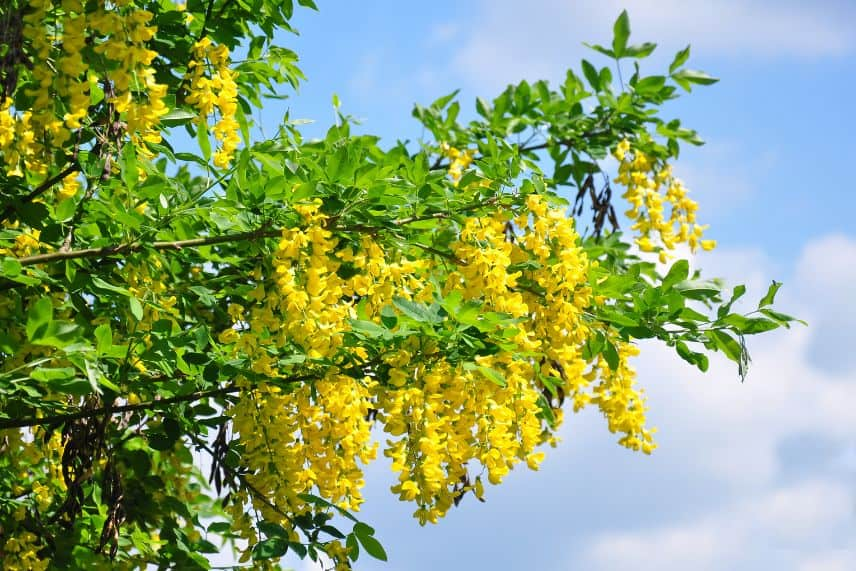 Those who love yellow flowers will surely appreciate the laburnum
The yellow colour of its flowering will be complemented by the violet of Alliums or by the red or purple foliage of shrubs such as Photinia or purple-leaved hazel.
For more information: Laburnum: planting, pruning and care
Hazel (Corylus)
Hazel (Corylus) cultivation is fairly straightforward, such an accommodating tree. It can thus adapt to rocky, calcareous soil. In fact, it shies away from heavy, damp soils. It also tolerates urban growing conditions, wind, and salt spray… It is therefore an ideal tree that also offers ornamental and edible qualities. Hazel is commonly grown for its hazelnuts, which come in a range of shapes, colours and yields, but not only… With hazel, one also appreciates the flowering of coloured aments (the male flowers) that appear early in the year, from January to April. The female flowers are more discreet, but distinctive. The hazel foliage is no exception: it takes on beautiful yellow colours in autumn. Finally, its extreme hardiness makes it a tree suited to all regions.
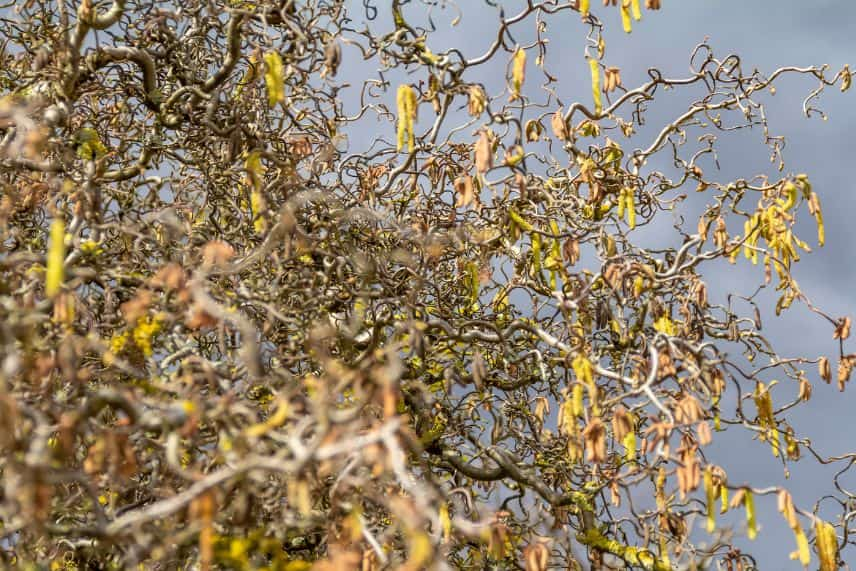 Graphically speaking, the sinuous branches of Twisted hazel will have a striking effect in rocky soil
If you fancy a bit of whimsy, consider the Corylus avellana ‘Purpurea’, with magnificent purple foliage that does not exceed 5 m in height and 3 m in width. But in rocky soil, it is certainly the Corylus avellana ‘Contorta’ (Twisted hazel) that will have the greatest effect with its sinuous, interlaced and highly graphic branches, splendid in winter, and its spring flowering in delicate aments.
For more information:
- Subscribe!
- Contents
Comments