


7 bronze-leaved grasses
Ideal for adding a warm, luminous touch
Contents
Grasses are among the garden essentials for adding visual interest and lightness. Their great diversity allows them to integrate anywhere, from the smallest spaces to the largest gardens. These particularly decorative plants are suitable for naturalistic-style gardens as well as for creating contemporary scenes.
Foliage colours can range from the classic green to the most extravagant multicoloured hues. Bronze tones, sometimes present in subtle nuances, help to bring warmth, brightness and diversity. This aged metal colour pairs easily, for example with orange flowering, to add a real touch of the exotic.
Discover our selection of grasses with coloured leaves or bronze-tinged leaves.

Carex comans 'Bronze Form'
Carex, or sedges, are among perennial plants often grouped with grasses. They form low-growing silhouettes that rarely exceed 1 metre in height. These plants fit easily anywhere, in the garden as well as in pots. There are over a thousand species, highly diverse, but all share evergreen foliage, decorative all year round.
‘Bronze Form’ is a small New Zealand sedge variety with a compact habit, not exceeding 40 cm in all directions. It will quickly form a soft and airy tuft, with a trailing fountain-like silhouette. This Carex features fine, linear foliage, delicately arched and curled at its tip, swaying naturally with the breeze. It graces us with a warm and bright colour. Initially bronze with metallic reflections, the leaves take on more orange tones from autumn, to brighten the entire winter season.
In terms of cultivation, this grass will thrive in ordinary soil, in full sun as well as partial shade. The substrate should be fairly moist (not waterlogged), but it can tolerate occasional drought.
Hardy down to -15°C, our Carex will find a place in most of our gardens, but also in pots to create a pretty scene alongside other plants on the balcony or terrace. It will help create a contemporary and graphic display, for example in a large tub or planter, paired with bulbous plants.
For more information: Carex: plant, divide and maintain
Read also
5 grasses with variegated foliageThe Carex flagellifera
This flagellate sedge produces long, slender and flexible leaves, reminiscent of whips. These are certainly what earn it its nickname. They have tapered edges and are slightly spiralled. Carex flagellifera forms a spreading tuft, creating a real mane of foliage that is slightly tousled. This grass features a bronze colour leaning toward russet or brown. This evergreen foliage is ornamental all year round.
In terms of silhouette, this Carex reaches 75 cm in height with a 40 cm spread. Easy to grow, it will mainly require well-drained soil (that does not retain excess water) and fairly cool, as well as a sunny aspect. It makes an ideal edging for a path or walkway when planted in mass.
For its part, the cultivar ‘Bronzita’ offers a smaller silhouette, not exceeding 40 cm and slightly wider than tall. Its foliage with warm tones yields a lovely bronze with brown-red reflections, lighter at the tips. Its only drawback? Its hardiness, which is limited to -10°C.
Carex buchananii ‘Red Rooster’
‘Red Rooster’ is a Buchanan’s sedge (Carex buchananii) with evergreen foliage, just as decorative as its peers. The thread-like leaves with curled tips form a dense, erect tuft, yet graceful. Its appearance is delightfully tousled. This Carex charms with its bronze colour subtly red-tinged, interesting all year round. It takes on a browner hue in summer, before becoming truly flamboyant in autumn, with its copper-bronze and orange colouring.
The light, graphic silhouette of this pretty perennial reaches 50 cm in height and 40 cm in spread. It will be wonderful in a border, alongside red-flowering perennials.
Read also
7 fast-growing grassesCarex berggrenii
The Carex berggrenii is a mini-form, reaching no more than 5 cm in height and 30 cm across. This low-growing silhouette thus makes an ideal evergreen groundcover. This grass forms a tuft of foliage in ribbon-like leaves with pronounced veins. Its metallic colour evolves: initially green, it becomes olive green before revealing a bright bronze, which sometimes leans toward coppery brown. The cold allows the foliage to change colour again, displaying very bright red, purple and orange tones.
Plant this miniature grass in sun or partial shade, in well-drained soil that remains cool to damp. It will gradually form a small, glossy and colourful carpet. Hardy down to -18°C, it will even suit mountain gardens, for example to brighten up a rock garden that isn’t too dry in summer.
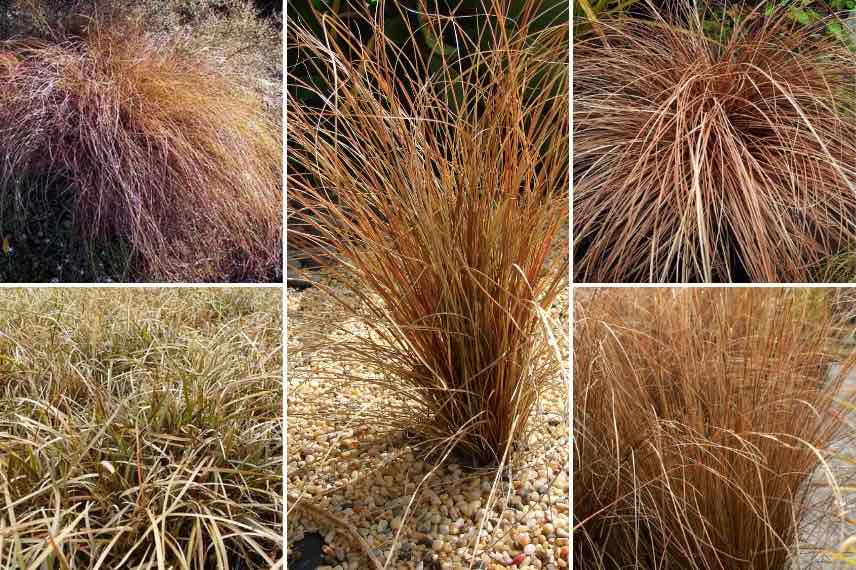
Clockwise from the top: Carex flagellifera, Carex comans ‘Bronze Form’, Carex flagellifera ‘Bronzita’, Carex buchananii ‘Red Rooster’, Carex berggrenii
The Phormium tenax ‘Purpureum’
The Phormium, or New Zealand flax is a tall evergreen perennial prized for its particularly colourful foliage. Phormiums never go unnoticed in the garden and help to structure the space. Plant them as specimens, in a bed, in a rock garden, or in a large container. This plant, suited to a mild climate, prefers winters that are not too harsh, with frosts not exceeding around -8°C. This is an ideal candidate for coastal gardens, as it tolerates sea spray well. ‘Purpureum’ has an architectural silhouette, which naturally draws the eye. It forms a broad and generous tuft, reaching 2 to 3 metres across at maturity. The linear, upright leaves grow vertically. They consist of tough ribbons, up to nearly 10 cm wide. The leaves display a purple hue highlighted by bright bronze stripes, leaning toward purplish in summer. Evergreen, these leaves remain decorative year-round. They pair beautifully with the summer flowering on dark red-orange spikes that rise above the clump. This Phormium is an ideal plant for Mediterranean gardens, as it tolerates soils that are occasionally dry. But it can also be grown in a large container, becoming one of the showpieces of a contemporary-looking terrace or a small urban garden. Fairly tolerant of growing conditions and requiring little maintenance, this Phormium mainly needs a sunny position. It will grow in all soil types, preferably well-drained and moist. Choose its position carefully, as this rhizomatous perennial can take up a lot of space! For more information: New Zealand flax: planting, pruning and care.
Phormium tenax 'Sundowner'
‘Sundowner’ forms a slightly arching clump, made up of rosettes of leaves arranged in a fan. This variety is less imposing than our previous Phormium, as it only reaches up to 1.5 metres in all directions. But its foliage is just as interesting, colourful and ornamental. Its long, pointed leaves can reach 6 cm wide. They display bronze-green foliage, marginated with pink or salmon depending on the season. In winter, they will tend towards brown.
Flowering is infrequent in our latitudes.
This colourful ornamental grass will be easy to grow in a pot in regions that experience severe frosts (below -8°C). Plant it in full sun to add an exotic touch to the garden, on the terrace or balcony. You can pair it with perennials with silvery foliage to create a striking colour contrast.
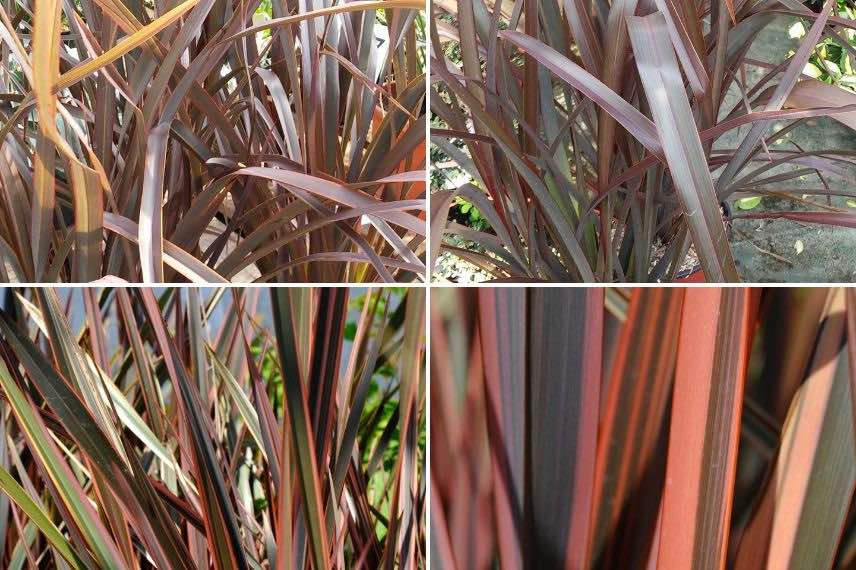
At the top, Phormium tenax ‘Purpureum’ and at the bottom, Phormium ‘Sundowner’
Uncinia 'Belinda's Find'
Uncinia rubra ‘Belinda’s Find’ is a pretty little perennial, grass-like, originating from the wooded, damp areas of New Zealand. Slow-growing, it will form over the years a compact and highly ornamental tuft about 30 cm high with a 40 cm spread. It features fine, light, ribbon-like foliage, gracefully arching, which makes it resemble a grass. In colour, this Uncinia reveals bronze margins of cherry-red and copper-red. The leaves reflect the sun’s rays, displaying handsome metallic reflections.
This evergreen perennial tolerates soils rich in organic matter, cool to moist but well-drained. It can be planted near a water feature, provided the soil isn’t constantly waterlogged.
This plant, suited to milder climates, does not tolerate hard frosts (hardiness to -9°C), but can also be grown in a container, allowing it to be sheltered in winter.
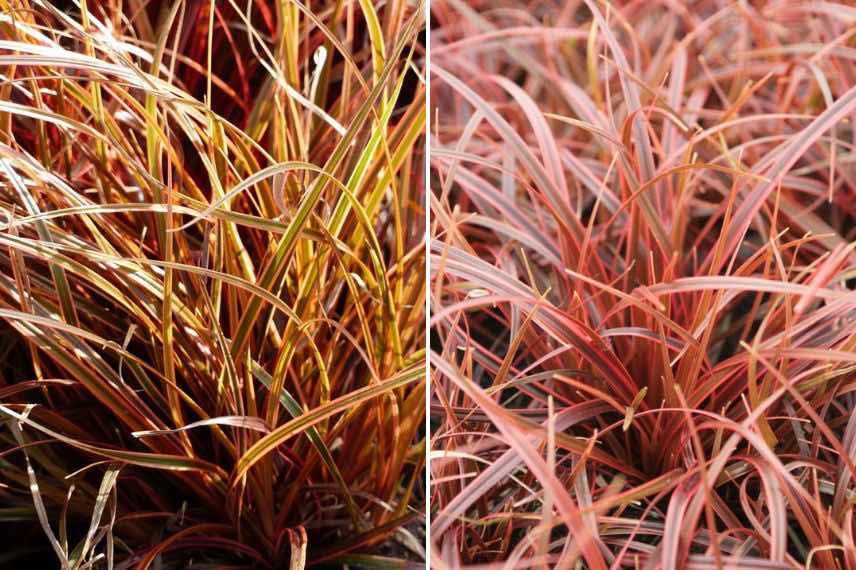
Uncinia ‘Belinda’s Find’
- Subscribe!
- Contents
Comments