





























7 evergreen trees
The most beautiful trees that keep their leaves all year round
Contents
Keeping their foliage in winter, the evergreen trees provide year-round presence in the garden.
There are many evergreen shrubs, but when it comes to trees, the choice is a little more limited, except among conifers, which are overwhelmingly evergreen.
We present our selection of the seven best evergreen trees!

Magnolia grandiflora
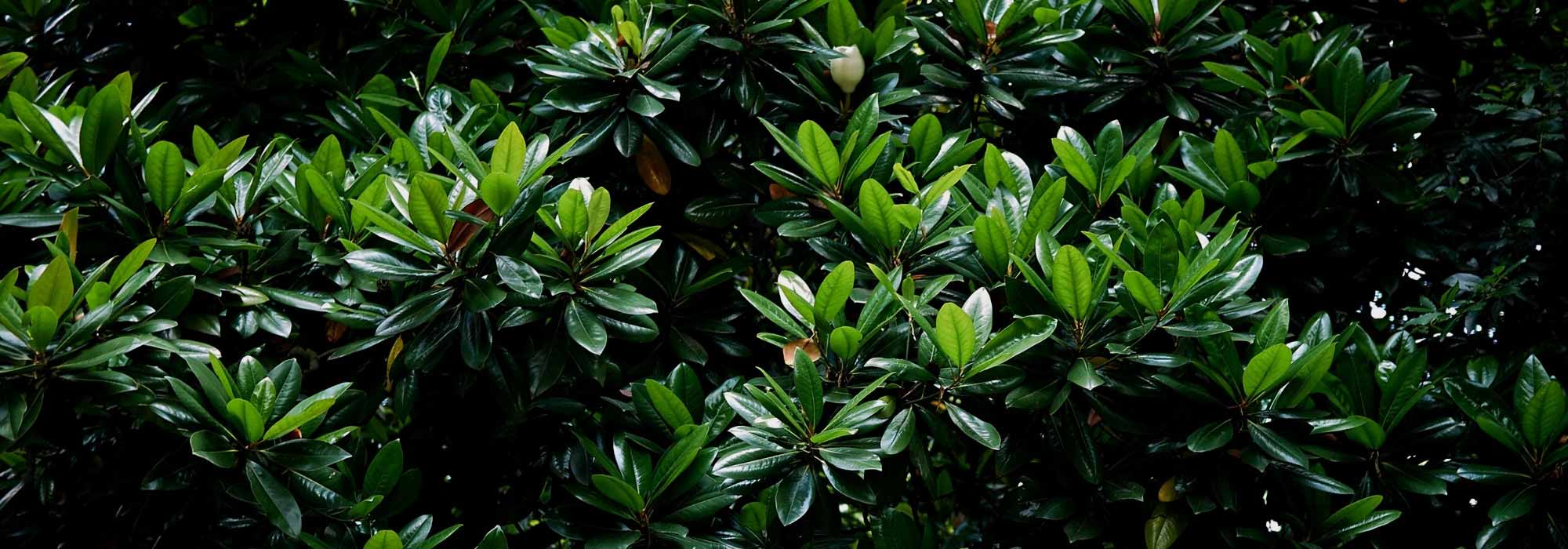
The Magnolia grandiflora, also called large-flowered magnolia or tulip laurel, is a handsome tree bearing large dark-green, leathery and glossy leaves, with a bronze underside. It bears large white flowers from June to August–September, particularly elegant. They are tulip-shaped, 15 to 25 cm in diameter, and consist of thick pure-white petals surrounding a central cone of yellow stamens. Each flower lasts only a day on the tree, but they renew continually for three months. At maturity, it can reach 10 to 15 m in height, but there are also dwarf varieties, better suited to small gardens, such as the Magnolia grandiflora Magnolia grandiflora ‘Nana’, which does not exceed 2.5 m in height. The Magnolia thrives in rich, cool and deep soil. The Magnolia delavayi (Chinese Magnolia) and the Magnolia yunnanensis are also evergreen.
The Magnolia is very handsome as a specimen or as an avenue tree, but do not hesitate, however, to pair it with perennials with decorative and glossy foliage, such as acanthus. You can also plant carpets of Farfugium and Bergenia at its feet. You can also plant it in company with a spring-flowering magnolia, such as Magnolia soulangeana, which bears pink tulip-shaped flowers in May–June.
Discover our full guide: “Magnolias: Planting, pruning and care”.
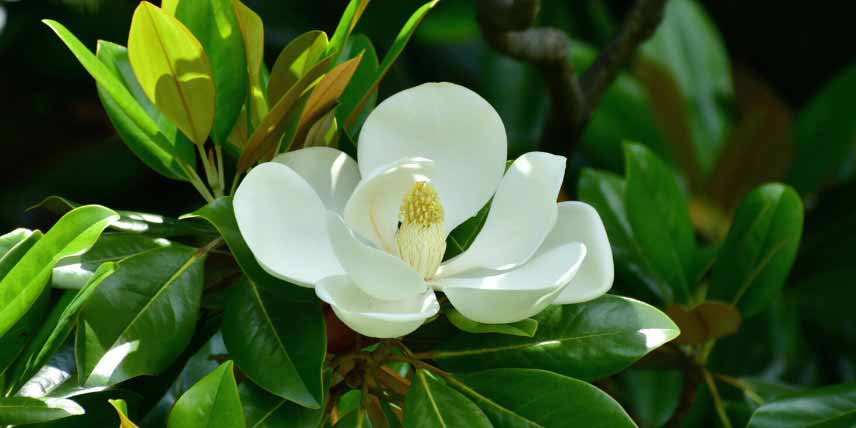
The elegant white bloom of Magnolia grandiflora
Read also
5 fast-growing evergreen treesHolm Oak
Holm Oak (Quercus ilex) is a tree that grows naturally around the Mediterranean basin, especially in Corsica. It is one of the characteristic species of the garrigue. It is also nicknamed Yeuse in Provence or the “false holly oak,” as its leaves resemble holly. They are leathery, dark green on the upper surface and silvery grey on the underside. It forms a stout, gnarled trunk with grey, fissured bark. It is a particularly hardy and long‑lived tree, but it grows very slowly. It reaches up to 20 m in height at maturity, with a trunk circumference of 2–3 m. It prefers very well‑drained soils, rather poor, calcareous or neutral. Not very hardy, it tolerates temperatures around −7 °C, even down to −10 °C when well established. It is drought‑tolerant and resistant to temperature fluctuations.
In the garden, pair it with cistus, Phlomis, sages, rosemary and Teucrium, as well as the graceful silhouette of strawberry trees and olive trees.
You can also opt for the Cork Oak (Quercus suber). It is also native to the Mediterranean regions, but this time on acidic soil. It is characteristic of the Mediterranean scrub vegetation. We also invite you to discover the Phillyrea‑leaved Oak, Quercus phillyreoides, native to China.
Our complete guide: “Oak: Planting, pruning and maintenance”.
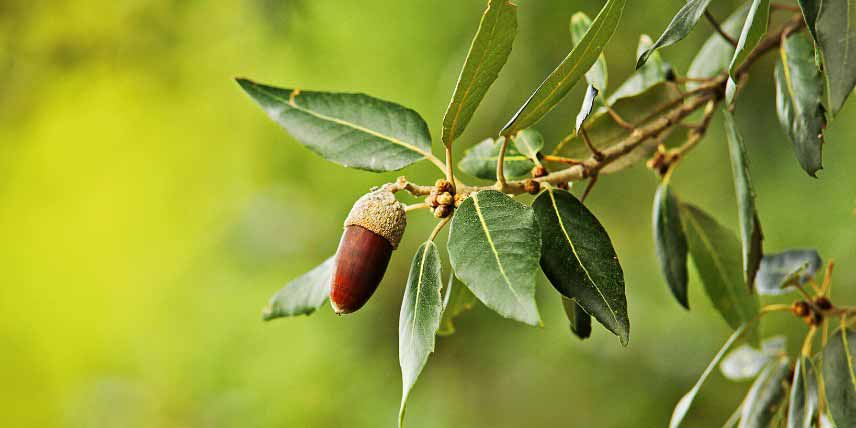
The leaves and acorns of Holm Oak, Quercus ilex
The Japanese loquat
The Japanese loquat, or Eriobotrya japonica, not to be confused with the common loquat, is a small tree with an elegant habit, forming a broad, ramified and spreading crown. It reaches up to 6 m in height at maturity and bears large dark-green, wrinkled, leathery and glossy leaves. It offers in autumn, typically in October–November, clusters of beige flowers with an almond- and vanilla-scented fragrance. It also bears, in spring (May–June), oval yellow-orange fruits, edible, with juicy flesh and a slightly tart flavour. The loquats can be eaten raw, as they are, or in compote. It will thrive in a mild-climate region, such as the Mediterranean basin or the Atlantic coastline, but can be grown in a container in the coldest regions, which will allow it to be brought under cover for the winter.
Plant it in an exotic border with lantanas, euphorbias, cannas and Pittosporum tobira.
Our full guide: “Japanese loquat: planting, growing and harvesting”.
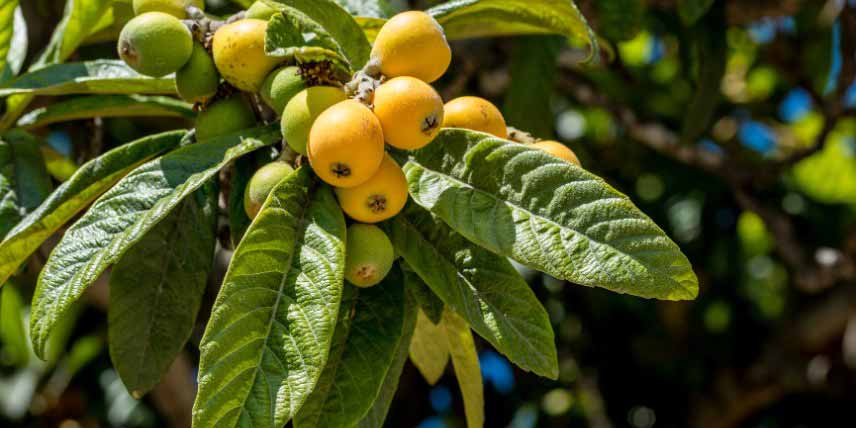
The loquats and wrinkled leaves of the Eriobotrya japonica
Read also
10 magnolias with evergreen foliageEucryphia
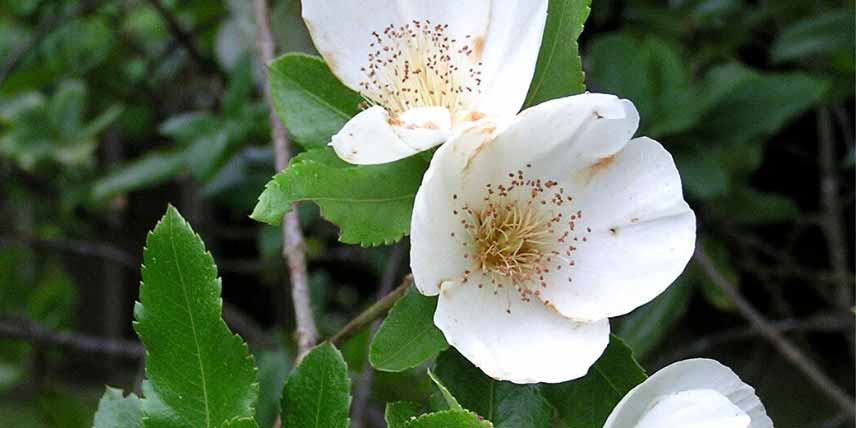
Eucryphias are charming small flowering trees or shrubs, unusual and little-known! They bear lovely white or pink flowers in summer, pleasantly scented. They consist of four petals surrounding a central bouquet of stamens, reminiscent of dog-rose flowers. Eucryphias have fairly ordinary foliage, consisting of dark green, glossy leaves, variegated in some varieties such as Gilt Edge. Also discover the Eucryphia moorei, with finely dissected leaves. Note that Eucryphias are nonetheless fairly demanding trees and shrubs, requiring particular conditions to flourish. Originating from Australia and Chile, they favour mild and humid climates, and are therefore particularly suited to mild regions of the Atlantic coast, such as Brittany or Normandy. You can also plant them near a pond, where they will benefit from a humid atmosphere. Most species prefer cool, light and humus-bearing soil that is not calcareous. They enjoy having their roots in shade but their crowns in the sun.
Pair Eucryphia with ericaceous shrubs, such as rhododendrons and azaleas, the Japanese maples, Pieris japonica, Daphnes and hydrangeas. Also consider Crinodendron hookerianum, a shrub distinguished by its pretty red bell-shaped flowers.
Our full guide: “Eucryphia: Planting, growing and care”.
Eucalyptus
Eucalyptus or gum trees are beautiful trees native mainly to Australia, bearing blue-green or silver-grey, evergreen and aromatic foliage. They grow rapidly and can become very tall, forming an elegant silhouette, with a slender trunk and bark that is white to grey and peels in strips. Eucalyptus provide light shade. Their juvenile foliage is rounded, while the adult leaves are elongated, lanceolate. We especially recommend the Eucalyptus gunnii, but you may also opt for the Eucalyptus parviflora or the Eucalyptus niphophila. Eucalyptus enjoy mild climates, but their hardiness is very variable between species (up to -18°C / -20°C for the Eucalyptus niphophila, also known as Snow Gum). They favour sun and adapt readily to poor, dry soils.
Take advantage of the blue foliage of Eucalyptus to compose a blue-silver massif, pairing it with the euphorbia ‘Glacier Blue’, the Salvia argentea, the Eryngium ‘Jos Eijking’ and the blue flowers of the Salvia patens. Eucalyptus will also find its place in a Mediterranean-style garden.
Our full guide: “Eucalyptus: planting, pruning and care”.
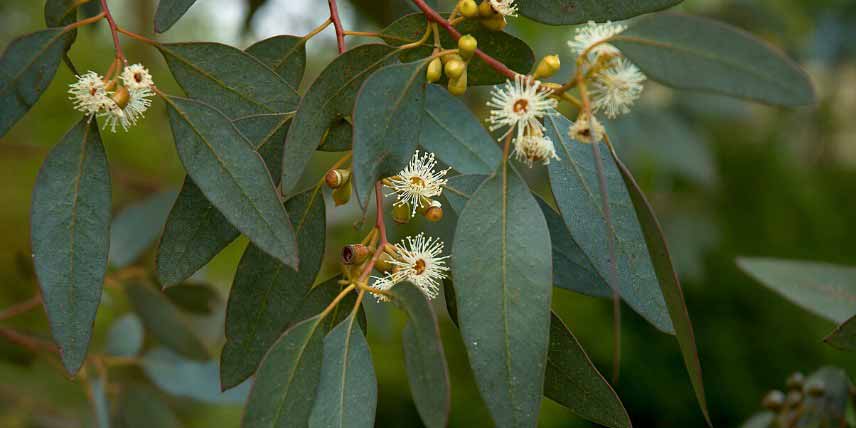
Adult leaves and the flowers of the Eucalyptus gunnii (photo: Wouter Hagens)
The Olive tree
An iconic tree in Mediterranean landscapes, the olive tree is prized for its silvery foliage and its nodose trunk. It indeed bears fine grey-green leaves, with silvery undersides. It typically starts bearing fruit after about 10 years, producing green olives, then black at maturity, not edible in their present state. The olive tree can live for thousands of years. It enjoys full sun and soils that are perfectly drained, even stony. It does not tolerate temperatures below -10 to -12°C. Cultivation in the open ground is therefore best reserved for mild-climate regions.
Plant the olive tree in a Mediterranean-style garden, alongside perennials and Mediterranean shrubs, such as lavender, Santolina, rockroses, Helianthemum, oleander… It will also be perfect to accompany the Holm Oak.
Our full fact sheet: “Olivier, Olea europaea : planting, pruning”.
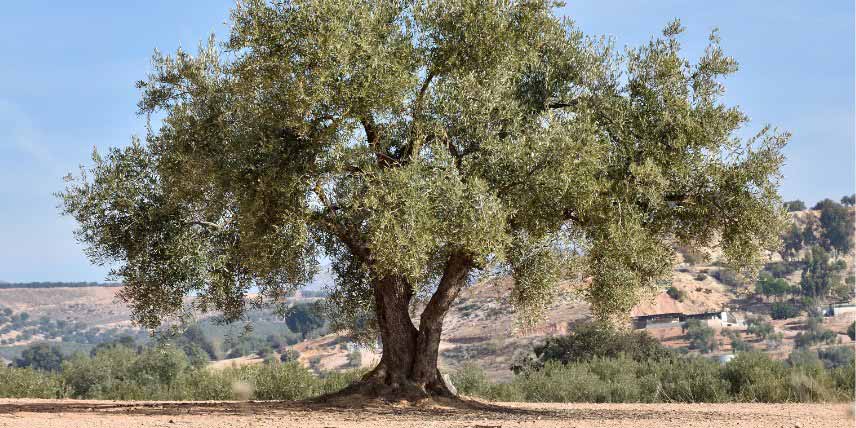
The elegant silhouette of an olive tree, Olea europaea
Wattle
The florist’s wattle or Acacia dealbata delights us with its feathery foliage and its yellow pom-pom flowers, highly fragrant. Although evergreen plants often have thick, leathery foliage, that is not the case with wattle: it is distinguished instead by the fineness of its leaves, particularly delicate. It tolerates drought as well as calcareous soil. However, it is not very hardy (between -7 and -10 °C): growing it in open ground should therefore be reserved for regions with a mild climate. In the colder regions, it should be grown in a large pot and stored under cover for the winter. It is a small tree that reaches between 4 and 5 m in height and spread at maturity. It has the peculiarity of flowering in winter, from January to March. Its branches, covered with yellow pom-pom flowers, are ideal in a vase, to bring brightness (and a pleasant scent) to a bouquet! It is usually grafted onto Acacia retinodes, which makes it less hardy, but not suckering and more tolerant of calcareous soils.
In the garden, wattle easily finds its place as a specimen plant, to really showcase it, but it is also perfect to accompany the early flowering of the Japanese quinces, Forsythias and Prunus triloba.
See the full guide: “Wattle: planting, pruning and care”
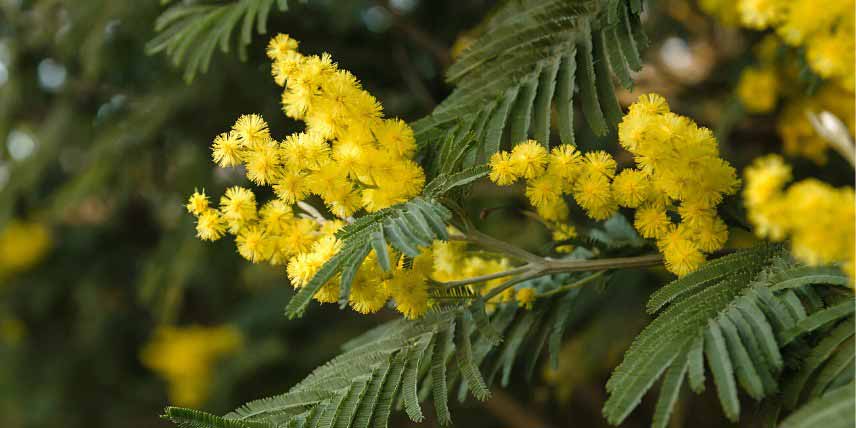
Acacia dealbata offers lovely yellow pom-pom flowers, very fragrant
- Subscribe!
- Contents

Comments