





























7 hardy succulent plants
Cacti and succulents even in the North
Contents
A succulent plant (or malacophyte) is a fleshy plant adapted to survive in arid environments, thus enduring very severe droughts, thanks to its ability to store water in its leaves, stems, or roots. The term “succulent” has no relation to gastronomy; it refers to the “juice,” the thick and viscous sap contained within the plant. Succulent plants include “fat plants” such as sedums, orpins, houseleeks, agaves, and some tropical euphorbias… and cacti such as Opuntias, for example. More prevalent in warm and dry regions of the globe, some fat plants and cacti are, however, hardy enough to be grown in the ground in our gardens.
→ Let’s explore truly hardy succulent plants for lasting planting in the garden.
Please note: the hardiness of a plant depends on many factors such as its exposure to sun and wind, whether the soil is well-drained or not, the duration of frost episodes, and even the age of the plant or the planting period. To be certain that a particular plant is truly hardy in your area, it is not enough to look at its theoretical cold resistance. Fortunately, to assist you, Promesse de Fleurs has developed an application called Plantfit. This will provide you with the best advice for choosing your future plantings.

Houseleeks or Sempervivum
Houseleeks or Sempervivum are small, hardy succulents, native to mountainous regions. Houseleeks form rosettes made up of fleshy leaves. The Sempervivum tectorum, the roof houseleek, is a fairly common species in France. Meanwhile, the Sempervivum arachnoideum, the cobweb houseleek, is interesting for its rosettes adorned with thin white threads. However, there are also thousands of horticultural varieties, offering a great diversity of shapes and colours. The foliage can be green, reddish, orange, bronze, purplish, and sometimes almost black… Houseleeks also bloom with beautiful star-shaped flowers, often pink, red, or yellow.
Houseleeks thrive in sunny and rocky locations. It is important that the soil is well-draining to avoid stagnant moisture. Plant them on a wall, on a roof, in a sunny rock garden, or even in pots…
→To learn more, read Houseleek-Sempervivum: planting, growing, and caring for.
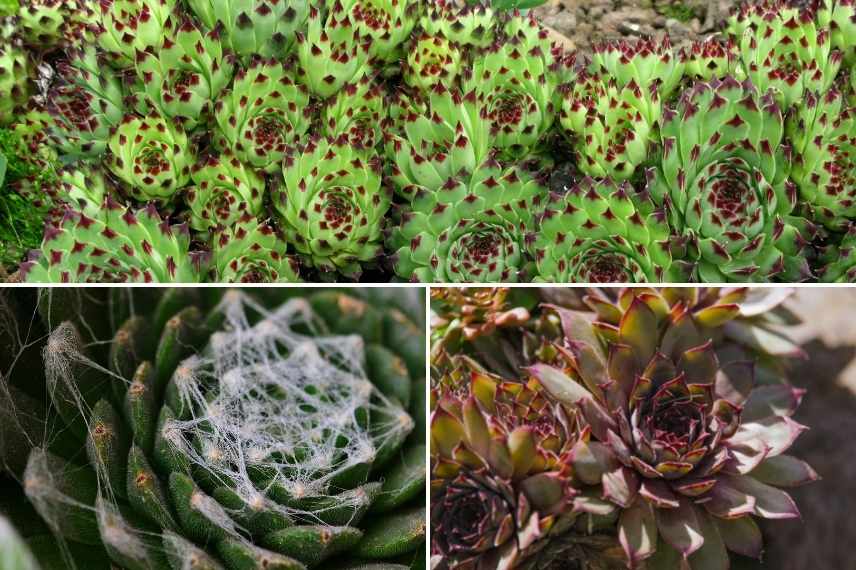
Houseleeks or Sempervivum display a beautiful variety of colours
Read also
7 iconic cacti and succulent plantsSedums and Hylotelephium
Sedums or stonecrops are among the hardiest and most resilient succulents. There are generally two main categories of Sedum:
- Small creeping Sedums that hug the ground and rarely exceed 10 to 15 cm in height. During flowering, they create beautiful carpets of small star-shaped flowers in yellow, pink, or white. This is the case for Sedum acre or Sedum spurium. Most of these Sedums are used in green roofing. The foliage can take on various colours (purple, yellow, red, green…), making them remarkably decorative.
- Tall upright Sedums. This includes Hylotelephium spectabile, formerly Sedum spectabile, or Autumn stonecrop, which can reach 60 cm in height. Hylotelephium are used in borders, mass plantings, or pots. The flowers, in pink or white, are grouped in dense, flat inflorescences. Even after flowering, the dried inflorescences remain decorative, even in the heart of winter. The foliage can be green, purple, or even variegated.
The roots of sedums do not penetrate deeply. They can thus grow with very little substrate. This is why they are found in nature on walls, roofs, rocks, cliffs… as seen with Sedum reflexum, for example. Sedums and Hylotelephium are generally hardy down to -15 °C. They thrive in sunlight and well-drained soil.
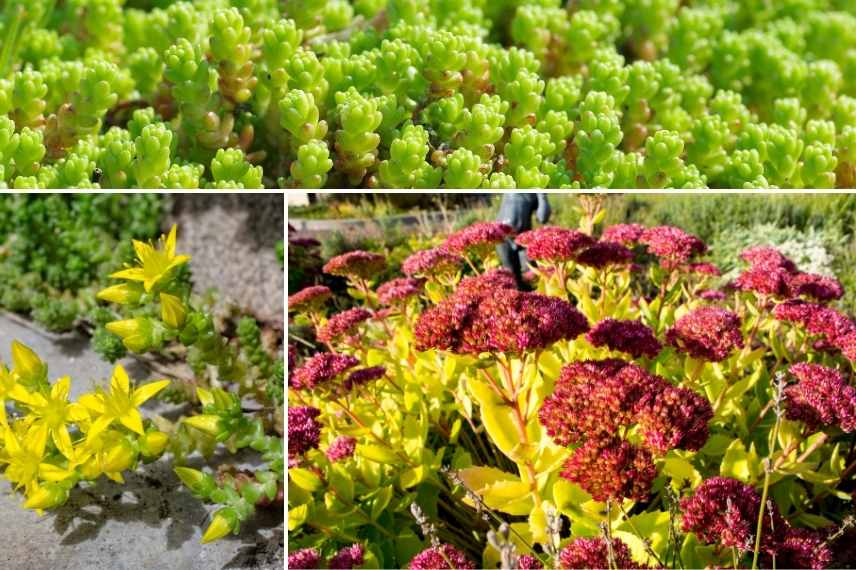
Stonecrops, creeping or tall,
Discover other Cacti and succulents
View all →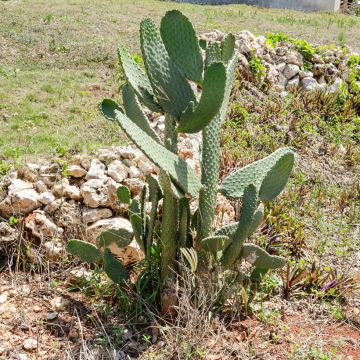
Available in 1 sizes
Available in 1 sizes
Available in 1 sizes
Available in 1 sizes
Available in 1 sizes
Available in 1 sizes
Available in 1 sizes
Available in 1 sizes
Available in 2 sizes
Available in 1 sizes
Opuntia or "prickly pear
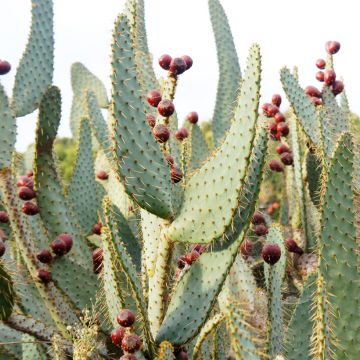
Opuntias, Prickly pears or Paddle cacti are distinctive cacti characterised by their flattened, paddle-like segments. They have flat, ovate, fleshy stems that bear small cushions where thorns are attached. Opuntias also offer a beautiful flowering display: their flowers are large, with numerous petals in warm colours (often yellow, orange, red…). A good number of opuntia species are sufficiently hardy (down to -20 °C) to be grown here provided they are given sunlight and well-draining soil.
This is the case for Opuntia engelmanii, Opuntia compressa, and Opuntia sanguinicola, as well as Cylindropuntia imbricata, a peculiar botanical cousin of the opuntias, developing bumpy cylindrical forms rather than paddles.
→To learn more, read Opuntia: planting, growing, and caring for.
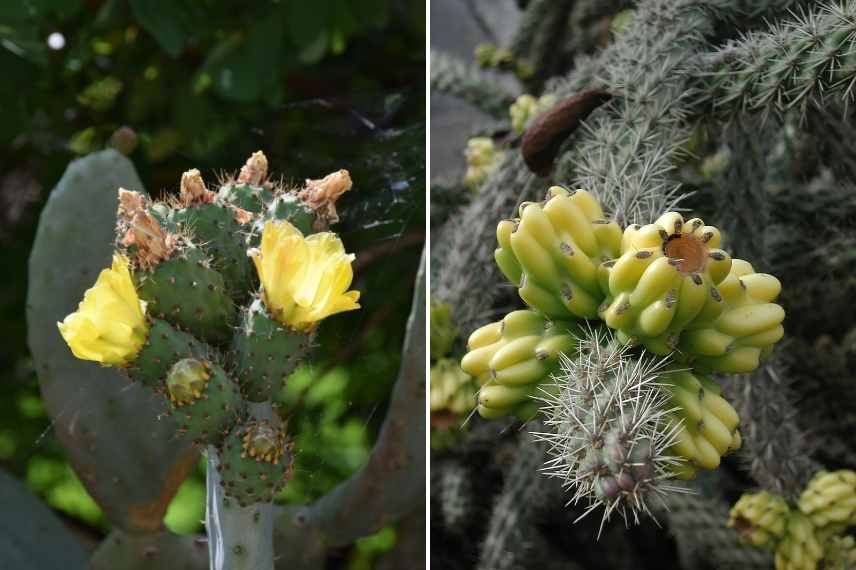
Opuntia compressa and Cylindropuntia imbricata
Read also
How to plant cacti in the garden?Aloes
Some aloes can withstand temperatures down to -10 °C in well-drained soil. This is the case for Aloe striatula and Aloe aristata.
The Aloe striatula is a shrub-like aloe, reaching up to 1.5 metres in height and 2 metres in spread at maturity. Its leaves are long and narrow, fleshy, and very tapered. This aloe produces an abundant yellow flowering in late spring, with elongated spikes made up of numerous tubular flowers. Relatively hardy, it can tolerate temperatures down to -10 °C in well-drained soil. However, place it in a sunny location.
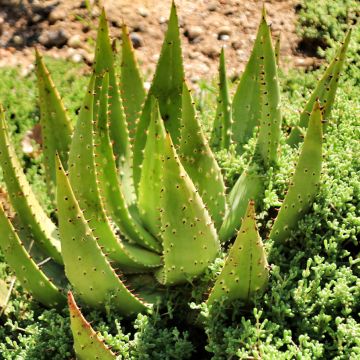
The Aloe aristata is a small species of aloe. This perennial forms a round rosette, growing close to the ground, composed of fleshy, elongated leaves edged with non-spiny, dentate teeth. The foliage is dark green speckled with silver-white. In late spring or early summer, beautiful dark spikes appear, adorned with pleasantly coral-pink flowers. The Aloe aristata also thrives in full sun and well-drained soil. This aloe is hardy down to -12 °C.
→To learn more, read Aloe: planting, growing, and care.
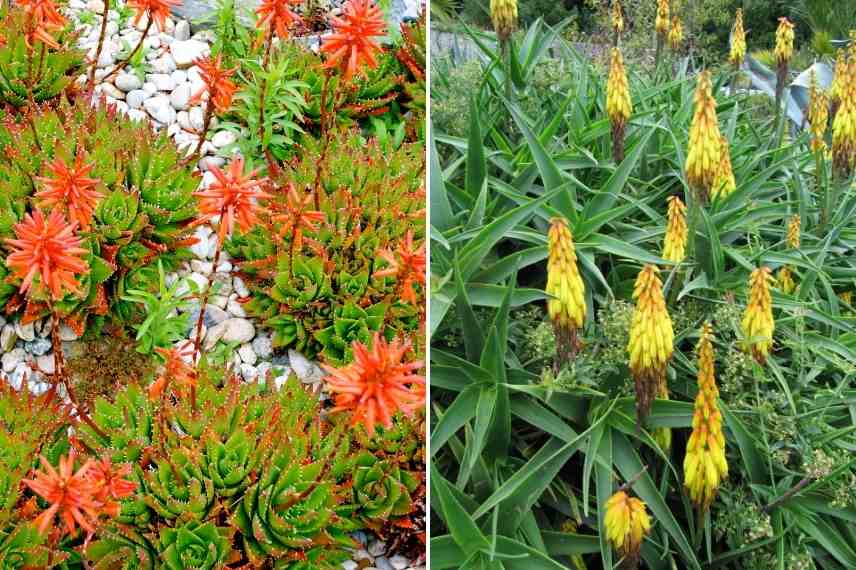
On the left, Aloe aristata; on the right, Aloe striatula (© Leonora Enking)
Agaves
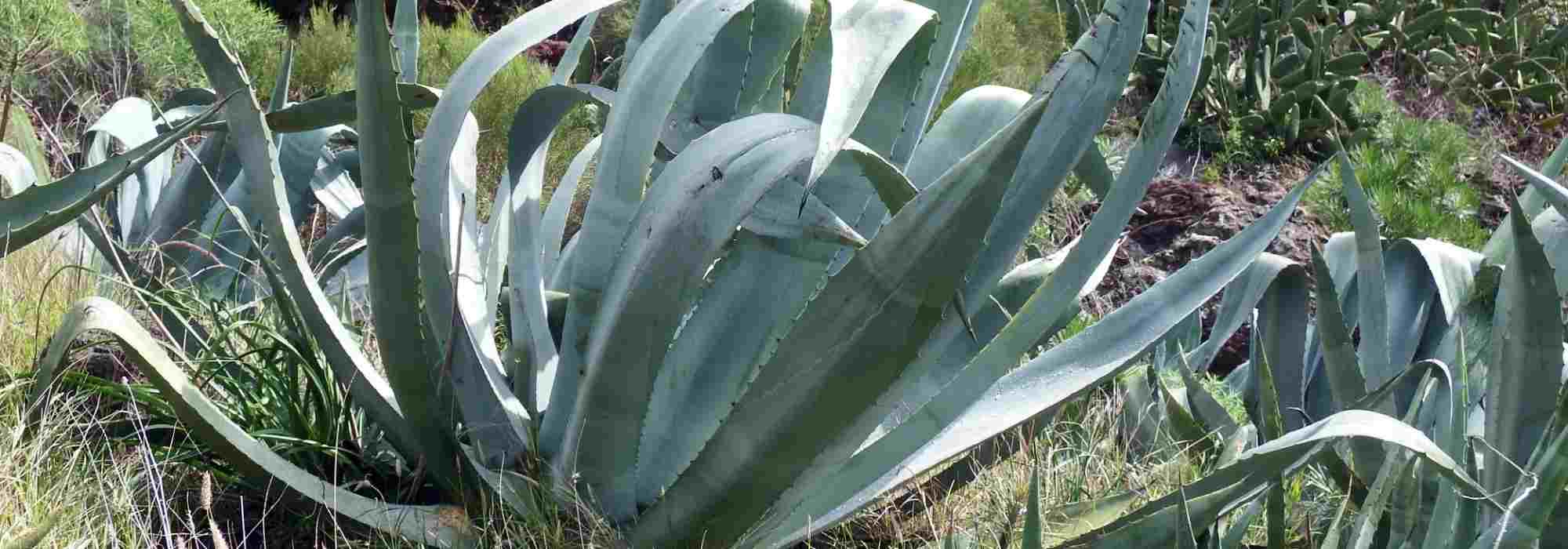
Agave is a stunning fleshy plant from arid climates, thriving in sunny, well-drained, and poor soils where it can be hardy down to around -10 °C.
The most commonly cultivated is the Agave americana or American Agave. It develops a rosette of blue-green fleshy leaves, sometimes variegated (like Agave americana ‘Variegata’). The rosette can reach 1 m in all directions, but the flower spike can soar to 8 m in height. Unfortunately, as the plant is semelparous, it dies after flowering. However, there’s no need to worry, as many offsets appear on the stump.
Other, even hardier but more compact agaves can be grown in the garden: Agave montana, Agave neomexicana, Agave havardiana, Agave stricta ‘Nana’, and Agave ovatifolia. All require the same growing conditions as Agave americana.
Nota bene: the tips of the leaves and their margins are armed with large thorns. Care should be taken, especially with young children and pets.
→ To learn more, read Agave: planting, growing, and maintaining and agaves: the hardiest varieties
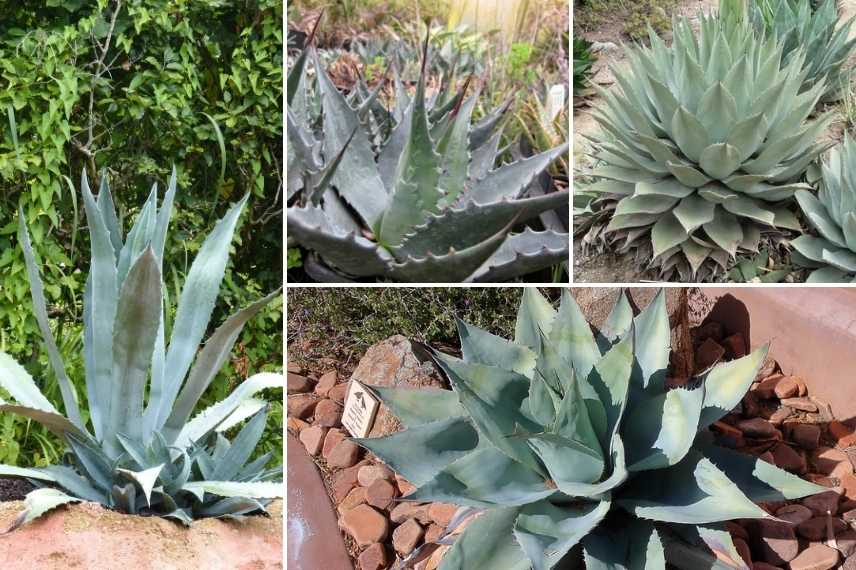
Agave americana on the left. Top left: Agave montana (© Megan Hansen), Agave havardiana, and bottom right Agave ovatifolia ‘Wave Tongue’ (© Cultivar 413)
Delosperma
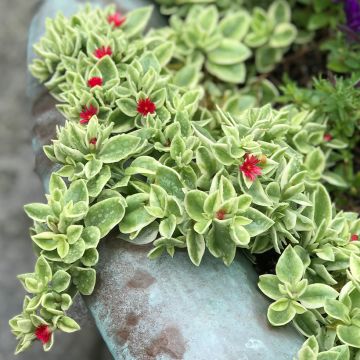
The Delosperma, or hardy perennial purslane, is a groundcover young plant that is still too little known. However, this plant is full of qualities: a long, vibrant flowering from June to autumn, vigorous growth, and an ability to establish itself easily. This perennial requires no maintenance and proves to be an excellent alternative to lawn in neglected and ungrateful corners of the garden.
The most common species is Delosperma cooperi: it comes in stunning cultivars of various colours (pink, mauve, yellow, orange…) and in new must-have varieties like Delosperma ‘Wheels Of Wonders’.
Delosperma thrives in full sun, in dry and very well-drained soil. It is a delightful plant to grow in rockeries, dry banks, above walls, in pots, and hanging baskets. Semi-hardy, it typically withstands temperatures down to -8 °C. If you are in a region with harsher winters, it is better to grow it in a pot and bring it indoors during frost.
Nota bene: do not plant Delosperma cooperi near a natural habitat in Mediterranean areas! The plant could “escape” the garden and become problematic for local flora.
→To learn more, read Delosperma, hardy perennial purslane: plant and grow.
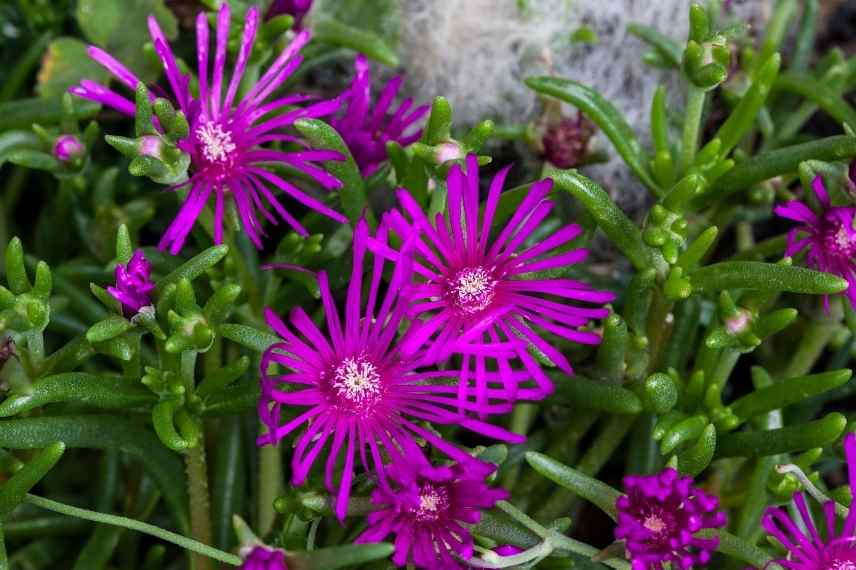
Delosperma cooperi
A crassula for outdoors
Crassulas, or Jade Plants, are well-known as houseplants, such as Crassula radicans or Crassula ovata. However, there is a species in the Crassula genus that is surprisingly hardy: Crassula sarcocaulis, or the Fleshy-stemmed Crassula.
This crassula, native to South Africa, forms a small ramified shrub (30 cm in all directions) with thick stems. The foliage resembles small apple-green needles. The plant produces a profusion of small pinkish-red flowers from May to September. Crassula sarcocaulis requires poor, dry, and very well-drained soil. If you provide this, its hardiness can be astonishing, reaching down to at least -12 °C.
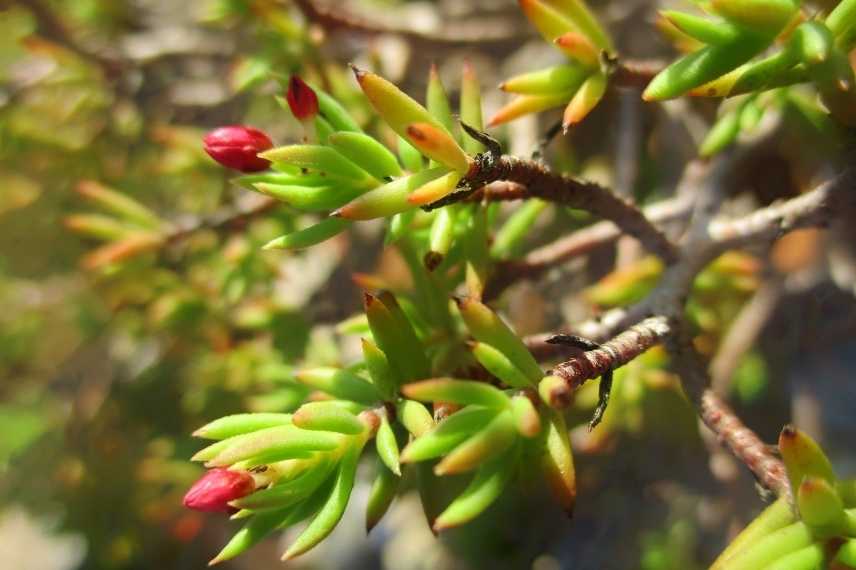
Crassula sarcocaulis
- Subscribe!
- Contents
Comments