


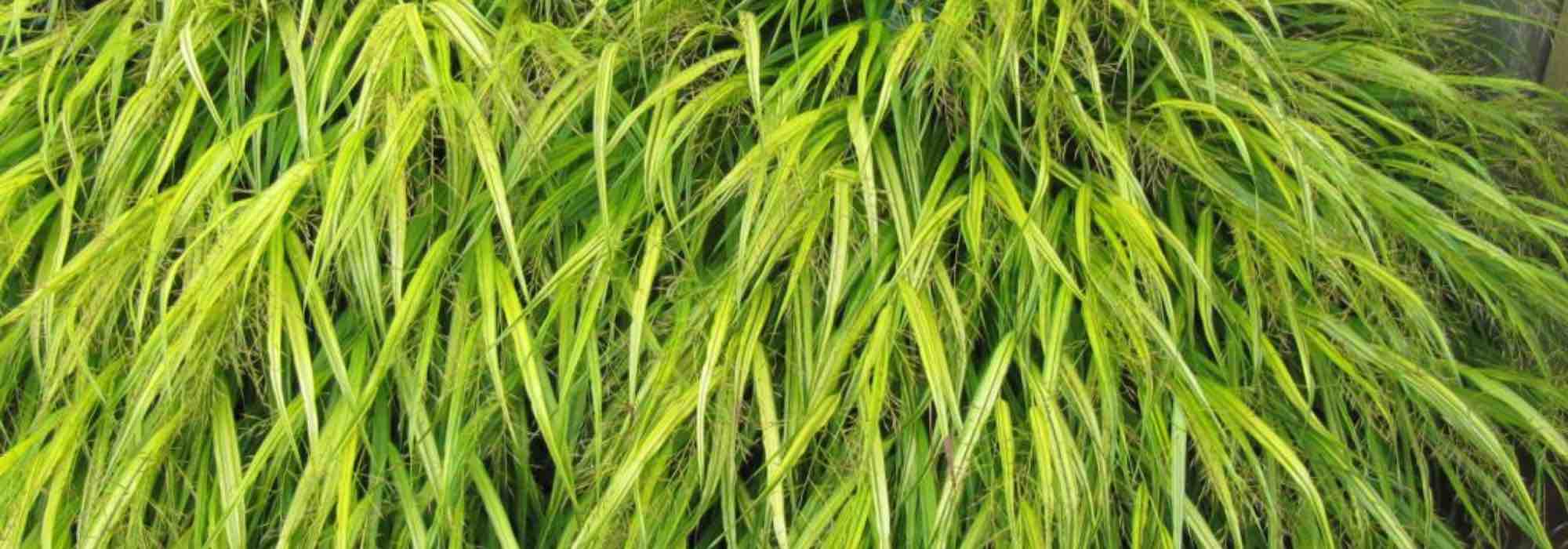
7 ornamental grasses with golden-yellow foliage
Ornamental plants ideal to brighten up gardens, patios or balconies
Contents
Grasses are particularly decorative plants, useful for bringing lightness and structure to all types of gardens. They also lend themselves very well to pot culture, for easy greening of a terrace, a balcony or an inner courtyard.
There is a wide diversity : they are distinguished by their silhouette, their size, their flowering and their foliage. The leaf colours range from the traditional green to dark purple, passing through vibrant or variegated colours. Golden-yellow is one of the brightest colours among grasses. It adds a touch of brightness, sometimes even playing with the sun’s reflections. This colour provides an interesting focal point. It contrasts with the classic green and pairs well with other cooler shades (reds, blues, dark tones…), which it highlights nicely.
Discover our selection of 7 golden-yellow‑leaved grasses.

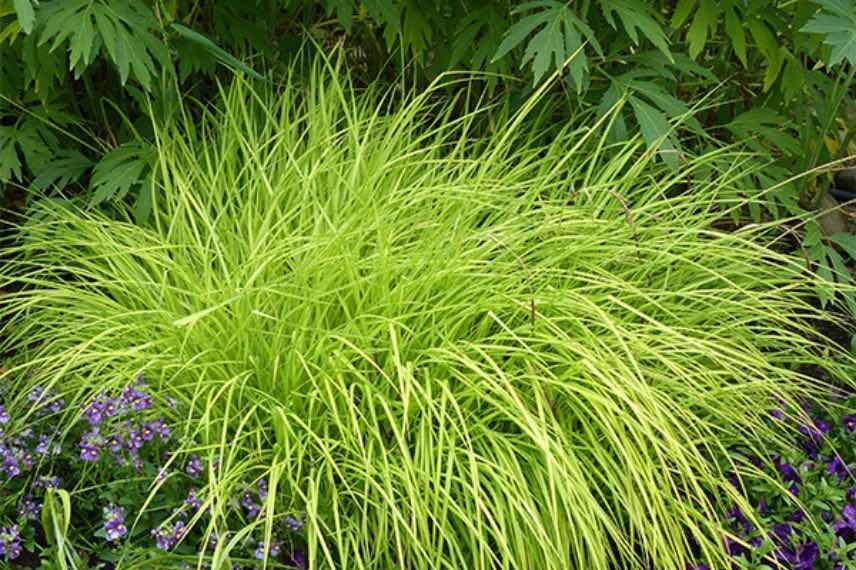
Carex elata ‘Aurea’: golden foliage for moist soils
Carex are among these perennial grasses that offer a beautiful range of colours. Their compact habit allows them to blend in anywhere and with all garden styles, from the most modern to the wildest.
The golden sedge ‘Aurea’ has slender foliage, distinguished by its sunny, glossy colouring. The more sun this grass receives, the stronger its golden reflections will be emphasised, forming a true ball of light in the garden or in a pot. Its habit is supple, airy and slightly arching. It will gradually form a small, rounded tussock about 70 cm tall by 40 cm wide.
In late spring, this Carex flowers, revealing discreet brown spikes, which are then followed by small fruits.
If the foliage dies back in winter, the plant is hardy (down to -29°C) and will re-emerge in spring.
This native plant is found in many regions of France. It often provides shelter for surrounding aquatic wildlife. Being virtually maintenance-free, ‘Aurea’ will mainly require damp, even marshy soil. This variety makes a perfect candidate for the margins of water features such as ponds, rivers, lakes or pools, where it will bring a touch of light and airiness. It can even be permanently submerged, up to 10 cm. Plant it alongside other perennials that enjoy water’s edges, such as horsetails or the hostas.
For more information: Carex: planting, dividing and maintenance
Read also
7 blue grassesAcorus gramineus 'Ogon': very bright variegated foliage
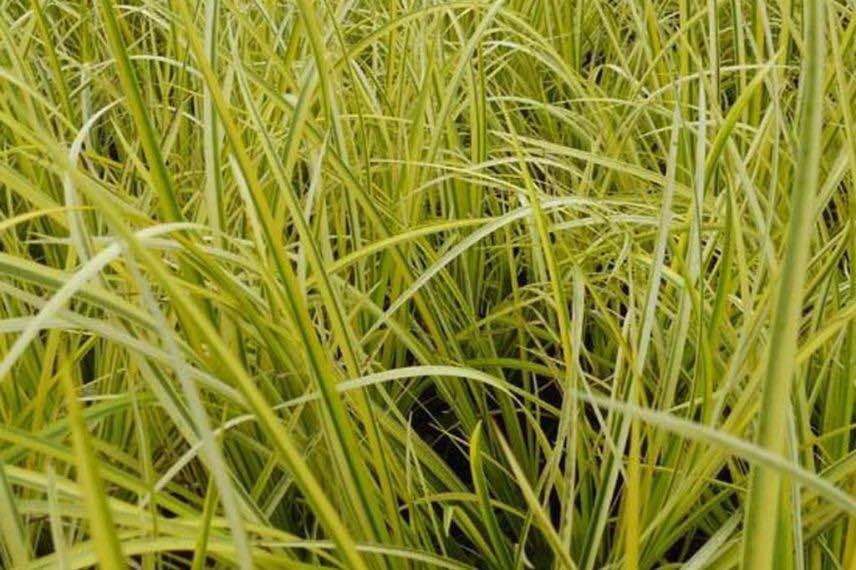
Acorus are semi-emersed aquatic perennials, ideal for adding a touch of graphic impact and volume along the banks.
The Acorus gramineus‘Ogon’ or variegated Japanese sweet flag has the advantage of displaying semi-evergreen foliage, bright in all seasons in regions with mild winters (its hardiness is limited to -12°C). It consists of slender variegated leaves, green striped with golden yellow and cream. ‘Ogon’ forms a dense, compact little mound of about 40 cm in height with a 30 cm spread.
Early-summer flowering is fairly inconspicuous, discreetly revealing small greenish flowers.
Easy to grow, this grass will provide a bright focal point along damp or marshy margins, in heavy soils. It can also be grown in pots, tubs or troughs, provided it remains continually submerged in water. Install this Acorus in full sun or partial shade.
For more information: Acorus, Acorus gramineus and calamus: plant, grow and maintain
Hakonechloa macra ‘All Gold’: brighten shaded areas
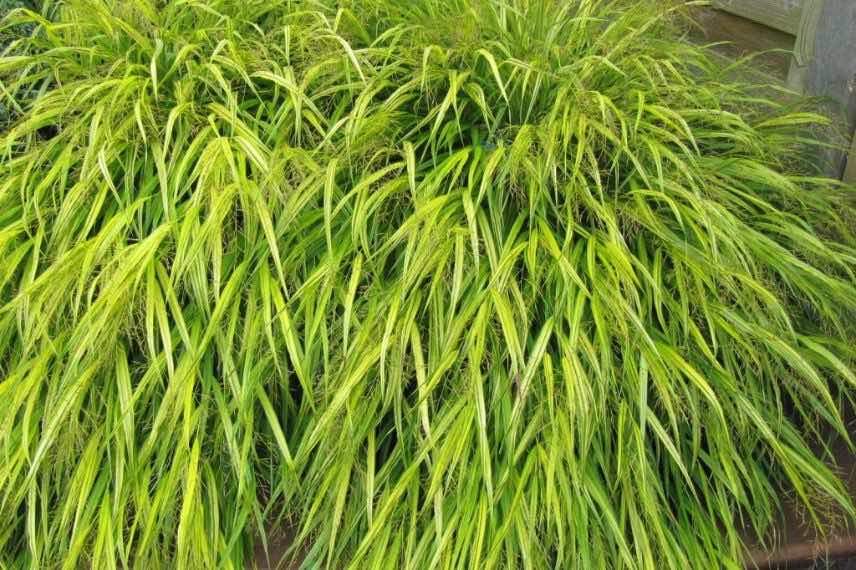
The Japanese herb (Hakonechloa macra) ‘All Gold’ is a graceful, cascading perennial grass, which drapes softly. Over time it forms a true cushion of foliage. This variety is notable for its particularly bright foliage, a uniform golden-yellow that lasts for many months, from spring through to autumn. It helps brighten and warm borders on moist soil, light woodland or any other shaded areas of the garden. Note that in too shady exposures, the foliage will tend to green. The lanceolate leaves are thicker than those of other grasses, which gives them as much bulk as light.
Late-summer flowering consists of slender spikelets, which easily go unnoticed.
This easy-to-grow grass will reach 40 cm in all directions at maturity. It enjoys fairly mild and humid climates of western France, but is nonetheless hardy down to -15°C. It will pair wonderfully with bamboos, for a Japanese touch.
For more information: Hakonechloa, Japanese herb: planting, cultivation, care
Read also
5 grasses with variegated foliagePennisetum alopecuroides 'Hameln Gold': a small ball of golden light
Pennisetum grasses are valued for their ornamental qualities. They are admired for their airy, architectural foliage as well as their charming bottlebrush-like flowering with a velvety appearance.
The golden bottlebrush grass (Pennisetum alopecuroides ‘Hameln Gold’), its slender leaves display a lemon-yellow to golden colour, particularly warm, which will inevitably catch the eye. Plant it among plants with foliage more traditional to showcase it to best effect. In autumn, the colour will shift to warmer orange tones, in harmony with the season. Its foliage is marcescent, i.e., it dries off during the cold season but remains in place, which makes it ornamental virtually year-round.
‘Hameln Gold’ offers a compact, arching silhouette, reaching 40 cm in height with a 30 cm spread. In summer, this Pennisetum produces plump, silky bottlebrush plumes, brown-toned, leaning toward bronze and cream.
Hardy and easy to grow, it will not require maintenance once established. Give it a sunny position, even if exposed to sea spray and occasional drought. This grass is an ideal choice for coastal gardens, to be grown in borders, rock gardens or containers.
For more information: Pennisetum – Bottlebrush grass: planting, pruning, maintenance
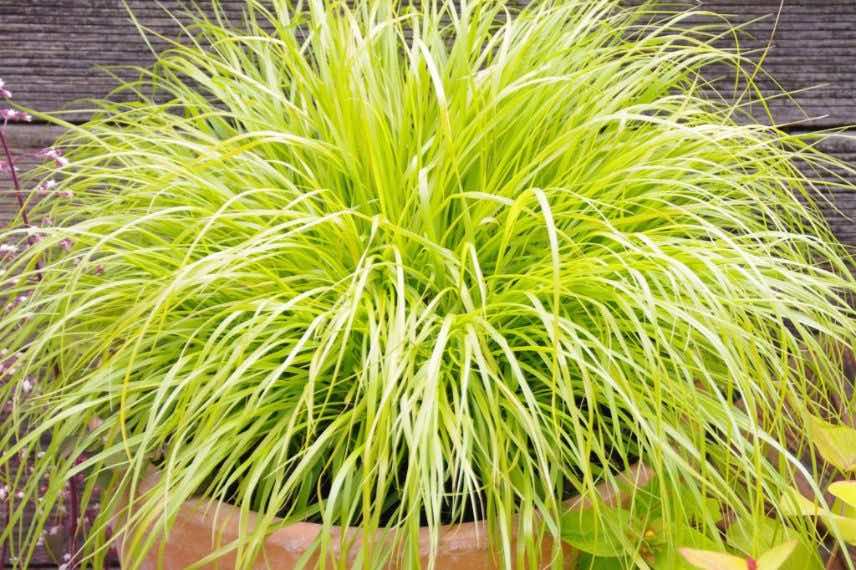
Bromus inermis 'Skinner's Gold': variegated golden foliage
‘Skinner’s Gold’ is a bromus grass variety that offers golden foliage variegated with dark green. It forms a tuft of linear, flat foliage from which feathery, spike-like inflorescences rise in summer. Their green colouring is tinged with bronze and purple, carried by yellow stems that further enhance the brightness of this charming grass.
This bromus will reach at least 60–80 cm in height with a 50 cm spread, developing via creeping rhizomes. While this plant is not particularly invasive, you may prefer to grow it in a pot.
Hardy and undemanding, ‘Skinner’s Gold’ will thrive in both heavy and light soils, even poor and calcareous ones. In terms of exposure, it will tolerate sun or partial shade, but will prefer soil that remains cool to keep its attractive foliage. This perennial will pair beautifully with blue-flowering shrubs (Ceanothus, Chaste Tree, Blue Spirea…), to create a striking contrast with its golden and green foliage.
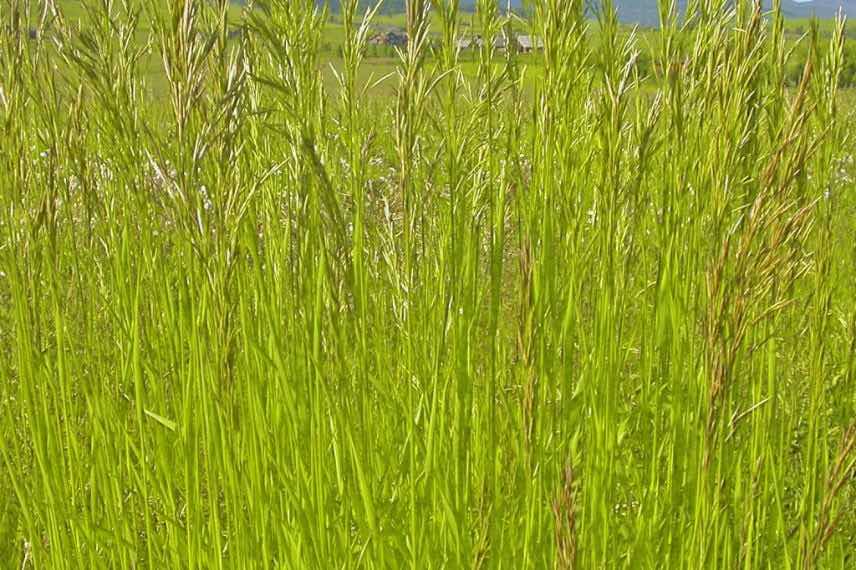
Luzula sylvatica 'Solar Flare': a sun-loving groundcover for shaded areas
Woodrush Luzula sylvatica ‘Solar Flare’ has an evocative name, as it means ‘solar flare’. Its foliage is very bright, consisting of broad linear leaves in a lovely green-gold colour. To top it off, it is evergreen, which makes it ornamental even in winter, when the garden often lacks colour and brightness. The contrast is all the more striking as this perennial thrives in partial shade or shade, which it will undoubtedly enliven with its colour. In terms of habit, this groundcover will reach around 50 cm in height and will widen as the years go by.
In spring, our woodrush reveals small orange spikelets, which add an extra touch of warmth.
Hardy and robust, this perennial will thrive in fairly cool soil, in a partially shaded position. It is ideal for dressing the base of deciduous trees or shrubs which will take on lovely autumn colours, contrasting wonderfully with its foliage. In our country, it is not uncommon to come across woodrushes in woodland understoreys.
To know more: Woodrush: planting, cultivation and care
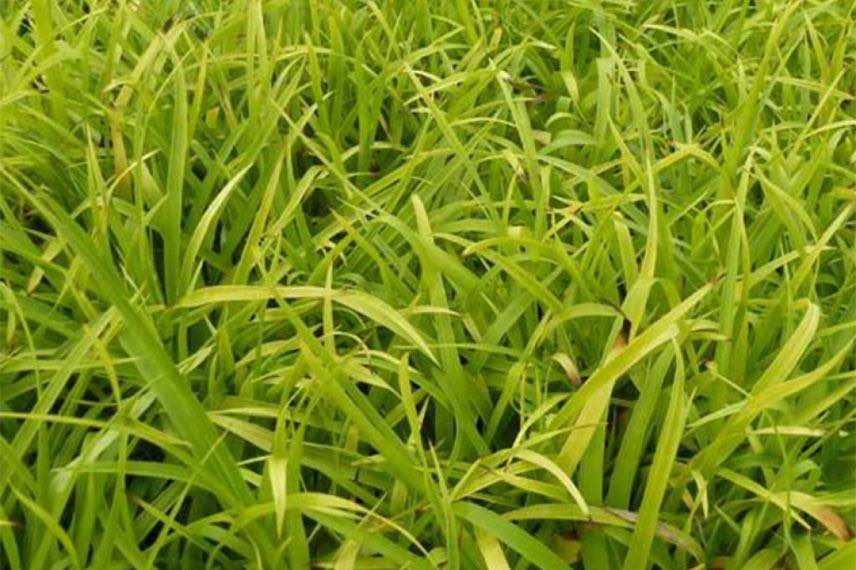
Alopecurus pratensis 'Aureovariegatus': decorative foliage and flowering
Alopecurus is one of those grasses with light, bright foliage, but it also has the advantage of an ornamental flowering display. The variety ‘Aureovariegatus’ unfolds in the heart of spring and into early summer, producing fluffy spikes from pale green to mauve. These inflorescences have earned the plant its nicknames ‘fox-tail’ or ‘rat-tail’.
But it is mainly for its bright foliage that this variety is of interest here, with its variegated colouring of green and gold. The clump is made up of fine, graphic and airy leaves, all in elegant form. It will reach a height of 60 cm with a spread of 30 cm at maturity.
This wild plant is frequently found in meadows. It will bring a countryside touch to a border exposed to sun or partial shade. It will also help delineate a border. Plant it in fairly rich, moist soil. Very hardy (down to -29°C), it will thrive in all our regions.
For more information: Alopecurus: planting, cultivation, maintenance
- Subscribe!
- Contents
Comments