





























7 superb Cimicifuga varieties to discover
Elegance in the shaded garden
Contents
Discover the best varieties of Cimicifuga, also known as Actaea, this woodland perennial that lights up shaded gardens with its airy flowering in feathery spikes, borne on tall flowering stems, and its elegant foliage. Its flowers are often likened to silver candles, hence its common name; they rise above foliage that is deeply lobed and sometimes tinged with purple. Cimicifugas, hardy and robust, offer unique beauty and thrive in partly shaded to shaded areas of the garden, bringing colour and structure where other plants might struggle. Used as a solitary specimen or in groups to create a mass effect, Cimicifugas add a refined vertical dimension to the garden or in pots. In this article, let’s explore some of the most remarkable varieties or species.

Cimicifuga racemosa
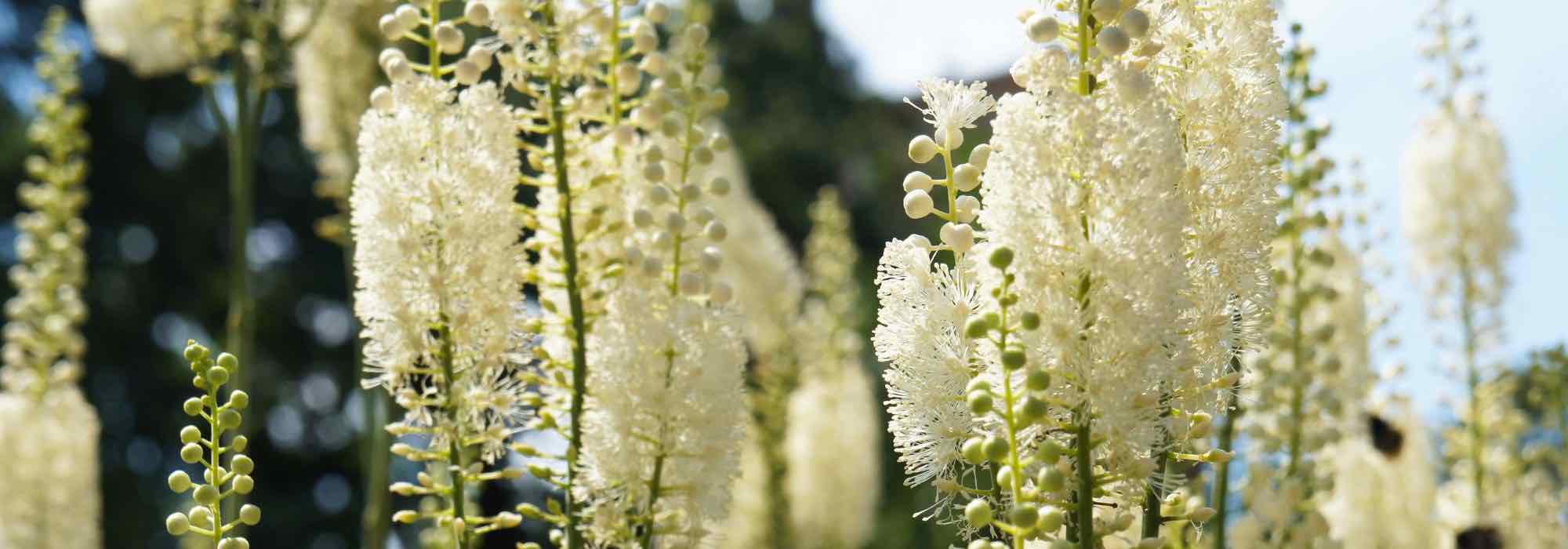
Actaea racemosa, or Cimicifuga racemosa, known as black cohosh, native to North America, is the most widely grown species in gardens. It is among the most drought-tolerant actaeas and is notable for its considerable height, reaching up to 2 m when in bloom, and its bright green foliage. Its white flowers in spikes appear from July to August.
Cimicifuga racemosa is characterised by dense, light foliage reminiscent of giant Astilbe; it really takes off toward the end of summer with its tall, graceful pale inflorescences, which resemble silver candles. This hardy plant, which particularly enjoys bright woodland conditions, slowly forms bushy clumps, with a minimum spread of 70 cm. The large compound leaves, deeply divided, can reach up to 50 cm in length and emit a notable fragrance when crushed.
Less densely stemmed than other varieties, black cohosh displays in July spectacular white spikes, upright or arching, formed of small flowers with a distinctive and memorable fragrance. Although its scent is not to everyone’s taste, it is highly valued by pollinators for its abundant nectar.
At the back of the border, in semi-shaded areas such as the edges or light woodland, black cohosh forms a striking graphic backdrop, particularly toward the end of summer when other perennials begin to fade. Its foliage harmonises well with pink and blue asters.
Cimicifuga atropurpurea 'Brunette'
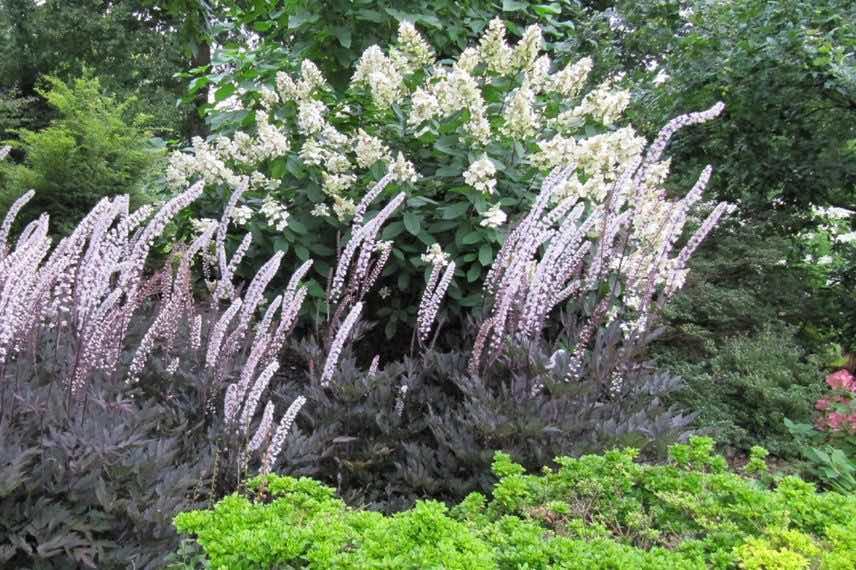
The Cimicifuga atropurpurea or Actaea simplex ‘Brunette’, is a well-known cultivar prized for its palmately-compound foliage in a very dark brown-purple shade, nearly black, which forms clumps of leaves measuring 30 to 75 cm across. The type species is native to the temperate forests of Asia. This plant follows a deciduous growth cycle, emerging in spring and dying back in autumn.
Its star-shaped pale pink flowers are grouped into cylindrical spikes 10 to 20 cm long, arching gracefully. Flowering late in the season, from August–September to October, Actaea ‘Brunette’ is notable for its enchanting vanilla fragrance and attracts butterflies.
It reaches a height of 1.2 m in full bloom.
This plant integrates perfectly into partially shaded borders, in borders, woodland margins, or even as a specimen. For a harmonious garden, pair it with blue hostas, Astilbes, pink masterworts and Corydalis.
Also consider the varieties Actaea simplex ‘Carbonella’ or Actaea simplex ‘Chocoholic’, newer selections, for an even more compact habit and increased floribundity.
Cimicifuga 'James Compton'
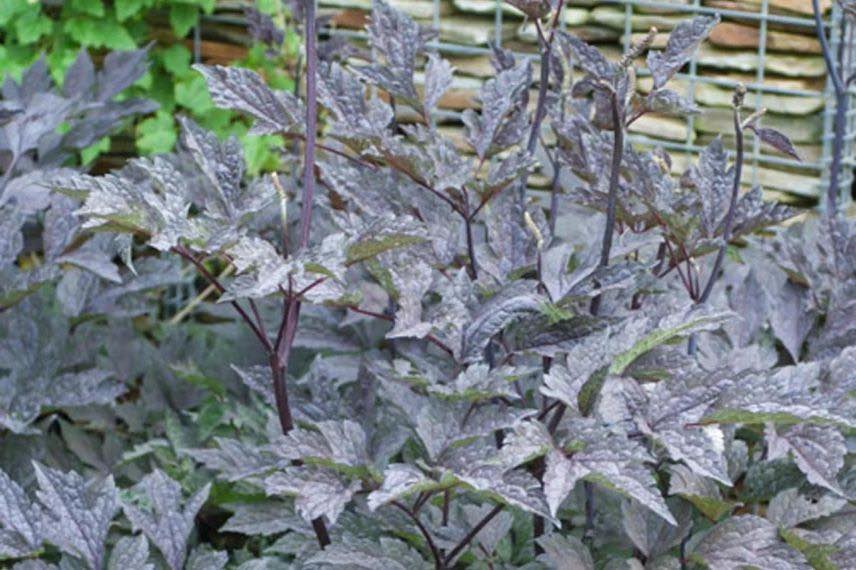
Actaea simplex ‘James Compton’ stands out for its compact size, perfectly suited to small gardens. It features glossy, deeply lobed leaves, displaying a purple-violaceous to almost black tint. In late summer or autumn, it produces slender, flexible spikes, topped with pink buds that open into intensely scented white-pink flowers, bringing lightness and verticality to the garden when other blooms are scarce. Very similar to the cultivar ‘Brunette’, it is nevertheless more compact and offers even more fragrant spikes.
‘James Compton’, with slow development from a nodose rootstock, forms mounding clumps reaching 90 cm in height with a spread of 50 cm. Its large dentate leaves emerge green in spring and turn violet-purple as the sun hits them, creating the illusion of almost-black foliage. The terminal spikes appear towards the end of the season, attracting butterflies in abundance with their nectar and vanilla-scented fragrance.
Ideal for partially shaded spots, Actaea ‘James Compton’, like all Cimicifugas, appreciates cool, deep soils. Its architectural silhouette and vibrant flowers make it an excellent choice for a shaded border, its dark foliage harmonising with the vibrant colours of asters and hardy fuchsias.
Actaea pachypoda 'Misty Blue'
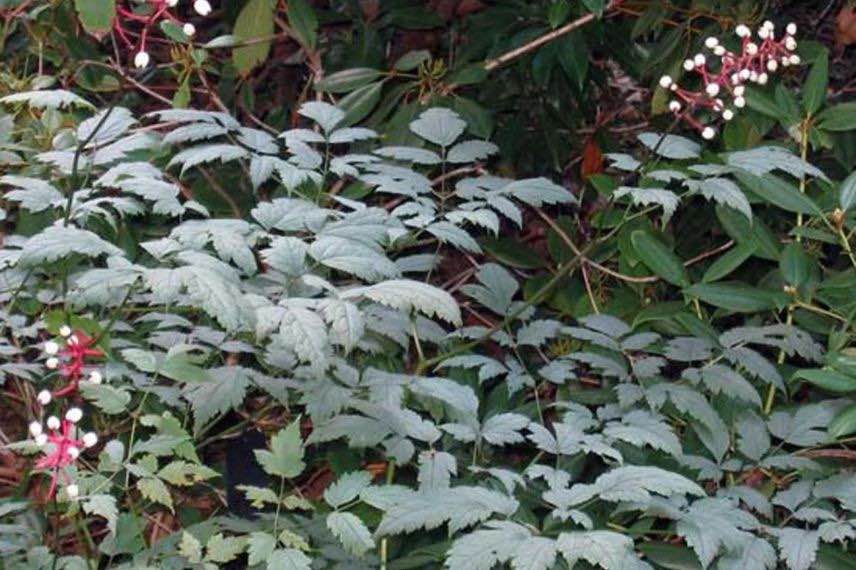
The Actaea pachypoda ‘Misty Blue’ is a distinctive variety, little-known, yet with decorative qualities. The species is native to eastern North America. ‘Misty Blue’ develops compound leaves, divided into ovate, dentate leaflets, which initially take on a powdery blue tint in spring, with a frosted appearance, before turning bluish-green.
From May onwards, it is adorned with charming pom-poms of small white star-shaped flowers, which are then followed by white berries borne on large red pedicels. These bright fruits, though toxic to humans, are greatly appreciated by birds and contribute to the biodiversity of the shaded woodland understory.
Although it thrives in cool, humus-rich soils enriched by leaf litter, it tolerates also slightly dry soils. Actaea ‘Misty Blue’ slowly flourishes, forming dense clumps that become particularly imposing and long-lasting with time.
This Actaea pairs harmoniously with plants such as ferns and Hakonechloa.
Cimicifuga dahurica
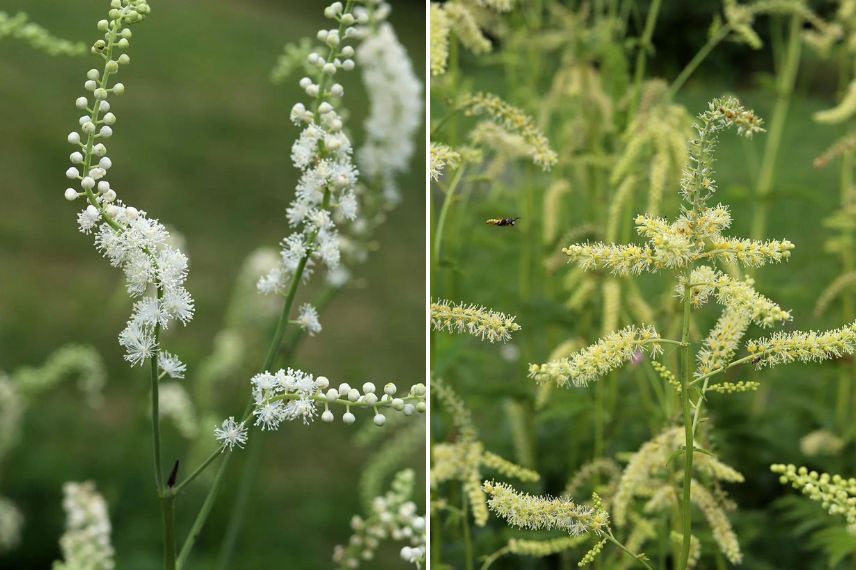
Actaea dahurica, also called Cicimifuga dahurica, is a rare plant species with a majestic habit, native to temperate regions of Asia such as Korea, Mongolia, Siberia and northern China. Its lush foliage resembles that of a giant astilbe, with its large triangular leaves divided into three dentate lobes. In a deep green, sometimes tinged with purplish-grey, it forms a striking contrast with the tall spikes of cream-coloured flowers that bloom in late summer. These branched inflorescences, highly melliferous and nectariferous, can reach up to 2 metres in height, for a remarkable visual display, though their fragrance is not to everyone’s taste.
Actaea dahurica is ideal for partly shaded locations where it thrives in moist but well-drained soil. Resistant to competition from surrounding roots, it adapts well to the back of borders, where it provides an impressive graphic backdrop to highlight perennials that have ceased flowering earlier in the season. Its association with plants with dark foliage, such as conifers, holly or Osmanthus, enhances the brilliance of its white flowers.
For a harmonious integration into more structured gardens or even pots on a terrace, Actaea dahurica can also be paired with hardy geraniums for partial shade, such as Geranium nodosum, G. cantabrigiense, or G. macrorrhizum.
Cimicifuga japonica 'Cheju-Do'
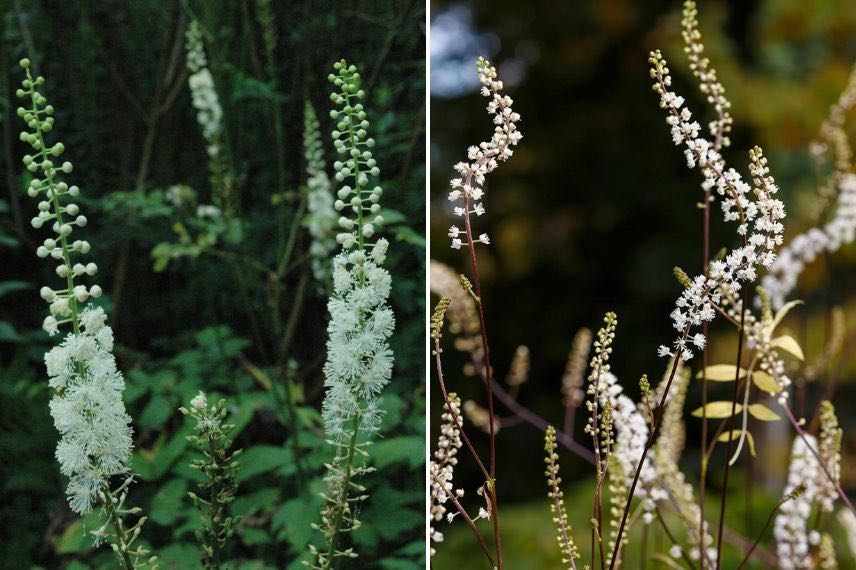
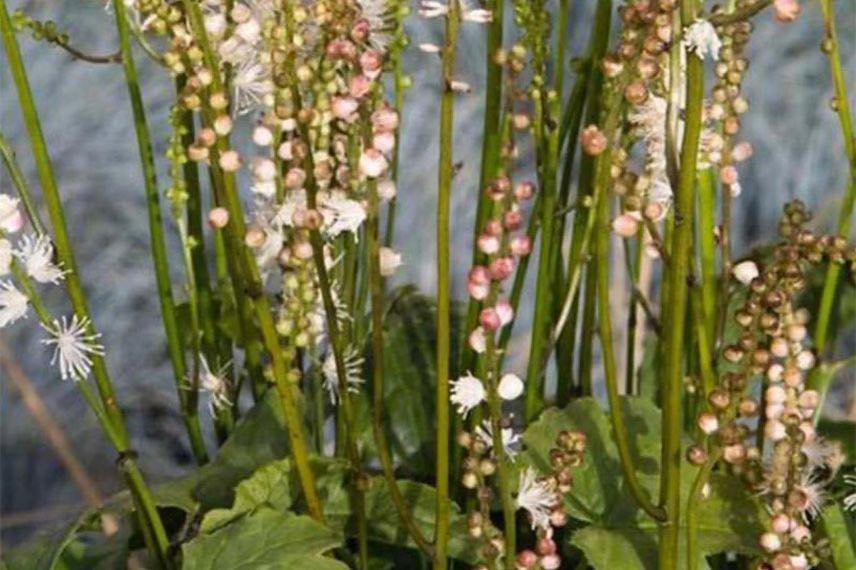
Actaea, or Cimicifuga japonica ‘Cheju-Do’, is a variety originating from Jeju Island off the southern coast of South Korea. Compact and resistant to leaf spots, it captivates with its spring foliage of purple-tinged young shoots that develop into lobed leaves with silvery reflections. It flowers in late summer with long pale cream spikes that are slightly scented.
‘Cheju-Do’ forms dense clumps that reach 80 cm in height when in bloom, 30 cm for the foliage, with a minimum spread of 50 cm.
Its basal leaves, long-petiolate and rounded, are divided into three dentate lobes, a light green, slightly greyish, glossy colour with tin reflections, dulling somewhat as the season progresses. In September and October, it bears 12 to 15 terminal inflorescences, very airy spikes, whose pink buds open into pale cream flowers. Their fragrance, though not appreciated by all, attracts pollinating insects.
Preferring partial shade and rich, moist soil, Actaea ‘Cheju-Do’ can also thrive on the very damp margins of ponds. In borders, its architectural form and foliage perfectly complement those of hostas and heucheras, while its bright flowers harmonise with Japanese anemones.
Cimicifuga 'Queen of Sheba'
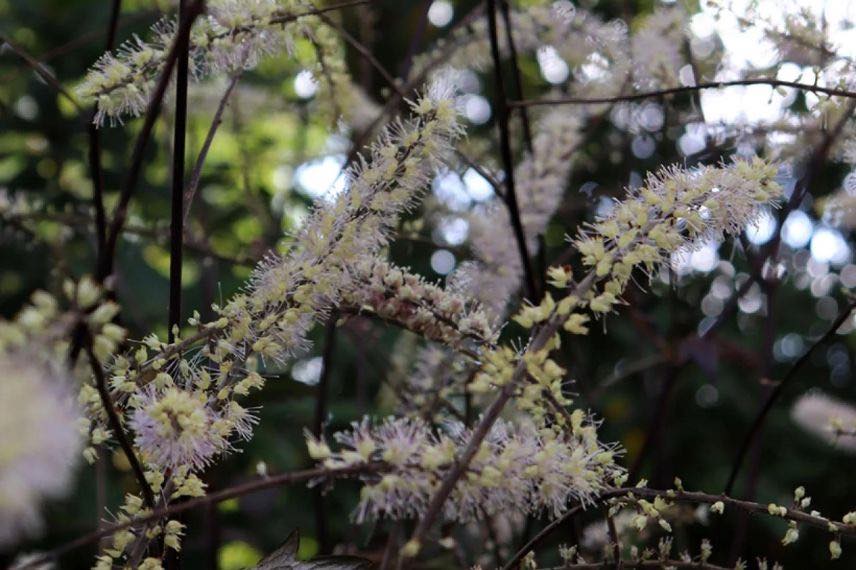
Actaea ‘Queen of Sheba’, created by Piet Oudolf, the renowned landscape designer of naturalistic gardens, is an exceptional hybrid variety that combines robustness and aesthetics. In spring, it unfurls deeply cut purple foliage that turns olive green with time. This plant is notable for its extremely late flowering, with long flower spikes on arching stems, releasing a captivating fragrance. More resistant to summer heat than other Cimicifuga varieties, it adapts well to partial shade and cool soils.
Derived from a cross between the Asian Actaea simplex and the American Actaea racemosa, ‘Queen of Sheba’ displays a bushy habit. Its leaves, which can reach 30–60 cm in length, start purple and then transition to olive-green depending on light exposure. This perennial can reach up to 2 metres in height when flowering, with a spread exceeding a metre. Its flowering spikes terminate in white inflorescences with pink reflections, highly attractive to butterflies, and not always in bloom until October. After flowering, the plant bears brown fruits on red stems that persist until the end of winter.
‘Queen of Sheba’ pairs with other large perennials such as Astilboides tabularis, Persicaria amplexicaulis and Rodgersias, to create a lush and diverse woodland planting.
- Subscribe!
- Contents
Comments