





























Alternative to lawn: how to plant Lippia nodiflora?
For a sustainable and low-maintenance lawn alternative
Contents
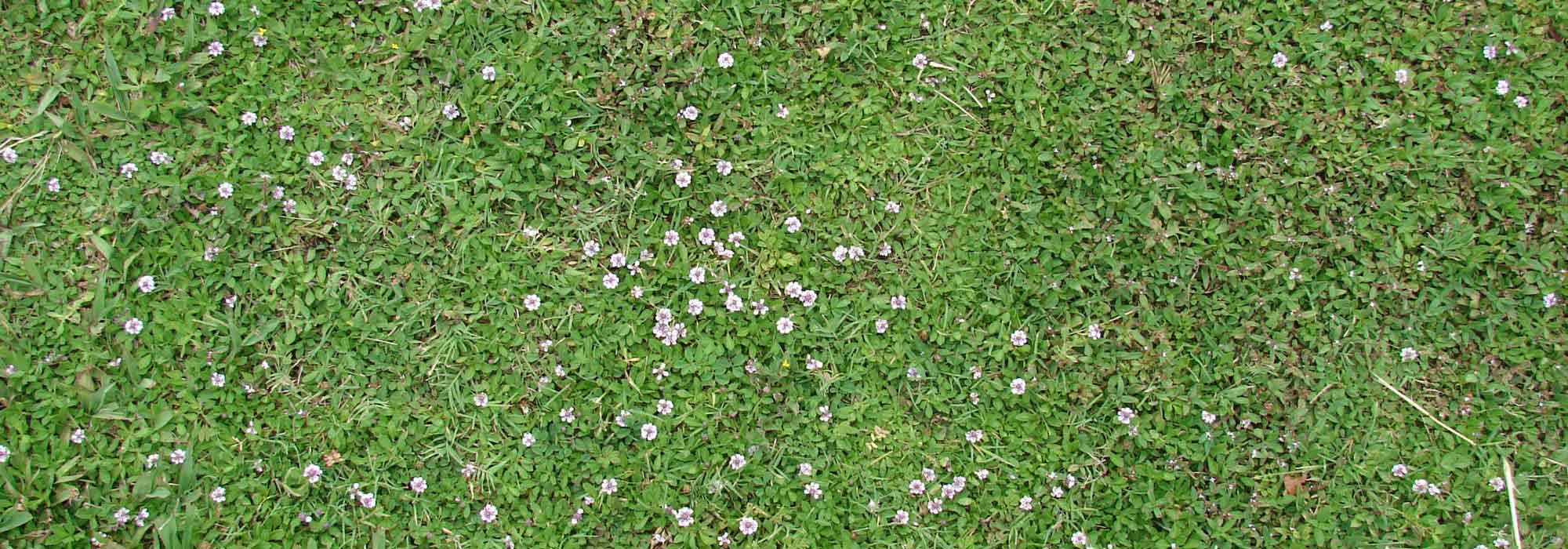
Lawn can be a practical choice for a green garden, but it can also be tedious to maintain and consume a lot of water. If you are looking for a more sustainable alternative that is easy to manage, Lippia nodiflora – or Phyla nodiflora – is an excellent option. This plant can be used to replace your lawn and create an alternative lawn that does not require as much watering and mowing. Additionally, Lippia nodiflora offers numerous benefits in terms of biodiversity and erosion control. In this article, we will explain how to plant and care for Lippia nodiflora to replace your lawn.

What is Lippia or Phyla nodiflora?
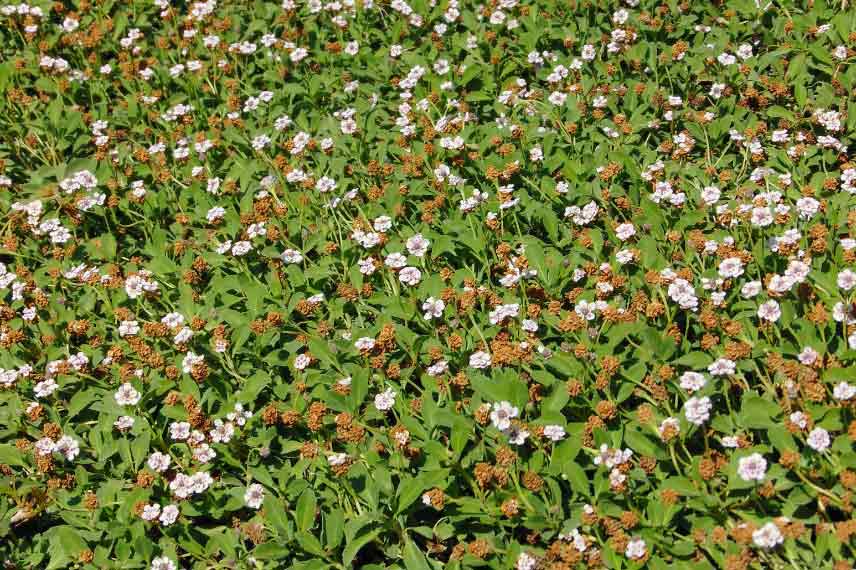
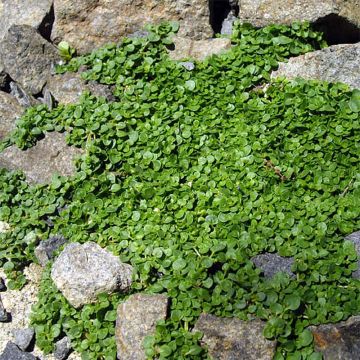
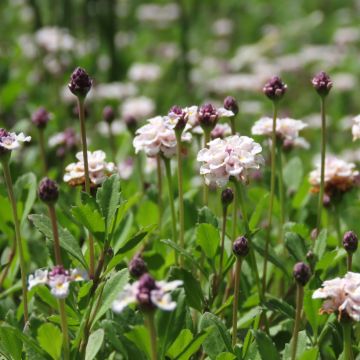
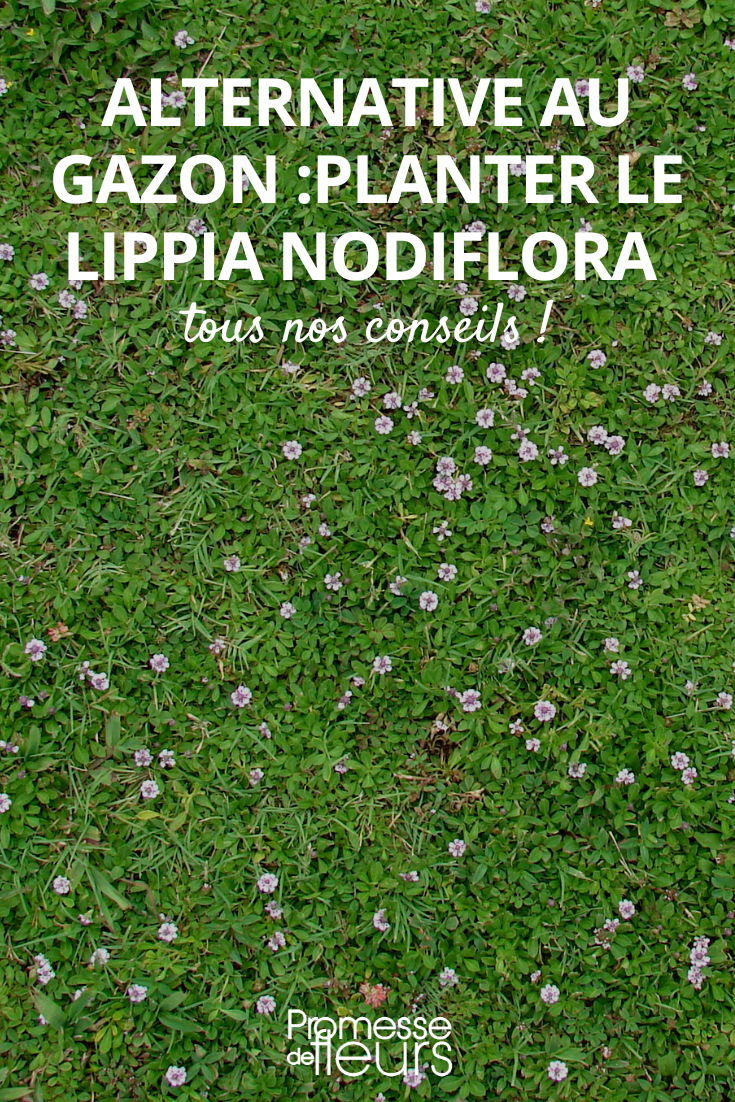
Small perennial groundcover that quickly forms vast, low, semi-evergreen mats in winter, Lippia or Phyla nodiflora boasts beautiful, vibrant green foliage. In spring, countless pale pink flowers appear, intensely foraged by bees as they are highly melliferous. Starting in May-June, this flowering can sometimes continue throughout summer if the soil remains slightly moist. These small flowers are grouped in clusters of 1 to 3 cm in diameter, borne on very short stems just above the foliage. It is a close relative of verbena, sharing its classification in the verbena family.
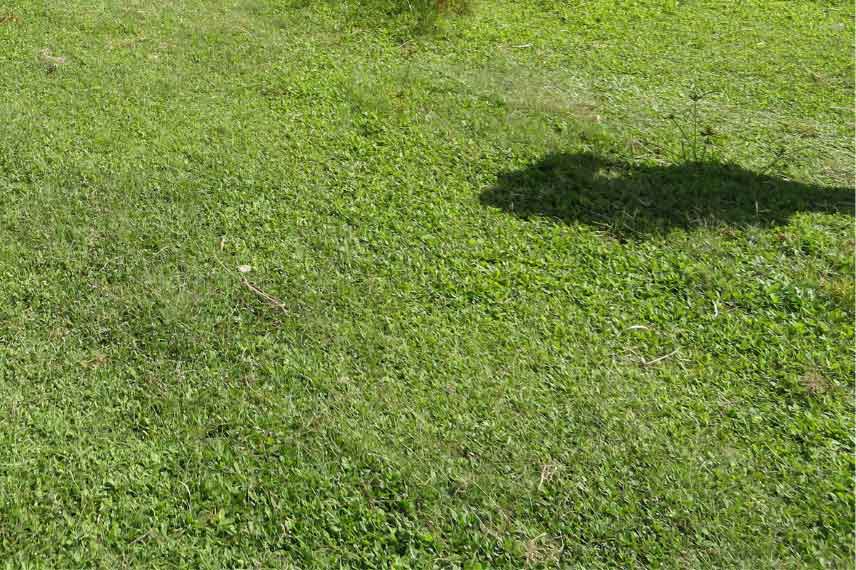
Truly low-maintenance but moderately hardy (-10 to -12 °C), this groundcover thrives in both full sun and partial shade. It is one of the best alternatives to lawn in dry soils, even in trampled areas: through its stems that root upon contact with the soil, Phyla quickly forms extensive, very low (between 1 and 5 cm in height) and dense carpets, more or less evergreen in winter depending on the climate.
This plant tolerates complete drought well, but it will be more lush and floriferous with watering every 15 days in summer if it is very dry and hot.
You can optionally mow the carpet once a year, after flowering or during it if the presence of bees is bothersome, for example, in children’s play areas or near the swimming pool.
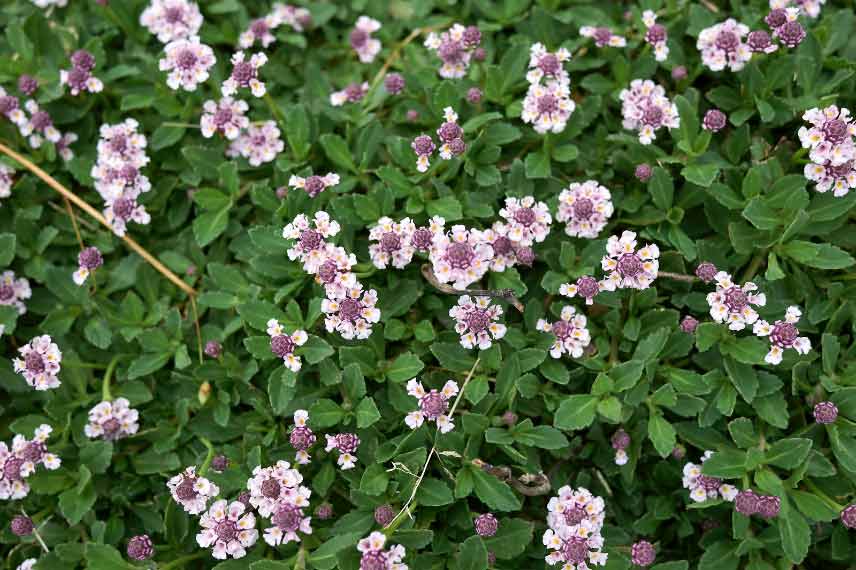
Note: Lippia nodiflora can be considered invasive. This plant can spread rapidly through its seeds and stolons and may become difficult to control. In some regions, it can cause problems by competing with local plant species. It is therefore important to monitor its growth, especially near natural areas, and to control it if necessary to prevent its negative effects from outweighing the benefits provided by the plant.
Why choose Lippia as an alternative to lawn?
Lippia can be chosen as an alternative to lawn for several reasons:
- It is highly drought-resistant and requires much less water than lawn
- Naturally very low, Lippia does not need to be mowed regularly, which reduces maintenance time and costs
- It withstands foot traffic well
- It adds a touch of greenery to outdoor spaces, while having a different appearance from traditional lawn, with its lovely white-pink flowering
- Highly melliferous, Lippia is beneficial to biodiversity
- Not demanding regarding soil type, it tolerates limestone as well as sea spray.
It is important to note that Lippia may not be suitable for all regions due to its hardiness limited to -10 to -12 °C.
Discover other Alternatives to lawn
View all →
Available in 2 sizes
Available in 0 sizes
Available in 2 sizes
Available in 1 sizes
Available in 1 sizes
Available in 1 sizes
Available in 2 sizes
Available in 2 sizes
Available in 1 sizes
Available in 2 sizes
On which surfaces can Lippia be used to replace lawn?
There is theoretically no limit to planting Lippia. The only constraints may be the cost, the labour required for installation, and the growth time.
One young plant occupies a surface area of 1 m², or even more, with stems rooting at each node upon contact with the soil, colonising all available space. It can be considered that 4 young plants per m² are sufficient to cover the ground in a year, while 8 or 9 can reduce the time to just a few months. Therefore, it can theoretically be used for large areas.
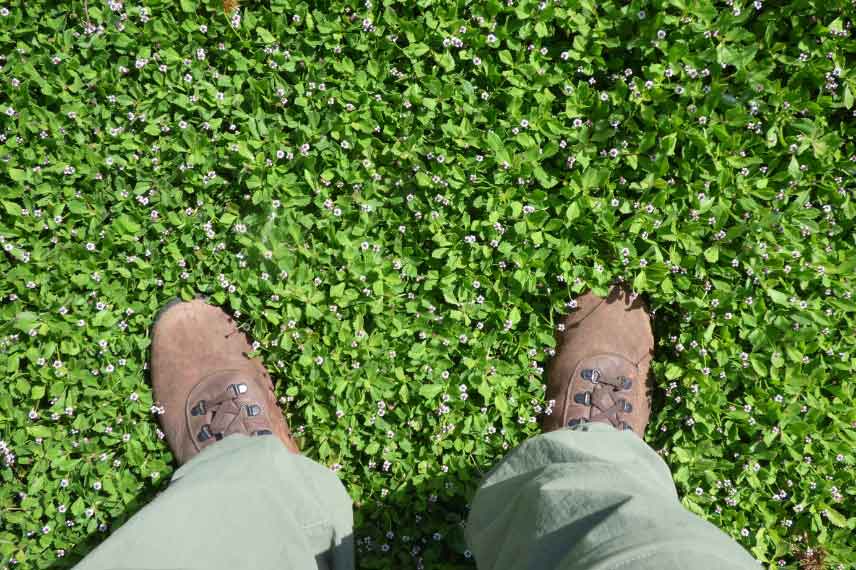
My advice: do not simply calculate the expense for purchasing your Lippia young plants, but also consider the water savings you will achieve by adopting this plant. Also, factor in that you will only need to use the mower very sporadically (or not at all!), thus saving on fuel or electricity and maintenance of your equipment… not to mention the time saved to do other things!
Read also
Steppe lawnWhere to plant it?
Lippia nodiflora is a plant suited to hot and dry climates. It can grow in regions where winters are mild and summers are hot, with little rainfall. This plant is often used in arid and semi-arid areas, where water availability is limited.
However, Lippia nodiflora can also thrive in more humid climates if properly maintained and conditions are not too wet for extended periods.
Lippia nodiflora is a plant suited to poor and dry soils: it can grow in sandy, gravelly, or rocky soils, but can also thrive in richer soils.
Install Lippia to cover areas typically planted with lawn, as well as between the slabs of a path or stepping stones. You can also use it to green a bank, as its stolons help stabilise the soil. This plant is used for road verges and difficult-to-cultivate areas.
Can it be combined with other groundcover plants?
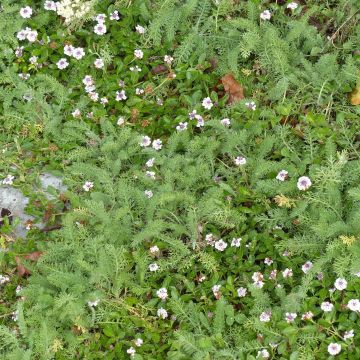
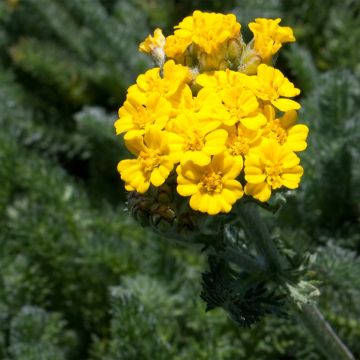
Lippia nodiflora can easily be combined with other ground-cover plants as alternatives to lawn, vigorous and with complementary growing cycles. This can help create a palette of different colours and textures for a garden or green space. For example, it can be paired with Achillea crithmifolia. Both plants are suited to hot, dry climates and can thrive in poor, well-drained soils. Achillea crithmifolia is a perennial flowering plant with very light grey foliage. In summer, the lush green and flowering Phyla will dominate, and in winter, it will be the soft, silver, evergreen foliage of Achillea that takes over.
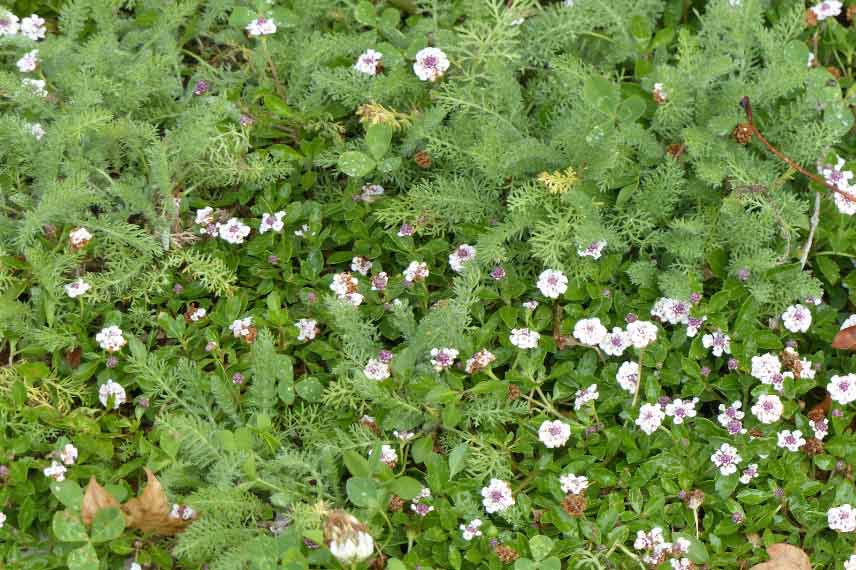
Lippia nodiflora paired with Achillea crithmifolia
When and how to plant it?
If you live in a region with a mild climate and experience hot, dry summers, it is advisable to plant your Lippia young plants in autumn so they can establish their roots properly before the first summer. If your winters can be quite cold, opt for planting in early spring.
- Buy a sufficient quantity of Lippia pots by calculating based on the area to be planted and the number of plants you wish to plant per m². The denser you plant, the quicker the area will be covered. For example, if you want to cover an area of 50 m² quickly, you will need to count 8 plants per m², so 50 x 8 = 400 plants. If your budget is tighter, you can plant 4 per m², so 50 x 4 = 200 plants.
- Prepare the soil by removing existing vegetation and loosening it to a depth of about ten centimetres.
- If necessary, improve the quality of the soil by adding compost or well-decomposed manure to promote growth. Ensure that the soil is well-drained, as Lippia nodiflora does not tolerate waterlogged soils: add gravel or coarse sand to the bottom of the planting holes if needed.
- Plant the Lippia pots by making each hole with a spade or using a bulb planter to make the task easier. The top of the young plant should be level with the soil.
- Water the plants immediately after planting and continue to water them regularly to encourage rooting during the first few weeks.
My tips: if you find the expense too high compared to traditional lawn sowing, know that Lippia multiplies very easily by taking rooted stolons. You can start by covering a small area, from which you can take new plants the year following the planting. This way, you can gradually and exponentially expand the covered area.
Maintenance of Lippia Surfaces
- The weeks following planting and the first summer if you planted in spring, water regularly if the weather is dry to encourage recovery
- Then, only water if it starts to show signs of distress due to lack of water. Otherwise, it can easily do without watering
- You may eventually mow once a year if your Lippia is not as low as you would like (in partial shade or in rich soil, for example). Carry out this mowing after flowering or at the beginning of it if the presence of bees is bothersome to you
- If Lippia nodiflora becomes too invasive, particularly at the edges of beds or paths, do not hesitate to cut it back to control it. Mowing before it sets seed helps prevent its spread by self-sowing

- Subscribe!
- Contents
Comments