





























Unusual Japanese maples
Our selection of 5 rare and remarkable varieties
Contents
With their changing colours, the delicacy of their finely cut foliage, and their Japanese-inspired silhouette, Japanese maples enchant gardeners who cherish refined and zen atmospheres. Some varieties of Japanese maples are truly original, whether due to vibrant bark, astonishing variegation, captivating autumn colours, or an ultra-compact size. They stand out particularly in a garden. These Acer will delight discerning collectors, offering wonderful surprises.
Come and discover these rare and unusual varieties of Japanese maples!

Acer palmarium 'Manyo No Sato': the chocolate maple
Here is a sublime variety of Japanese maple, as rare as it is divine. Its astonishing hue is the first thing to catch the eye, as the leaves of ‘Manyo-No-Sato’ don a colour in spring that hovers between chocolate brown and violet, irregularly marginate with a striking lemon green. In summer, this bicolour wonder evolves into a light green and cream foliage, before finally taking on warm, orange hues washed with purple in autumn.
This seasonal colour change is not its only charm: the shape of its leaves is also a delight, being finely cut and dentate along the edges. Small in size, yet larger than a dwarf maple, this maple grows slowly to reach a height of 2 to 2.5 m, with a slightly narrower spread of up to 2 m. It is therefore suitable for planting in a heather soil bed, as it requires acidic soil, or in a large pot on a shaded terrace. While it can tolerate sunlight, it is best to protect it from the hot rays of the afternoon sun. It thrives in partial shade, either to the East or West.
Like most Japanese maples, it boasts excellent hardiness, comfortably withstanding temperatures down to -25 °C, making it suitable for many regions. It requires fresh, well-drained soil.
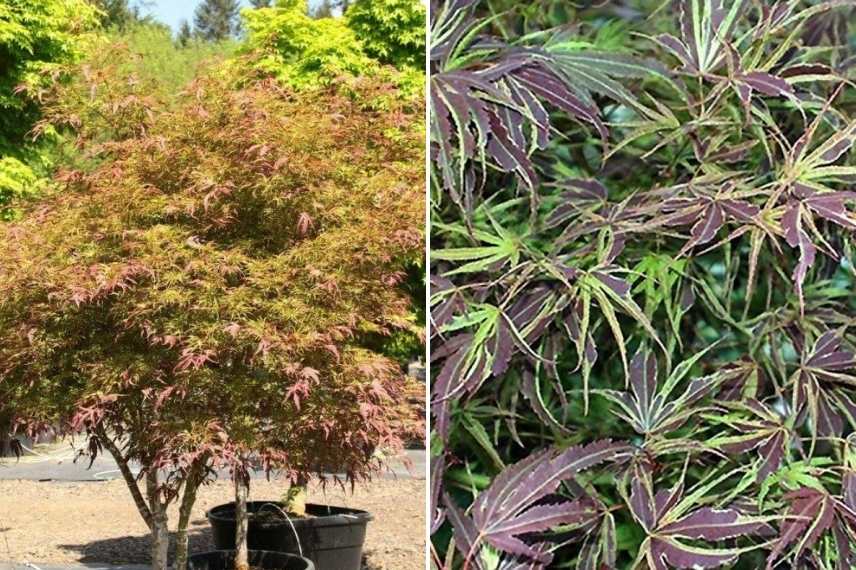
Acer ‘Manyo No Sato’
Read also
Maples: planting, pruning and careAcer palmatum 'Koto No Ito': ultra fine
The Japanese maple ‘Koto No Ito’ is a small extraterrestrial in the world of maples with palmate foliage: its leaves are incredibly laciniate, meaning very finely cut, almost becoming linear, especially in spring when it unfurls. The foliage then takes on an unusual appearance for a Japanese maple, somewhat reminiscent of certain bamboos or Acer palmatum ‘Fairy Hair’ with this unusual foliar delicacy.
Its colours changing throughout the year are also worth mentioning, as they accompany the bush from a crimson red to a stunningly bright apple green, and then to an orange-yellow in autumn. Another characteristic is its naturally spreading and horizontal silhouette. It too will be suited to a partially shaded location, planted in acidic, cool, and sufficiently drained soil.
With ‘Koto No Ito’, you invite graceful Japonism into your garden!
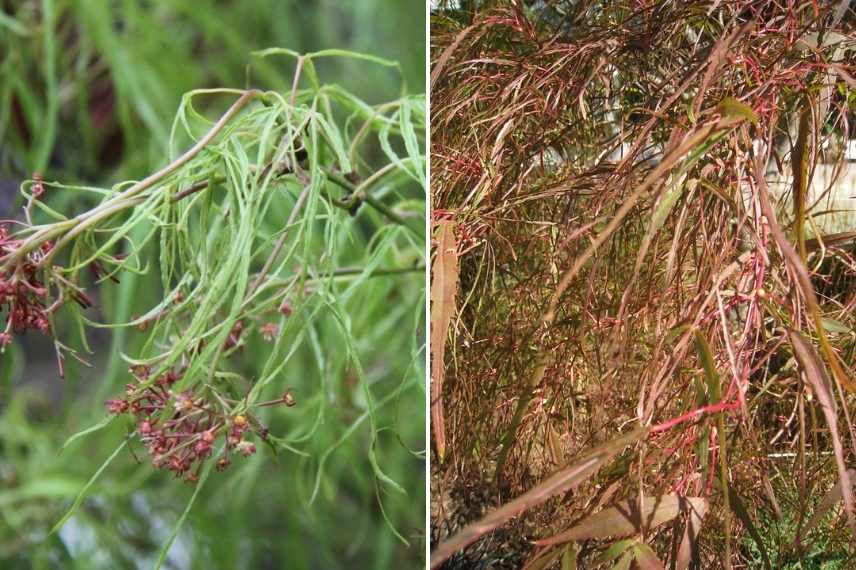
Acer ‘Koto No Ito’ (© Jennifer Snyder)
Discover other Japanese Maples
View all →
Available in 1 sizes
Available in 1 sizes
Available in 3 sizes
Available in 1 sizes
Available in 4 sizes

Available in 6 sizes
Available in 1 sizes
Available in 1 sizes
Available in 2 sizes
Available in 1 sizes
Acer palmatum 'Sango-Kaku': a sublime bark
Also known as ‘Sango Kaku’ or ‘Senkaki’, this Japanese maple has an irresistible asset, and it must be said, quite rare among them: a beautifully coloured bark that would make the most stunning winter barks in the garden blush! Standing out with its coral red colour, it adds a magnificent scarlet touch during the coldest months, as well as a superb structure. The red bark is particularly pronounced in its youth and on the young shoots of the bush, intensifying with the cold.
As for other remarkable features, the ‘Sango Kaku’ maple offers striking colours from spring to autumn: initially light between yellow and salmon pink, the leaves turn green in summer, then gradually change to a beautiful display of yellow, orange, and red as frost approaches and before they fall.
Of medium size, this maple will reach between 3 and 4 m at maturity, with a spread of 2 to 3 m, and has an upright habit, knowing that it grows slowly. Enjoy the many qualities of Sango Kaku to make it a focal point in a shaded border.
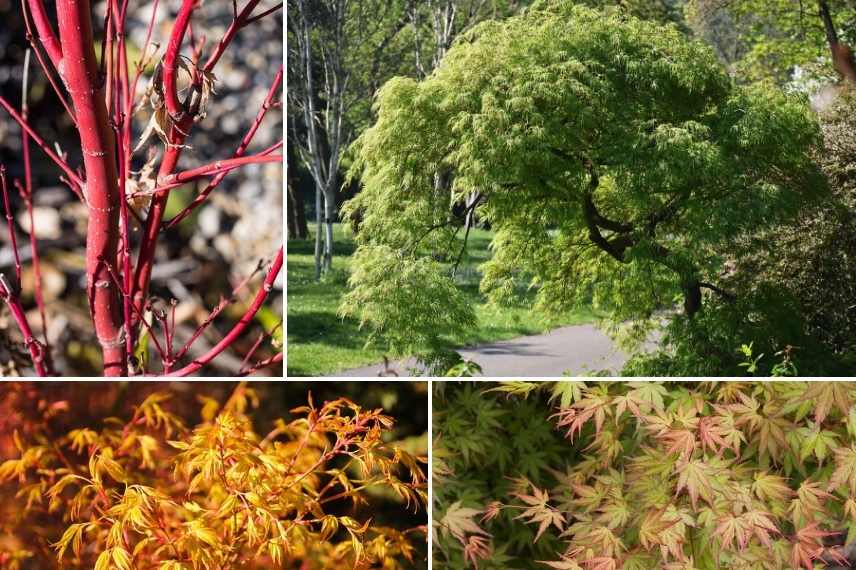
Bark, habit, spring foliage (on the right) and autumn foliage (bottom left) of the ‘Senkaki’ maple
Acer palmatum 'Ukigumo': as white as snow
Variegated leaf variety enthusiasts, the Japanese maple ‘Ukigumo’ is for you! It showcases one of the most unusual variegations among maples, with a striking dominance of white. The proportion of white varies among individual plants, appearing at the centre of the leaf and along the central vein, sometimes in a creamy hue to a very pale pink. The initially white leaves gradually become punctuated with green, giving a predominantly green impression in summer. As autumn approaches, it surprises once again with its golden, yellow, and orange leaves.
Its habit is upright (the bush typically reaches 3.50 m in height with a spread of 1.50 m), making it an ideal variety for a border or to plant as a specimen. Like other Japanese maples, ‘Ukigumo’ requires cool, well-drained, or sufficiently light soil, with a tendency towards acidity. Due to the sensitivity of its white variegation, this maple must be placed in shade or partial shade.
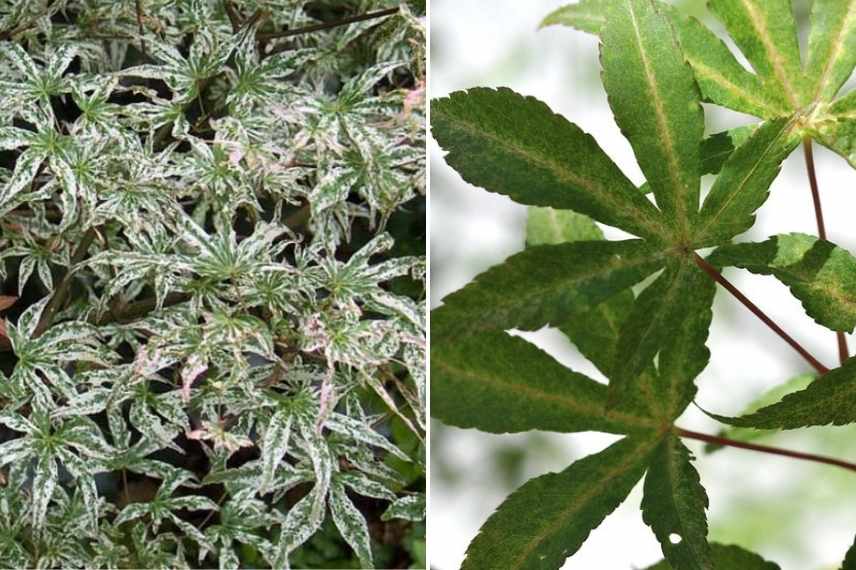
Acer Ukigumo (© Megan Hansen)
Acer palmatum 'Mikawa Yatsubusa': compact and bushy
In the category of small Japanese maples or dwarf Japanese maples, Acer ‘Mikawa Yatsubusa’ stands out for its astonishing foliage density, due to very short internodes that bring the leaves together in tight tufts. It is a quirky little specimen, very endearing with its tousled appearance, perfectly suited for small spaces, balconies and terraces, or in a cocoon within an ornamental garden. Measuring between 1 m and 2 m with a spread of about 80 cm, it displays a spring foliage of a soft, tangy green, contrasted by the reddened samaras in April-May, then turning to a darker green in summer and concluding the autumn season beautifully with a lovely yellow-orange coloration.
This little marvel particularly enjoys shade or partial shade and a sheltered position from winds, as it is somewhat less hardy than other maples in this selection. It also requires a soil that is slightly acidic, remaining cool in summer and well-drained. ‘Mikawa Yatsubusa’ grows slowly like its counterparts, making it a beautiful subject to treat as a large bonsai in a pot, especially as its trunk becomes beautifully sinuous over the years.
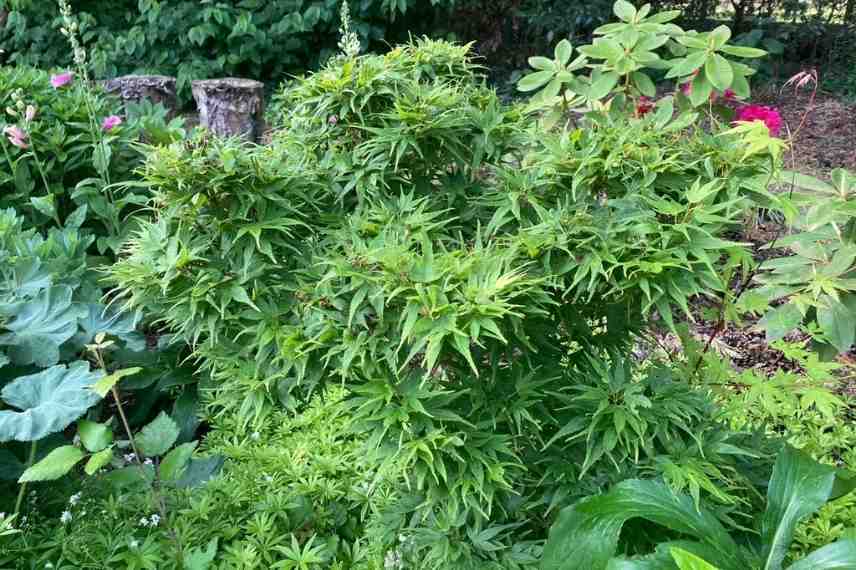
Acer palmatum ‘Mikawa Yatsubusa’ (© Gwenaëlle David)
- Subscribe!
- Contents
Comments