




























Discover the blackbird!
A bird found in all our gardens
Contents
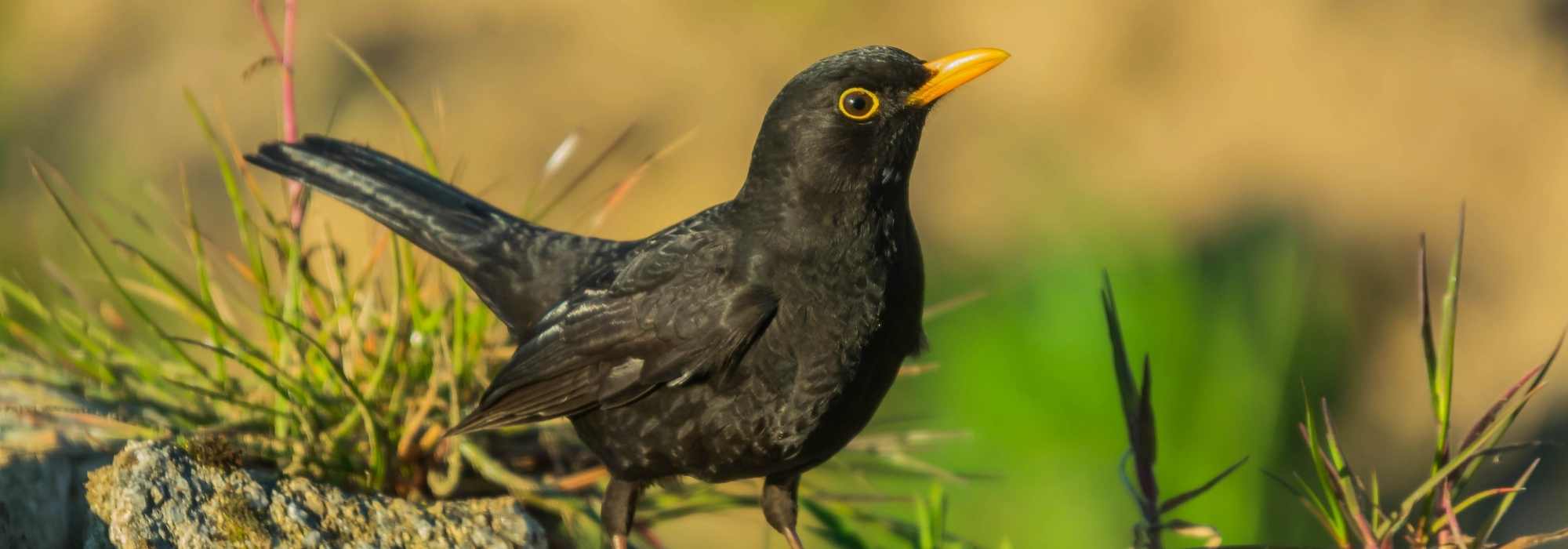
If you are asked to name a bird commonly found in gardens, there’s a fifty-fifty chance you’ll mention the blackbird. And for good reason! The Blackbird, Turdus merula, is indeed one of the most frequent birds in our gardens, towns, countryside, and forests. Easily recognised by its black plumage and yellow beak for the male, and entirely brown for the female, the blackbird is a bird that charms more with its song than its appearance. A gardener’s ally, the blackbird is also a very effective helper due to its predation of pests such as certain insects, larvae, caterpillars, or slugs. However, in winter, it is more inclined to feed on berries and other small fruits.
→ Let’s discover together the life of this friendly bird that accompanies us all year round in the garden!
How to recognise the Blackbird?
The Blackbird (or simply “blackbird”), Turdus merula, is a large and very common passerine bird from the Turdidae family, like thrushes for example. The Blackbird is found in Europe, Asia, North Africa, and has been introduced to Australia and New Zealand. Its size, from head to tail, is 27 cm with a wingspan between 34 and 38 cm. There are 7 subspecies, but the Blackbird found in our area is considered the type species or more precisely the subspecies: Turdus merula merula.
What are the differences between male and female Blackbirds?
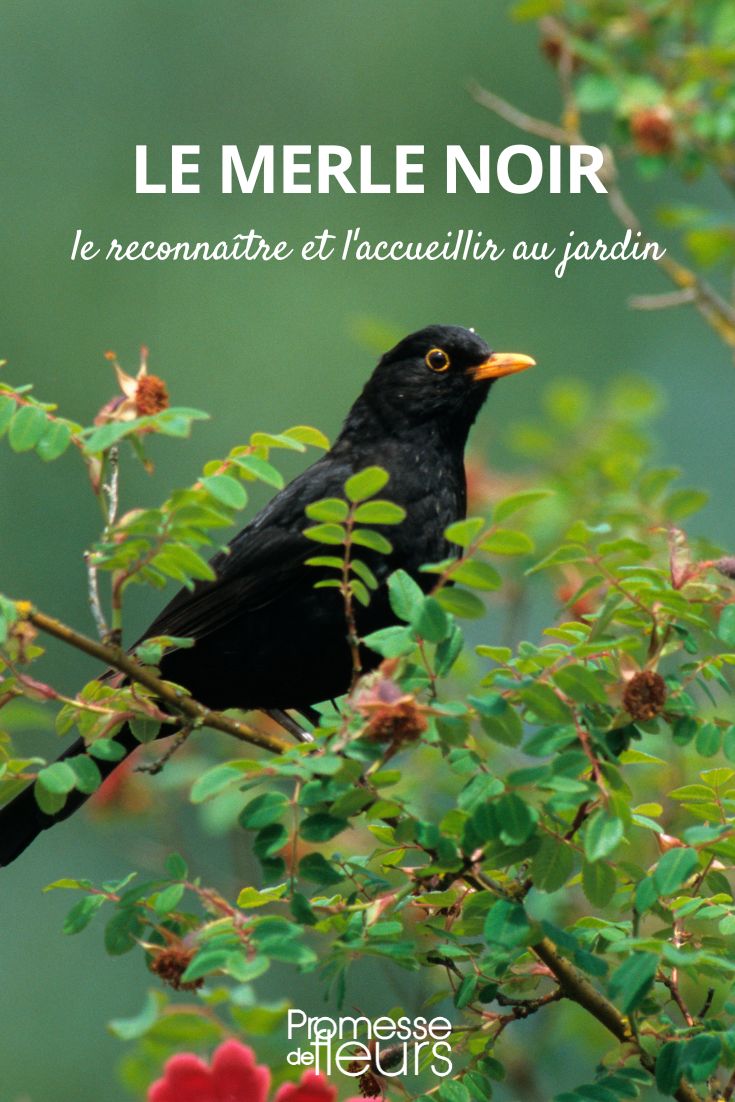
The male Blackbird is, except for variations between subspecies or individuals (feather anomalies), entirely black with a yellow beak and a yellow ring surrounding the eye. The female generally has brown plumage, with a brown beak and a light brown eye ring. Males are slightly larger than females. However, be careful not to confuse a juvenile blackbird with brown plumage with a female: juvenile plumage is, however, speckled with beige on the chest. The yellow beak and the well-defined black plumage only become apparent in young males after a full year.
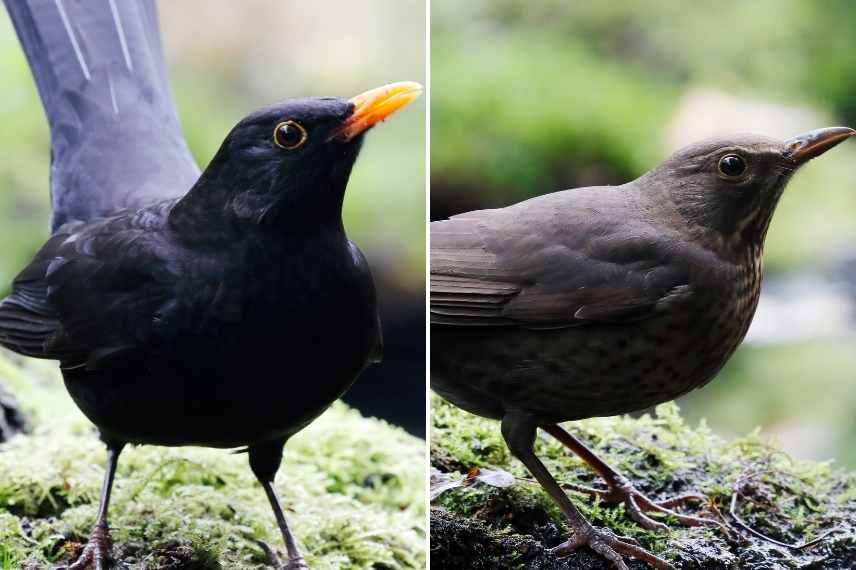
Male and female Blackbird
The Life of the Blackbird
Habitat
The Blackbird is originally a species that frequents the edges of forests. However, its adaptability has brought it closer to humans in our countryside and cities. The blackbird requires trees, primarily leafy ones, and bushes. It is one of the most common birds in gardens.
Feeding
Blackbirds are relatively omnivorous. They consume insects (larvae and adults), spiders, earthworms, slugs, snails, myriapods… Very occasionally, blackbirds may feed on pollarded trees, small amphibians, and lizards.
But blackbirds also enjoy fruits: from small berries to apples. They will eat whatever they find: elderberries or privet berries, dogwoods, blackberries, cherries… In winter, they can still find hawthorn berries, mistletoe, ivy, cotoneaster, or holly. In the south of France, it is not uncommon for them to feast on olives, figs, grape seeds, myrtle berries… The consumption of all these fruits contributes to seed dispersal.
It is worth noting that, during the nesting period, blackbirds adopt a more carnivorous diet (insects, worms, slugs…) for themselves and their offspring. Meanwhile, in autumn and winter, they are more frugivorous. They do not neglect feeders filled with seeds during the coldest periods, but prefer that you leave some apples in the garden.
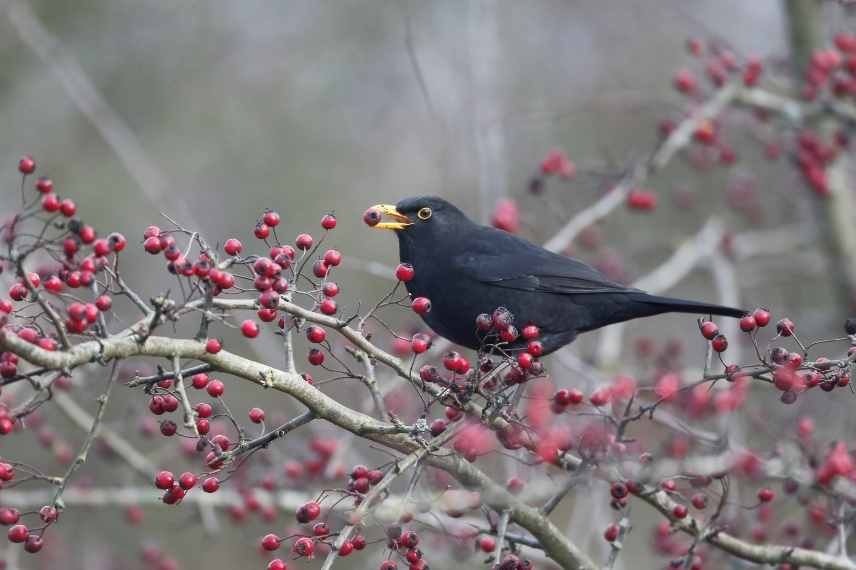 In winter, fruits and berries constitute the main diet of the blackbird
Behaviour
The blackbird is a territorial bird during the breeding season. The male repels other males through intimidating postures and chases, rarely more. It is more sociable outside of the breeding periods, but never forms large groups.
The blackbird moves on the ground to search for part of its food, but finds itself in trees to nest, sing, and look for berries. The Blackbird also enjoys sunbathing on the ground, with its tail and wings spread to maximise the surface area exposed to the sun. The blackbird’s flight is direct, often low.
It is worth noting that blackbirds can be sedentary, partially migratory, or fully migratory depending on the climate. In our area, it is considered to be rather sedentary.
Reproduction and Nesting
In spring, the male begins its courtship display: a short run on the ground, head bobbing, open beak, and a clearly audible song. Blackbird pairs are generally monogamous, but a “separation” is possible if breeding is not optimal.
Nesting begins as early as March, in a bush (either shrubby or climbing), usually about 2 m off the ground or in the fork of a large tree. The nest, primarily built by the female, is cup-shaped, made of moss, grass, small roots, and twigs, then lined with mud or muddy leaves. The female lays 2 to 6 blue-green eggs, marked with reddish-brown spots.
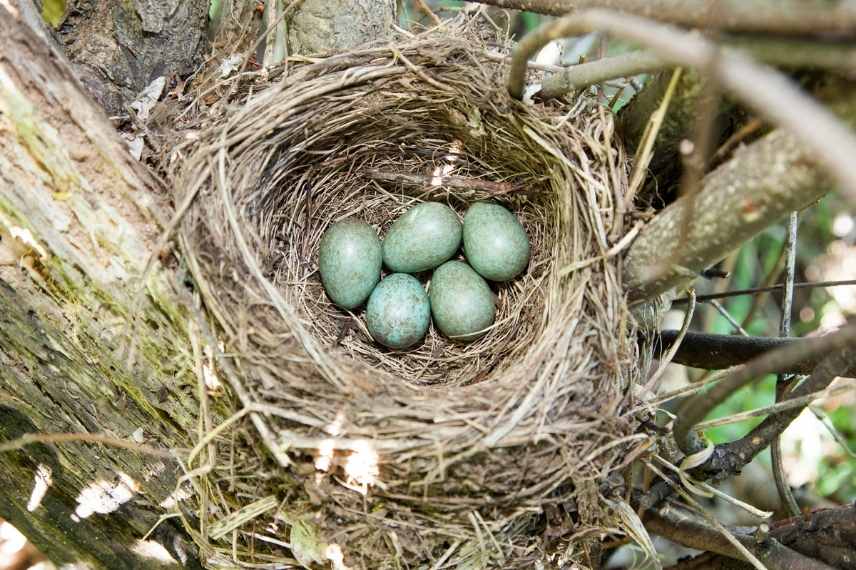 Blackbird nest
The chicks are nidicolous (they remain in the nest until they can fly) and leave the nest after 12-13 days. Afterwards, the young are still fed on the ground for 3 weeks before becoming independent. A second brood may then be considered, often in the same nest.
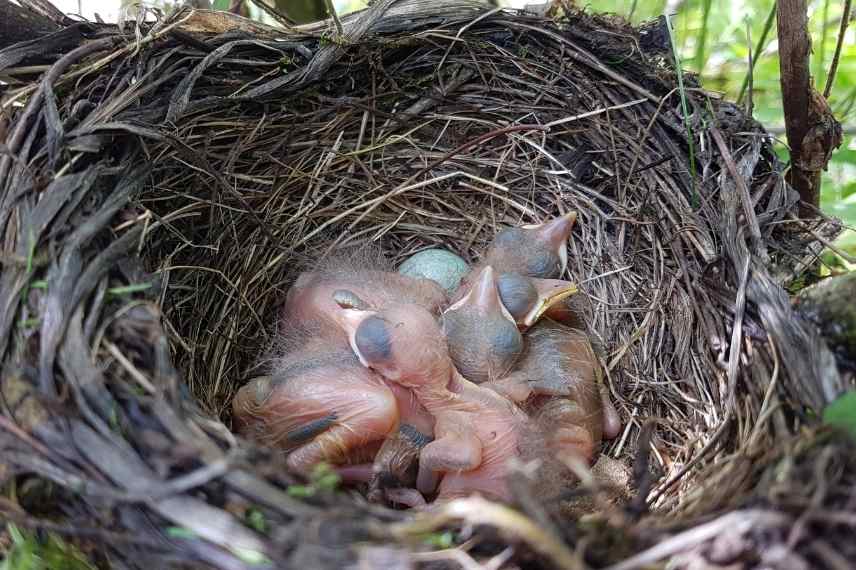 Blackbird chicks in the nest
Threats and Lifespan
In our area, predation, diseases, hunting, and climatic hazards cause an average mortality rate ranging from 50 to 80% depending on the location. Additionally, the Blackbird appears to be the most vulnerable bird to an African-origin virus: the Usutu virus. Otherwise, if nothing happens to it, the Blackbird can live up to 16 years.
How to attract blackbirds to our gardens?
It’s simple, do as little as possible! By that, we mean: prioritise tranquility and a natural look in your garden.
- forget all ecocides (insecticides first and foremost!), even so-called natural ones;
- plant (or let grow) leafy trees, berry bushes, and dense shrubs: Hawthorns, Black elder, Bloodtwig dogwood, Cotoneasters, Privets…;
- leave some wilder areas: by not mowing certain patches to attract insects, by allowing ivy or brambles to fruit…;
- think of the birds in winter: some water basins and a few apples placed here and there will do the trick.
→ We offer hedge shrub kits, including a kit for a countryside hedge. It includes, among others, an Aronia, a Cotoneaster lacteus, a Guelder rose, a blackthorn, and a holly that can serve the Blackbird.
- Subscribe!
- Contents
Comments