





























Choosing a Stachys
Differentiate the species of Stachys
Contents
The Stachys comes in various species with different needs and behaviours, although one has taken all the limelight to the point that the others are often overlooked. Indeed, the Stachys byzantina is by far the most well-known and widely cultivated, with its stunning, downy foliage that is almost white-grey. Enjoy this article to discover other members of this genus, featuring some lovely species with bright green, dentate, crinkled foliage. Their summer flowering in violet spikes is generous and vibrant. There is a Stachys for every type of soil or garden. Happy exploring!

According to the colour and shape of the foliage
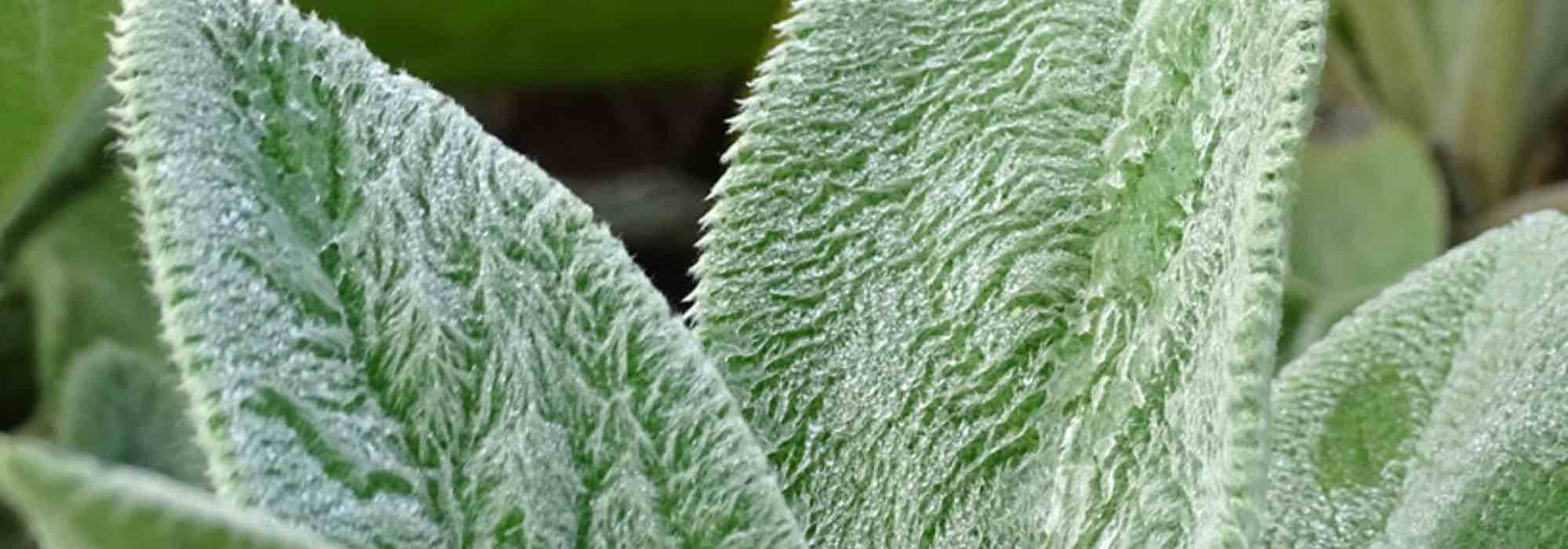
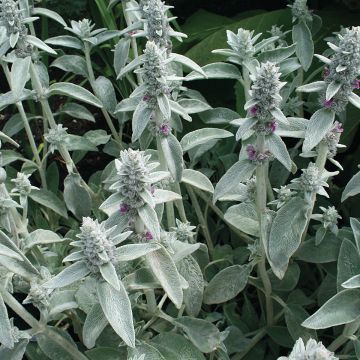
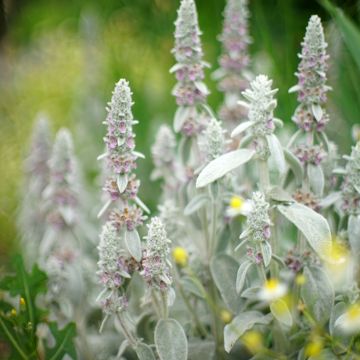
There is a significant difference between the best-known Stachys, Stachys byzantina, and other Stachys species. While the latter all have green foliage, this one displays grey. An astonishing, wooly, soft foliage that earns it the nickname Bear’s Ear. Its foliage features a changing colour, slightly green and covered in a silver-grey felt, sometimes bluish, almost white in well-drained soil. Therefore, to clarify the Stachys family, you can start with this most obvious criterion. There are also a few other nuances to distinguish in the colours and shapes of the leaves among Stachys, which, as you may have guessed, are perennials with ornamental foliage.
- The Stachys byzantina is adorned with this characteristic foliage, primarily grey, with a very velvety texture. It is evergreen except in areas with very harsh winters. Its leaves measure 4 to 10 cm long, broad, opposite, ovate, lanceolate to cordate. They are thick and plicate, furrowed and downy, crenate. They are covered in wooly bristles that give them bright silver or bluish-grey reflections. In Stachys byzantina ‘Big Ears’, the leaves are significantly larger, measuring up to 20 cm long.
- The Stachys officinalis, also known as betony or medicinal woundwort, has lovely grey-green foliage. Its leaves are opposite, lanceolate, rough, and dentate.
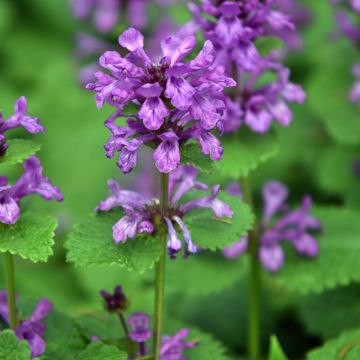
- The Stachys grandiflora features beautiful dark green leaves, glossy, ovate, cordate, and dentate.
- In the Stachys palustris, the leaves are also dark green, with a lanceolate shape, crinkled appearance, dentate, and pointed tips.
- The Stachys monieri has more vibrant foliage, ranging from light green to bright green. Its large leaves are crinkled and glossy, ovate to cordate, veined. This foliage is semi-evergreen.
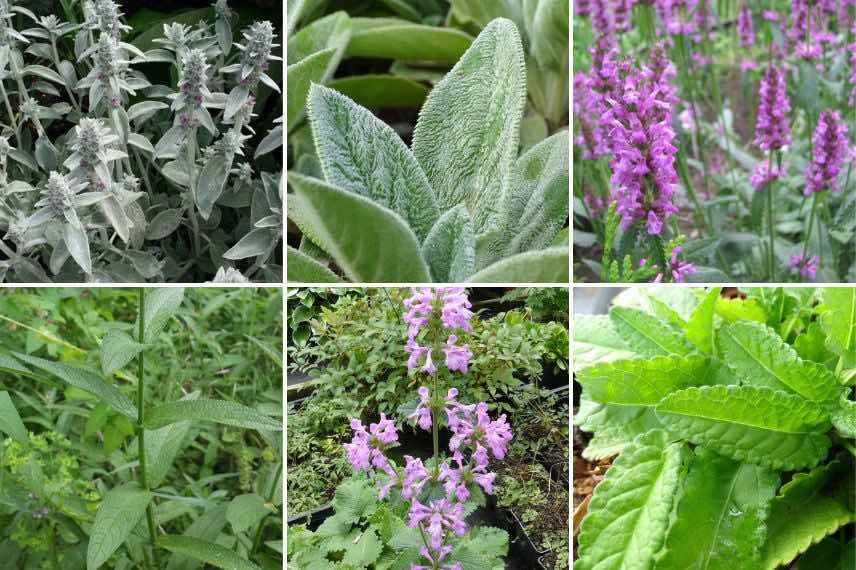
Stachys byzantina, then Stachys byzantina ‘Big Ears’, Stachys officinalis with grey-green foliage, Stachys palustris, Stachys grandiflora, Stachys monieri ‘Hummelo’ with vibrant foliage
According to the colour of the flowers
In summer, from June to October depending on the regions and species, spike-like inflorescences, reminiscent of those of sages, rise above the foliage. They consist of a multitude of tiny, tubular, labiate flowers arranged in whorls around the stem. Most often, the flowers are a purplish-pink. This melliferous and nectariferous flowering lasts throughout the summer and attracts foraging insects.
- Stachys byzantina or Stachys lanata encloses its flowers in woolly bracts. It retains its cottony appearance even during flowering. The purplish-pink hue of the tiny flowers is drowned in an abundance of almost white wool.
- In Stachys grandiflora, the flowering is pronounced, even more so in the variety ‘Superba’. Its very large flowers are of a very bright purplish-pink in well-defined spikes above the foliage. This Stachys wins the prize for the most luminous and spectacular flowering.
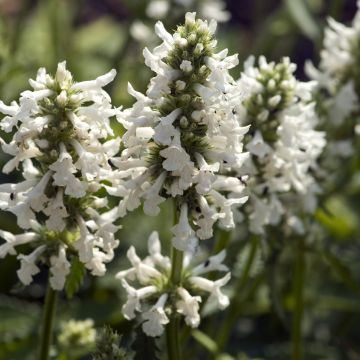
- Stachys officinalis displays vividly coloured purplish-pink flowers. In the variety ‘Alba’, they are white, and in ‘Pink Cotton Candy’, they are a lovely candy pink.
- The long spikes of bright violet flowers from Stachys monieri ‘Hummelo’ are delicately scented, exhaling fragrance when brushed against. The variety ‘Rosea’ expresses itself in soft pink.
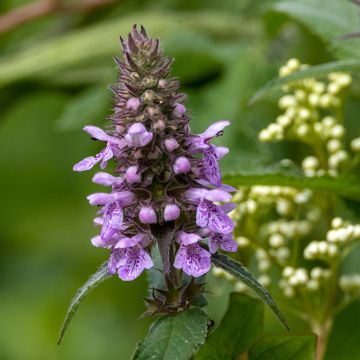
- In Stachys palustris, the pink-mauve, spotted labiate flowers resemble wild orchids.
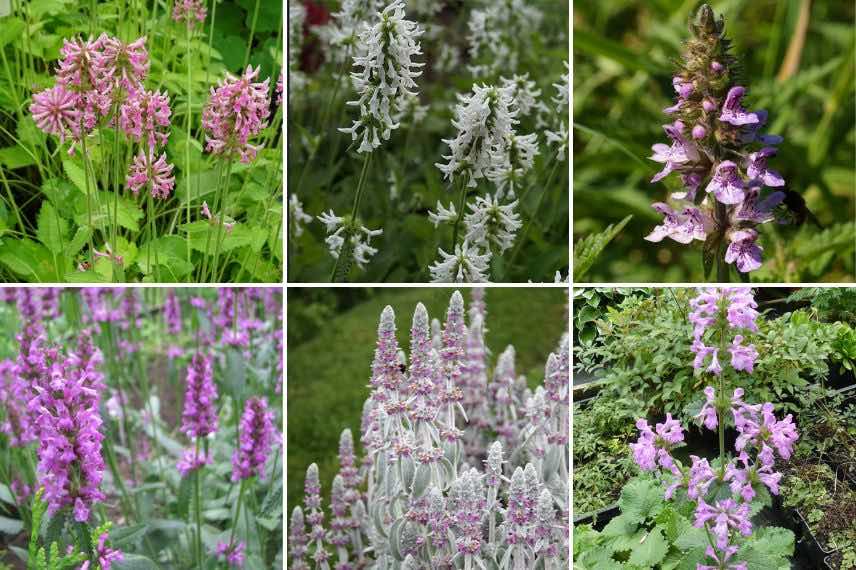
Stachys officinalis ‘Pink Cotton Candy’ then ‘Alba’, Stachys palustris, Stachys officinalis, Stachys byzantina, Stachys grandiflora ‘Superba’
Discover other Stachys
View all →
Available in 2 sizes
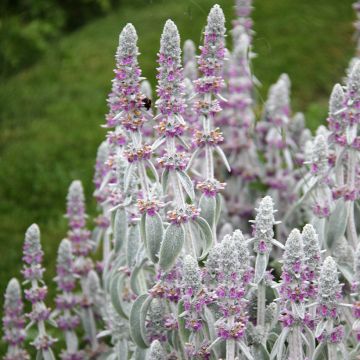
Available in 2 sizes
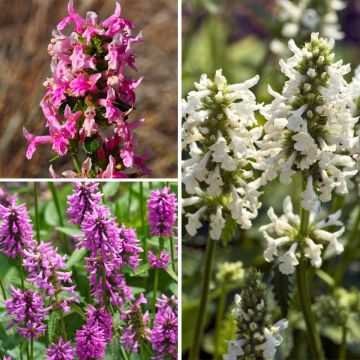
Available in 0 sizes
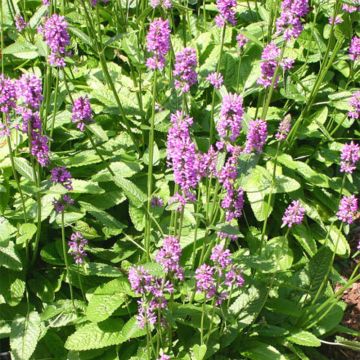
Available in 3 sizes
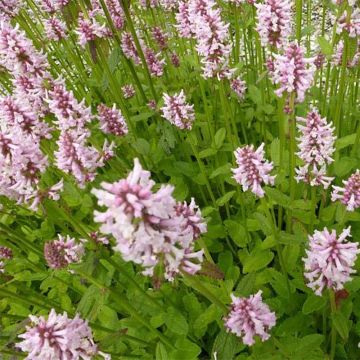
Available in 1 sizes
Available in 1 sizes
Available in 1 sizes
Available in 1 sizes
Available in 1 sizes
Available in 1 sizes
According to height
Of relatively medium size, ranging from about 40 centimetres to around 80 cm in height, Stachys are rather modest and easy to establish in borders or within a bed. Let’s see what sets them apart. The tallest is undoubtedly the Stachys palustris, which, encouraged by its roots in water, can grow up to 80 cm tall, even reaching 1 m under the best conditions. All the others are shorter, approximately 40 cm for the Stachys byzantina, while the Stachys officinalis reaches a height of 60 cm; the other species fall within this height range.
According to soil moisture
The Stachys byzantina is renowned for being a hardy plant that thrives in dry, poor, stony soil and is drought-resistant. However, this is not the case for all Stachys. Each species grows under quite different conditions. Take, for example, the Stachys palustris, or Marsh Woundwort, which is at the opposite end of the spectrum, a native perennial of our wet, marshy soils and water’s edge. Between the two, other Stachys species are fairly accommodating, though they do have preferences. The Stachys grandiflora grows in light soil if it is not too dry, but its preferred soil is cool, even moist, heavy, and rich. It also thrives on riverbanks. The Stachys officinalis is not very demanding; it requires soil that is not too dry and enjoys cool, heavy soil as well as light soil. The Stachys monieri also prefers soil that is not too dry and likes well-drained soil. It is the one that is most similar to Stachys byzantina. While it does not favour chalky and dry soils as much as the latter, and it is clear that its tender green leaves will suffer more quickly from a lack of water than the tough leaves of Stachys byzantina, it proves to be quite drought-resistant once well established.
Depending on the use
As different species of Stachys do not all thrive in the same conditions, their uses are necessarily dependent on this primary criterion.
In dry and mineral gardens, coastal gardens, or sunny rockeries
The Stachys byzantina is the plant you need! Essential in such arid conditions, it brightens up gardens with its silvery, almost white foliage, thriving in well-drained soil without winter waterlogging, in full sun. It prefers calcareous, poor, stony soils, but can also be used in any sufficiently drained soil to survive winter without suffering.
- As a border and in beds: it is an excellent choice for drawing attention to the front of your beds, enhancing your perennials, and creating lovely soft or contrasting scenes. It forms a dense carpet that is very useful in these conditions.
- In rockeries or on a somewhat ungrateful slope: its hardiness allows for these somewhat extreme uses that may not suit other plants.
- Planted in masses: it spreads over the years with its running rhizomes, the clumps grow larger, and it eventually wanders where it pleases.
- In pots: its drought resistance and dense, compact habit make it a good candidate for pots, either alone or accompanied by plants with similar needs.
The Stachys monieri, although more sensitive, is still quite drought-resistant once established. It can be used in beds with moderately dry soil, as a border, or in rockeries.
In gardens with fresh to moderately dry soil, in full sun or partial shade
Green-leaved Stachys: Stachys monieri, Stachys officinalis, Stachys grandiflora can be used in most gardens not subjected to extreme conditions. They are tolerant and low-maintenance. Due to their height, they are also suitable for borders and the front of beds. They fit well into many atmospheres, whether romantic or vibrant, rustic, wild, or naturalistic. If you plant green-leaved Stachys in masses, accompany them with perennials that take over to hide the deciduous foliage that tends to wilt after flowering.
In gardens with fresh to moist soil, in full sun or partial shade
This is the preferred terrain for the Stachys grandiflora, which finds its full potential here, alongside lush plants suited to fresh soil.
On banks, by a pond
This is where you plant the Stachys palustris, as well as the Stachys grandiflora; they even appreciate heavy soils. The Stachys palustris can also be planted in marshy or flooded soil.
In a physic garden
The Stachys officinalis is edible and has medicinal properties. It is worth noting that this is also true for the Stachys palustris.
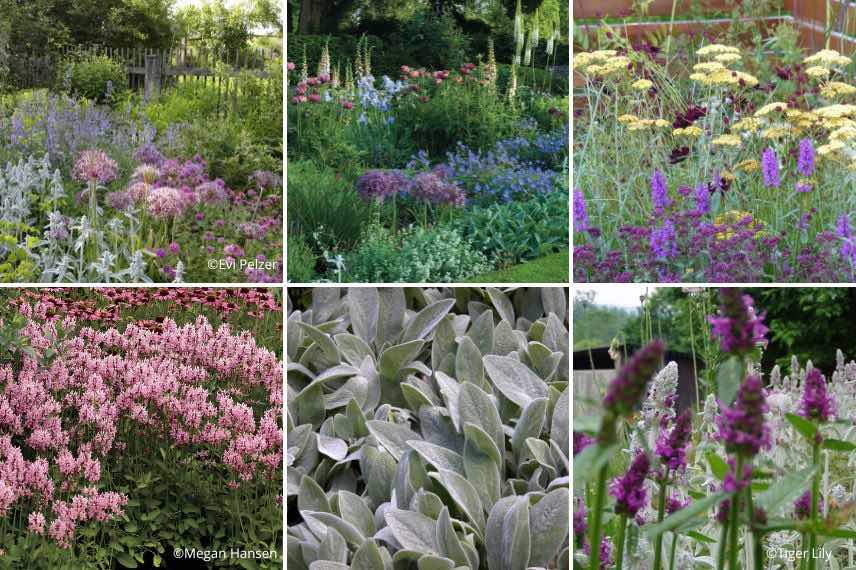
The Stachys byzantina in a soft bed and then as a border, the Stachys monieri ‘Hummelo’ in a contrasting bed, the Stachys officinalis ‘Pink Cotton Candy’ and Stachys byzantina in mass, and a duo of Stachys
- Subscribe!
- Contents
Comments