





























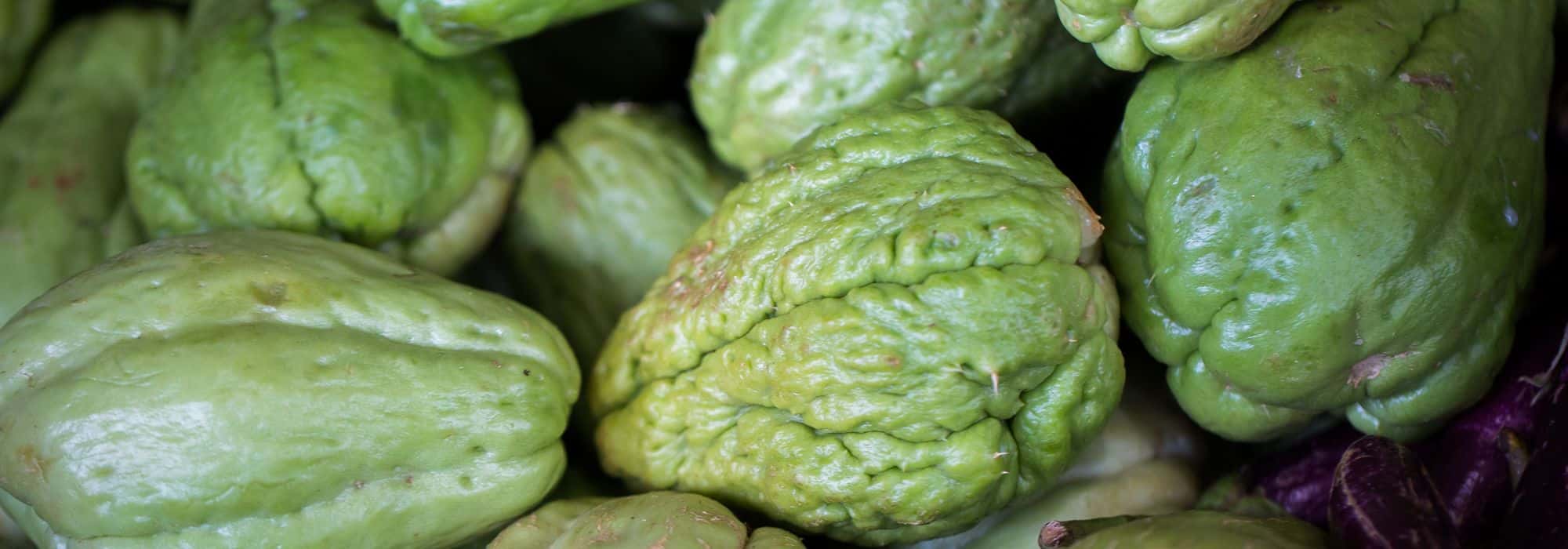
Growing chayote
In the ground or in a pot, chayote or christophine can be planted and grown in our latitudes
Contents
Chayote, christophine, chouchou, chuchu, mirliton… Perhaps you have already heard of this vegetable-fruit in the cucumber family? Perhaps you have even tasted it on a trip to the Caribbean or Latin America? For those who do not know, note that the chayote (Sechium edule) is a tuberous perennial plant that bears in late summer, in September or October, large pear-shaped vegetable fruits, usually green. As for the flavour of chayotes, it is closer to that of courgettes, but finer and more delicate.
Very common and cultivated in Martinique, Guadeloupe and across the Antilles, this christophine can also be grown here, under our latitudes. Indeed, although frost-tender, this perennial with very exuberant creeping stems and tendrils can be grown in open ground or in pots anywhere in France, provided there is enough sun and warmth. And success is often on the cards, as this plant is productive. Moreover, these chayottes can be stored for several months, like pumpkins and squashes.
Discover with us how to plant and grow chayote, in open ground or in a pot.
→ Read also our full guide on the chayote or christophine: planting, care and harvest!

What exactly is chayote, also known as christophine?
Within the Cucurbitaceae family, chayote belongs to the genus Sechium. It is a perennial climber or creeping vegetable plant with tuberous roots, native to Central America, particularly Mexico. Already cultivated by the Aztecs, it is very widespread in Latin America and the Caribbean where it is eaten raw or cooked.
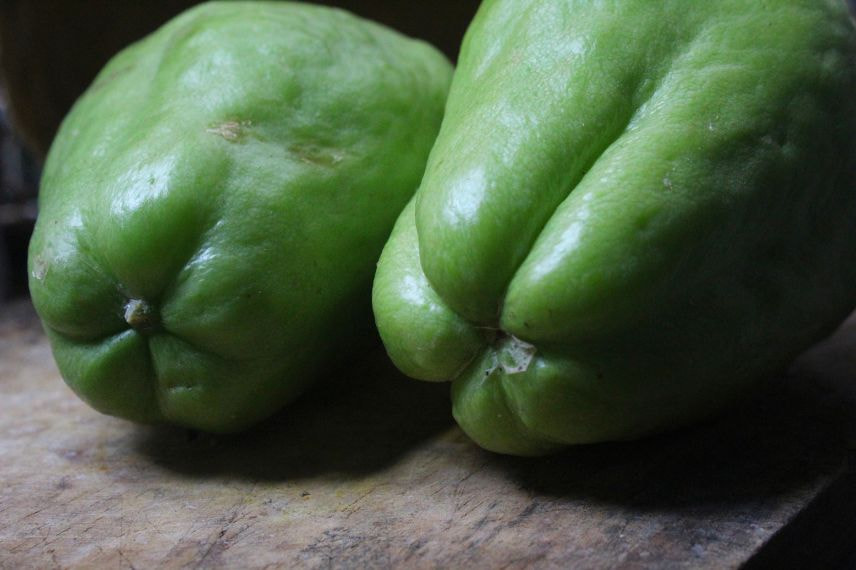
Chayote or christophine is a vegetable-fruit in the Cucurbitaceae family
Sechium edule is therefore a tuberous perennial with alternate, simple or palmately lobed leaves. It forms long scrambling stems with tendrils that can extend from 5 to 10 m in length. Needless to say, chayote needs space to develop. It can creep along the ground, but cultivation and harvest are easier if the trailing stems are trained on a sturdy trellis. Its stems can also spiral themselves around a tree, a wall, or any support.
The flowering occurs in summer. Chayote produces unisexual inflorescences, male flowers grouped in axillary panicles, female flowers solitary. The flowers consist of a calyx with five lobes and a five-petalled corolla. After fertilisation, female flowers give rise to obovoid berries, sometimes pubescent or spiny, greenish and warted, 8–15 cm long and 6–8 cm wide. These berries contain only a single seed which has the peculiarity of germinating within the fruit itself, which explains the planting method.
Read also
How to harvest and store chayotes?Planting chayote in the ground
Chayote is a tropical perennial and frost-tender. Nevertheless, its tuberous roots can withstand light frosts of around -3 to -4 °C. Planting in the open ground is therefore feasible in the south of France, around a broad Mediterranean belt, and even along the Atlantic coast. Provided you protect the stump in winter with a thick mulch of dead leaves or straw. If the tuberous stump has this effective winter protection, it can survive in the ground for many years.
Also, due to its exotic origins, the chayote has an imperative need for sun and warmth to bear fruit. Harvesting takes place between September and October. But with climate change, increasingly evident year after year, it is entirely possible to harvest these fruit-vegetables fully ripe in early autumn. In fact, it needs five consecutive months without frost.
What soil and exposure?
Full sun is essential, at a site well sheltered from winds and cold air currents, for example at the foot of a south-facing wall.
Sechium edule is very demanding and favours soils that are very fertile, rich in organic matter, rather cool and humus-bearing, well loosened. That’s why, ahead of planting, it’s essential to enrich the soil with well-decomposed compost or manure well decomposed, or even a natural and organic fertiliser. Similarly, the soil should be worked deeply.
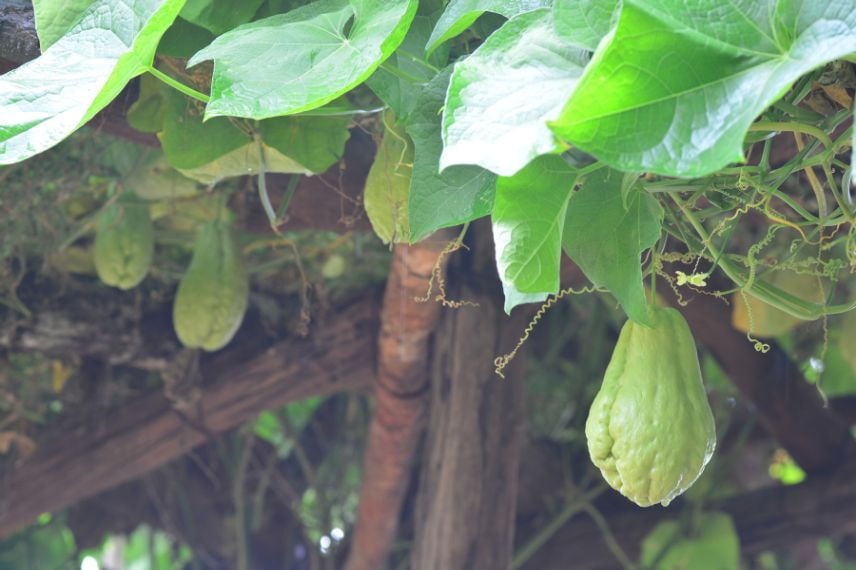
The seed germinates right in the heart of the kernel, so plant a chayote directly in the soil
When to plant chayote?
Planting in the open ground takes place between March and April, when all risk of frost has definitely passed. It is also possible to plant the chayote in a pot from March and then transplant it into the open ground once frosts are over.
It is also possible to plant the chayote in the open ground under a greenhouse, provided it has enough space or can extend outdoors through the skylights.
How to plant chayote?
Comme la graine unique germe au sein même du fruit, on plante directement une chayotte dans le sol:
- Well-work the soil at the foot of a trellis or any support and add a generous amount of organic matter
- Dig a hole and place the fruit-vegetable in the hole lengthwise
- Cover with soil, leaving the chayote slightly above the surface of the soil
- Water well.
Do not forget to add a solid stake for the running stems! It is also possible to let it climb a pergola or a tree.
Christophine planting in a pot
Chayote adapts very well to planting and pot culture, although it is less productive in pots. Pot culture is essential in regions where summers are not warm and long enough. But it is also possible to grow your chayote in a pot from March, and transplant it into open ground from mid-May. Or simply place the pot outdoors.
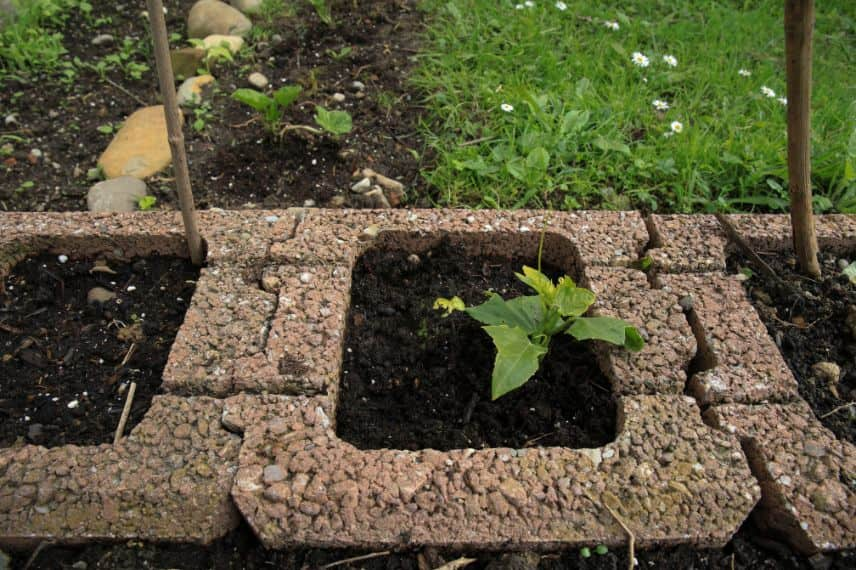
Germination occurs quickly within a few days
For pot cultivation, you will need a pot with drainage holes that is wide and deep enough—at least 40 to 50 cm. Indeed, chayote has a very developed root system. This planting should begin in March:
- Place a layer of expanded clay pellets or gravel at the bottom of the pot
- Fill the pot halfway with good-quality potting soil, optionally mixed with garden soil and well-decomposed compost
- Insert a sturdy stake in the pot
- Place the chayote on its side
- Fill the pot with the remaining soil, leaving the fruit slightly above the surface
- Water generously
- Place the pot in a conservatory or a bright room with a temperature of at least 20 to 25 °C.
When frost risk has passed, the pot can be placed outside in a sheltered and sunny spot. Otherwise, you can transplant your well-developed plant into open ground.
Read also
7 exotic vegetables to discoverCaring for chayote in the kitchen garden
Chayote doesn’t require a great deal of maintenance. However, it has a few requirements to develop properly and bear fruit:
- Water regularly and abundantly to keep soil moist. Installing mulch is also recommended to retain moisture.
- Pinch out the young plants above the 4th leaf to achieve dense foliage.
If you live in the South, you should apply a very thick winter mulch to the stump of your chayote after removing the stems that will be composted.
When and how to harvest chayotes?
Chayotes are harvested from mid-September to the end of October. Harvest must take place before the first frosts. Chayotes should be firm.
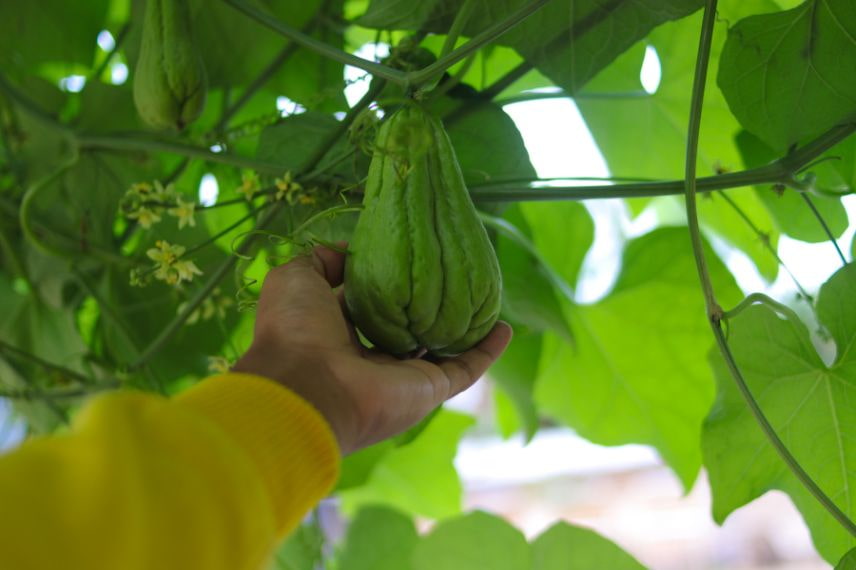
Harvest takes place between September and October–November, just before the first frosts
They can be stored for a few months in a dark, dry, well-ventilated, cool but frost-free room.
- Subscribe!
- Contents
Comments