





























Cypress diseases and pests
Identification, prevention and natural treatments
Contents
With its slender, flame-shaped silhouette, the Provence cypress or Cupressus sempervirens is a very decorative conifer, which evokes the natural landscapes of Tuscany and the Mediterranean. It belongs to a family of conifers with a wide range of shapes. Cypresses or Cupressus bear scaly, fragrant foliage and display different growth habits. They are columnar in the Provence cypress, form masses with a spreading crown in Lambert’s cypress or Cupressus marcocarpa, and are conical in the Arizona cypress or Cupressus arizonica. They should be distinguished from false cypresses or Chamaecyparis, whose branching is flattened rather than cylindrical and whose cones are smaller. It is relatively undemanding to grow and drought-tolerant, and is commonly found in gardens. It thrives in full sun, in well-drained soil and tolerates drought well. The cypress is not particularly susceptible to diseases or pests. Nevertheless, like any tree, it can occasionally be attacked. Discover which diseases and pests can attack the cypress, how to recognise them, how to prevent them and how to treat them.

Cortical canker
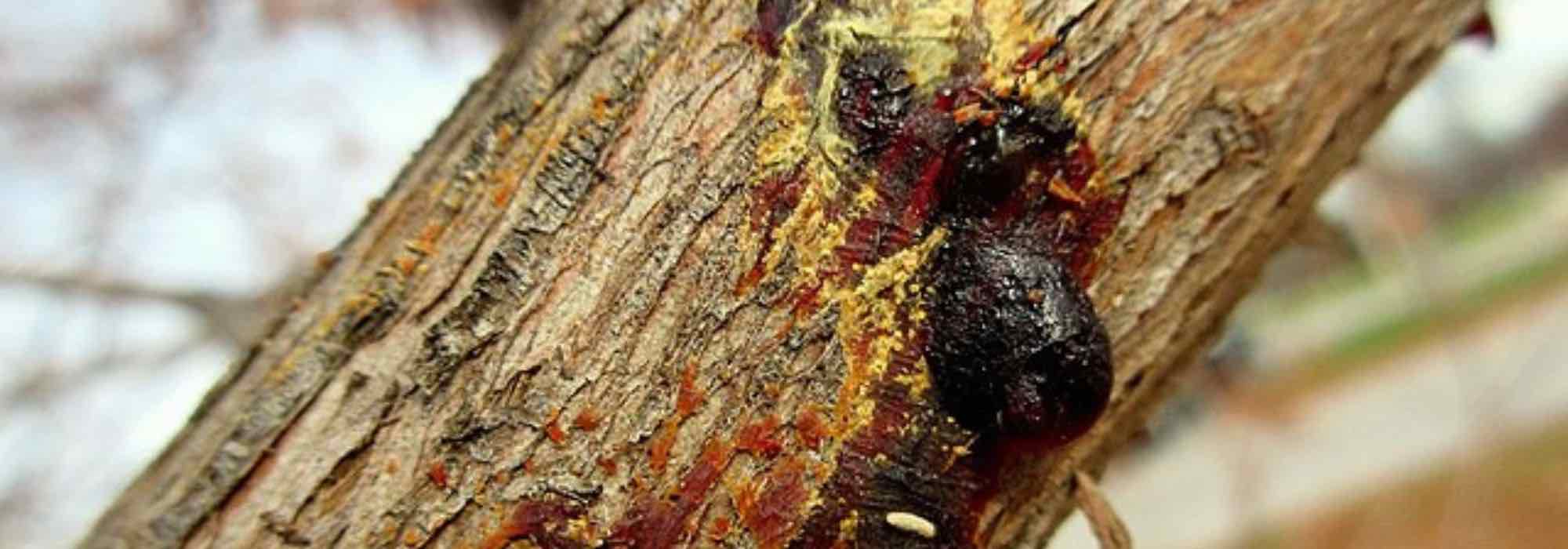
Cypress canker can affect cypress trees, a disease caused by a fungus called Seiridium or Coryneum cardinale. This microscopic fungus grows beneath the tree’s bark and can kill it. It mainly attacks Provence cypress and Leyland cypress. Be vigilant if your cypress shows brown branches rather than green ones.
Symptoms
Cypress branches turn brown and this browning can spread to the entire tree, then kill it. The symptoms begin with yellowing and drying of the shoots before turning brown. The bark in turn changes: it becomes red, then brown and cracks. Black pustules and resin exudates appear. Cankers appear.
Prevention
The best way to fight cypress canker is to prevent it. When pruning the tree, only sterilised tools should be used.
Treatment
There is no curative treatment. The solution is to prevent the spread of the fungus by cutting off the affected branches at the base of the trunk, or even removing the entire tree if it is completely infected to prevent contaminating neighbouring cypresses.
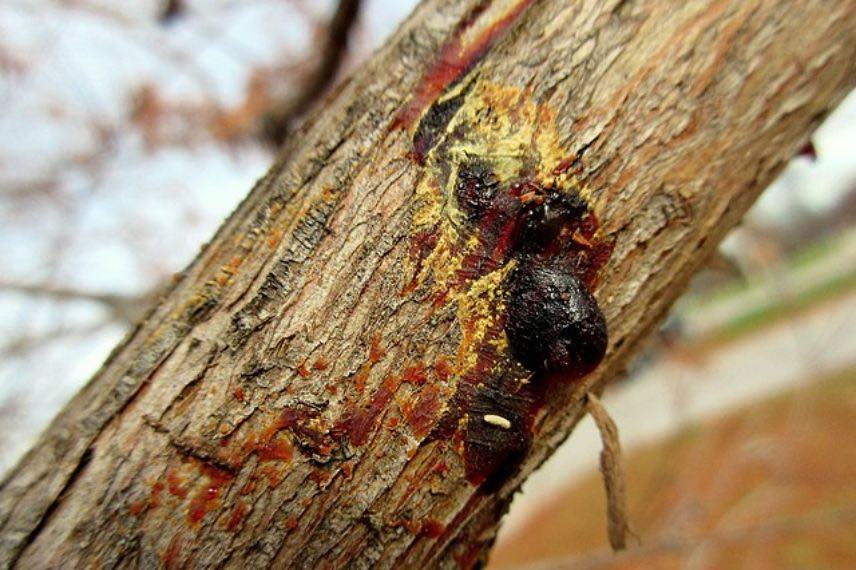
The bark cracks. Resin exudates appear. Cankers appear.
Read also
Major diseases and pests of conifersRed spider mites
Red spider mites can attack cypress. These microscopic pests are red and suck sap from plants.
Symptoms
Red spider mites measure about 1 mm and are difficult to see with the naked eye. Their presence is noticed by white silken threads that resemble fine spider webs. The leaves may change colour and become white, yellowish or greyish. They eventually dry out and fall off.
Prevention
Red spider mites proliferate in a dry and hot atmosphere (above 30°C). They also favour soils rich in nitrogen.
To prevent their appearance, you can spray the cypress leaves with rainwater when it is hot and dry, especially if your cypress is in a greenhouse.
You can also use nettle manure or horsetail manure to spray the cypress leaves.
It is also advisable to avoid using nitrogen-rich fertilisers, which can attract mites.
Treatment
There are several treatments.
You can spray the branches and leaves with a solution based on rosemary essential oil, liquid black soap and rapeseed oil.
Mix 20 to 25 drops of rosemary essential oil with 4 drops of liquid black soap and 5 ml of rapeseed oil in 1 litre of water.
Another option, spray with a garlic decoction prepared with 30 g of garlic in 1 litre of water and diluted to 30%.
You can also resort to predatory mites of red spider mites, such as the Phytoseiulus persimilis and lacewings.
Further reading: see our advisory sheet: “Red spider mite: identification and treatment”.
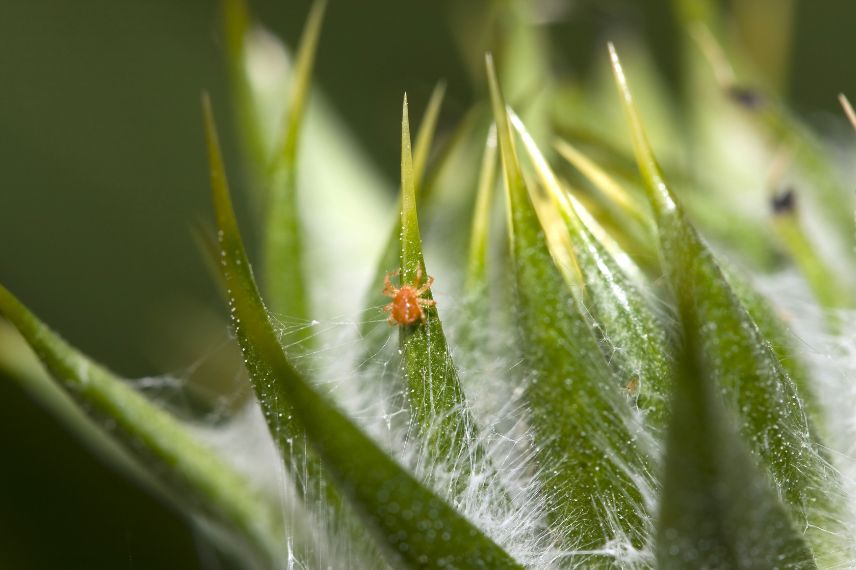
Red spider mites are difficult to see with the naked eye, but their white threads are even more noticeable
Aphids
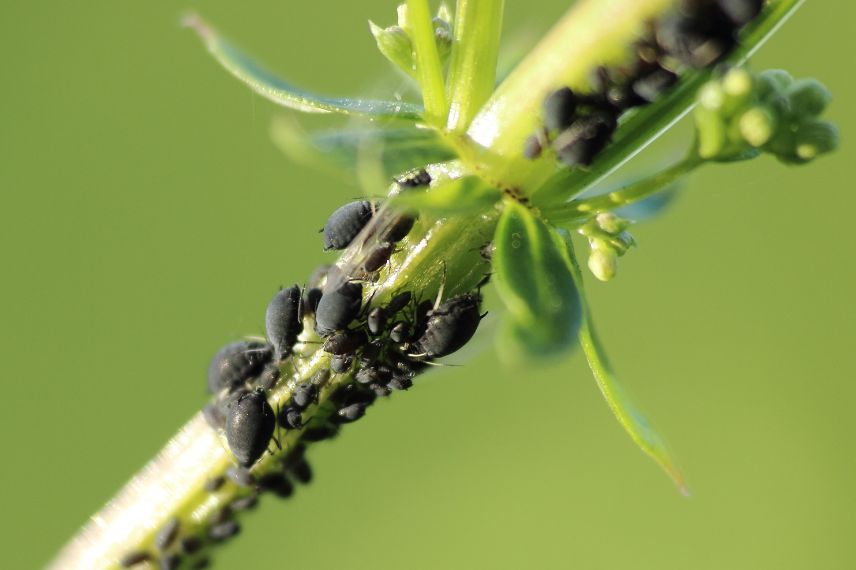
Aphids are small sap-sucking insects commonly found in a garden. They come in green, black or yellow, and measure between 2 and 4 mm.
Symptoms
The presence of aphids is evidenced by a slowdown in the plant’s growth and honeydew, a black, sticky substance that appears on the leaves.
Prevention
Encourage the establishment of beneficial insects and wildlife that will eat aphids, such as ladybirds and blue tits.
Treatment
To get rid of established aphid colonies, you can dislodge them with a strong jet of water or spray a black soap-based solution. Mix 15 to 30 g of liquid black soap in 1 litre of water and spray onto the affected branches.
You can also place a glue ring around the trunk or branches of the cypress to trap the insects.
For further reading, see our article: Aphids: identification and treatment.
Scale insects
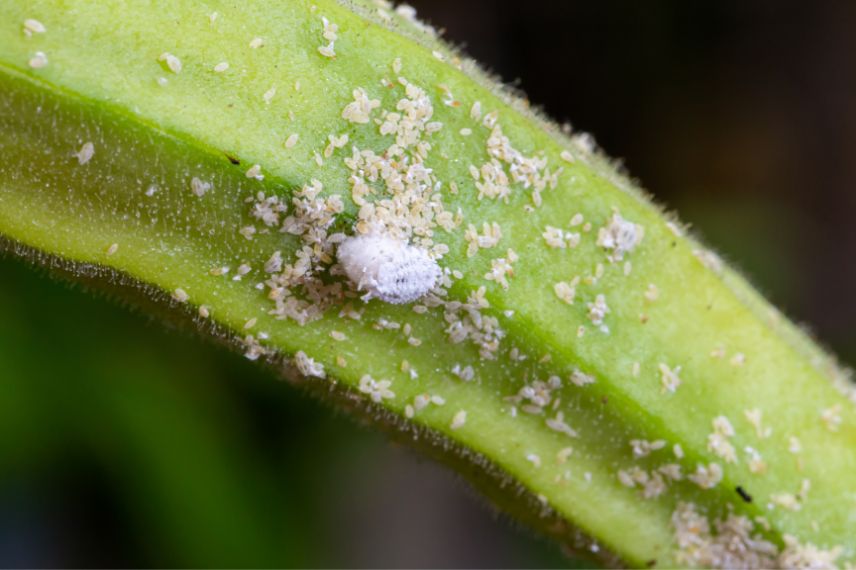
Mealybugs are also small sap-sucking insects that are difficult to see with the naked eye. There are mealybugs, armored scales, or shield scales.
Symptoms
Mealybugs reveal their presence by sooty mould, a sticky black powder that covers the leaves, or small patches of whitish secretions or small brownish spots.
Prevention
Mealybugs thrive in warm, humid conditions. Avoid placing the cypress in a confined environment that promotes their proliferation and place it in a well-ventilated outdoor setting.
Treatment
To get rid of mealybugs already established, you can use a strong jet of water on the branches or spray a homemade solution you have prepared. Mix 1 teaspoon of liquid black soap, 1 teaspoon of denatured alcohol and 1 teaspoon of vegetable oil such as rapeseed in 1 litre of water and spray onto the affected branches.
For more information, consult our advice sheet: Mealybug: identification and treatment.
To learn more about Cypress, discover our comprehensive guide to Cypress: planting, pruning and care, and our full range of cypresses.
- Subscribe!
- Contents
Comments