





























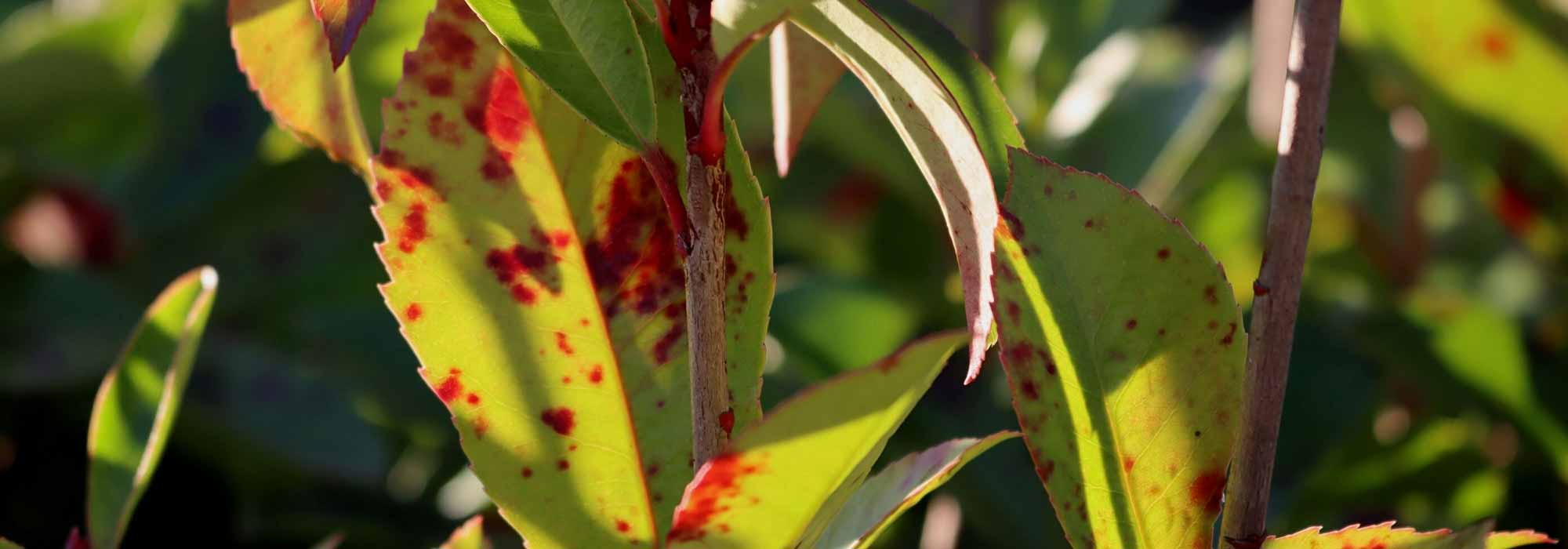
Diseases and parasitic pests of Photinia
Identification and natural treatments
Contents
Photinia is a popular shrub for its rapid growth and evergreen foliage, with changing colours. It is perfect for forming dense privacy hedges, effective in all seasons and requiring little maintenance, but it can also be planted at the back of a border, as a specimen, or even in a container for the most compact varieties. In spring, its new shoots are often bright red, as in the well-known variety ‘Red Robin’. Photinia thrives in cool, deep soil, acidic or neutral, but tolerates drought and soils that are slightly calcareous.
Although it is fairly hardy and easy to live with, Photinia can sometimes be attacked by diseases or pests. To limit damage and prevent them from spreading in your garden, it is important to recognise them at the onset of the first symptoms and to know how to remediate. Discover all our advice!
→ Find our complete guide Photinia: planting, pruning and care.

Powdery mildew
Powdery mildew is a cryptogamic disease caused by a microscopic fungus. It is favoured by warm, humid conditions and poor air circulation.
Symptoms: It appears as a white or grey powdery coating on the leaves, stems and sometimes the flower buds. In severe infestations, young leaves, shoots and buds may become deformed.
Prevention methods: Confined environments and humidity promote the development of powdery mildew. Ensure good air circulation around your Photinia by avoiding planting too densely and by pruning from time to time. Avoid overwatering, as well as nitrogen fertilisers. Spray a horsetail decoction onto the Photinia, which has fungicidal properties.
Treatments: As soon as the first symptoms appear, remove the affected parts to limit the spread of the disease. To treat powdery mildew, you can spray a solution of bicarbonate of soda onto the affected parts of the plant. Thanks to its alkaline pH, bicarbonate blocks the growth of the fungi. Another option is milk diluted in water at a 1:10 ratio. If that is not sufficient, use a sulphur-based solution (at a rate of 7.5 g of powder dissolved in 1 litre of water) to be sprayed on the foliage.
Notre fiche-conseil : “Powdery mildew or the white disease: prevention and treatment”
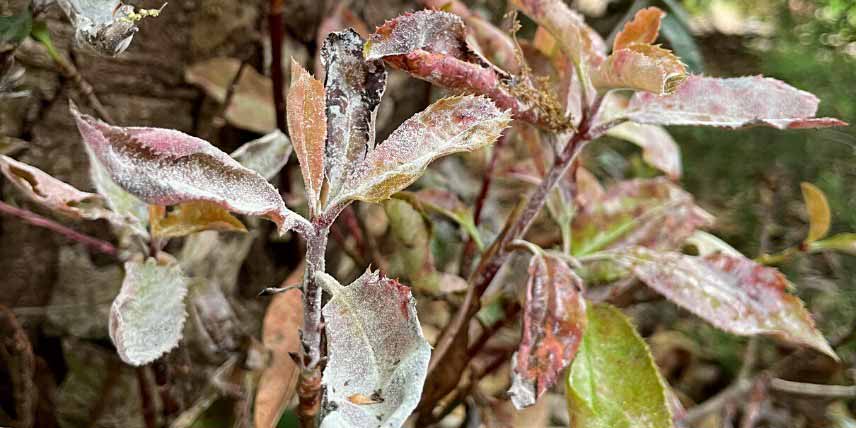
Powdery mildew leads to the appearance of a grey powdery coating and sometimes deformation of young shoots (photo: Matt Borden)
Entomosporiosis
Entomosporiosis is a cryptogamic disease caused by the fungus Entomosporium maculatum. It thrives particularly in humid conditions and can be very damaging to Photinia. It also attacks other shrubs in the Rosaceae family, such as quince trees, cotoneasters, loquats, and Amelanchier…
Symptoms: Entomosporiosis appears as round spots 1–3 mm in diameter, dark brown to reddish on Photinia leaves. These spots then develop a small, characteristic brown crust, and they are sometimes surrounded by a yellow halo. In cases of heavy infestation, the affected leaves may yellow and drop.
Prevention methods: The fungus responsible for this disease develops mainly in humid weather in spring and summer, while drought slows its progression. To prevent entomosporiosis, avoid overhead watering, which promotes moisture on the leaves. Ensure you space your plants to promote good air circulation, and remember to prune from time to time. Remove and destroy infected leaves, as well as those that have fallen to the ground, to limit the spread of the disease. When pruning, remember to disinfect your tools with 90% alcohol. You can also use a horsetail decoction, rich in silica, which strengthens the plant’s tissues and makes it less susceptible to fungal infections.
Treatments : To treat entomosporiosis, we recommend using Bordeaux mixture, at 20 g per litre of water, as soon as the first symptoms appear. Repeat the treatment one month later.
Our advice sheet: Entomosporiosis: prevent and control
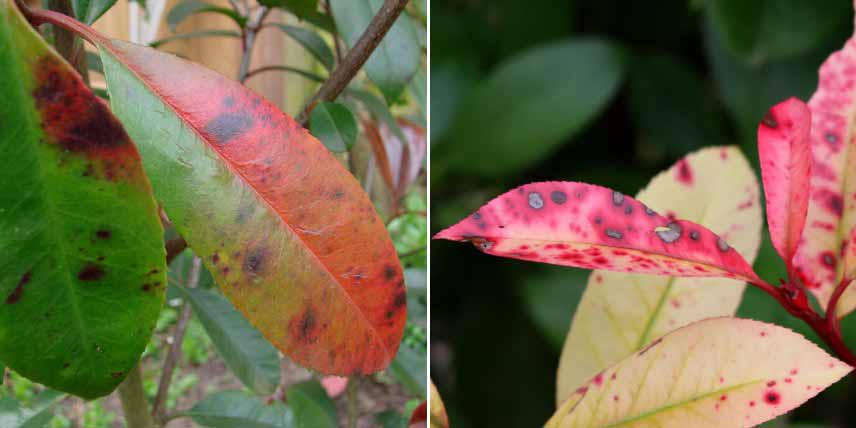
Entomosporiosis is characterised by the appearance of red or brown spots (left photo: Vangelis7)
Fire blight
Fire blight is caused by the bacterium Erwinia amylovora. It is a serious disease that affects certain shrubs in the Rosaceae family such as cotoneasters, pyracantha, Amelanchier, bird-cherries and hawthorns, as well as fruit trees such as apples, pears and quinces. This disease can spread quickly and affect several types of plants in the garden.
Symptoms : Fire blight manifests as wilting and browning of the leaves, shoots and flowers, which take on a burnt appearance. The affected parts may also exhibit a viscous ooze. Plants affected by fire blight are unfortunately doomed. They can die within just a few months.
Prevention methods : The best way to prevent fire blight is to disinfect pruning tools and avoid excess moisture. It is also recommended to monitor the symptoms and act quickly if you suspect an infection.
Treatments : There is no curative treatment. If your Photinia is affected by fire blight, you will need to remove it and burn it as soon as possible to limit the spread of this disease. Control of fire blight is obligatory. In case of spread, you should notify your local council or the Regional Plant Health Service.
Our advice sheet: “Fire blight: preventing and combating this disease”
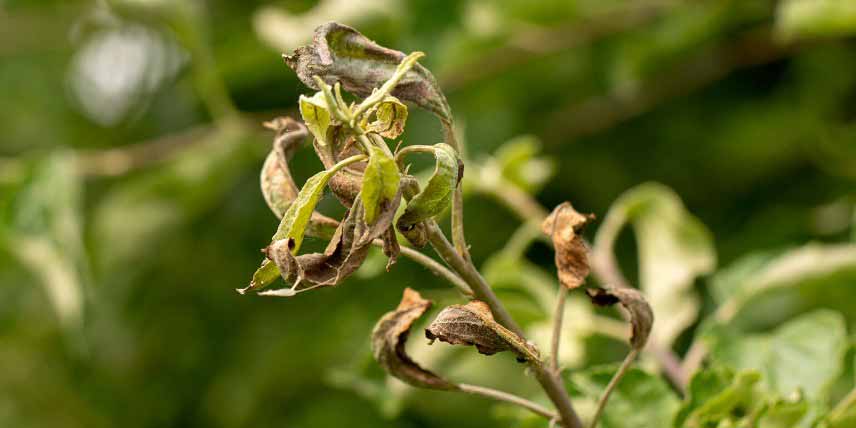
Young shoots of an apple tree affected by fire blight
Read also
When and how to prune Photinia?Aphids
Aphids are small insects that pierce leaves and new shoots to feed on sap, which weakens plants. They can transmit diseases and cause sooty mould to develop.
Symptoms: Aphids generally cluster on new growth and leaves. They suck sap, which sometimes causes leaf deformation and slows the plant’s growth. They excrete honeydew, on which sooty mould can develop, a cryptogamic disease characterised by the appearance on the foliage of a black, sooty layer. This limits photosynthesis and weakens the plant.
Prevention: Encourage natural predators such as ladybirds in your garden. Avoid excess nitrogen fertilisers, as they promote aphid proliferation.
Treatments: We recommend using black soap, 15–30 g per litre of water. Mix well and spray this solution on the foliage at the first signs of attack. If that is not enough, use a pyrethrum-based insecticidal product.
Our advice sheet: “Aphid: identification and treatment”
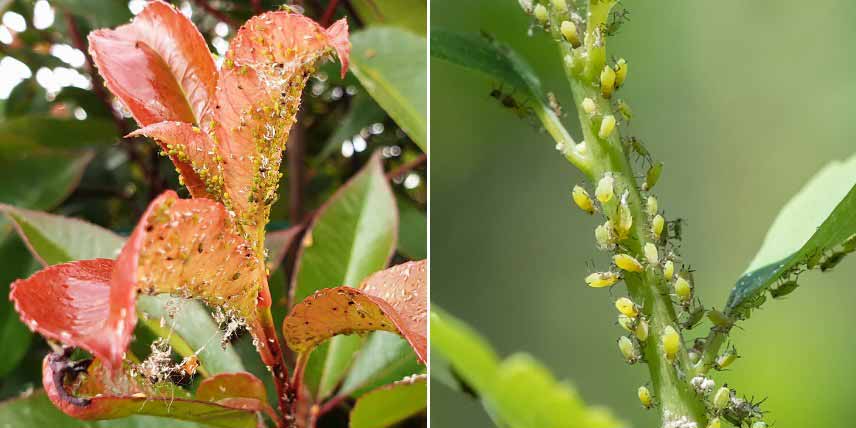
Green aphids
Otiorhynchus weevils
Vine weevils are small beetles measuring 7–10 mm in length and are generally dark in colour. They are cousins of weevils. They spend the majority of their life in the soil as larvae, where they feed on the roots of plants. The larvae then pupate to become adults, which chew the leaves. They are predominantly active at night. They attack many shrubs, such as rhododendrons, privets, viburnums or cherry laurels, but also perennials such as Astilbes, Heucheras and bergenias…
Symptoms: The presence of vine weevils is indicated by chewed leaves, often crescent-shaped or irregular holes along the margins. New growth may also be affected, resulting in slowed plant growth. Damage caused by the larvae is harder to recognise, as it is less specific. The roots are damaged and excavated, and the plant then stops growing and gradually wilts.
Prevention methods: To prevent an infestation of vine weevils, carefully inspect the roots of plants you buy before planting. If larvae are hiding in the rootball, you can remove them. If the roots are damaged, that may indicate an infestation of vine weevils. Create hedgehog refuges (leave a pile of wood or fallen leaves in a corner of the garden): they feed on the larvae present in the topsoil. Rosemary, thyme and garlic are also said to have repellent properties against vine weevils.
Treatments: The most effective method for controlling vine weevils is to use nematodes, microscopic worms that parasitise and kill the larvae in the soil. When you spot adults on the foliage, remove them manually to limit their proliferation.
Our advice sheet: “How to get rid of vine weevils?”
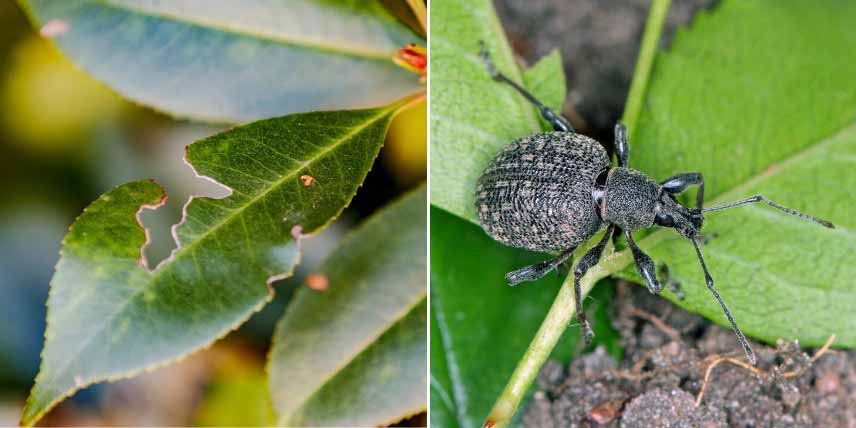
Vine weevil damage is characterised by leaves chewed along the edge of the lamina
- Subscribe!
- Contents
Comments