


From dock in the garden: how to combat it?
An adventive a bit boring
Contents
Rumex or dock or large sorrels are “weeds” or adventive plants in crops and gardens. These undesirable herbs particularly appear in heavy, compacted soils that are overly enriched with nitrogen and potash. To get rid of them, one can opt for manual removal with a spade or choose to modify their cultural practices. The two main Rumex species in the garden are blunt-leaved dock and curly dock.
→ Let’s take stock of Rumex and how to eliminate them!

What is this plant?
Firstly, we should talk about Rumex in the plural. Indeed, there are around twenty species just in France, with nearly 200 species distributed worldwide. The genus Rumex belongs to the family Polygonaceae: the family of rhubarbs, knotweeds, and bistorts…
We know Rumex acetosa, common sorrel, and Rumex acetosella, sheep sorrel. However, in our gardens, we may sometimes find Rumex obtusifolius, blunt-leaved dock, and especially the bane of farmers and gardeners, Rumex crispus, curly dock or curled sorrel, also known as patience dock.
Rumex is easily recognisable:
- thick upright and channelled stems;
- sagittate leaves shaped like a spearhead (it seems that the Latin name means “spear” or “lance”) for Rumex obtusifolius, but very large ovate leaves with undulate edges for Rumex crispus;
- small membrane (ochrea) enveloping the nodes, characteristic of plants in the Polygonaceae family;
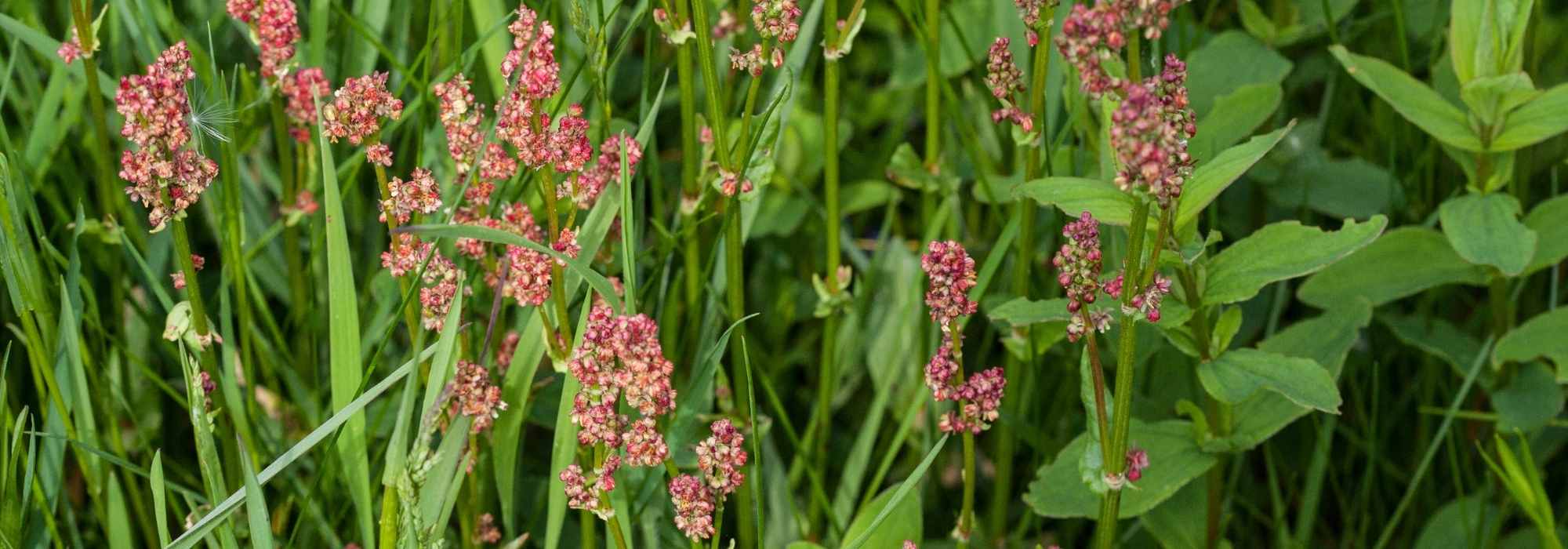
- flowers arranged in tiers, forming long clusters, green then purple at ripeness.
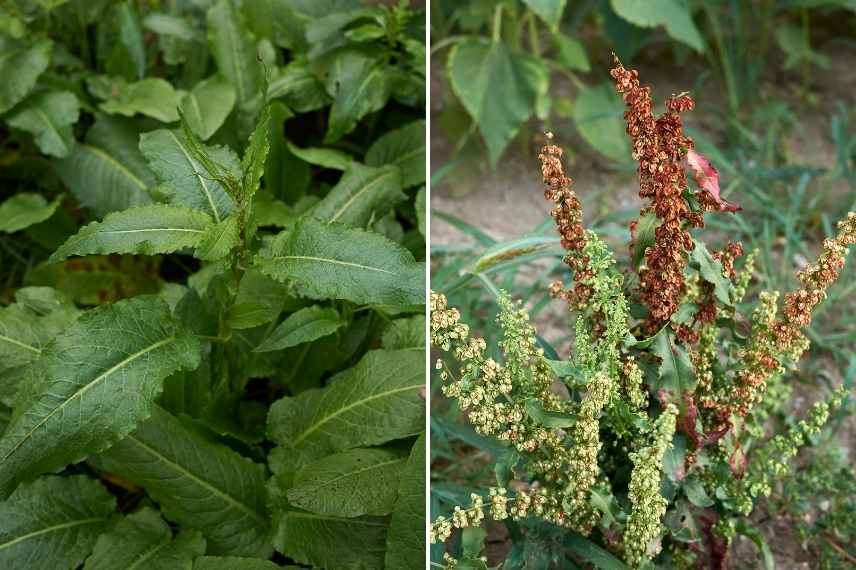
Rumex obtusifolius and Rumex crispus
Read also
10 good reasons to let weeds growWhy does dock establish itself in the garden?
Rumex thrive in clayey and relatively cool soils. Curled dock (Rumex crispus) prefers rather calcareous soils, while blunt-leaved dock (Rumex obtusifolius) favours slightly acidic soils.
Moreover, garden docks (Rumex crispus and Rumex obtusifolius) appreciate high-nitrogen soils enriched with potash, often waterlogged and rich in organic matter.
However, these plants are also indicative of overly compacted soils (due to machinery traffic, repeated trampling by animals and humans). These compacted and overly rich soils may lack oxygen, causing nitrates to convert into nitrites and releasing toxic aluminium and iron ions.
Heavy metals can also break the dormancy of dock seeds. Therefore, dock can also indicate the presence of these pollutants.
 Blunt-leaved dock colonises compacted soils
In other words, docks are organic indicators and their presence serves as a genuine warning for the gardener.
How to eliminate dock?
The root of the dock is taprooted and can penetrate up to 2.5 m deep into the soil. It is therefore difficult to uproot the plant simply by pulling it out by hand. Often, all you end up with are a few leaves and a somewhat slimy substance… The dock is a perennial plant, and after just 3 years, the lateral adventitious roots can, in turn, become main roots and give rise to another plant. Gradually, the dock spreads.
It is necessary to remove the dock using a spade, or a root-cutting spade (like a root cutter spade) or a sturdy weeding knife when it is still young. It is advisable to deal with docks before they set seed to prevent them from reseeding everywhere.
A modification of the soil and cultural techniques can also gradually limit the presence of dock: primarily an interruption of nitrogen fertilisation and a cessation of soil compaction. Adding compost, lightly working the soil, and applying a layer of RCW in autumn can help limit the proliferation of dock.
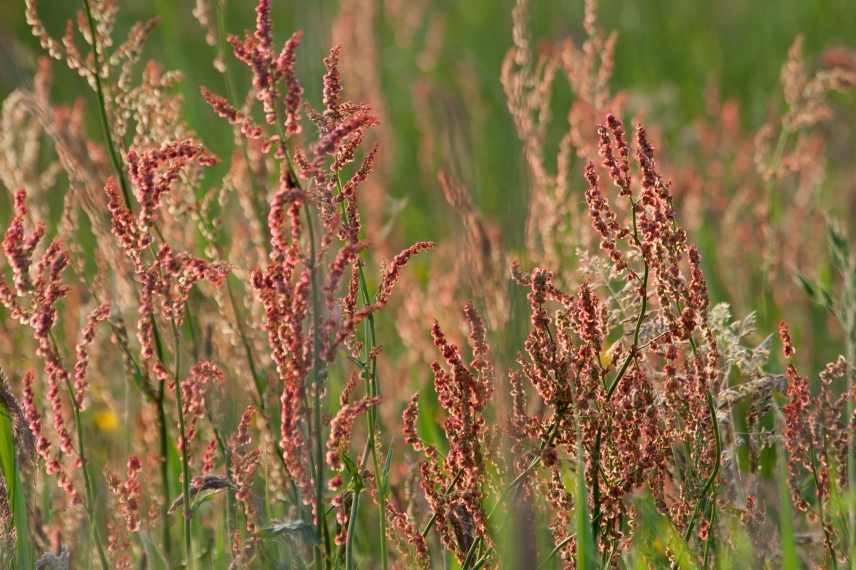 Typical inflorescences of dock
Should we really fight against dock?
The plant is avoided by livestock as it is toxic to animals. Consequently, in a meadow, the proliferation of dock limits the usable area, which devalues the land. In the garden, we do not have this perspective in mind, but some find the plant unsightly.
However, dock in the garden also does its job: by absorbing nitrates and heavy metals, dock helps to purify the soil.
Please note: furthermore, docks in general are host plants for many butterflies: the caterpillar of the vine-plant moth can feed on Rumex obstusifolius and curly dock serves as food for the caterpillar of a noctuid, the Dark-Light.
- Subscribe!
- Contents
![[remove_plant plant_name="Rumex"]](https://en.promessedefleurs.eu/blogwp/wp-content/uploads/2022/06/Du-rumex-au-jardin-comment-lutter-.jpg "From sorrel in the garden how to fight")
Comments