





























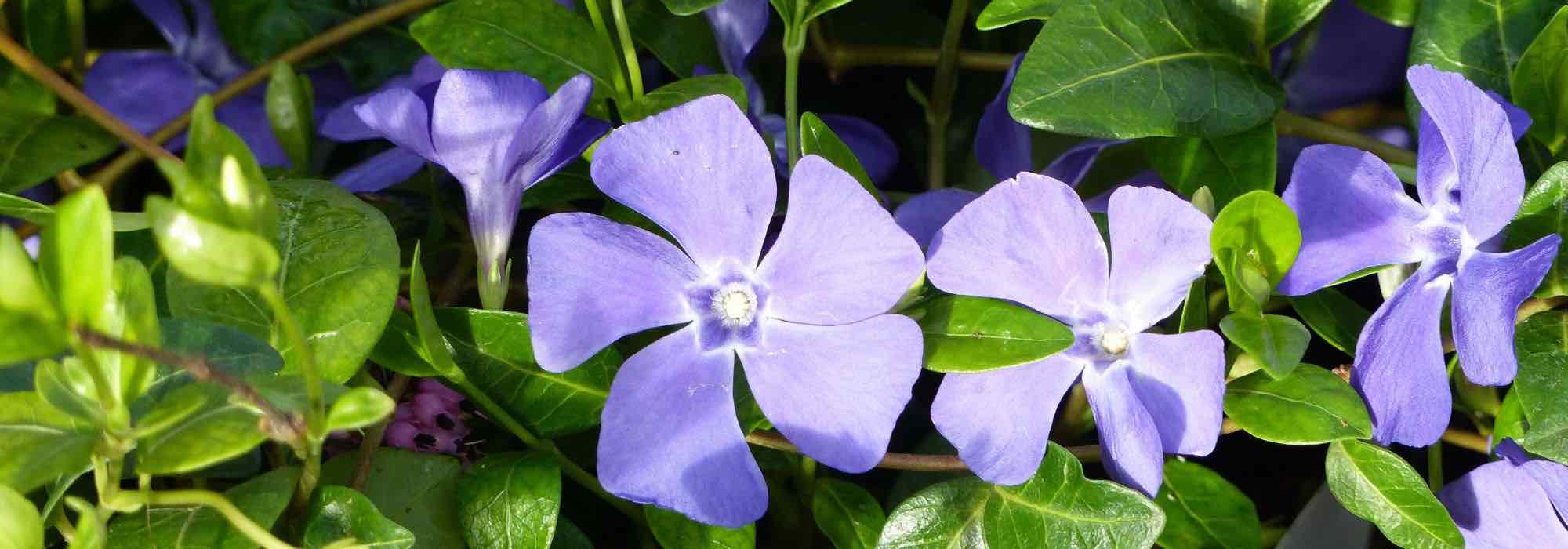
Growing a periwinkle in a pot
to fill a pot all year round
Contents
The periwinkle or Vinca is an easy plant to grow in both the ground and in pots, requiring no maintenance. Take advantage of its conquering qualities to quickly fill a pot or hanging basket, either alone or as a groundcover, and enjoy its fine foliage present all year round and its prolific flowering once or twice a year. Very hardy and virtually indestructible, it is a plant you can almost forget about, and it won’t hold it against you.
Discover our tips for planting periwinkles in pots and enjoy worry-free, well-filled containers that are resilient to all conditions.

How to grow periwinkle in pots? Which varieties to grow?
Periwinkle is a very easy perennial to grow; it requires only a bit of soil and water, and protection from scorching sun. It grows quickly and can become invasive. In pots, this allows you to quickly achieve a lush display, which you can then prune to shorten or use to fill other pots. Alone or as groundcover for a bush or a sufficiently large perennial, you simply need to avoid growing it alongside plants that may struggle against its competition.
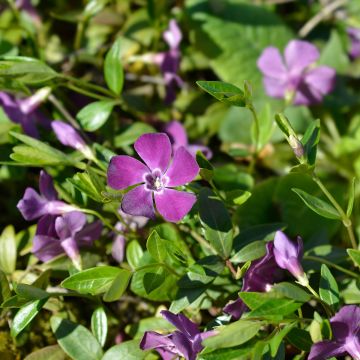
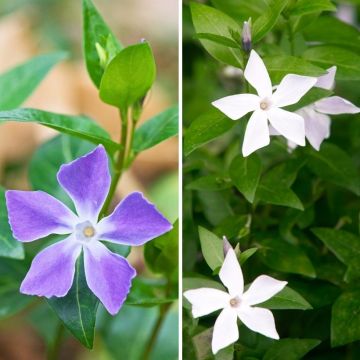
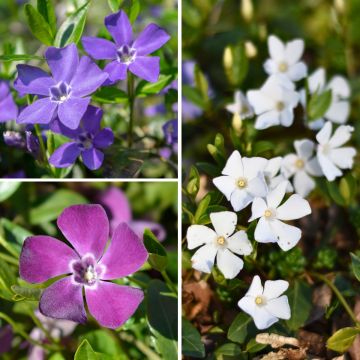
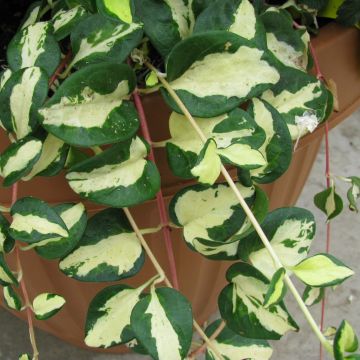
All varieties are suitable for pot cultivation. However, prefer Vinca minor for pot planting, as it has a denser and less bushy growth than Vinca major. You can choose from varieties with white, blue, mauve-violet, and purple flowers. You can also grow varieties with attractive green foliage variegated with a cream edge, such as Vinca minor ‘Ralph Shugert’, or variegated with cream and adorned with a silver margin like ‘Argenteomarginata’, or even the opposite with yellow foliage edged in green, as seen in the variety ‘Illumination’.
The species Vinca difformis, rare in cultivation, is a possible choice in regions that are not or are only slightly frost-prone; it is hardy down to about -7°C. It produces lilac flowers with slender petals, finer than those of other species.

Clockwise from top: Vinca minor ‘Gertrude Jekyll’, Vinca difformis, Vinca minor, Vinca minor ‘Anna’, Vinca minor ‘Ralph Shugert’, Vinca minor ‘Illumination’, Vinca minor ‘Atropurpurea’
Read also
Periwinkle: planting, growing and careWhat type of pot? What size?
Vinca, although it tolerates dry soil in open ground, blooms better in moist soil. The substrate dries quickly in a pot, especially in a porous terracotta pot. It may be preferable to opt for other pot materials to retain moisture a bit longer. However, if you choose a terracotta pot that is significantly larger than the small nursery pot of the vinca, the substrate will take longer to dry due to its volume; terracotta is suitable for a while, until the plant has developed well and its roots absorb water much more quickly.
Use a pot with drainage holes or drill a few holes yourself if it doesn’t have any.
Choose a pot that is wider than it is tall, as vinca is a low-growing plant that spreads significantly. A pot 20 cm deep is sufficient; for the width, it’s up to you to decide how much area you want it to cover, as there are no limits!
Hanging pots are well-suited to the habit and growth of the trailing and cascading vinca.
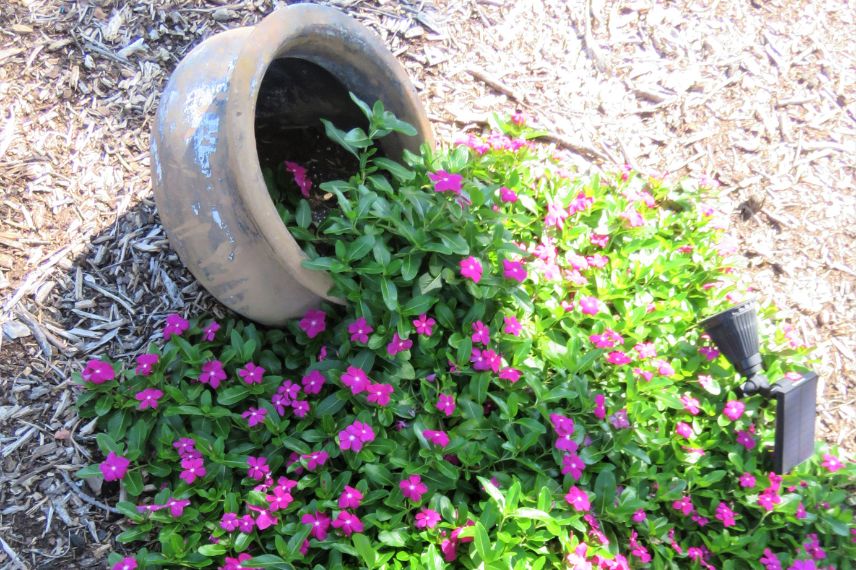
Vinca in pot
Discover other Vinca - Periwinkle
View all →
Available in 2 sizes
Available in 1 sizes
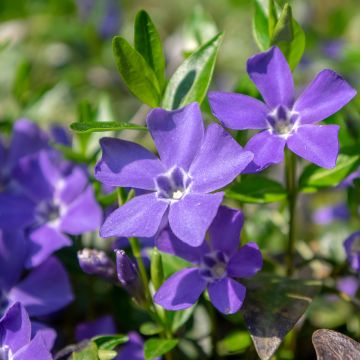
Available in 2 sizes
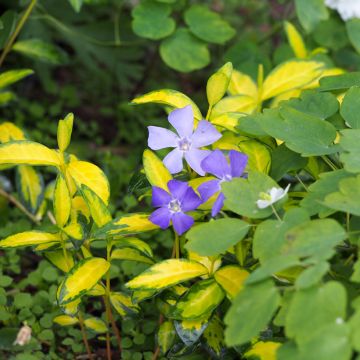
Available in 1 sizes
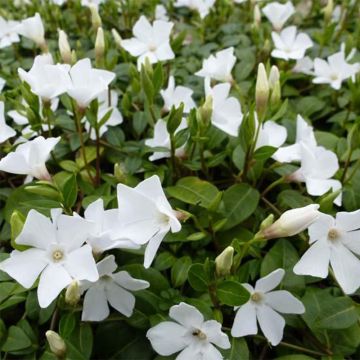
Available in 2 sizes
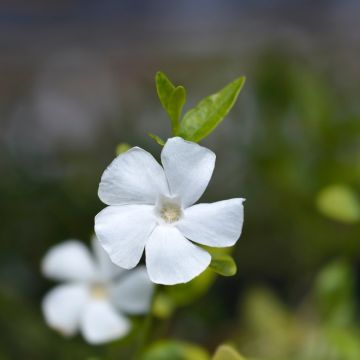
Available in 1 sizes
Available in 2 sizes
Available in 0 sizes
Available in 0 sizes
Available in 2 sizes
What substrate?
Very accommodating in open ground, periwinkle benefits, and so do you, from a slightly draining substrate that retains enough water to keep it a bit cool without needing constant watering.
You can choose to grow it in 100% quality horticultural compost with good water retention. You can also create a mix of 30% compost, 20% compound, 40% garden soil, and 10% sand to improve drainage, or a similar blend.
Also, equip yourself with clay balls and an organic mulch.
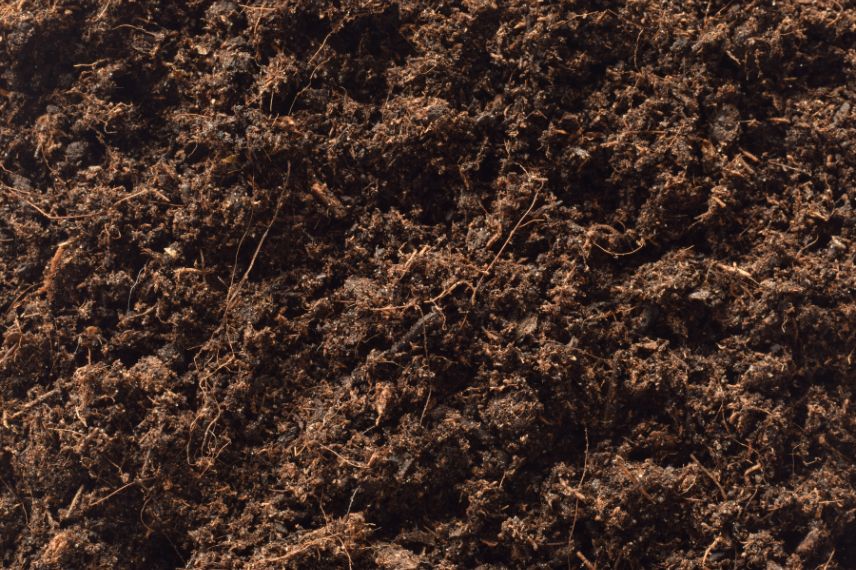
Create a water-retaining substrate for periwinkle
When and how to plant?
Plant periwinkles in autumn from September to November or in spring from March to May after the frosts.
- Moisten the root ball of the plant by soaking it in water while preparing your pot.
- Use a pot with drainage holes at the bottom.
- Fill the bottom of the pot with clay balls.
- Add your potting soil or homemade substrate up to two-thirds of the pot.
- Position the root ball of the periwinkle in the pot.
- Ensure the root ball is slightly sunk, just below the level of the pot.
- Fill in with your potting soil or mixture.
- Lightly compact to ensure the pot is filled with substrate in a homogeneous manner.
- Water generously and check that no air pockets have formed; if so, fill with substrate.
- Spread an organic mulch on the surface of the pot a few centimetres deep to retain moisture.
Where do you install your periwinkle?
Vinca tolerates all exposures, with a preference for partial shade, where it is more floriferous than in full shade. In full sun, it requires more frequent watering, especially in pots. If you can provide it with this partial shade, that is ideal, but the other two exposures also work, provided you avoid the hottest hours in summer or full sun in the warmest regions.
Watering and fertilising?
To support flowering, water your periwinkles in spring. Between waterings, allow the substrate to dry several centimetres down in the pot, even halfway down the pot, then water again.
In summer, water occasionally if the weather is dry to prevent the foliage from drying out.
If the plant flowers again in autumn, water as needed.
No fertiliser for periwinkles; they grow fast enough on their own!
Maintenance
Vinca require little maintenance, except perhaps trimming the stems that extend beyond the pot when they appear unsightly or too long.
- Subscribe!
- Contents
![[plant id="pervenche" growing="pot"]](https://en.promessedefleurs.eu/blogwp/wp-content/uploads/2022/11/cultiver-une-pervenche-en-pot.jpg "[plant id=\"123\" name=\"periwinkle\" growing=\"in a pot\"]")
Comments