





























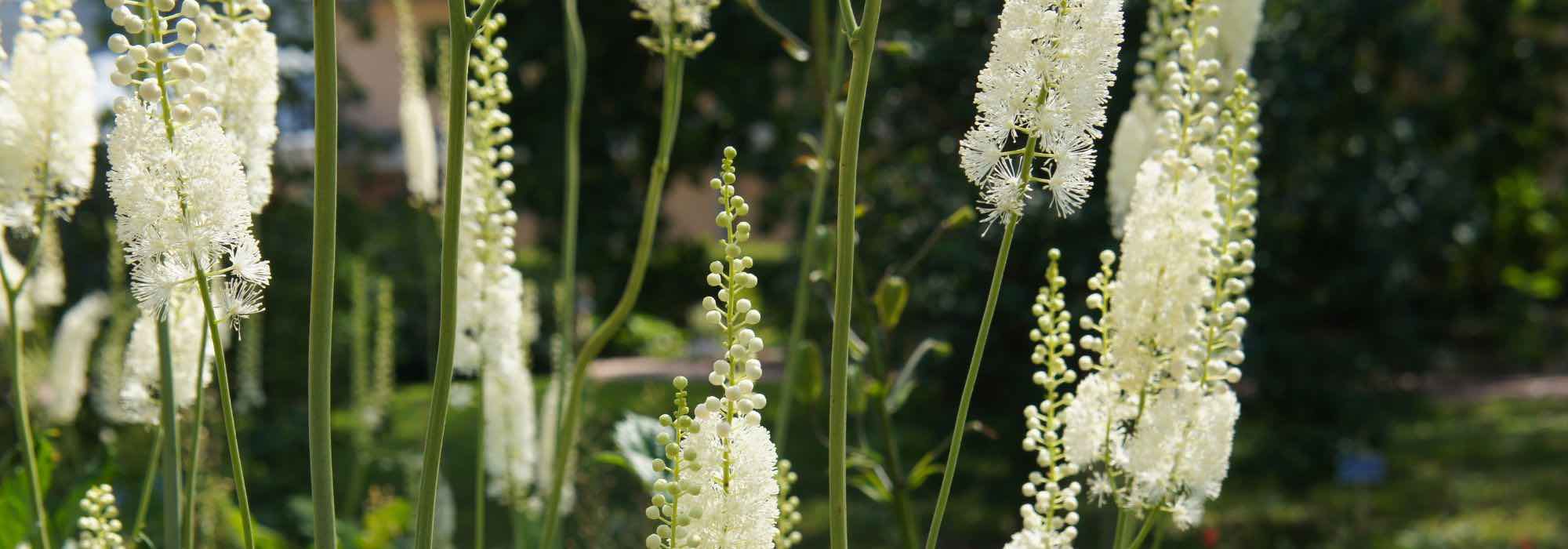
Growing Cimicifuga in pots
Our tips
Contents
Cimicifuga, also known as Actaea, is a perennial plant with elegant foliage and fragrant white flower spikes that brighten shaded gardens in late summer. Often appreciated for its graceful appearance and its value in shaded borders, it can certainly be grown in a pot, provided you understand its needs. If you dream of adding a touch of refinement to your terrace or balcony, without necessarily having a lot of space, Cimicifuga is an excellent choice! In this article, discover how to grow this handsome plant in a pot, by providing it with a favourable environment and all the care it needs to thrive.

Actaea with purple foliage and green foliage

Which Cimicifuga varieties should I choose?
For container planting, choose the most compact Cimicifuga varieties, with reduced growth, always ideal for planting in a smaller container, where they require less maintenance and will thrive longer. Cultivars derived from the species Cimicifuga japonica have more modest growth.
For example, consider the following varieties:
- Cimicifuga ‘Black Negligee’
- Cimicifuga ‘Chocoholic’ with very dark foliage
- Cimicifuga ‘Carbonella’ with high floribundity
- Cimicifuga ‘Cheju-Do’, with green foliage and silvery reflections
- Cimicifuga ‘James Compton’ with a pronounced fragrance
- Cimicifuga ‘Misty Blue’, blue-tinged foliage and clusters of white berries
- Cimicifuga japonica, the type species naturally compact
- Actaea rubra, with bright red berries
Actaeas form plants taller than wide; varieties with a typical growth habit, reaching 1.50 to 1.80 m in height, require deep soil. A pot does not allow them to express their growth properly.

A view of the habit of Cimicifugas
What type of pot? What size?
Choose a pot with a hole at the bottom so that water can drain freely. Choose the material to suit your preferences according to your aesthetic criteria. Simply note that a terracotta pot, porous, will lose the water used for watering more quickly than a plastic pot.
Therefore, terracotta is best reserved for heavy-watered plants, as Cimicifuga requires a substrate that stays cool and moist at all times. However, it is a material that avoids the opposite problem, a characteristic of plastic pots: a substrate that remains waterlogged in case of overwatering.
That said, this drawback isn’t a problem for Cimicifuga, which does not fear waterlogged soil. To limit watering, therefore prefer a plastic pot.
Regarding pot size, start with a pot at least 30 cm deep for a small clump. After a bit of growth, when the plant increases in size, plan to replace it with a pot at least 50 cm deep and 50 cm wide.
Which substrate?
Cimicifuga prefers a soil that is rich and humus-bearing, rather neutral, even heavy and clayey. But beyond its characteristics, the substrate must stay moist, which isn’t the easiest to maintain in a pot.
It is therefore about creating a substrate with excellent water retention and nutrient-rich content, two aspects that go hand in hand. Potting composts are generally slightly acidic or tend towards neutral.
On our site, in the description of the potting composts, there is a section “technical characteristics” where the retention capacity is indicated, in ml per litre or in percentage. Choose the highest one possible, above 70%. Look in the sections for potting compost, multipurpose compost, professional compost, for example.
You can also add a water-retaining additive. An addition of well-decomposed compost in a potting compost mix at a rate of 20–30% of the potting compost volume is beneficial.
It is not necessary to add drainage elements; the most important aspect when growing Cimicifuga in a pot is water retention.
If you have access to clay garden soil, you can make a 1:1 mix of potting compost and garden soil. But it will be harder to keep it moist in summer, as clay soils dry out in summer.
Provide a drainage layer at the bottom of the pot in the form of expanded clay balls, terracotta shards, gravel, pozzolana, to prevent roots from sitting in standing water after watering.
Also obtain organic mulch to retain moisture in the substrate for as long as possible. This step is as important as choosing a potting compost with good water retention. Provide a mulch layer 3–5 cm thick on top of the pot.
When and how to plant?
Plant Cimicifuga preferably in spring, between March and April, so it has time to acclimatise a little before the hotter, drier summer period. You can also plant it in autumn, in October or November. Avoid frost or heat.
Procédez ainsi :
- Add a drainage layer a few centimetres deep at the bottom of the pot in the form of clay balls, gravel or broken terracotta shards.
- Soak the Cimicifuga root ball for about 30 minutes.
- Fill the pot with substrate to about one third of its depth.
- Plant Cimicifuga.
- Top up with potting compost, gently and evenly firming it.
- Fill to within a few centimetres of the rim and firm down again.
- Water thoroughly.
- When the water has been absorbed, add a little substrate if necessary, if any gaps have appeared.
- After a few minutes, water again.
- Apply an organic mulch to a depth of a few centimetres.
Where to plant Cimicifuga?
Cimicifuga is a shade- or semi-shade-loving plant. If it receives too many hours of sun per day in spring and summer, or too much sun during the hottest hours between noon and 4 pm, you will quickly see its foliage scorch around the edges of the leaves.
If you have a balcony or terrace facing north, east or west, it is an ideal plant for you, provided you can offer it a wind-sheltered position. Cimicifuga is a tall, graceful plant whose flowering stems are wind-sensitive. Moreover, wind will dry out the soil and the plant.
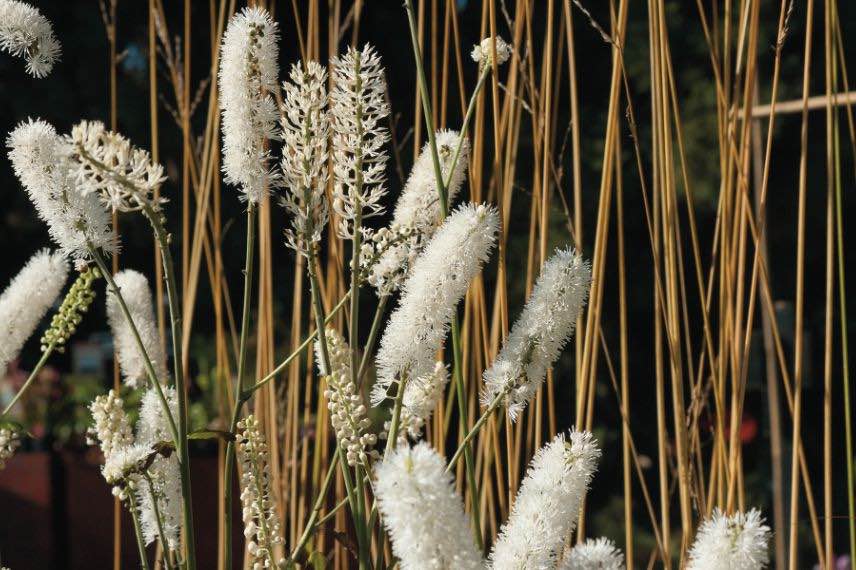
Cimicigugas grow in partial shade. Some varieties have a delightfully fragrant flowering
Care
Pot-grown Cimicifuga is easy to care for.
As the flowering progresses, cut back the faded flowers to encourage new blooms. At the end of flowering, leave the last flowers and the foliage to dry off.
In spring, prune the dry clump back to ground level before new growth begins.
During flowering, you can stake the tall flowering stems if necessary.
Cimicugas are very hardy and rarely troubled by pests or diseases.
Once the clump has a few years behind it, after about five years of cultivation, don’t hesitate to divide it to rejuvenate the clump and obtain a second plant. Do this in spring or autumn, cutting the clump with a spade, favouring one end of the rootstock. It takes about three years to achieve the first dense flowering.
Being a hardy plant, Cimicifuga does not require special winter protection, except in regions with very severe winters. Simply mulch the crown lightly to protect the roots from frost, especially if the pot is exposed to extreme temperatures.
Watering
As noted above, Cimicifuga prefers cool, moist, heavy soil. This latter aspect means the plant is not afraid of staying in consistently wet soil without effective drainage. Soil drying out is the Cimicifuga’s enemy and it suffers fairly quickly from it.
Once planted in a substrate that holds moisture as much as possible and with the surface of the potting mix covered with a thick mulch, you maximise the chances of your watering being effective.
Avoid letting the substrate dry out. Occasionally the Cimicifuga may tolerate it, but keep the substrate as fresh and moist as possible as a baseline, avoiding leaching or continual waterlogging of the substrate. That means if you touch the substrate, it leaves a slight dampness on your fingers because it is “cool”, i.e. some moisture remains inside. You can still allow the substrate to dry a little on the top few centimetres between two waterings, but not more than that and not all the time.
However, the substrate dries more quickly in spring and then in summer, so adjust watering year-round and reduce it substantially once the plant’s deciduous foliage has fallen in autumn. Increase watering during growth and flowering, and even more during hot periods.
Similarly, if your Cimicifuga is planted in shade, the substrate will retain moisture longer than if it receives a few hours of sun per day.
Fertilising
Fertilising will also help Cimicifuga improve moisture retention.
The ideal amendment for achieving this effect is well-decomposed compost if you have some available, applied twice a year on the surface in early spring and late summer.
As an alternative, consider an organic amendment such as vermicompost, one to two times per year, following the manufacturer’s usage recommendations.
- Subscribe!
- Contents
Comments