





























Gypsophila: discover the qualities of different varieties
Poetry for the garden or in a pot
Contents
Gypsophilas are delicate plants known for their ability to create clouds of airy, poetic flowers. Often used in cut flower arrangements for their lightness and beauty, gypsophilas offer a surprising diversity that can transform any garden or cut flower arrangement. In this article, we explore six varieties of gypsophilas, from the popular Gypsophila paniculata to the rare Gypsophila aretioides. Whether you’re looking to add a misty floral haze to your garden, to compose cut flower arrangements, or to discover species suited to specific conditions, you’ll find all the information you need here to choose the gypsophile that’s right for you.
→ Read our gypsophila full guide.

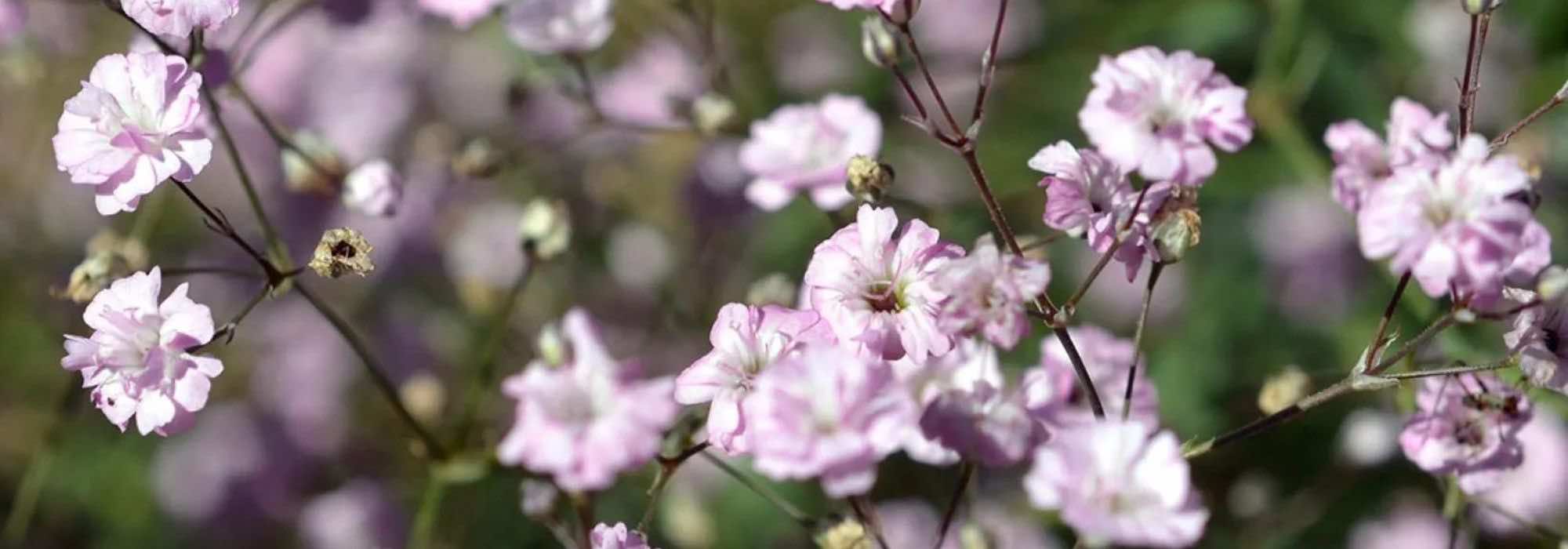
Gypsophila paniculata Festival® 'Pink Lady': florist's gypsophila
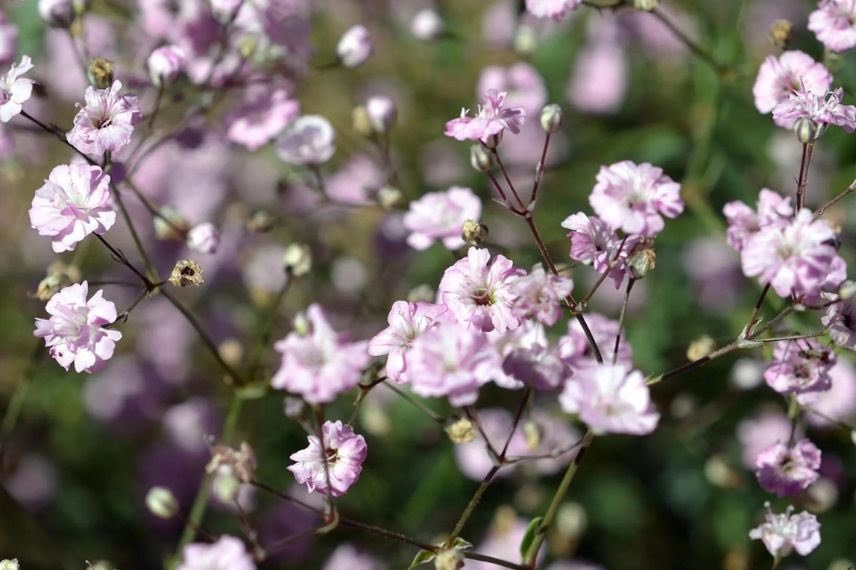
The Gypsophila paniculata Festival® ‘Pink Lady‘ offers a compact size and a bushy habit, making it ideal for container growing or to edge borders. In summer, it cloaks itself in a cloud of tiny pink flowers, with remarkable delicacy and poetry. It pairs beautifully with roses in gardens and in bouquets, thanks to its romantic flowering. Very easy to grow, this perennial thrives in dry, light, well-drained soils in full sun.
‘Pink Lady’ is a horticultural hybrid reaching around 40 cm in height and width at maturity. Its flowering period runs from June to August. The flowers, semi-double and tiny, open in large panicles up to 40 cm wide, creating a light, pink-graded effect. The glaucous foliage, semi-evergreen in winter depending on the climate, consists of small linear, fleshy leaves.
Gypsophila ‘Pink Lady’ fits perfectly into rockeries, sunny borders and beds, where it harmonises superbly with plants in white, pink, mauve and purple tones. It is perfect when paired with plants such as the Salvia ‘Blue Bouquetta’ and the Verbascum phoeniceum ‘Violetta’. It is also highly prized for its delicate contribution to bouquets, whether dried or fresh.
Gypsophila cerastioides: a cushion-forming gypsophile
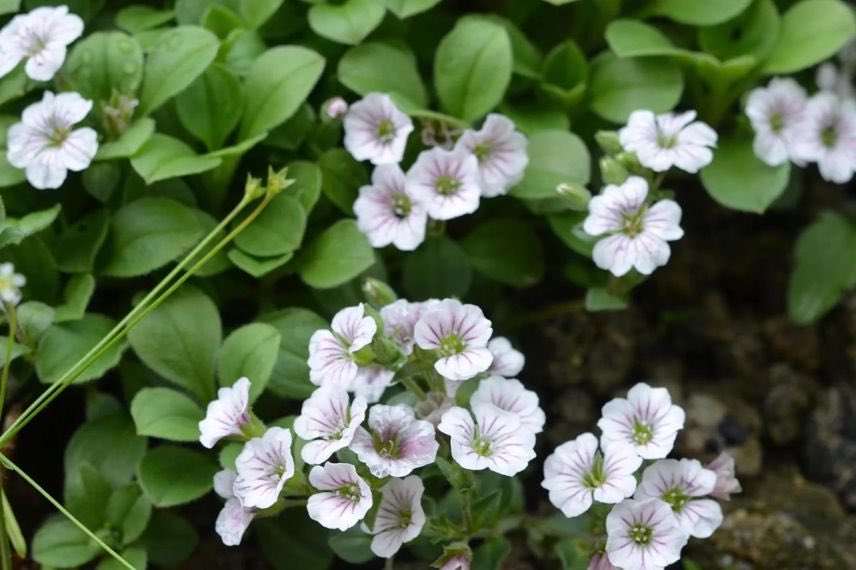
The Gypsophila cerastioides is a perennial that forms a compact cushion of attractive round leaves, no more than 15 cm tall. From late spring to August, the plant bears small white flowers delicately veined with purple, attracting butterflies with their subtle beauty.
Originating in the Himalayan mountains of Pakistan, this Cerastium-leaved gypsophile grows naturally on rocky soils at altitudes ranging from 1,200 to 4,700 metres. It is often found in varied habitats such as mixed mountain forests, woodland meadows, and rocky areas near watercourses. Its prostrate growth is the result of adaptation to the harsh climate, protecting the plant from cold and drought.
The Gypsophila cerastioides presents a low growth habit, with foliage typically under 15 cm in height and about 30 cm wide. Its spatulate, green and villous leaves develop in loose rosettes. In the height of summer, the foliage can turn grey.
Ideal for rockeries alongside other small plants such as Aubrietas, the Gypsophila cerastioides is also grown along a path edge or at the front of a border, in well-drained soil. In pots, it pairs very well with Erodium and Geranium sanguineum.
Gypsophila repens 'Rosa Schönheit': a creeping gypsophila with dark pink flowers.
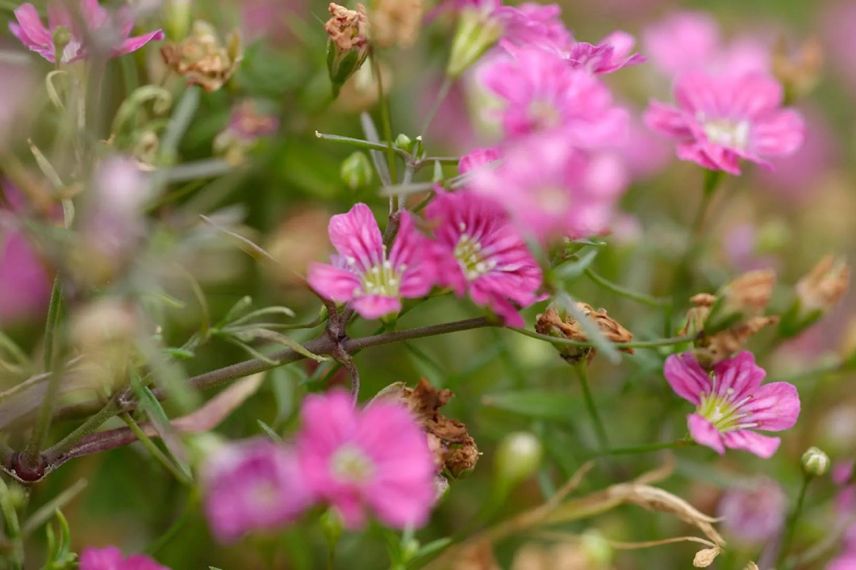
The Gypsophila repens ‘Rosa Schönheit’, known as creeping gypsophila, is a prostrate perennial that forms a dense, vigorous mat. Its semi-evergreen foliage, mid-green with a blue tinge, fine and slightly fleshy, transforms in summer into a cloud of large, deep-pink, starry flowers, typical of the genus, but unusually large, giving the plant a wispy appearance.
Creeping gypsophila originates from European mountains, notably the Iberian Peninsula, France, the Apennine Peninsula, and eastern Central Europe. ‘Rosa Schönheit’, with a naturally spreading, ground-covering habit, reaches maturity at around 20 cm in height by 40 cm in width, or more. Its flowering, lasting from May to August if soil remains cool, consists of numerous five-petalled flowers arranged in cymes to create a light, misty floral effect. The foliage, semi-evergreen, consists of small fleshy leaves, opposite, glabrous, 1–3 cm long, borne on creeping stems that rise and bend at the nodes.
The Gypsophila repens ‘Rosa Schönheit’, recipient of the Award of Garden Merit, sits well in borders of light, well-drained soil, among plants such as old roses and hardy perennials like the Oriental poppy. It highlights large-flowered perennials such as Iris germanica, creating a floral mist.
Read also
Growing gypsophila in potsGypsophila pacifica: taller plants, larger flowers, for heavy soils.
The Gypsophila pacifica, closely related to the Gypsophila paniculata is well known to florists, and stands out for its taller habit, larger flowers and leaves, thicker stems, and its ability to thrive in a range of soil types, including clay soils and cold winters. Its summer flowering, a wispy pink-tinged white, enchants gardens with its lightness and enhances the more pronounced presence of plants with a heavier habit.
Originating from temperate regions of Asia, such as eastern Siberia, Korea and northern China, this species naturally grows in deciduous forests, meadows and low-altitude rockeries. In full bloom, the plant forms a bushy, rounded clump, reaching about 1.30 m in height and 60 cm in width. The flowers, about 1.5 cm in diameter and arranged in loose terminal cymes, bear a campanulate calyx and a pink-tinged white colour. Its deciduous foliage, absent in winter, consists of oval leaves in a green-blue-grey colour, measuring up to 6 cm long by 3.5 cm wide.
Gypsophila pacifica pairs perfectly with the opulent flowers of tree peonies for a striking contrast. This perennial requires little maintenance and tolerates occasionally challenging conditions: a rich, even heavy soil that remains cold in winter and dry in summer is sufficient for its development.
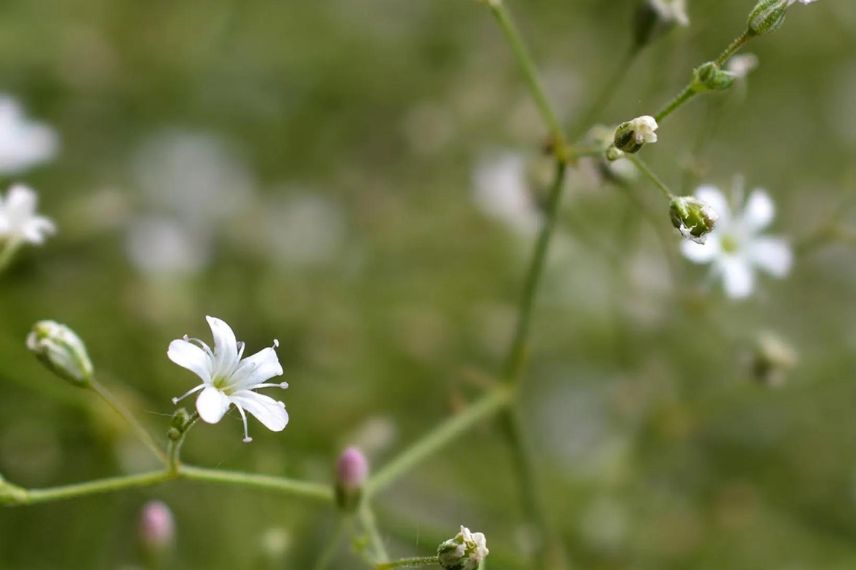
Gypsophila aretioides: a dense cushion of tiny white flowers
Gypsophila aretioides, which was once regarded as a rarity among alpine plants twenty-five years ago, now attracts only limited interest. This perennial is characterised by the formation of an extremely dense cushion, to the point of appearing almost artificial. Over time, after about ten years, the plant evolves into a small hemispherical dome of 10 to 20 cm in diameter.
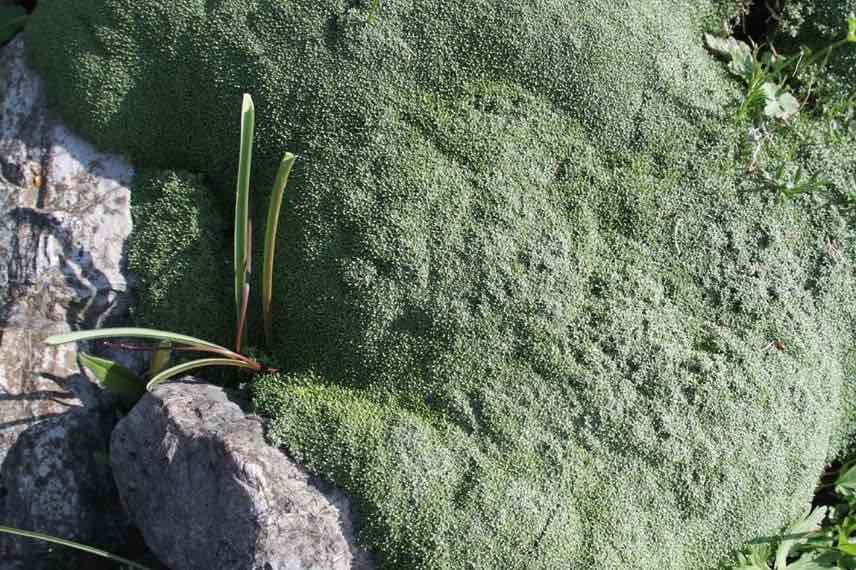
Gypsophila elegans 'Covent Garden': annual gypsophila to sow.
The Gypsophila elegans ‘Covent Garden’ is an annual variety that, on long, slender, ramified stems, bears a multitude of tiny white flowers of exceptional delicacy, stunning when paired with Cosmos or in fresh or dried bouquets.
This plant, with a bushy habit, reaches 45 cm tall and 35 cm wide. The ‘Covent Garden’ variety is distinguished by its single flowers grouped in panicles, with pretty white petals lightly tinged with mauve. Its foliage, consisting of small lanceolate leaves in grey-green, forms a delicate, airy haze. Commonly known as Baby’s Breath in English, this variety is highly regarded for its abundant flowering that lasts from late spring to early autumn.
Essential in white gardens, it is perfect for wedding ceremonies and adds a touch of lightness to borders. For a refined ambience, pair it with delicate Cosmos or Thalictrums. Pot culture is also perfectly feasible.
Despite its delicate appearance, Gypsophila elegans ‘Covent Garden’ is easy to grow. It prefers a sunny position and well-drained soil, not too rich, and even tolerates calcareous soils. Once established, it requires little care or watering.
- Subscribe!
- Contents
Comments