





























How and when to use codling moth traps?
Highly effective attractants against these pests that affect apple, pear and quince trees, etc.
Contents
This is none other than the codling moth of apple and pear trees, more commonly known as Cydia pomonella. If the moth is quite inconspicuous, its larva is less so because of the damage it causes. It bores a spiralled tunnel right inside the fruit, gnawing it down to the pips. And rendering them completely unfit for consumption. Knowing that one to two generations, or even three in the southern regions, can occur in a year, a harvest can be wiped out.
To organic control against this pest, there are attractants and traps that prove highly effective against both males and females. Let us discover together how they work, and, above all, when and how to install them in the orchard.

Understanding the life cycle of codling moths
Let’s get to know Mr and Mrs Cydia pomonella.
A moth that’s hard to spot
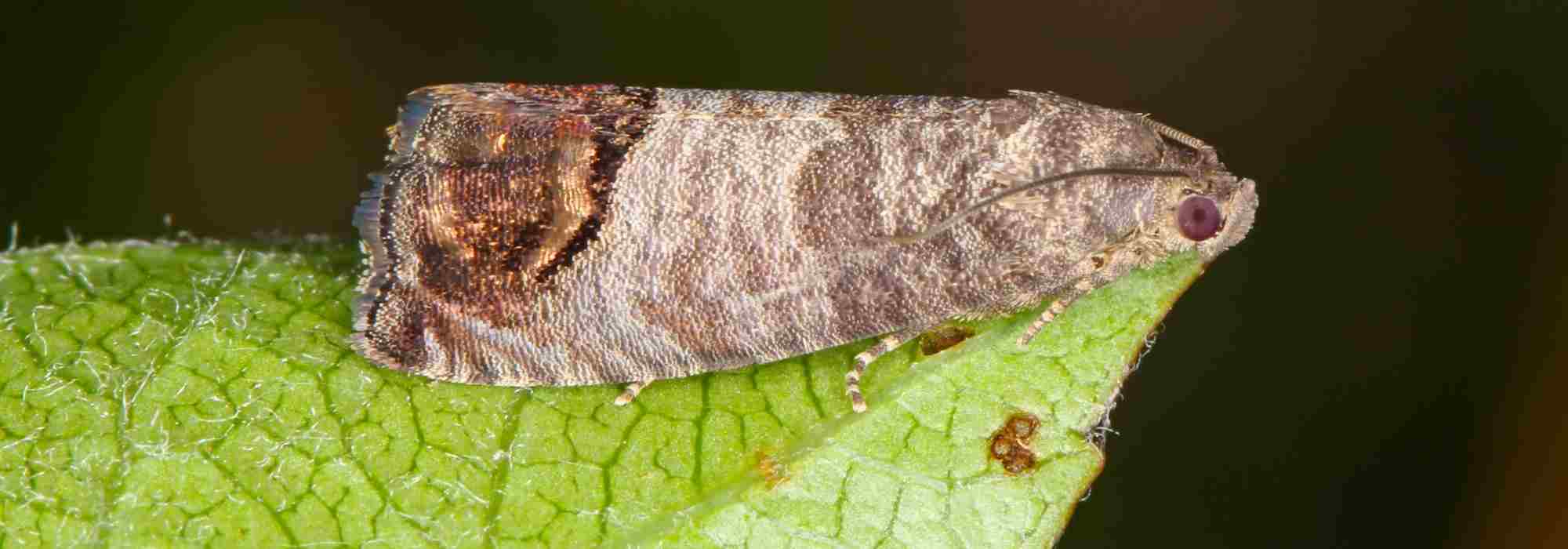
This tortricid moth, a member of the Tortricidae family, is a crepuscular insect of great discretion. First, by its nocturnal flight, which makes it almost invisible. Then, by its size. It bears a grey-brown hue that makes it inconspicuous and invisible in daylight, hidden on the bark. Nevertheless, you can recognise it by its forewings that are striate, marked with a brown oval spot at their tip, and by the copper-coloured hindwings.
According to the regions, from early April to June, at a temperature around 15°C and in dry weather, the adults, emerging from their chrysalis, undertake their first flight. A mating flight that lasts only about a fortnight, depending on climate conditions. The males locate females using the pheromones they secrete. Then, just after mating, oviposition begins on the leaves, young shoots, twigs or fruits in the process of ripening, each female laying between 50 and 100 eggs, lens-shaped, grey and ringed with an orange ring.
The codling moth on apple and pear trees attacks mainly apples and pears, but also quince trees, apricot trees, sometimes peach trees and plum trees, or even walnut trees.
Very voracious codling moth larvae
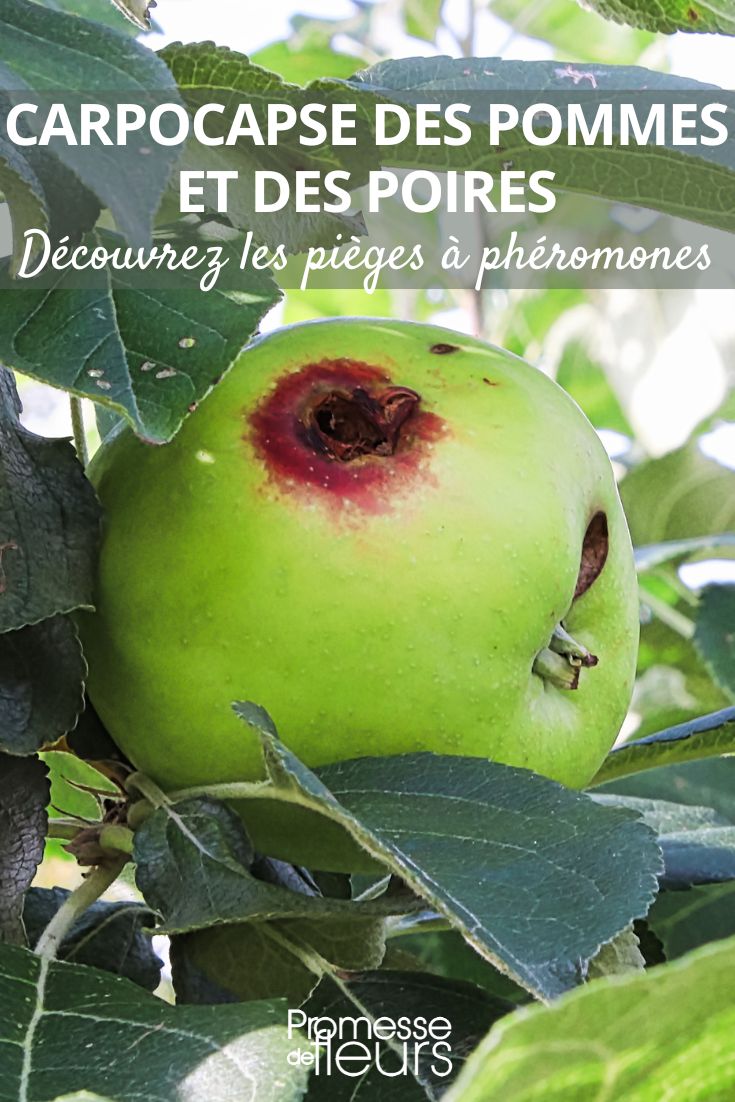
Fifteen days later, the caterpillars hatch. They are about 1.5 mm long, pale at birth, with a black head and a brown thoracic patch. For five days they traverse the twigs in search of a fruit, nibbling a few leaves along the way. This is the so-called “wandering” stage during which these larvae are the targets of numerous predators. When they have found a fruit, they bore a spiral gallery to reach the area of the pips. They stay there for about four weeks to progress through their five development stages. The affected fruits are distinguished by the small entrance hole surrounded by dark frass.
In mid-July, well-fed, the larvae, now pale pink, exit the fruit and spin a cocoon in the crevices of trunks or large branches. If climate conditions are favourable, pupation occurs very quickly. And a second generation may appear, very damaging to the fruit, particularly when the fruit are much more mature. Otherwise, the larvae enter diapause until the following spring. Some may seek shelter in the soil.
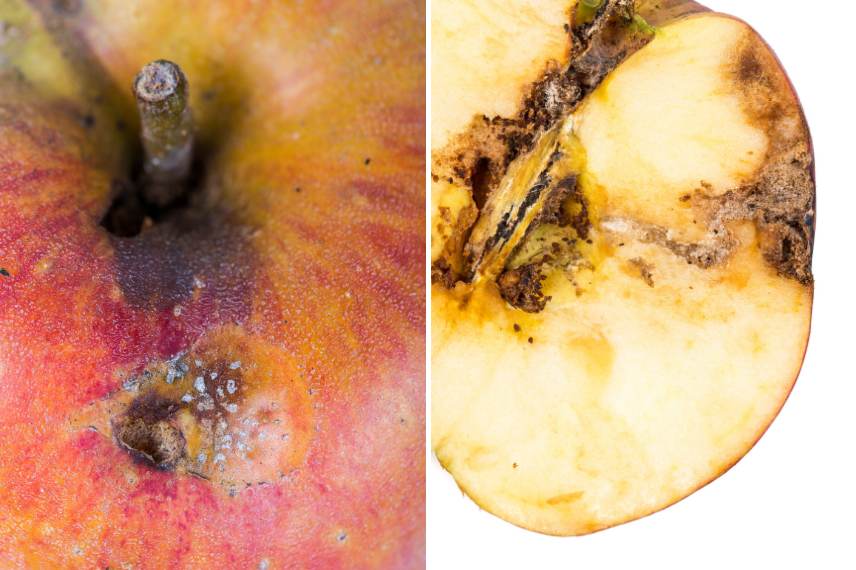
A codling moth attack on apple and pear trees renders the fruit unfit for consumption
Further reading: Codling moth on fruit trees: combating the fruit worm
Read also
Codling moth on fruit treesWhat exactly are attractants—these traps?
If you’re a fan of biological control against the many pests that attack fruit, as well as vegetable crops, trees or shrubs, you’ll already be familiar with pheromone traps. Right? Then a few explanations are in order before discussing attractants.
What is a pheromone trap?
Before we begin, perhaps it’s essential to clarify that all these traps work in a completely ecological and environmentally friendly way in that they are free from pesticides. They attract pest insects and trap them using various methods. Specifically, the pheromone traps are sex traps: synthetic pheromones, similar to those released by the females during nuptial flights, irresistibly attract the males and trap them. Thus, diverted, the males can no longer perform their reproductive function. These traps are not only used to trap the males, but also to monitor their flight to act differently, in a more targeted way, especially in large orchards. However, in small orchards or on a solitary tree, one pheromone trap per tree may be sufficient to prevent any reproduction.
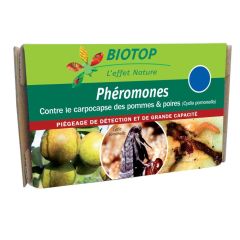
Phéromones Carpocapse des pommes et des poires (Cydia pomonella) Biotop - Etui de 2 capsules
Another type of trap, the male and female attractant
An attractant against codling moths of apples and pears is another type of trap, which targets both males and females for a reinforced effect and even more effective biological control. Attractants play on two fronts: sexual attraction as with pheromone traps, but also appetite and tastiness. Indeed, these are traps that diffuse sexual pheromones to capture the males, but also food baits that appeal just as much to males as to females. Thus, codling moths of apples and pears reproduce considerably less, which limits the spread of the population.
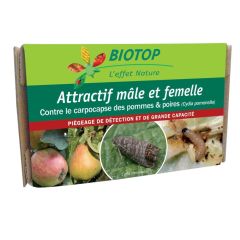
Attractif Carpocapses combo mâles et femelles Biotop - 1 capsule
When and how to install them?
Male and female attractants for codling moths on apples and pears are deployed during the adults’ nuptial flight.
When should the attractants be deployed?
The first nuptial flight begins at the start of April and lasts for quite a long period. Indeed, depending on weather conditions, two to three generations may potentially occur in a year. Therefore, for effective control, it is recommended to deploy attractants until at least September. As a reminder, the moths are mainly active at dusk when the thermometer reads at least 15–16°C.
These attractants have a release period of 8–10 weeks, so renewal of the capsules is obligatory to cover the period from mid-April to September.
Packaged as capsules, these attractants must be used with the brand’s own moth traps, which can take two forms. Either simple plastic funnel traps, or Delta-style hut traps.
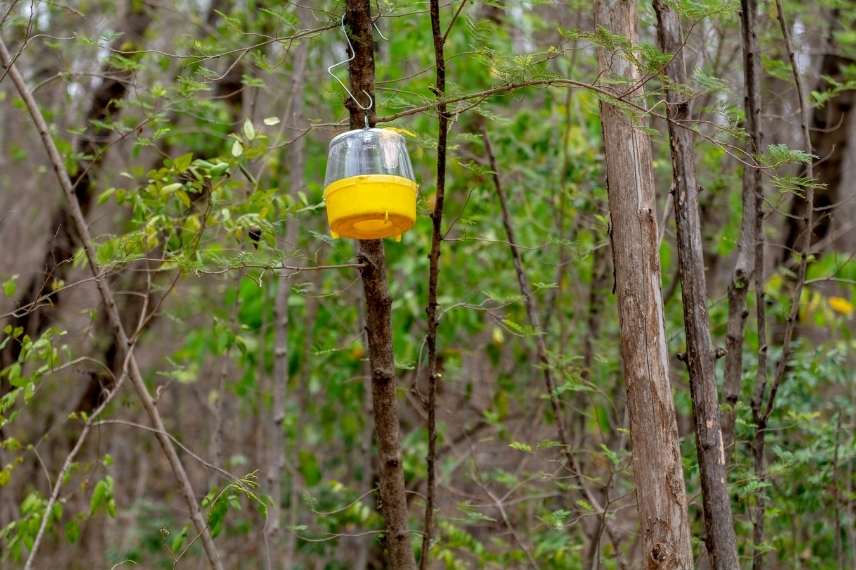
The male and female attractant capsules are installed in funnel-type traps
How should you set them up?
- Open the sealed pheromone sachet using gloves or tweezers to avoid touching it with your fingers and interfering with the pheromone signals
- Slide the capsule into the position provided for this purpose
- Position the trap at the centre of the canopy using the fastener
- Count one to two attractants per tree.
If the attractants are not used immediately after purchase, they must be stored in the fridge at a temperature of 3–5°C for 12 months, or in the freezer for 2 years.
Other means of control to be implemented in parallel
To avoid discovering worm-eaten fruit at harvest, it is best to implement other preventive methods to combat codling moths:
- Encourage beneficial insects throughout the year, and in particular garden birds such as blue tits and coal tits, or bats that catch the adults at dusk. It is often enough to place feeders and nest boxes all around the orchard or garden. In parallel, maintain biodiversity by planting berry-bearing bushes and melliferous plants. Lacewings are also formidable predators of larvae. They can be attracted by a pot filled with straw, placed upside down
- Lay corrugated cardboard bands along the trunks: larvae may shelter there for their pupation. It will suffice to lift them and burn them when required. These bands are installed from late May until harvest, about 20 cm above the soil
- Collect all caterpillar-damaged fruits that have fallen to the ground from the end of June to prevent a second generation
- Enclose ripening fruit in kraft paper bags after thinning until about a month before harvest
- Spray the fruits with wormwood infusion or tansy on the fruits: the odour tends to mislead the moths, as it masks the scent of the fruits
- Limewash the trunk in autumn to kill larvae in diapause, hidden in the bark
- Remove all potential refuges that could harbour larvae in winter: pallets, pruning wood, stumps… and all wooden supports
- Let your hens loose in your garden or orchard. They will peck out every last larva
As for curative control, it involves Bacillus thuringiensis (Bt), which is relatively effective against caterpillars. However, in some regions codling moths are developing resistant strains.
- Subscribe!
- Contents
Comments