





























How can I get rid of tiger bugs on trees and shrubs?
Our solutions to combat these tiny reticulate bugs
Contents
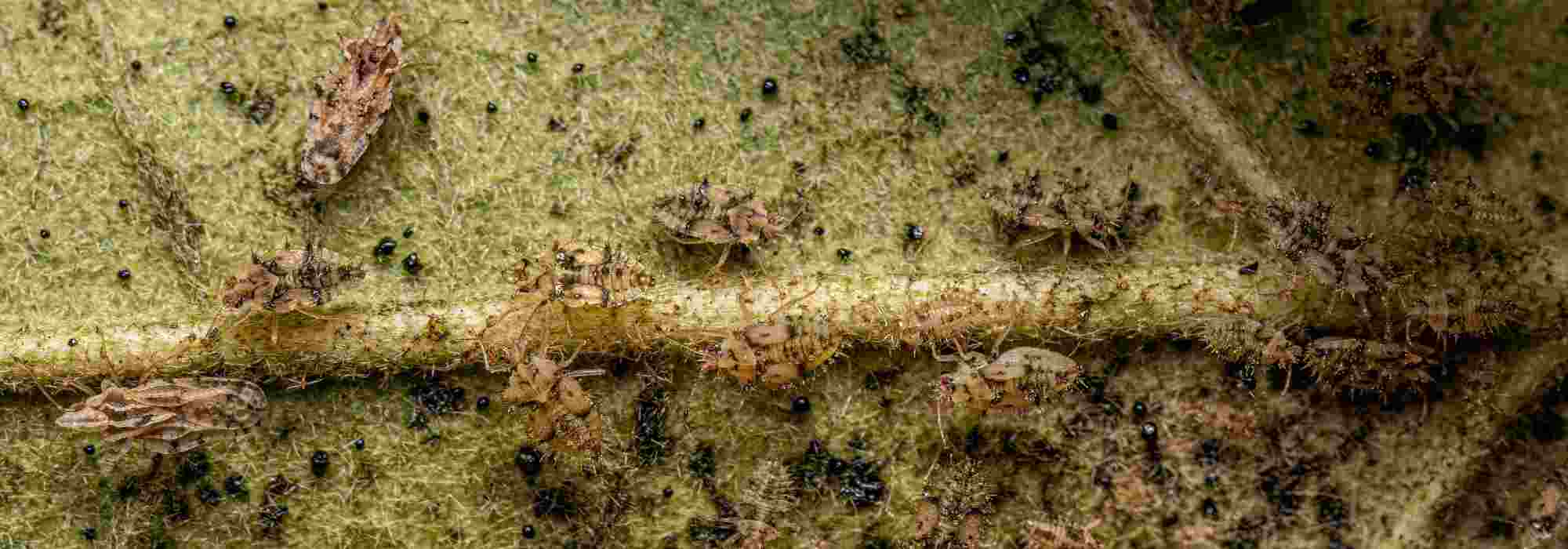
Right from the outset, I want to reassure our readers: in our latitudes, there is no risk of seeing a tiger perched on your plane tree or your catalpa, ready to pounce on you! We are going to talk about small creatures! Indeed, in entomology, tiger insects designate hemipteran insects of the Tingidae family, and more specifically, small winged and reticulate bugs, rather flat, that live on the undersides of the leaves of a multitude of plant species. They are therefore pest insects that damage foliage, weaken and exhaust the plants whose growth will be affected.
Whether you are a keen ornamental plant enthusiast or an amateur arborist, you may have to deal with these organic pests. Discover how to identify these little beasts, but above all how to get rid of them naturally to preserve your plants, fruit trees and shrubs.

Tiger bugs, tiny true bugs that attack a range of plants.
There isn’t just one lace bug, but several species of lace bugs that are bound to certain plants, shrubs or trees!
Reticulate true bugs
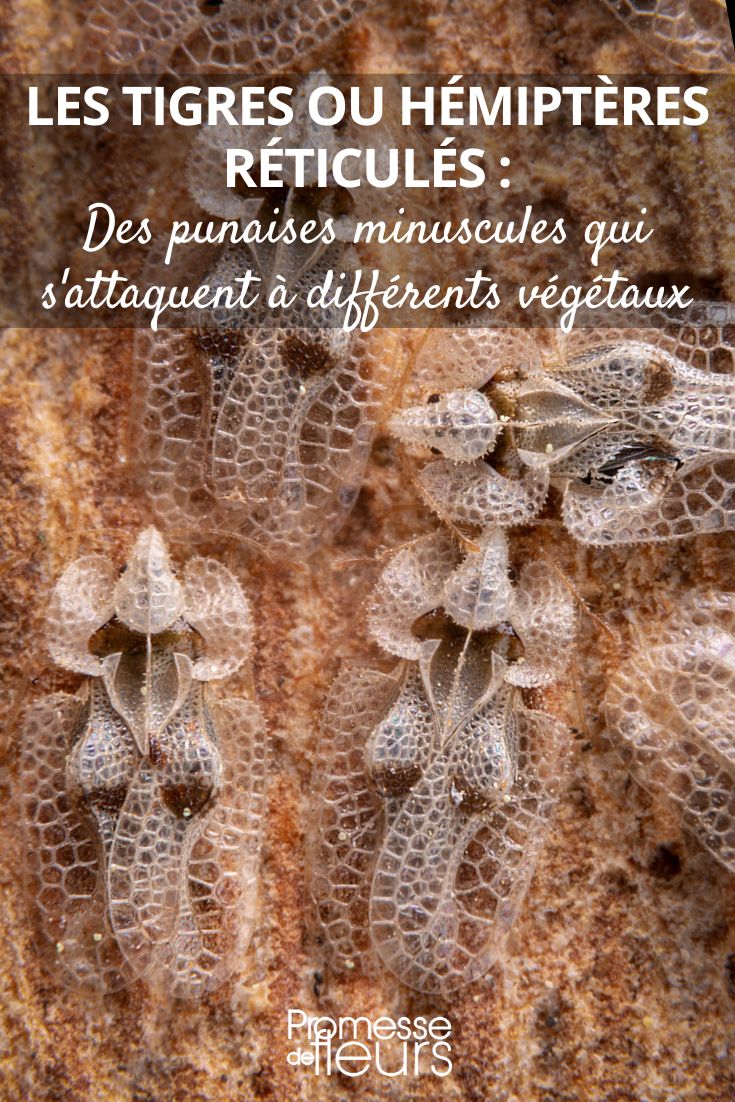
Lace bugs are true bugs in the Tingidae family, and more specifically tiny phytophagous bugs. All share several characteristics. They do not exceed 4 mm in length, are endowed with a slender, flat body and possess short, transparent and flattened wings. But their distinguishing feature lies in their bodies: lace bugs are recognisable by the foliate expansions of their pronotum (the upper part of the thorax) and of the hemelytra (the forewings), adorned with mosaics that resemble lace. It is said that the pronotum and the wings are reticulate, hence the name of reticulate bugs or lace bugs, often given to plant lace bugs.
Lace bugs are parasitic and pest insects that pierce the foliage to suck intracellular fluids such as sap. They are piercing-sucking insects, just like aphids. Unlike aphids, lace bugs, in their larval or imago stages, live in colonies exclusively on the undersides of the leaves of the plants they feed on.
However, like aphids, lace bugs secrete honeydew; their excretions promote the development of sooty mould and can spread diseases of varying severity.
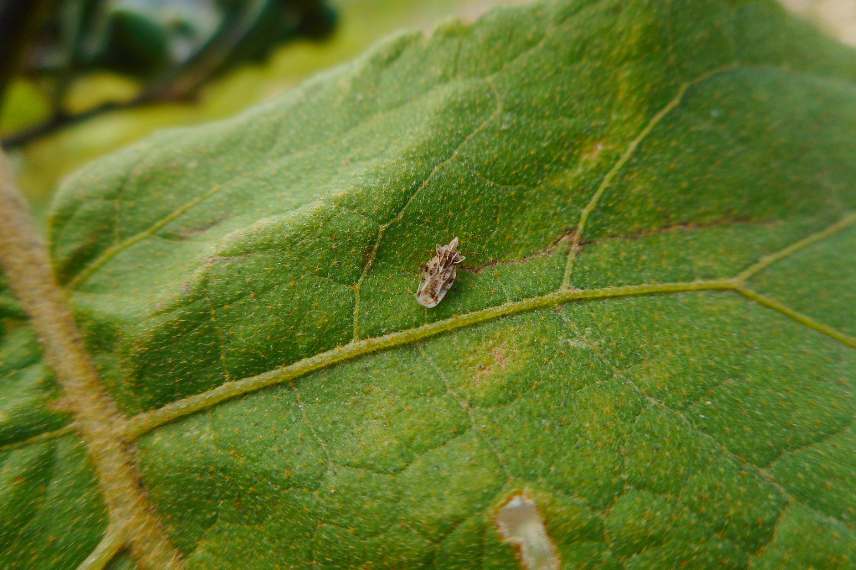
Plant lace bugs stand out for their wings and a pronotum speckled with mosaics
The life cycle of lace bugs
As for their life cycle, it is the same across species. Adults overwinter, well hidden beneath the bark of trees or shrubs. Mild, dry winters limit mortality and favour infestation. In spring, adults emerge from their hiding place and head to the first leaves on which they feed for about a month. By mid-May, eggs are laid on the reverse of leaves, often along the veins. Hatching is rapid. The larvae, passing through five developmental instars, then remain on the host plant. A first generation of newly emerged adults arrives by the end of June. A third generation may appear. All in all, the infestation is long-lasting…
Different species of tigers
There are different tiger species specific to various plant species. Some are very widespread in the area, others less so, but continually monitored by the authorities:
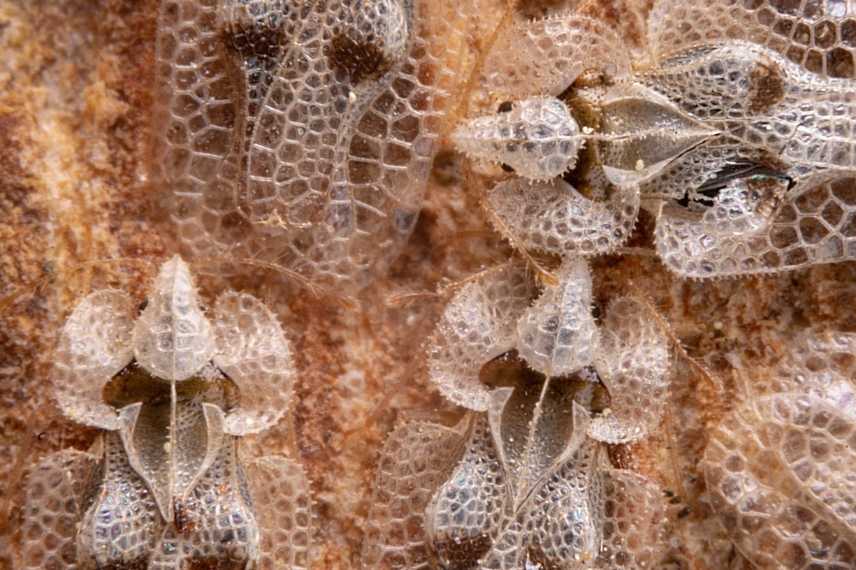
The plane-tree tiger (Corythucha ciliata)
- The plane-tree tiger (Corythucha ciliata) : this is the most widespread tiger and the easiest to distinguish, as it thrives on urban plane trees or plants planted along roads and canals. It also tends to enter houses and settle on people. Adults are white and measure about 3 mm, larvae black. Each female lays 200 to 350 eggs along the veins, and 3 to 4 generations can succeed one another in a year. For more information, please read Marion’s article: “How to Combat the Plane-Tree Tiger?”
- The oak tiger (Corythucha arcuata) : of North American origin, this tiger has established itself in France recently (2017), after being detected in Italy, Switzerland, Turkey, Bulgaria… Slightly smaller than the plane-tree tiger, adults are distinguished by four brown markings. Nymphs are spiny, dark grey with pale spots. There are easily 3 generations per year, sometimes 4. This tiger attacks all oak species (Quercus pubescens, Quercus robur, Quercus petraea, Quercus cerris…) but also chestnut trees, raspberries, maples and roses
- The pear tiger (Stephanitis pyri) : this species is very similar to that of the plane-tree tiger, and is increasingly present on the territory. Adults measure between 3 and 4 mm. They display a brownish colour and yellow-brown to dark-brown hues. It favours Rosaceae plants (pear trees, apple trees, quince trees), species of the genus Prunus, hawthorns (Crataegus), cotoneasters, Japanese quinces (Chaenomeles japonica)…
- The rhododendron tiger (Stephanitis rhododendri): 4 mm long, this tiger with cream reticulations cannot fly. Nymphs are yellowish and spiny
- The almond tree tiger (Monosteira unicostata): a small tiger of 2 mm, it can also move onto pear trees, poplars and aspens
- The Pieris tiger (Stephanitis takeyai): a 4 mm tiger found on Pieris and on Ericaceae
- The bay laurel tiger (Stephanitis lauri): a bicoloured white-cream and brown tiger of about 3.5 mm that thrives on bay laurel (Laurus nobilis)
There are other species in the genera Corythucha, Gargaphia or Stephanitis, more exotic that are not yet present in France.
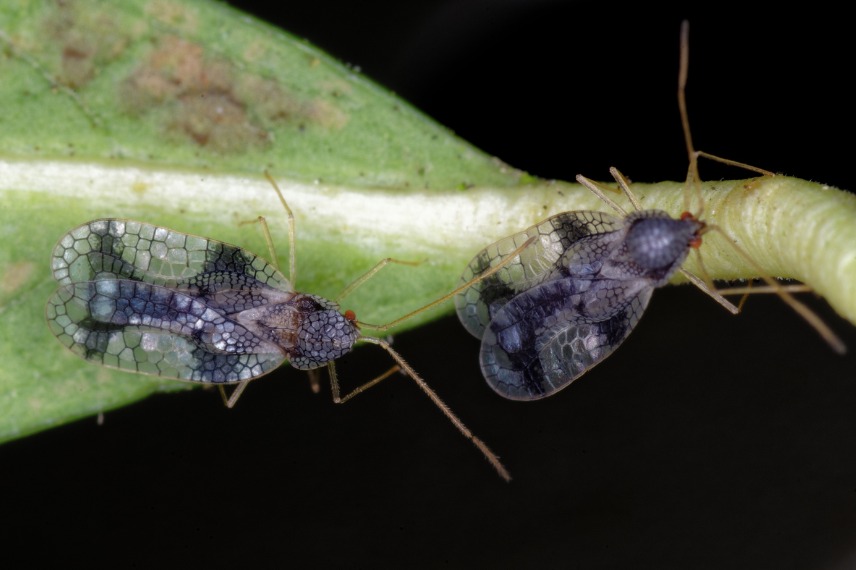
Pieris tigers (Stephanitis takeyai)
Damage to plants caused by tigers
Found in colonies, adult plant tigers, as well as larvae and imagos, pierce plant tissues to feed on sap. In small colonies, these true bugs are not truly dangerous to the survival of the plant or tree. However, in cases of severe infestation, the plant, shrub or tree may suffer and become considerably weakened. Leaves discolour and yellow; some show white or brown spots. Ultimately, these tigers hinder photosynthesis and the leaves eventually shed prematurely during the summer. The plant becomes exhausted and its growth may slow.
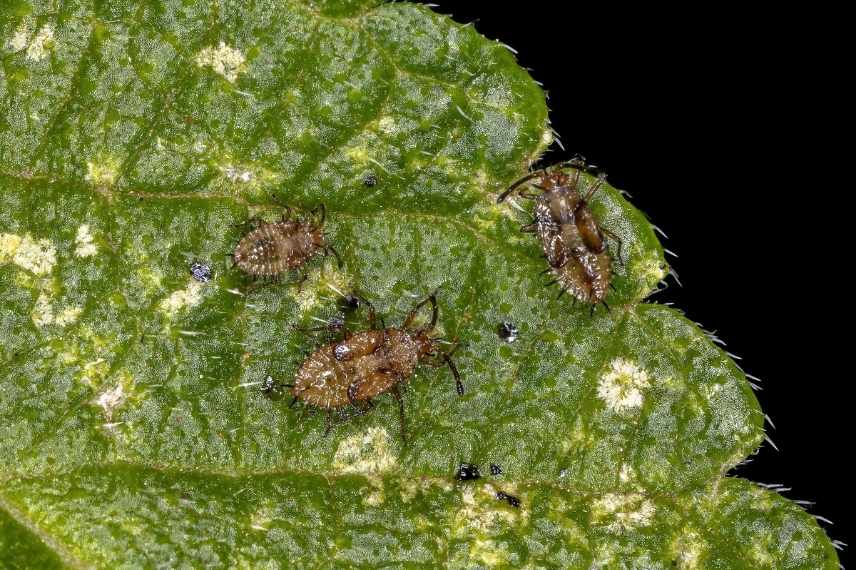
Tigers pierce leaves to suck sap
The presence of these tigers also causes cosmetic damage, as they mainly affect ornamental plant species.
Beyond this nuisance, the undersides of leaves are punctuated with black specks and honeydew that promote the development of sooty mould. In addition, some tigers, such as the plane-tree tiger, are vectors of serious cryptogamic diseases such as plane-tree canker and plane-tree anthracnose.
These tigers can also be quite unpleasant for people as they fall to the ground, clinging to clothing or skin. Nevertheless, they pose no risk to humans or animals.
How can you naturally combat tigers?
Obviously, to combat these tiger invasions, for your health, wildlife preservation and environmental protection, it is best to ban chemical or even organic insecticidal products that do not always have targeted action.
It is recommended to focus efforts on biological control, again with good reason. Indeed, the presence in small numbers of these insects on a tree can be unsightly, but not necessarily harmful. Control measures can be deployed, particularly in cases of an invasion.
Thus, against the tigers, and in particular the plane-tree tiger, it is possible to use a treatment based on entomopathogenic nematodes, microscopic worms that parasitize and kill the adults. These nematodes against the plane-tree tiger are sprayed onto the leaves, concentrating on the undersides.
Nematodes NemaPlatane Organic against lacewings - box of 100 million
The other solution to combat the tigers involves introducing predators. The main beneficial insect is the green lacewing and its larvae which feast on the tigers. But ladybirds could also take an interest.
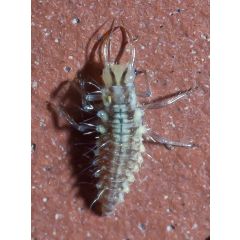
Chrysope Biotop contre les pucerons sur plantes basses
On lower shrubs, one can also remove the tigers by hand by rubbing the undersides of the leaves with a cloth. A high-pressure water jet can also prove effective.
Is it possible to prevent the emergence of reticulate bugs, or not?
Several preventive measures can be implemented to limit tiger establishment:
- Maintain biodiversity to foster the presence of beneficial insects such as lacewings. We can thus cultivate melliferous plants, install flowering, countryside-style hedges of native species, keep a fallow patch, and build insect shelters or insect hotels…
- Coat the trunks of trees and shrubs before winter with a vegetable oil to prevent adult hibernation under the bark
- Scrape the bark from the trunks of trees and shrubs with a wire brush
- Keep a humid atmosphere around the plants with regular fine-mist watering and mulching
- Carefully remove plant debris, pieces of bark (from plane trees that peel) and damaged leaves.
- Subscribe!
- Contents
Comments