





























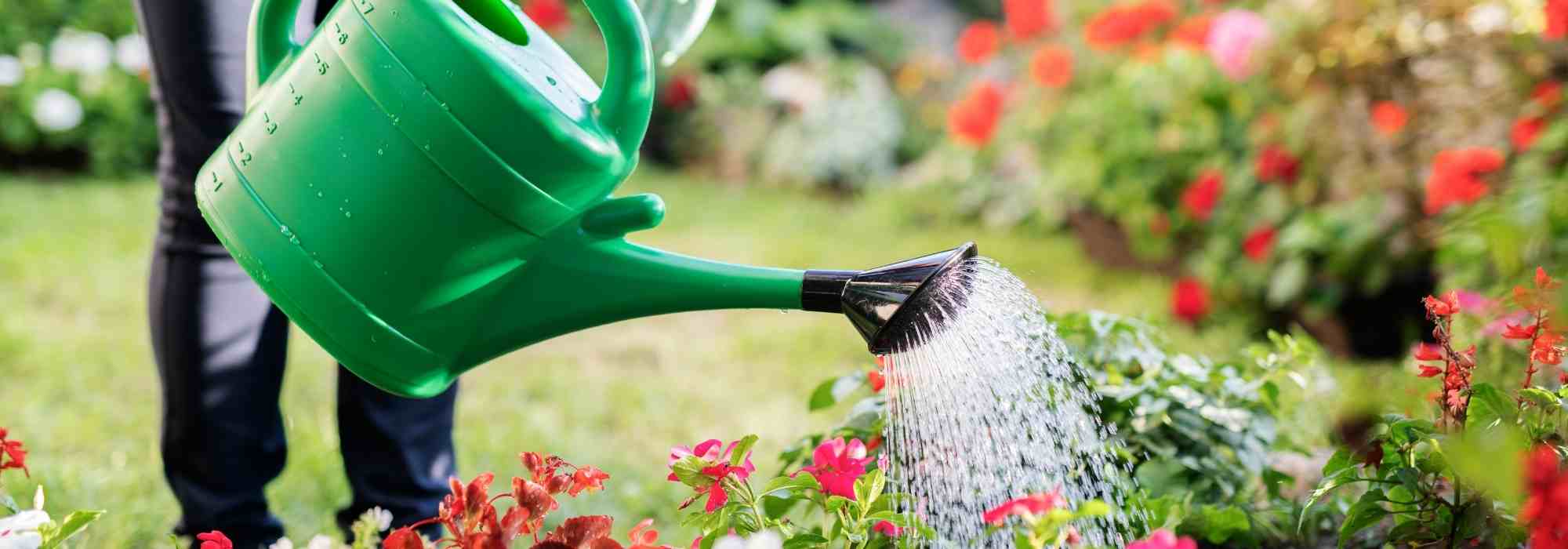
How often should you water your garden in summer?
Practical tips to keep your garden healthy during the summer
Contents
If there’s one topic that raises questions for a gardener in summer, it’s watering. When should you water your garden and your kitchen garden? How to water? And above all, how frequently should you do it to provide the right amount of water? And while the questions may seem obvious and legitimate, the answers are less so. Indeed, there is no constant when it comes to watering, since water inputs depend, of course, on the weather, but also on soil type, plant species…
Nevertheless, one can answer questions about watering frequency with a few simple tips to apply in any garden. Remember that watering the garden in summer is essential, but it is always better to do less than too much!

The basic rule for proper watering: know and prepare your garden soil
In the garden, if there is one area where there are no hard and fast rules, it is watering. Indeed, the water provided to the ornamental garden depends on many criteria, and it is difficult, if not impossible, to give precise guidelines.
The criteria for determining watering frequency
The first criterion that can affect the frequency of watering is the soil, and in particular its texture. Indeed, soil can be sandy, clayey, or loamy. And the difference is substantial! A sandy soil has no structure, it crumbles easily. It is poor in organic matter, therefore not very fertile, and above all, it does not retain water or nutrients. By contrast, clay soil is very compact and sticks together when moisture is high. This means it readily retains water, unlike sandy soil. As for loamy soil, it is easy to work and rather light. It is also very permeable to water. All things considered, you do not water in the same way in sandy soil as in clay soil! Waterings will logically be more frequent in sandy soil, because the water does not stay. To better understand your soil, I invite you to read Olivier’s article: Determine the texture of your soil: clayey, sandy, silty
The second criterion to consider for garden watering is simply the species of plants grown there. Some are very water-hungry, and you will need to water frequently and regularly as soon as the surface soil is dry; others have limited needs, and others again (succulent plants, Mediterranean plants…) tolerate hot weather and drought.
Finally, before watering, it is recommended to take a look at the weather forecasts. It would be a shame to water when a thunderstorm is forecast…
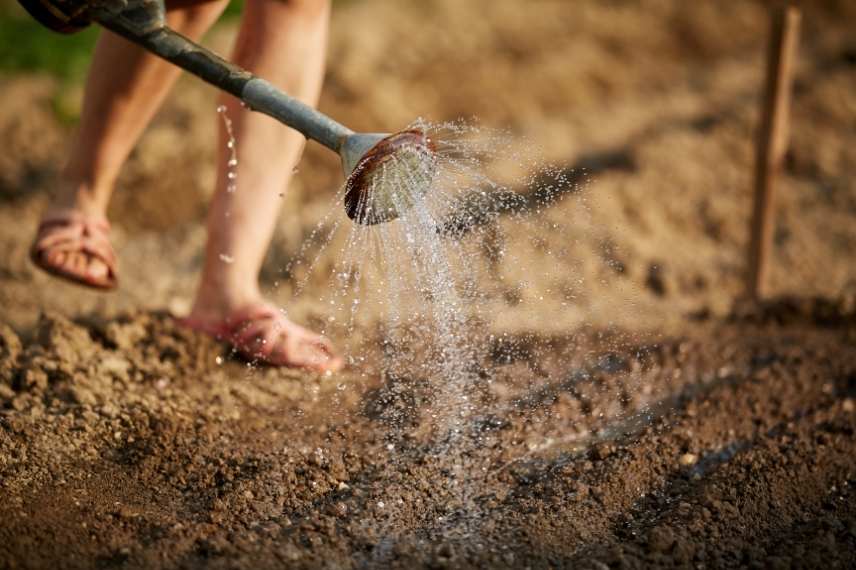
Knowing the texture of your soil is essential for tailoring the watering frequency
The importance of soil preparation
The way the soil is prepared and maintained is also crucial for estimating watering frequency. Indeed, soil rich in organic matter, as enriched with compost or manure, is better aerated and better structured. And watering will be more effective, as the water will penetrate deeper. Similarly, soil regularly forked and hoed, free of weeds, will require less water. Finally, mulching has a huge influence on the frequency of watering. Bare soil heats up very quickly, water evaporation is at its maximum there, whereas mulched soil retains moisture and limits evaporation.
How often should you water your garden?
Logically, it is impossible to answer this question with a one-size-fits-all reply! That said, we can summarise it in a few words: it’s better to water less often and more generously than daily and in small amounts.
Why? It’s simple: a plant that is given water daily will become lazy, because it will only develop its root system superficially and near the surface. It is, in fact, sure to receive its daily share of water. By contrast, it will be much more sensitive to heatwaves and drought, because its roots are poorly developed and near the surface, where the soil is warmest. Especially during the gardener’s well-deserved holidays.
A generous, deep watering at a lower frequency is more effective. Water in large quantities will penetrate deeper into the soil. The root system must therefore extend to reach the available water. Thus it develops and extends deeper, and proves more resistant to heatwaves. Merely wetting the soil is therefore not beneficial to the roots or the plant; you really need to provide a generous amount of water once a week during hot summers, and twice a week if a heatwave is sweeping through. Therein lies, incidentally, the main drawback of drip irrigation systems or porous-tube systems that render plants totally dependent. Moreover, water evaporation is higher in the upper layer of the soil. By contrast, ollas can be an interesting solution, as water is distributed more deeply.
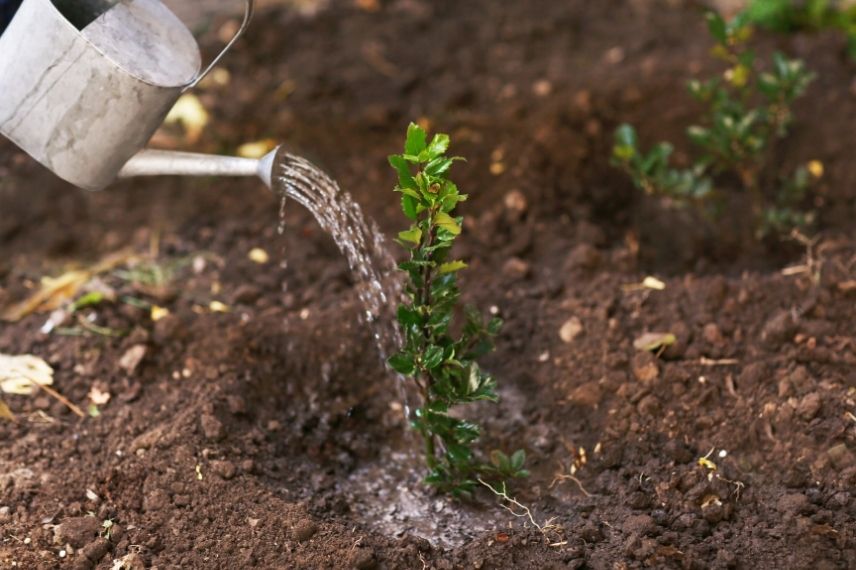
It’s better to have a generous watering once a week than light waterings every day.
Do feel free to consult Marion’s articles: Ollas or oyas: an efficient and economical watering system and Making a homemade olla to water the garden.
This principle applies broadly to clay soils, somewhat less so to sandy soils. In this particular case, water descends quickly into the subsoil.
Likewise, needs will vary from one plant to another. A plant grown in a pot, a flowering perennial or an annual, a plant recently transplanted, a plant with very broad leaves, has higher water needs. You will need to consider considerably more frequent watering than once a week. Climbing plants, shrubs and trees are more drought-tolerant.
Obviously, you should watch for the slightest signs of plant dehydration. But wilted foliage does not necessarily mean a plant is thirsty. Thus, plants with large leaves tend to droop simply because evaporation is higher.
How best to water your garden?
We’ve just seen that it’s best to water generously once a week, rather than in small amounts every day. That’s why the best watering technique lies in a watering can! Indeed, you can visualise and quantify the amounts of water delivered each week. Moreover, the watering can allows you to pour water right at the base of the plant, thereby avoiding any loss and wastage. And without wetting the foliage, which increases the risk of transmission of cryptogamic diseases in many plants.
Similarly, during the height of summer, it is more beneficial to water in the evening when the sun has set. Thus, the ambient heat won’t evaporate the water. We’ll keep morning watering for spring and autumn, or for summers that are not as hot. Nevertheless, morning summer watering is also effective and will always be preferable to doing it in the heat of the day. In fact, it all depends on your daily routine.
And the vegetable garden?
For the vegetable garden, watering is a little more frequent. Not least because some vegetables (courgettes,aubergines, squashes, melons…) have high water needs in light of the effort involved in producing their fruit. Leaf vegetables lose a lot of water through evapotranspiration, which is why they should be regularly watered. For beans, watering should be thorough but infrequent. By contrast, alliums are fairly drought-tolerant.
For more information, you can read my article: Vegetable garden watering: our tips.
- Subscribe!
- Contents
Comments