





























How to choose a rosemary?
Buying guide and criteria to find the perfect variety
Contents
Rosemary is one of those versatile plants. It has evergreen foliage that looks beautiful all year round, is used in cooking, but also for the medicinal properties attributed to it. Its abundant flowering delights both the gardener and visiting pollinators.
If rosemary is emblematic of Mediterranean zones, the quintessential garrigue plant, it can also be grown in gardens in other regions, in the ground or in pots.
Discover our guide here to choose the rosemary variety that suits your preferences and growing conditions.
And to learn everything about growing rosemary, discover our comprehensive guide: Rosemary: planting, benefits, harvest

Choose a rosemary variety based on the colour of its flowers.
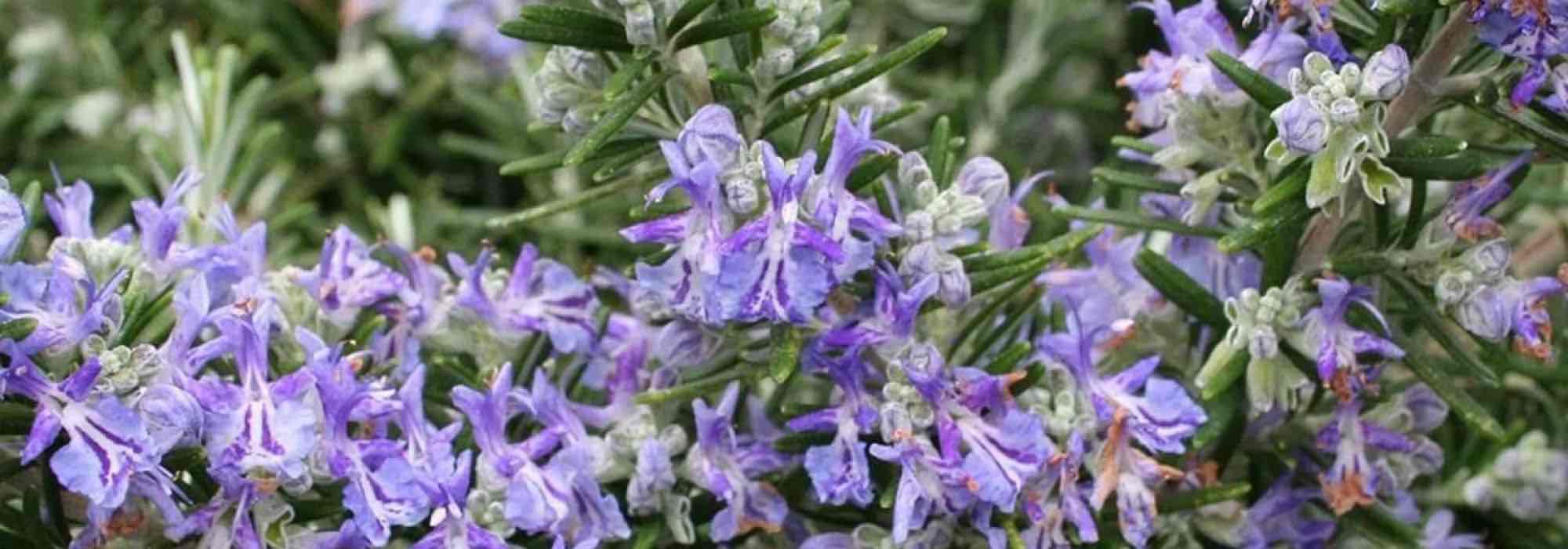
The rosemary flowers are typical of plants in the Lamiaceae family. They are funnel-shaped and bilabiate, i.e., composed of two lips. The lower part of the corolla is broad and very divided, reminiscent of tiny orchids.
This generous flowering is always highly melliferous, pleasing precious pollinating insects.
Blooms in blue-mauve tones
The rosemary flowers are generally a soft lavender-blue. Depending on the varieties, they differ by subtle nuances. ‘Tuscan Blue’ for example produces large blue-mauve flowers with a white throat. ‘Pointe du Raz’ opts for a lilac blue that is veined with dark blue. ‘Corsican Blue’ treats us to a mauve-blue flecked with white, very bright.
Other less common flower colours
But some varieties actually display entirely different colours.
That’s the case with Rosmarinus officinalis ‘Majorca Pink’, which for example opts for a soft pink that’s not common, very gentle and easy to pair with the garden. It is a good alternative for those who do not care for the violet-and-green pairing.
For its part, ‘Albiflorus’ is a variety that produces a multitude of small white flowers, with refinement and delicacy. It is a rosemary still not widely grown in gardens.
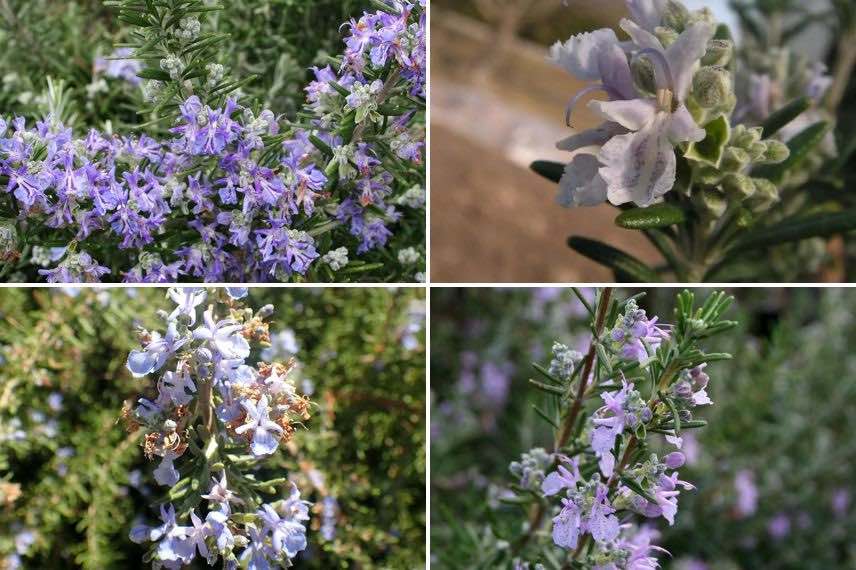
Rosemary shrubs in clockwise order: ‘Pointe du Raz’, ‘Albiflorus’, ‘Majorca Pink’, ‘Tuscan Blue’
Read also
9 creeping shrubsChoosing a rosemary based on its leaves.
The rosemary’s foliage is evergreen, remaining ornamental all year round.
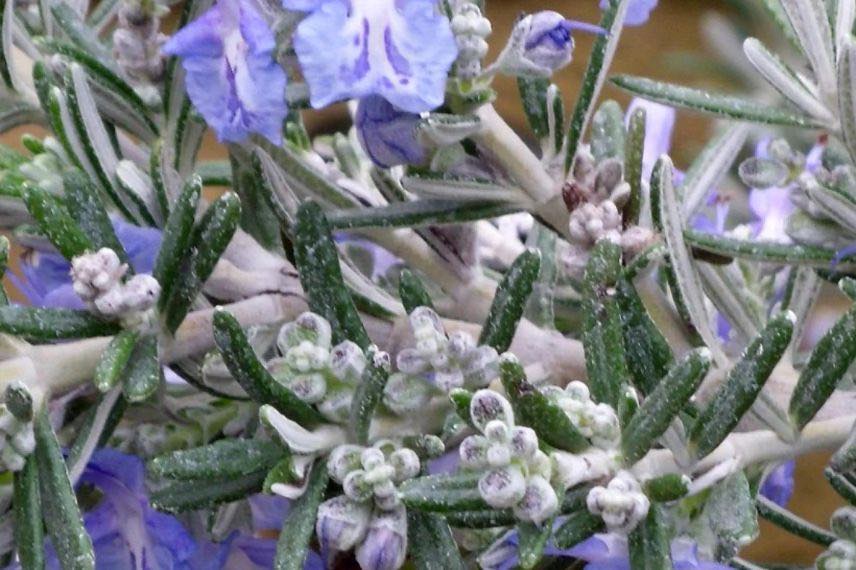
It consists of small linear lanceolate leaves, petiole-less, measuring between 2 and 8 cm in length.
Rigid and leathery, they resemble needles. They are generally a bright green on the upper surface and a woolly whitish on the reverse.
All officinal rosemary varieties have edible, aromatic foliage, which emits a strong, green and camphor-like scent.
The Rosmarinus officinalis ‘Whitewater Silver’ stands out from its peers, thanks to its dark green foliage with a silver reverse, which will shine in the slightest ray of sunshine. This trait makes it particularly bright.
Choosing rosemary by growth habit and intended use.
Rosemary can take on a range of silhouettes, from an upright shrub to a prostrate shrub, allowing them to be used in different areas of the garden.
The small varieties
They are perfect for container growing, particularly in regions where frosts are fairly severe (below -10°C) and winters are especially damp. This will indeed make it easy to move them to shelter during the cold season. For, while rosemary can tolerate a degree of cold, they dread waterlogged soils in winter.
Among the small varieties, we list creeping rosemary Rosmarinus officinalis ‘Capri’, a very compact shrub that looks wonderful in a pot or container, from which it will cascade gracefully. This mini rosemary with a spreading habit reaches only 20 cm in height by 40 cm across. It will also be a superb candidate for a border in a dry garden.
For its part, ‘Majorca Pink’ is a shrub variety with an upright habit, measuring only 1 metre in all directions. Again, it will be perfect for container culture or in small spaces. Over time, its silhouette will gradually widen with graceful ease.
Let’s also talk of ‘Blue Cascade’, the ideal candidate for planting on top of a low wall, which will cloak it by transforming into a true cascading greenery thanks to its trailing habit. It is also a superb plant in hanging baskets. Of small size, this variety does not exceed 40 cm across.
The groundcover varieties
With a creeping, spreading and prostrate habit, these rosemaries will be perfect for vegetating a slope, even very dry, a sunny rockery or for dressing a low wall from which they will cascade with much elegance.
That’s the case with Rosmarinus officinalis ‘Prostratus’ which, as its name suggests, has a truly prostrate habit, creating a dense groundcover that readily outcompetes weeds (“weeds”). It reaches only 30 cm in height, but 1.25 m across.
‘Pointe du Raz’ can reach, for its part, up to 1.5 m across and 50 cm tall. A creeping variety ideal for covering the most inhospitable parts of the garden.
Rosmarinus officinalis ‘Whitewater Silver’ will also form a lovely groundcover, with dimensions a little more modest. These measurements are 35 cm high by 90 cm wide.
A somewhat hybrid, ‘Corsican Blue’ has a semi-creeping, arched and somewhat irregular habit, giving it a dome-shaped silhouette. It reaches about 50 cm in height by 1.2 m across.
The upright-habit varieties
These varieties feature a more upright, bushy habit, which can tend to widen as they age.
They are perfect in dry garden borders, in low hedges, Mediterranean-inspired hedges or even as standalone specimens. Planted in the kitchen garden, they will attract pollinators.
Among them, we include the true Rosmarinus officinalis, a safe bet that will reach 1.5 m in all directions.
The small ‘Speedy’, with its erect habit and its compact silhouette, measures 80 cm across. It is ideal for busy gardeners: indeed, a fast-growing variety.
‘Speedy’, with its erect habit and its compact silhouette, measures 80 cm across. It is ideal for busy gardeners: it is indeed a fast-growing variety.
‘Mrs. Jessop’s Upright’ stands out for its upright, but rather narrow, silhouette. For a height of 1.40 m, it actually only reaches 70 cm in width.
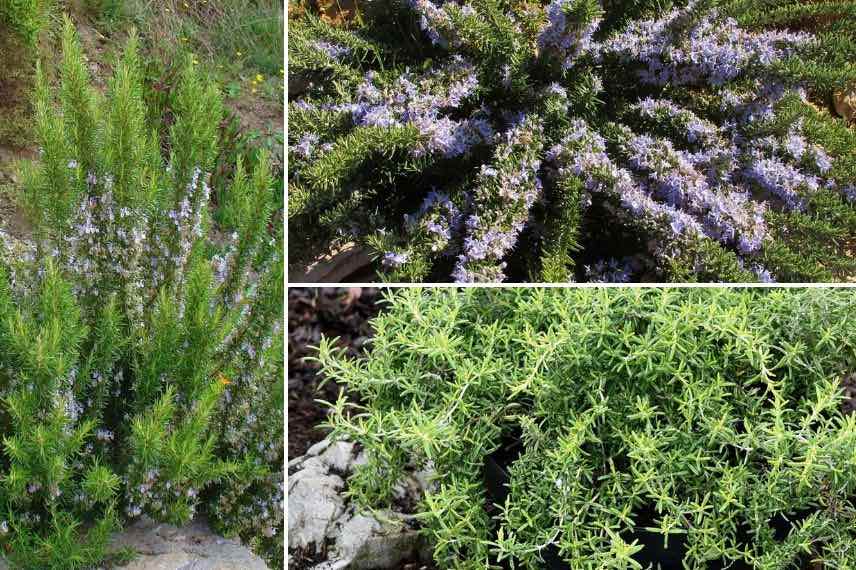
Rosmarinus officinalis, Rosmarinus officinalis ‘Prostratus’, Rosmarinus officinalis ‘Capri’
Read also
Growing rosemary in a potChoosing rosemary according to growing conditions
Rosemary plants thrive under the same growing conditions. Drought-tolerant, they thrive in dry soil, even poor, rocky, sandy or calcareous soils. The substrate simply needs to be light and well-drained, so moisture does not stagnate there, especially during the cold season. They enjoy full sun, even scorching heat.
As a Mediterranean plant, rosemary is not the hardiest bush when it comes to cold winters, but it still shows moderate resistance, down to -12°C to -15°C if the soil does not retain water.
If you live in a region with cold winters, choose the hardiest varieties, such as ‘Mrs. Jessop’s Upright’, one of the hardiest in the genus, capable of tolerating frosts down to -18°C.
- Subscribe!
- Contents

Comments