





























How to choose an Escallonia for your garden?
Our buying guide outlining different selection criteria
Contents
Escallonia belongs to this category of essential shrubs in a garden… especially if you live in a region with a mild climate or by the sea. Indeed, this shrub, native to South America, can be a touch frost-prone, but is highly resistant to sea spray. However, growing in pots remains possible to enjoy its charming summertime flowering, available in a range of pink shades, white or red. With evergreen foliage and relatively rapid growth, this flowering shrub finds its place in the border, but also in a hedge sheltered from cold winds. Not particularly demanding, it requires only minimal maintenance given its long-lasting flowering and its delicate charm, not to mention that it is melliferous.
Are you convinced by the virtues of escallonia? Now it’s time to choose! Discover our selection of varieties best suited to your criteria—whether related to cultural or climatic conditions, how you plan to use your shrub, or simply aesthetics.
Further reading : Escallonia: planting, pruning and care.

According to the flowering colour
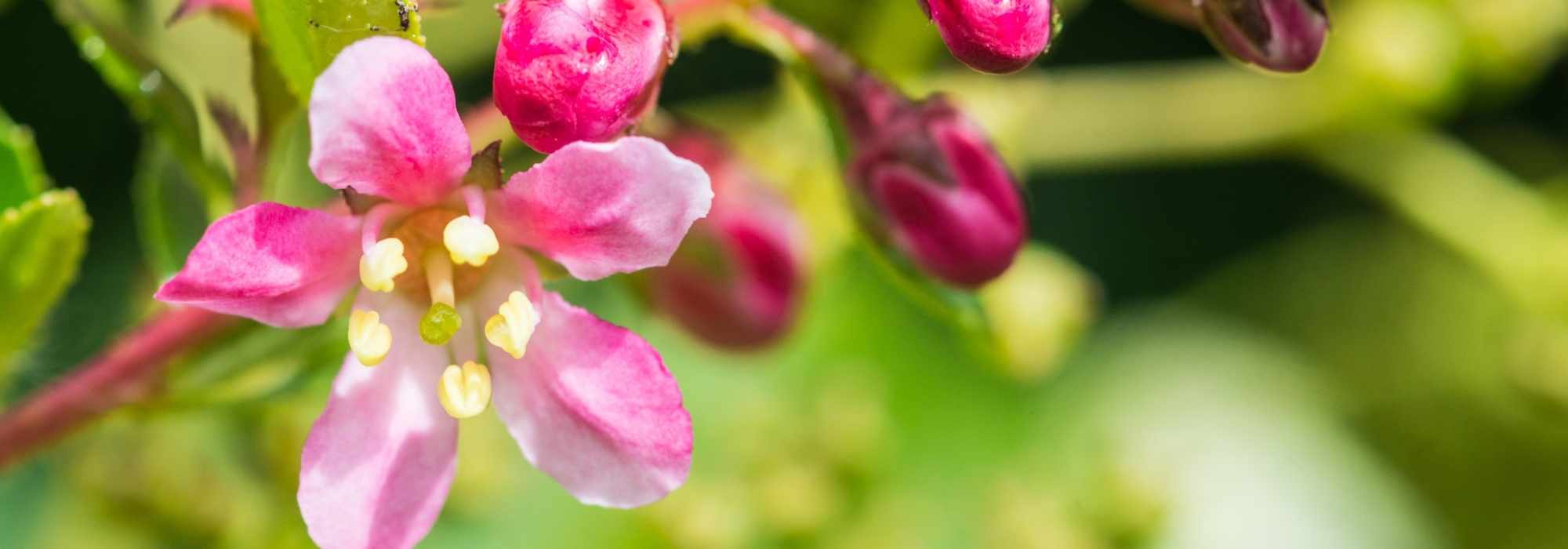
With its small tubular flowers that resemble little trumpets, Escallonia certainly charms. Indeed, this bush is highly regarded for its relatively long-lasting summer flowering. The flowers open, depending on the species, from May to August, with sometimes a fresh flush in October, in regions with a very mild climate. Fleshly, with a waxy texture, these terminal flowers are gathered in clusters or in closed panicles. Equipped with a calyx, most often tubular, these flowers lightly resemble the flowers of apple trees. They also have the peculiarity of having two or three carpels fused up to the stigmas and which are one with the calyx.
But they are above all flowers of great delicacy that offer simple colours, but very nuanced from one variety to another. The flowering of escallonias unfolds in a rich palette of pink, to which varieties with flowering of pure white or a strong red are added.
Pink-flowering Escallonias
Small in size, the flowers of Escallonia speckle the evergreen foliage with pink drifts in varying shades. If you’re looking for an Escallonia with flowers in a delicate, soft and pastel pink, two varieties stand out: ‘Pink Elle’ and ‘Apple Blossom’ whose flowers are a relatively pale pink, striped or speckled with white. By their delicacy, these inflorescences evoke blooming apple trees. As for the flowers of the variety ‘Donard Seedling’, they display a pale pink becoming almost white as they unfold.
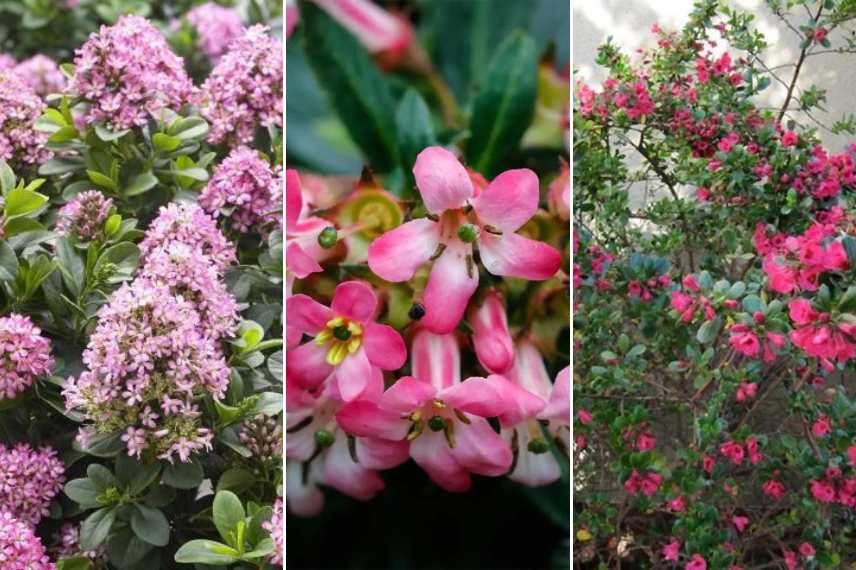
From left to right, the varieties ‘Pink Elle’, ‘Show Stopper’ and ‘Donard Radiance’ offer different shades of pink
For those who prefer colours with a bit more character, the variety ‘Donard Radiance’ offers a bloom of a deep and radiant magenta pink. Meanwhile, the flowers of ‘Dart’s Rosy Red’ lean more toward carmine pink. ‘Show Stopper’ plays the troublemaker with flowers of a very vivid pink, however softened by touches of white. Finally, ‘Donard Star’ asserts its particularity with flowers of a very strong pink.
Red-flowering Escallonias
Do you prefer shrubs with red flowering? Escallonia also comes in this colour range. And the most magnificent of all is certainly the Escallonia compacta ‘Coccinea’ which benefits from a bright red flowering of rare intensity. And as its name suggests, it is moreover a variety with a particularly compact habit.
In the family of red Escallonias, one cannot miss the variety ‘Red Dream’ whose flowers, more sparsely arranged, are in a charming red-pink. Finally, the escallonia ‘C.F. Ball’ proves to be an excellent choice for red-flowering enthusiasts. Its five-petalled, bell-shaped inflorescences offer a bright cherry red, veering toward carmine pink for the most striking effect.
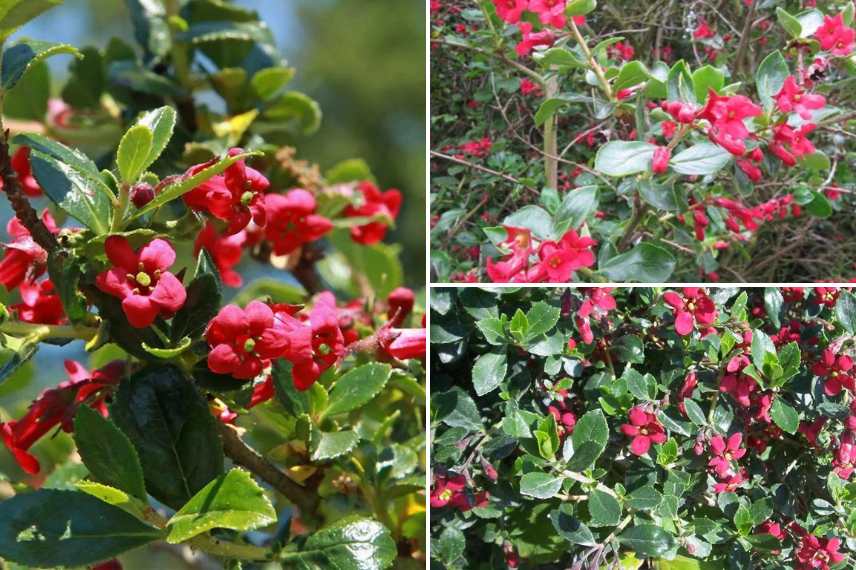
Three varieties of escallonias with red flowers: ‘Coccinea’, C.F. Ball’ and ‘Red Dream’
A white-flowering Escallonia variety
If you swear by white in your garden, one Escallonia variety stands out: the variety ‘Iveyi’, discovered in 1920 in Great Britain by a gardener named Ivey. This sizeable Escallonia, with slightly arching shoots, produces numerous corollas in delicate white, highlighted by a yellow heart.
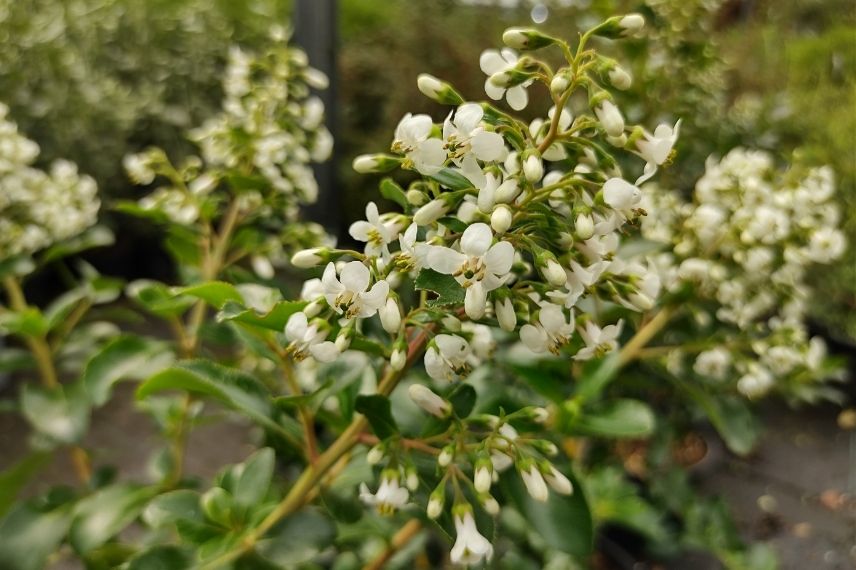
The Escallonia ‘Iveyi’ offers white flowering
Read also
Growing an Escallonia in a potDepending on the foliage colour
Most Escallonias have foliage that is a very green, glossy colour, ranging from fairly dark to deeper shades. The shoots are thus clad along their entire length with a multitude of small alternate leaves, sessile or subsessile, usually evergreen, tough and very durable. This foliage is very slightly dentate at the margins. This green-hued ramification forms a splendid backdrop for the white, pink or red flowers, with which it creates a striking contrast.
Some varieties show slightly different foliage. Starting with the Escalliona laevis ‘Gold Ellen’ whose oval leaves offer a bright colour. They are, in fact, golden-yellow largely maculated with green. The semi-open tubular flowers in carmine pink that bloom on this foliage are well set off by the colour of this foliage.
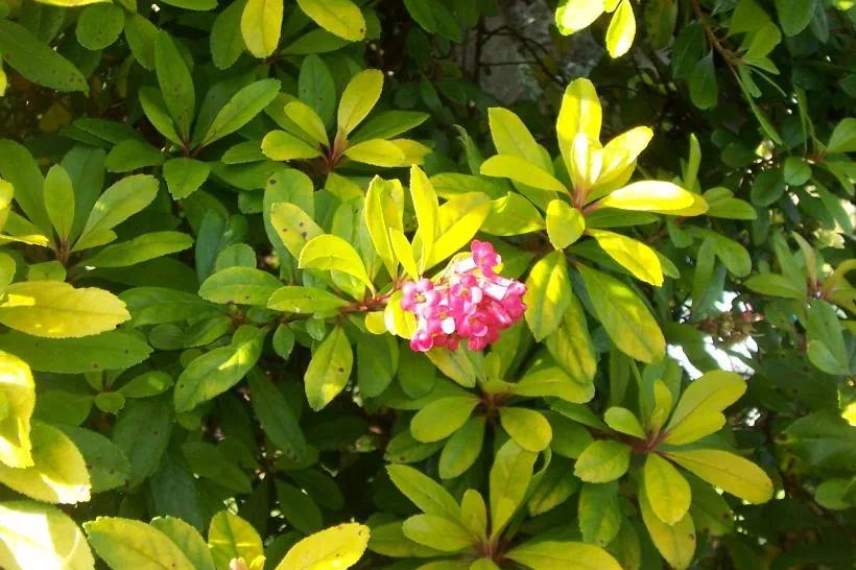
The variety ‘Gold Ellen’ features coloured foliage
The very recent hybrid variety ‘Glowing Embers’ also marks the difference through its foliage, while the flowering ranges in a more conventional fuchsia pink. This foliage is especially notable for its evolving appearance across the seasons. In spring, new shoots emerge adorned with orange-red. As time passes and summer approaches, they turn amber-yellow. Then they become light green, a very bright colour by the end of the year.
Finally, the hybrid variety ‘Golden Carpet’ is no slouch either for turning heads. Its small oval leaves with dentate margins shift from golden in summer to chartreuse green in winter. Two vibrant colours that bring maximum brightness to borders or pots.
According to the habit most suited to the situation
Overall, Escallonia shrubs have a bushy, dense habit, rather upright, rounded or erect. Very ramified, they are relatively compact, which makes them ideal for filling borders alongside other shrubs with fairly similar shapes. Thus, Escallonia particularly thrives in the company of a Ceanothus, a Deutzia, a Weigela… But the presence of perennials such as Gaura or hardy geraniums suits Escallonia perfectly.
However, other Escallonia display a completely different habit, which allows them to find their place elsewhere. Indeed, some varieties offer a distinctly more spreading habit and deliberately forming a groundcover. Thus, the variety ‘Pink Elle’ is a shrub with a nest-shaped habit, composed of thick, angular branches bearing resiniferous glands. It is ideally suited for pot cultivation on a balcony or terrace, or at the front of a border of low shrubs.
The variety ‘Red Dream’ forms on its own a dense, rounded and spreading ball or dome, while being very bushy. This Escallonia can thus find a place in a rock garden or on a slope, or in a flowering potting arrangement such as a trough. But it is certainly with the variety ‘Red Carpet’ that the difference in habit is most striking. Indeed, as its name suggests, this variety offers a very spreading, very stocky and creeping habit that makes it a wonderful ground-cover shrub. It fully deserves its name as “Red Carpet” as it can spread to a width of 1.5 m. In the same collection, the variety ‘Golden Carpet’ benefits from the same ground-cover shrub characteristics, except that the carpet is gold. This Escallonia indeed has golden-yellow foliage.
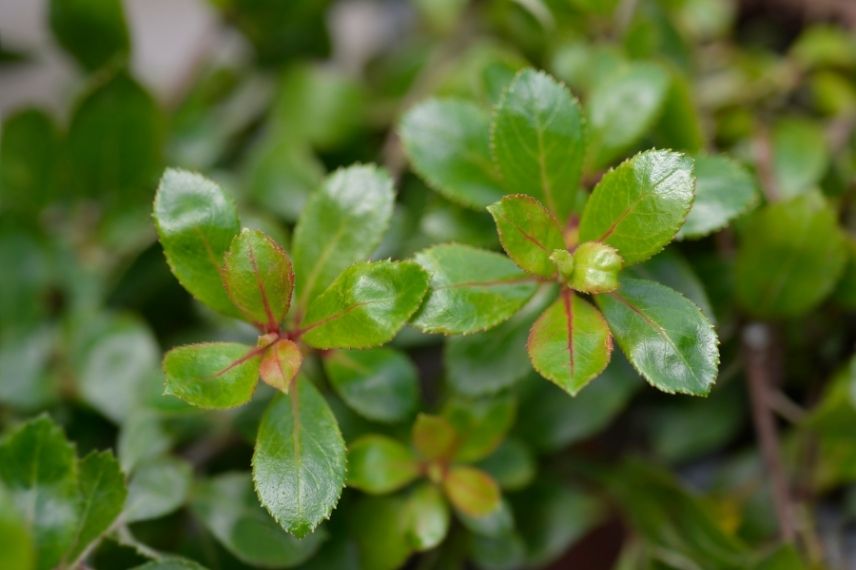
The ‘Red Dream’ variety benefits from a spreading habit to form a good groundcover
Read also
How to propagate Escallonia?Depending on its hardiness
When you love Escallonia, the only drawback you can find with them is their low hardiness. Indeed, as a bush native to South America, this bush shows relatively low hardiness, around -5 to -8 °C. Provided it is planted in well-drained soil, in a sunny position and sheltered from cold winds. However, some species are slightly more frost-tolerant than others. Thus, the species Escallonia rubra var macrantha can withstand temperatures down to -10 to -12 °C. Again, provided they are planted in locations sheltered from draughts and cold winds.
The species Escallonia virgata also proves somewhat more frost-tolerant. One of its most widespread representatives is the variety ‘Donard Radiance’.
According to its adult size
Among the latest criteria to consider when selecting an Escallonia is the pruning at maturity. Indeed, these varieties make excellent shrubs for a flowering hedge, provided they are tall enough. And the champion in this regard is the Escallonia rubra var. macrantha, which reaches 3 m in all directions. If its vigour is good, it makes an ideal shrub for a hedge.
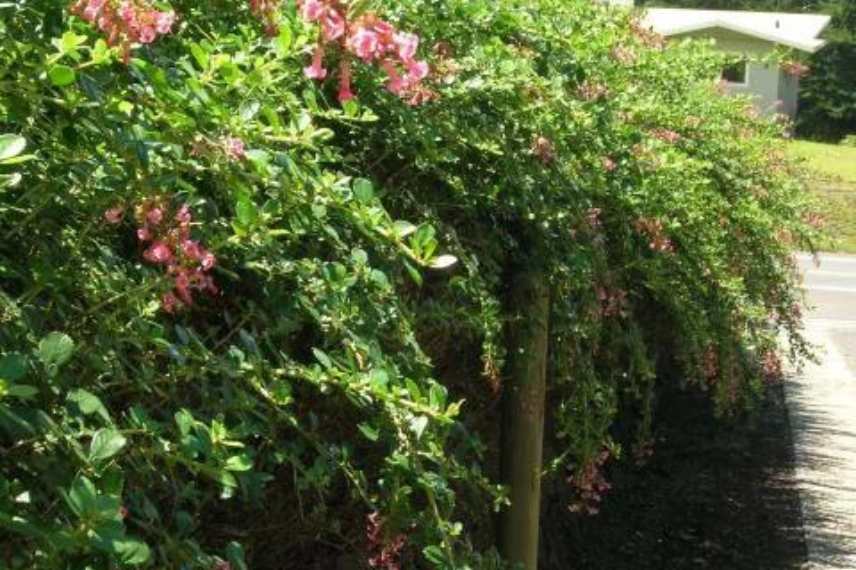
Ideal for hedging with its 3 m in all directions, Escallonia rubra macrantha proves slightly hardier
With a height and spread of 2.50 m, the varieties ‘Iveyi’, ‘Dart’s Rosy Red and ‘Gold Ellen’ can also be suited to hedge planting. Not least because they tolerate pruning well and benefit from a dense, compact habit.
- Subscribe!
- Contents
Comments