


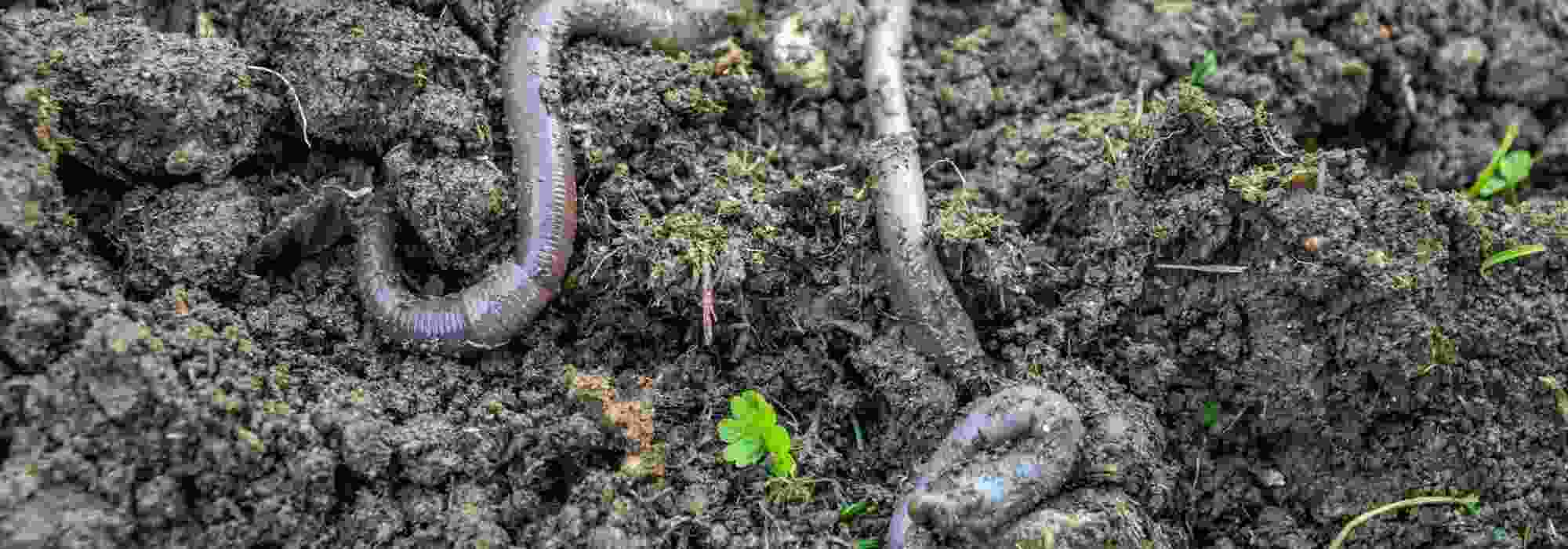
How to encourage soil life in the garden?
Soil is a living medium, teeming with thousands of organisms that must be preserved
Contents
Have you ever looked at soil in your garden or vegetable patch with a microscope? Of course not! Yet such an observation would reveal a wonderful world, made up of hundreds of millions of different organisms, each more important than the next. Indeed, in the soil of your garden, the constant activity of all these living beings, many of which are entirely invisible to the naked eye, results in the transformation of inert organic matter into mineral nutrients, usable by plants and essential to their growth, flowering or fruiting. Hence the importance of keeping this soil active and living, given that soil fauna accounts for around 80% of animal biodiversity.
Let’s discover together how to protect and foster the life of the millions of microorganisms that inhabit the soil of our garden.

Who lives in the soil of our garden?
At first glance, everyone imagines that soil is made up of a balanced mix between mineral matter and organic matter. Yet living beings play an essential role there. Indeed, the density, vigour, and importance of these living organisms determine a soil’s fertility. A living soil, one might say, since soils destined for intensive agriculture, saturated with fertilisers and pesticidal products and mechanically worked to excess, are no longer living soils.
Thus, in 1 m² of soil, it’s not an exaggeration to say that hundreds of millions of living organisms, of various sizes, lie hidden. And 90 % of this subterranean fauna and microfauna concentrates in the top ten centimetres of soil. Their function is to transform inert organic matter into mineral elements and nutrients for plants. But also to structure and aerate the soil through their incessant movements and their numerous tunnels. Some of these microorganisms, namely mycorrhizal fungi, allow plants to feed by making water and nutrients accessible to them. The presence of these microorganisms is therefore essential since it is they who make this soil living, active, fertile… Without this invisible life, soil is sterile.
But what is this pedofauna really made of? In fact, depending on their size, microorganisms are classified into different categories:
- The microfauna, composed of living beings smaller than 0.2 mm such as protozoa, nematodes, bacteria, rotifers, tardigrades… all living in the aqueous part of the soil.
- The mesofauna, comprising living beings whose size ranges between 0.2 mm and 4 mm. In this category, one finds microarthropods, mites, springtails, myriapods, other nematodes, pseudoscorpions…
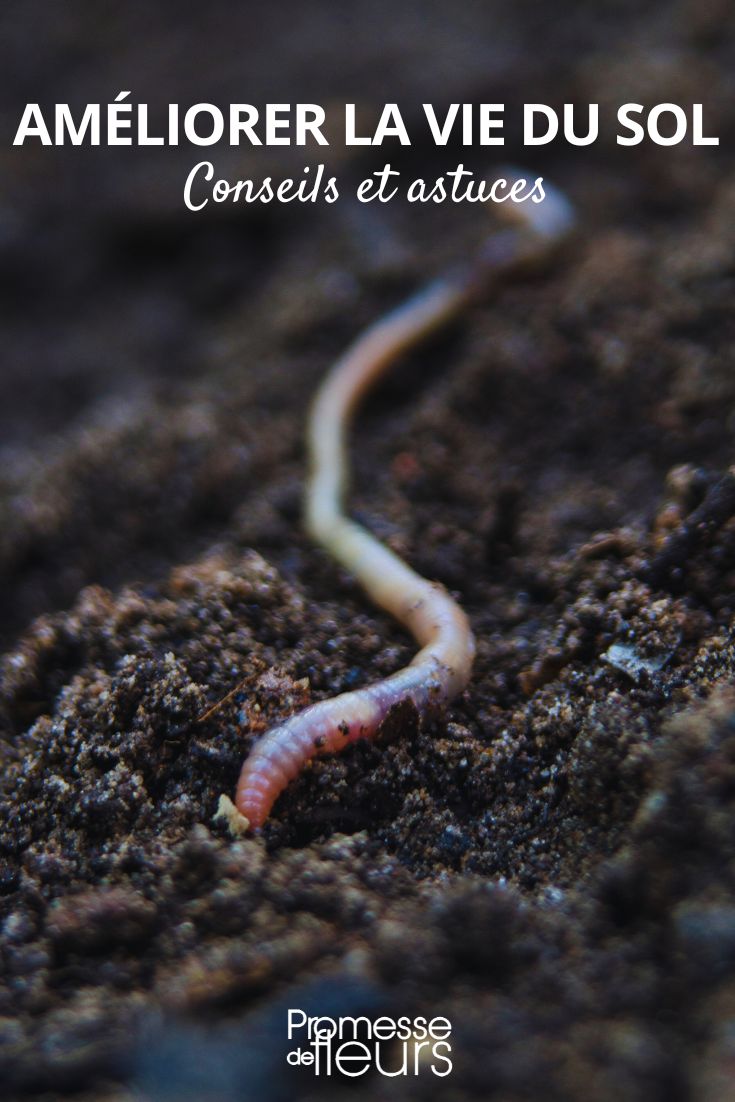
- The macrofauna which includes living beings between 4 and 80 mm such as earthworms, ants, insects and their larvae, woodlice, termites, gastropods, spiders…
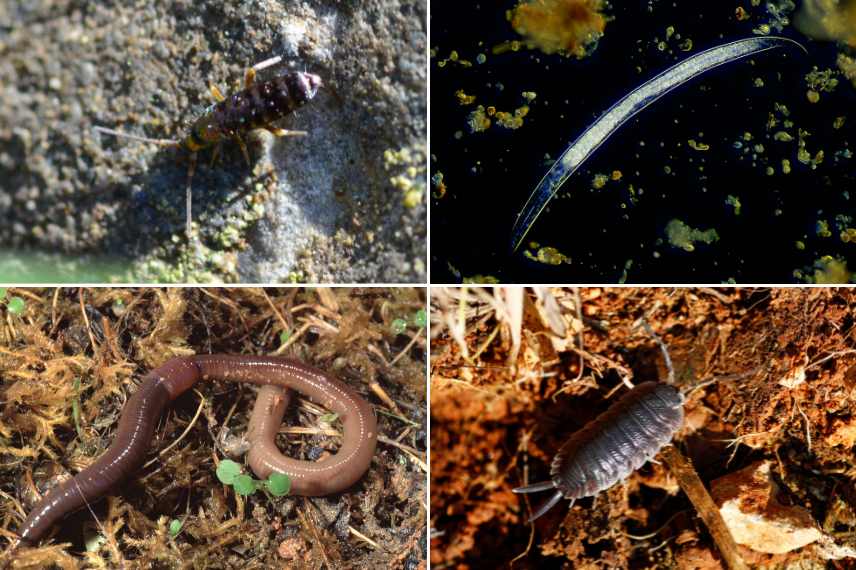
Hundreds of millions of microorganisms live in the soil, some microscopic, others visible to the naked eye
In addition to these living organisms, there are other equally lively beings such as fungi and slime moulds, algae… Or even a megafauna, composed of vertebrates, which also plays a non-negligible role in soil life and the structuring of the soil, as well as the transformation of organic matter. Thus, moles, small mammals, reptiles, amphibians… also contribute to life in the soil.
Because these living organisms all have completely different diets, they all contribute to keeping soil alive. The organic matter added to the soil is fragmented by macrofauna, then consumed and digested by earthworms. We obtain humus on which fungi and bacteria then act to make the nutrients present in the humus assimilable by plants. In return, plant roots promote the presence of these microorganisms.
Read also
Our 100% natural garden fertilisersTechniques to avoid in order to keep soil alive
Not surprisingly, the gardener, keen to preserve soil life, will ban all chemical soil-treatment products, namely pesticidal products and other insecticidal, fungicidal and weedkiller products… which ravage it (though they have their uses). Indeed, in a living soil and a healthy environment where biodiversity is respected, balance is maintained. The presence of predators, pests and pathogens is naturally regulated. And if needed, the gardener can turn to environmentally friendly products or to manures and other decoctions of plant extracts.
Today, chemical pesticidals are banned from sale to the general public and have been replaced by natural pesticidals, authorised in organic farming. To promote a living soil, these products should also be banned, as they do not always distinguish between pests and microorganisms or beneficial insects. As for natural fertilisers, their function is not to improve or feed the soil, but to supply nutrients directly to plants.
The other technique to avoid as much as possible is aggressive tillage of the soil. In particular with mechanical equipment, such as a rotavator or a rotary tiller, which turn the soil to a considerable depth. By breaking the soil structure, the blades of these motorised machines disrupt and kill earthworms, destroy their burrows, dislodge insects and totally disrupt microbial life and essential organisms. Likewise, repeated passes of these heavy machines tend to compact the soil, preventing it from “breathing”.
Similarly, deep tillage can also disturb the soil microfauna. To a lesser extent than the rotavator, but still with consequences. Likewise, it breaks the soil structure and dries it out. Nevertheless, tillage can be useful in heavy and clay soils, as it helps to loosen them. It also has the merit of bringing up certain destructive larvae that will be left to the appetite of predators (birds, shrews, hedgehogs…) or to the weather and cold.
In lighter soils, tillage of the soil can be detrimental.
Soil cultivation and amendment to promote soil life
In the previous paragraph, we looked at the drawbacks of deep digging, at least in light soils, namely sandy, loamy, and clay-loam soils. That said, the soil must be worked gently, without breaking its structure. All that is required is simply to decompact the soil, without turning it over, with a biofork or a grelinette®. These tools loosen and aerate the soil to a depth of 20 to 25 cm without destroying or disturbing the resident microfauna. Thanks to the tines in the soil and the two handles pulled toward you, the soil is dislodged at depth, without being turned over. Earthworms are spared, microbial life preserved, because the soil layers are not mixed. And you, you’ll be spared a good deal of effort. To learn more about using this tool: What is a biofork used for?
In the same vein, the croc is a tool to (re)discover because, like the biofork, it also serves to loosen the soil to a depth of around ten centimetres. To go further and learn more, we invite you to explore our various articles on amendments:
- All our articles on composting
- How to make good leaf mould?
- When and how to use manure in the vegetable garden?
- Pelleted manure: how to use it well in the garden?
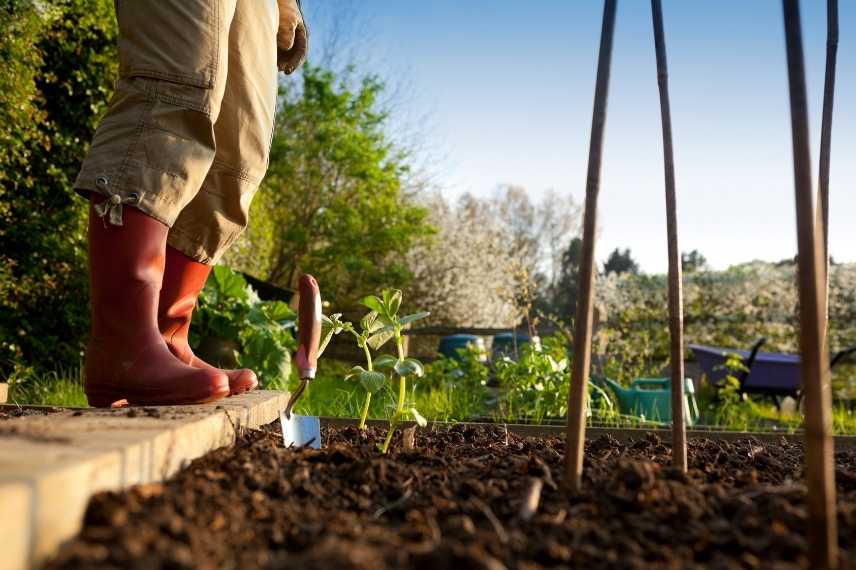
A living soil is a soil that has been worked gently and amended
To promote soil life, it is also essential to apply organic amendments in autumn and spring, just before sowing and planting. These amendments will obviously be very useful for the soil’s composition, but also its structure, the rooting of plants, and water retention. But above all they will provide food for all layers of the microfauna, which will transform them into humus. That is why it is essential to add compost to the soil, but also leaf mould, or manure.
To go further and learn more, we invite you to explore our various articles on amendments:
Soil cover, essential to the life of microfauna.
To promote soil life, it is also important not to leave bare soil. Indeed, bare soil is subjected to the weather, which forms a superficial crust that prevents the movement of water and air, and thus the life of soil fauna. Similarly, bare soil heats up strongly in summer and cools down abruptly in winter with frosts. As a result, thermal instability disrupts soil microfauna. Finally, in bare soil, water evaporates more readily. Not to mention that bare soil becomes depleted quickly: without inputs of organic matter, soil microfauna cannot feed. And it eventually dies out.
That is why it is essential to provide cover for this soil. And this in several ways:
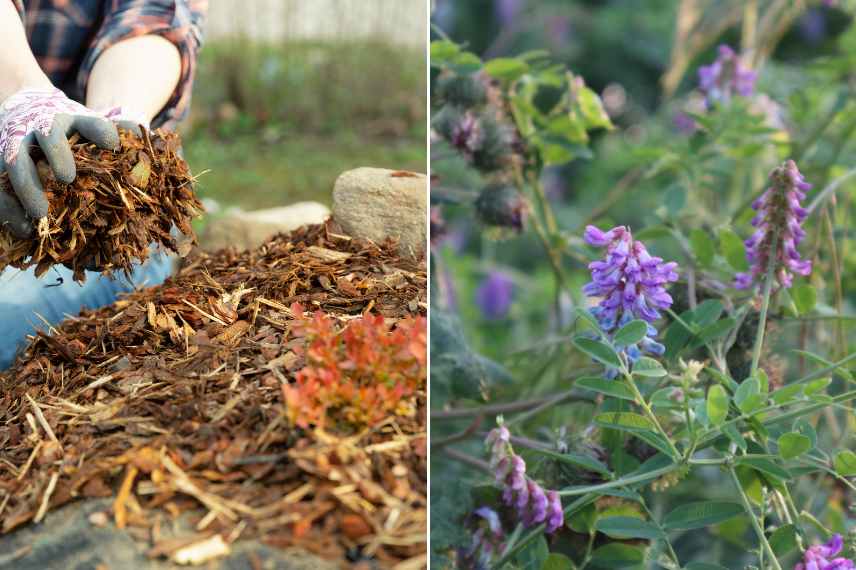 Mulching and the cultivation of green manures help cover the soil and thus support the life of soil microorganisms in the soil.
- Mulching: if it consists of organic materials, from shop-bought or home-made, it is very useful for soil life. Indeed, over time this mulching will decompose, producing standing crop and thus feeding soil microorganisms, which will transform it into humus. Not all mulches are created equal, and to promote soil life, home-made mulches such as dried lawn clippings, dead leaves, shredded branches, crop residues, straw, hay, compost… are perfect. Comfrey leaves or nettle leaves can also be used as mulch
- Green manures or cover crops: they are sown in spring or autumn on open beds or between crops. They produce organic matter, structure and enrich the soil, attract pollinators… Thanks to their powerful root systems, these green manures decompact and aerate the soil, thereby facilitating microbial life. Moreover, as they decompose, either on the surface or buried, their organic matter is returned to the soil, thus producing humus.
- Subscribe!
- Contents
Comments