


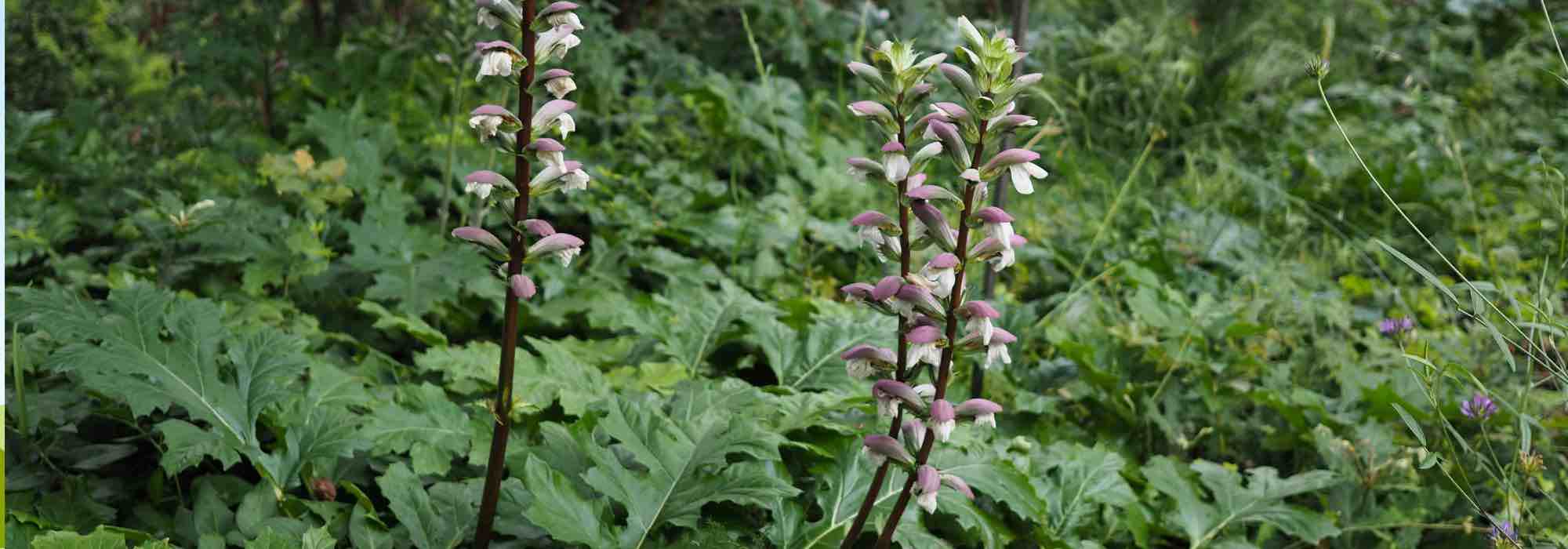
How to get rid of an invasive acanthus?
Identify acanthus, limit their spread in the garden, or eliminate them naturally
Contents
Acanthuses are striking plants that leave no one indifferent, with their large, cut leaves, sometimes spiky, and their impressive upright flower spikes. Highly ornamental, they immediately add a lot of structure and volume to all types of gardens.
However, these sculptural plants can sometimes become invasive when they thrive: thanks to their root system and fruit production, they can proliferate rapidly. They can thus colonise large areas, smothering their plant neighbours. Some species are known to be more tenacious than others, such as the spiny acanthus (Acanthus spinosus).
However, it is possible to simply limit their spread. If you need to completely eliminate them, patience and diligence will be required, but it is entirely possible to act naturally. Here are our tips for effectively containing or eradicating acanthuses in the garden.

How to properly identify Acanthus plants
Identifying the plant
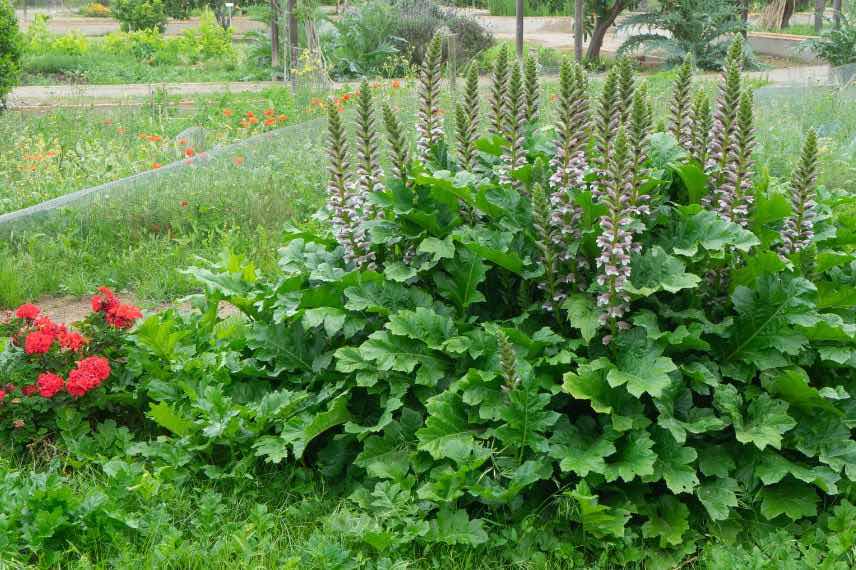
Acanthus mollis
There are different species and varieties of acanthus, ranging from 25 cm to over 1.5 metres in height. These plants share several physical characteristics:
- a fairly broad clump-like silhouette;
- large leaves that are often deeply lobed and sometimes spiny, reaching nearly 1 metre in length;
- a generous summer flowering with long vertical spikes, measuring up to 1.5 metres, or even 2 metres in the most impressive varieties;
- tubular flowers with two lips, whose colours range from white, cream, pink, green, yellow to purple;
- generally spiny bracts that sit above the flowers and can give them a bicoloured appearance.
The flowering is not fragrant, but it inevitably attracts pollinating insects.
The varieties most commonly found in gardens are the soft-leaved acanthus (Acanthus mollis), one of the most spectacular-looking acanthus, or the spiny acanthus (Acanthus spinosus). Its leaves resemble those of artichokes, but in a spiky version. The latter is considered more invasive.

Acanthus spinosus
How does it propagate?
Acanthus plants have a good capacity for proliferation and expansion, thanks to:
- rapid growth;
- a fleshy, powerful, and deep root system, which allows them to draw nutrients and water from the soil naturally, then store them in case of drought;
- the production of suckers (underground stems that allow for the formation of new shoots), which develop from the root stump;
- their seeds (about 4 per fruit), which are released at the end of flowering and allow them to self-seed spontaneously.
Their roots can also be easily propagated by cuttings, with each fragment able to quickly give rise to a new plant. Thus, acanthus naturalises and spreads easily when it is happy.
Read also
Acanthus: planting, growing and careLimit the spread of bear's breech in the garden
Over time, acanthuses can tend to smother neighbouring plants by proliferating. Therefore, it is important to choose their planting location carefully from the outset. On one hand, this limits competition in the garden; on the other hand, the acanthus does not appreciate being moved once established. Take this tendency to multiply into account when deciding on the growing location. Avoid small beds or borders where it will quickly become dominant. Opt for isolated cultivation, or in areas that are more difficult to vegetate with other plants: slopes, dry rockeries, under trees or bushes, etc.
To prevent acanthuses from developing too much, a few simple actions can be implemented.
- Cut the flower spikes down to the ground just after flowering and before the formation of shiny seed capsules to avoid spontaneous sowing. Take the opportunity to use the flower spikes in fresh or dried bouquets, adding a beautiful colourful and graphic touch to your interior.
- Do not move your acanthuses. As we have seen, the plant does not like to be disturbed, and moreover, any root pieces left in the soil are likely to sprout new shoots.
- Remove new plants arising from suckers as they appear by trimming them.
- If necessary, install a root barrier in the soil at the time of planting. This method helps control the spread of certain vigorous plants with invasive tendencies, such as bamboo.
- Do not provide overly favourable growing conditions that facilitate their expansion: the acanthus thrives in rich, deep, well-drained soil, but remaining cool in spring and autumn. It also prefers semi-shaded exposures in regions with a warm climate.
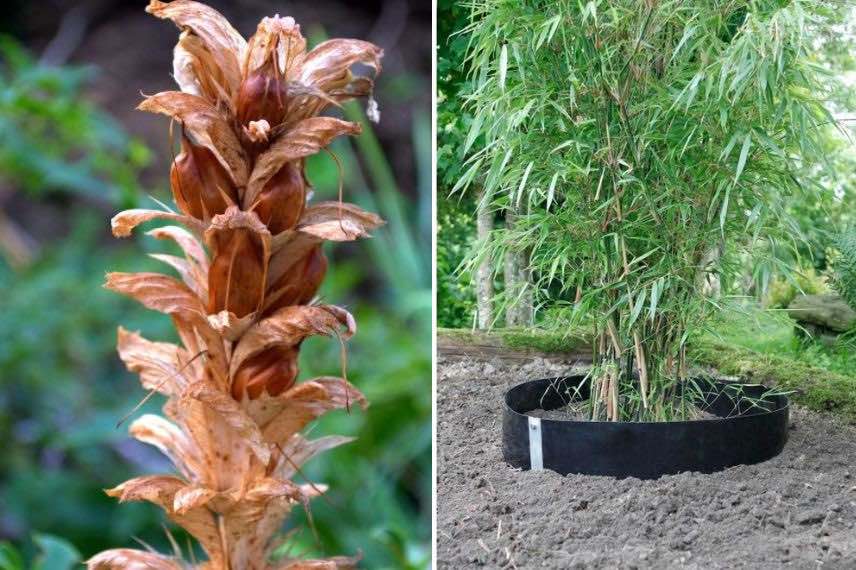
Cut the flower spikes before the seeds in the capsules spread. If necessary, install a root barrier
Eliminate acanthus naturally
As with many plants considered undesirable (the infamous adventive plants or weeds), getting rid of bear’s breeches is not so easy! However, it is possible to act effectively in a natural way without using chemicals, provided you have patience, observation, and a bit of elbow grease.
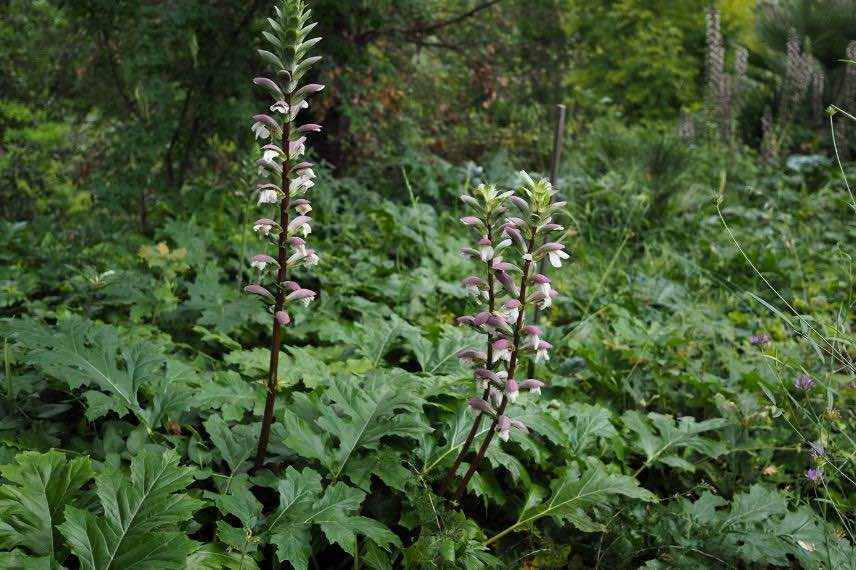
Bear’s breeches can spread far
Regular pruning of aerial parts
Removing the foliage of the plant several times a year will gradually weaken it by preventing photosynthesis. To do this, cut the foliage down to the ground in spring, before flowering, and if necessary, again in autumn before the plant stores its reserves.
For this, equip yourself with a sharp pruning shear, as well as thick, puncture-resistant gloves for the spiny bear’s breeches. If your plant is located on a lawn, you may also use a mower.
Do not throw the plant waste in the compost, but dispose of it at a waste disposal site.
Deep uprooting
To get rid of bear’s breeches, it is possible to proceed with a complete uprooting of the plant. Note: any root fragment left in the soil is likely to regrow. You must therefore be thorough and meticulous, going deep.
For this, use a spade, a weeding knife or root puller, and thick gloves. Manually remove all root pieces. This is a long and physical task that may need to be repeated. But this solution allows you to naturally get rid of bear’s breeches.
It is best to carry out this action after a rainy day when the soil is moist and facilitates root removal.
Covering the affected area
If you do not need to cultivate the area colonised by bear’s breeches for at least 1 to 2 years, you can opt for covering. Covering the area with an opaque material prevents the plants from developing by depriving them of natural light and oxygen. You can also use cardboard, which will need to be regularly replaced and weighed down to prevent it from moving in the wind.
For small plants, an opaque box or bucket can also do the trick.
Actions to avoid
Avoid using a rototiller in hopes of getting rid of bear’s breeches: by breaking up the roots, it opens the door to many potential regrowths.
We also advise against using chemical herbicides. In addition to not always being effective in getting rid of invasive plants, they pollute the soil and are harmful to biodiversity.
Finally, some “grandma’s remedies” using vinegar, salt, or bleach are also not without consequences: they are non-selective and seep into the soil, potentially causing imbalances.
- Subscribe!
- Contents

Comments