





























Rectangular garden design: our tips and ideas
Ideas and inspiration for your rectangular garden
Contents
Most gardens are rectangular in shape, a fairly practical layout for arranging a garden in many different ways. We indeed have a substantial stretch of land at our disposal to divide it into several spaces, which is usually what one aims for in a garden design.
What are the basic rules to know for planning a rectangular garden? How can you get the best from this classic shape to make the garden appealing while giving it enough character? We give you tips and a few inspiring ideas to replicate at home!

The rectangular garden: characteristics, advantages and disadvantages
Rectangular gardens are usually extensions of the house, facing it on one side of the façade. They can also appear in two parts, typically with a first section including access to the garage and the entrance, and a main part extending to the rear of the house. More rarely, some houses have a long, narrow garden along their narrow side, offering fewer views from the home.
Advantages
Rectangular gardens are one of the garden shapes that offer the easiest layouts, because their length allows them to be subdivided into several zones: the structure thus readily lends itself to a layout (the terrace, the lawn, the paths, the flower beds or shrub clusters, etc.). It also adapts to almost all styles (contemporary, English, naturalistic…). Divisible into several squares, the rectangular garden suits particularly well the classicism of the French formal garden which, through its lines and its depth, enhances the perspectives.
It is a very interesting form in small gardens, as it corrects the space’s narrowness by the play of diagonals, easy to integrate.
P.S.: If you follow the programme Silence ça pousse, you’ll surely see what I mean when I talk about a garden that can be subdivided. Stéphane Marie’s garden is one of the finest examples of a compartmented garden opening onto multiple scenes.
Drawbacks of the rectangular garden
If one were to find one, one could say that the rectangle is a shape that has the drawback of its qualities: a quadrilateral with equal sides in pairs, lacking a bit of imagination. The main drawback of the rectangular garden is, in reality, its long corridor effect in some gardens.
If the layout and plantings remain fixed in their lines, relying essentially on rigid and symmetrical tracings around the edges, then the rectangular garden becomes not very natural.
Finally, in the case of a sloping garden, the rectangle is less well suited, unless one systematically resorts to a layout by creating terraces and landings, which can be a deterrent for some gardeners because of the cost involved (but it gives a lot of character to this type of terraced garden).
Read also
How to design a long and narrow garden?What garden style suits a rectangular plot?
The rectangular shape of a garden suits many garden styles. You could even say that the rectangle allows almost any ambience to be incorporated, as it is so versatile. From the Japanese garden to the cottage garden or an exotic garden, you can confidently create the style you want. However, three garden styles stand out particularly for this shape:
- The French garden: it’s the first to come to mind when you think of the rectangle. This type of garden is characterised by strong symmetry, perspective and changes in level. They are often enhanced by parterres with intricate patterns or topiary, water features and fountains. Its rigid character suits a rectangle left intact, but it can also be subdivided, into four squares for example, and one subspace can host a maze. It is also well suited to interior courtyards.
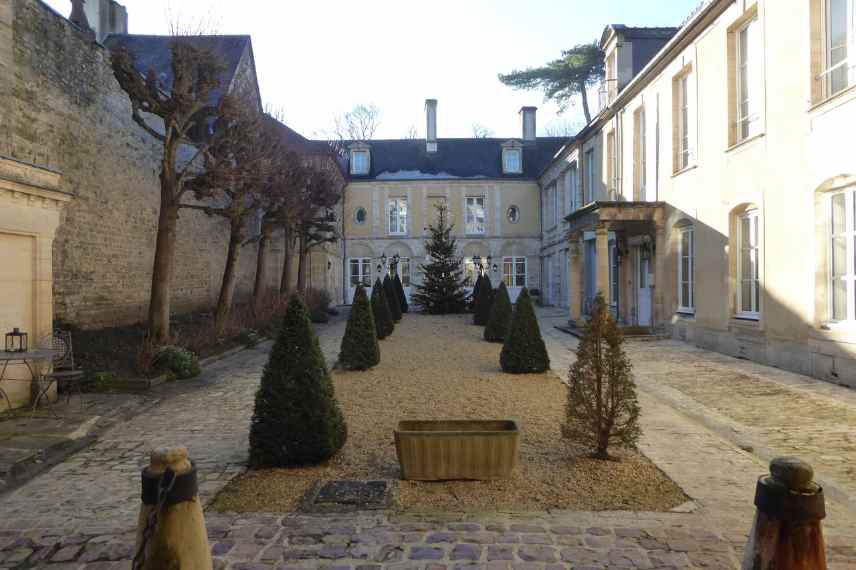
This large inner courtyard uses the full rectangle, combining mineral features with trees and shrubs (© Gwenaëlle Authier).
- The contemporary garden: this garden style, often small, is characterised by clean lines, geometric shapes and modern materials. The rectangle is a perfect fit! It can be complemented with designer furniture in dark or light colours (black, anthracite, white), lighting effects and graphic or massed plantings arranged geometrically.
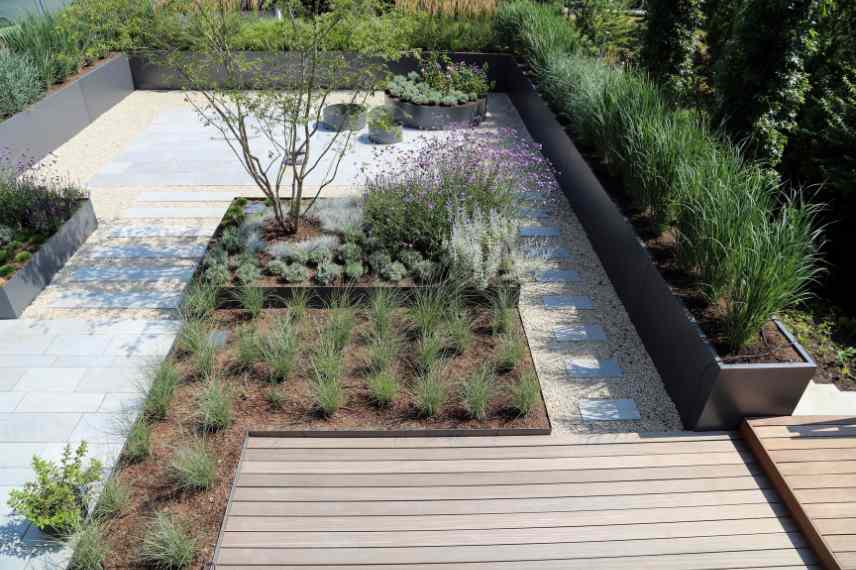
This garden makes good use of the rectangular shape, repeating geometric motifs.
- The Andalusian garden: heritage of the Arab garden, this garden is arranged either as a square-shaped patio with a fountain in its centre, or in a grand version, as quadrilaterals adorned with long, slender basins in their centre. The fairly formal framework is softened by the omnipresence of water and vegetation.
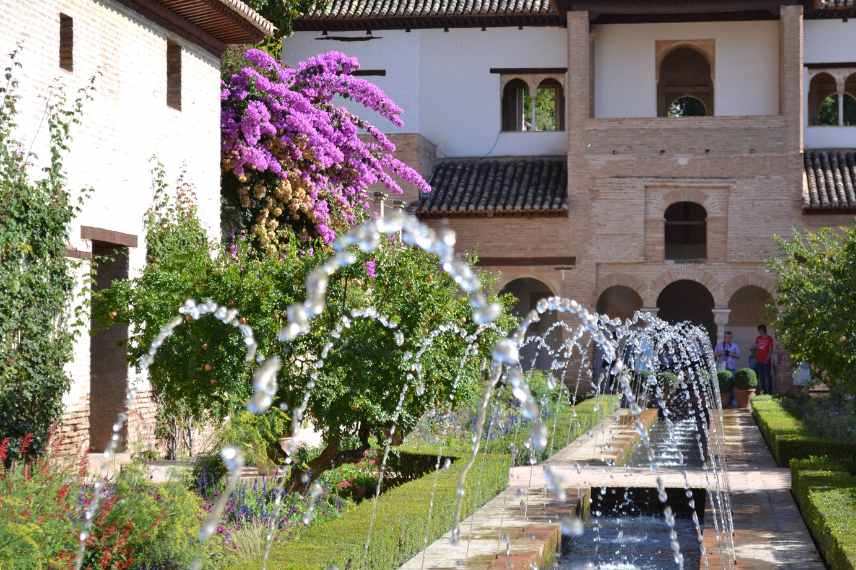
The Generalife Gardens of the Alhambra in Granada.
Split the space
Other gardens with a looser, more free-form design, such as the cottage garden, English garden, Japanese garden, exotic garden or naturalistic garden, tend to seek to divide space and operate with a compartmentalised garden. This is true for both large and small gardens, where it paradoxically helps make the garden look bigger.
Arranging a rectangular garden by playing with different spaces obviously won’t be done in the same way depending on the type of garden. Divisions are generally regular in classical-style gardens, but they are more free in a countryside, naturalistic, exotic or Japanese garden. Similarly, the width of the garden will condition the layouts: the narrower the garden, the more fragmentation should be present to avoid a visually oppressive look.
The first idea that comes to mind for arranging a rectangular garden is therefore to divide space into different zones. We indeed want to limit the overly elongated feel, or even a corridor-like effect in some gardens. A basic landscape rule is thus to consider different needs and uses you will have in the garden, and use them as distinct zones: relaxation area, children’s play area, dining space, vegetable garden, composting area, etc.
This can be achieved by using borders, hedges, low walls or paths.
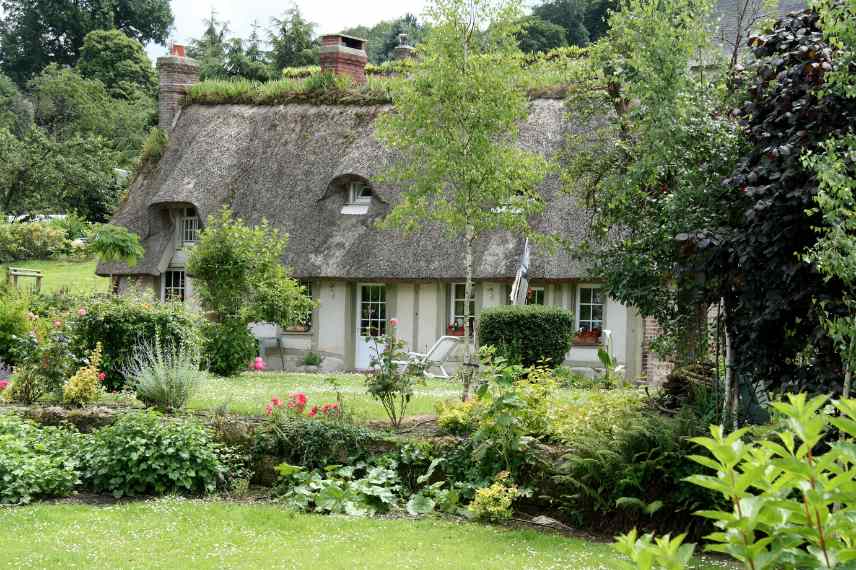
In this countryside garden, the large rectangular area is intentionally divided by a low wall to create a cosy cocoon – a relaxation area in front of the house.
Depending on garden style, subdivisions will vary greatly, with subspaces corresponding to the garden’s ambience.
For example, in large French or Italian gardens, one will subdivide the area to create as many surprises (green rooms, topiary zones, terraces and a labyrinth). In a Mediterranean or Provençal garden, one tends to create terraces, a rock garden, a zone with a pergola and a scree garden, whereas in a romantic garden, one composes with various leafy alcoves. In a Japanese garden, one tries to offer a zone with a pond, a stone garden or Zen garden, a shaded garden with a small pavilion or pagoda, a moss garden, etc.). Finally, in the country garden, one can play with zones more or less sunlit to create distinct worlds, form groves, with the orchard and vegetable garden remaining clearly defined spaces, often separated by hedges or gates.
We can also use the terraced zone to come forward, as in a square garden, to visually delimit the hardscape from the planting, the ideal being to define a minimum of 1/4 terrace to 3/4 lawn as in the example below.
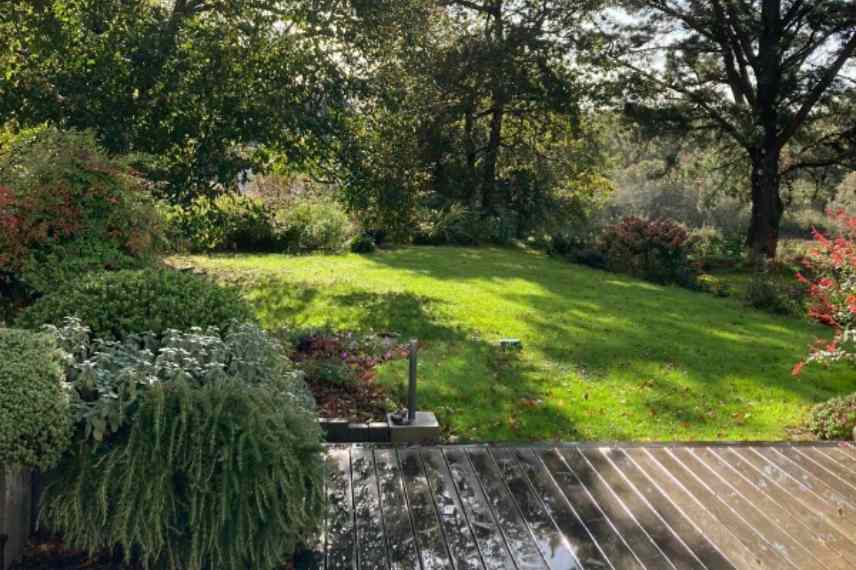
The role of the terrace is not to be overlooked: it alone creates an interesting optical effect and helps delineate spaces (photo by Loise Guiberteau).
Read also
Square garden design ideasMy garden design tips: a few tips and tricks
If the rectangular garden is not well designed, it can look monotonous and dull. It is important to introduce curves, height variations (terraces, stepped levels, and small steps where possible) and decorative elements to break the rigidity of straight lines. Here are several tips to implement:
Create curves
To soften the sharp corners of a rectangular garden, curves can be created using borders, hedges or flower beds. Here you can see that the overall effect makes the rectangle feel less cold.
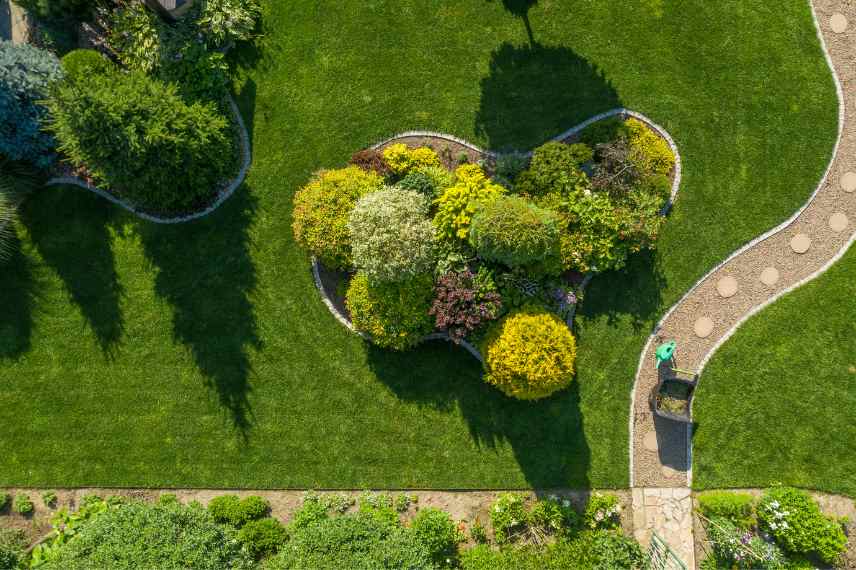
The sinuosity of the path and the planting beds adds a great deal of softness to a rectangular garden.
The simplest way to do this is to arrange circulation in the form of a broad, gentle curve, as shown below: The rectangle fades away; softness takes over!
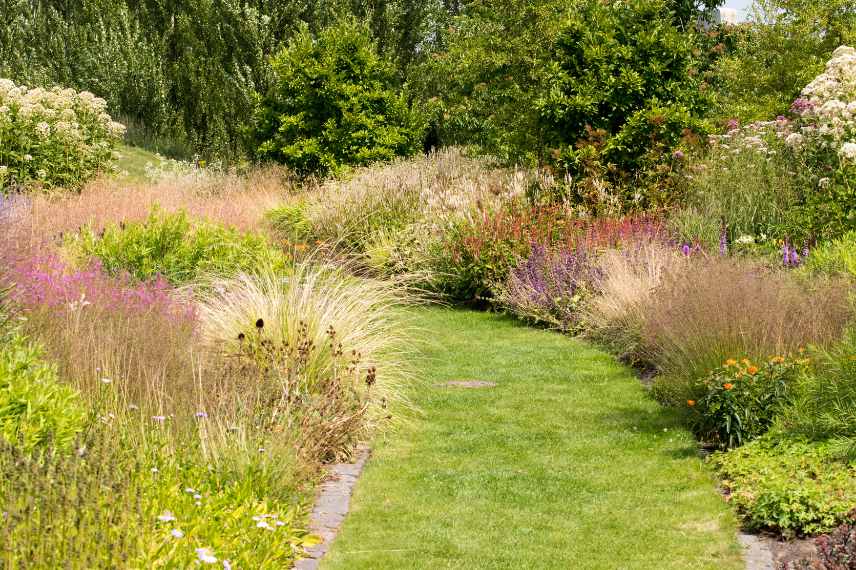
Bordered by soft grasses and beautiful perennials, the wide path stretches with graceful ease…
Compose a garden of mixed borders
The rectangular form, very common in gardens, can disappear entirely by using large planting beds, or mixed borders when the garden is generously sized. In the case of mixed borders, one relies on a hedge or a wall, often present, so one can take advantage of the rectangle’s lines by transforming them completely to obtain an opulent result, thanks to densely planted vegetation. The vegetation takes the upper hand over the shape!
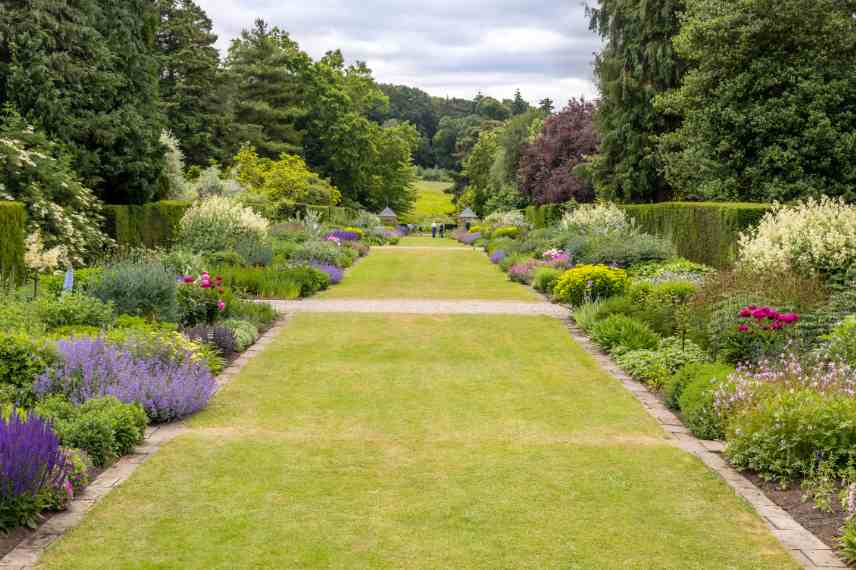
If you have a handsome and large space, a giant mixed border metamorphoses the rectangle’s linearity in a magistral way!
Create focal points
To give character to a rectangular garden, it’s important to create focal points. This can be done by using elements such as a fountain, a sculpture, an oversized pot, a striking tree, a small structure, etc. Focal points draw the eye and give direction to the stroll through the garden.
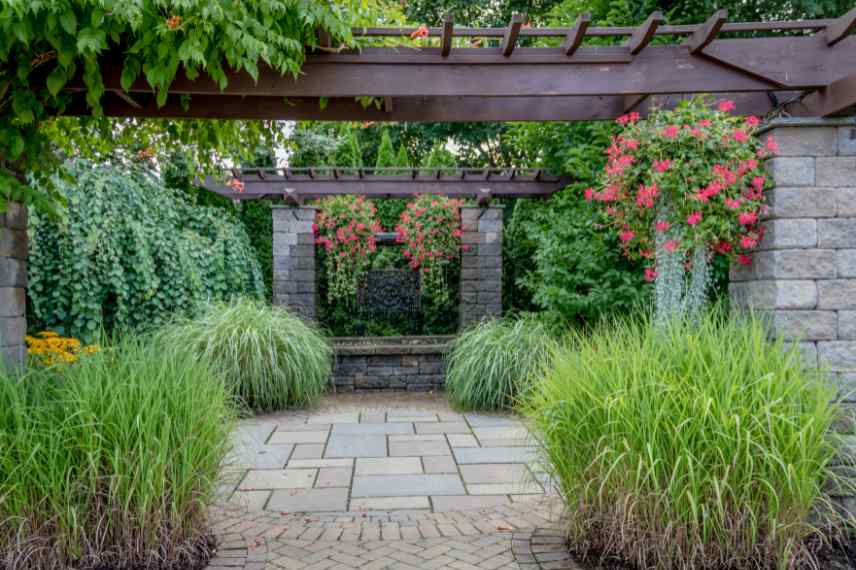
A fountain directs the gaze to the back of the garden, and leads to a more intimate area thanks to the pergola.
Introduce a different geometric shape
One can also completely reformat the rectangle by inserting a contrasting shape into its lines, as in the garden below. Here, a circular lawn occupies almost all of the space.
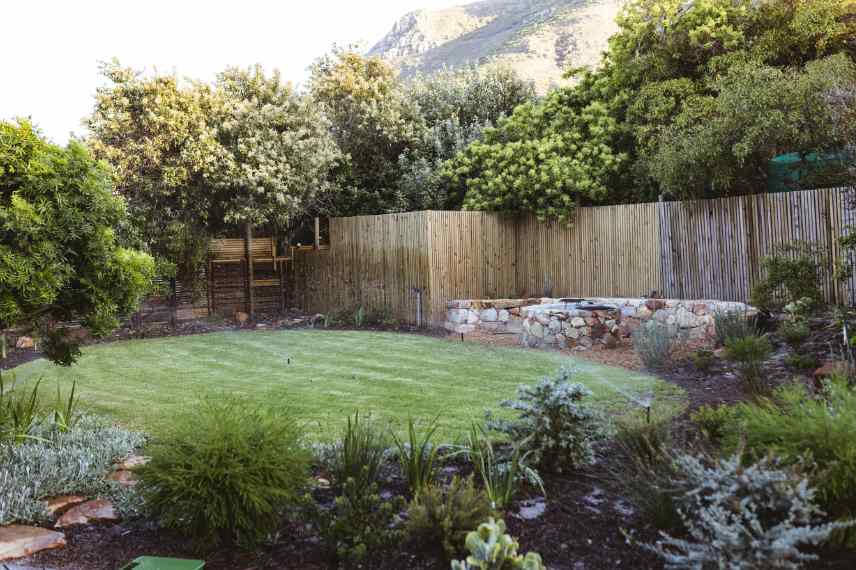
A small wall, trellis and recently planted vegetation in the foreground, which will grow, completely make one forget the rectangle in this small space.
Play with levels
To break up the rigidity of a rectangular garden, you can create terraces, low walls or steps. The clearest example is a sloping garden, as it can be laid out over several terraces linked by steps in natural stone. You will often see this in Garrigue gardens or mountain gardens. But you can also, provided you can excavate the site, create two levels in any garden.
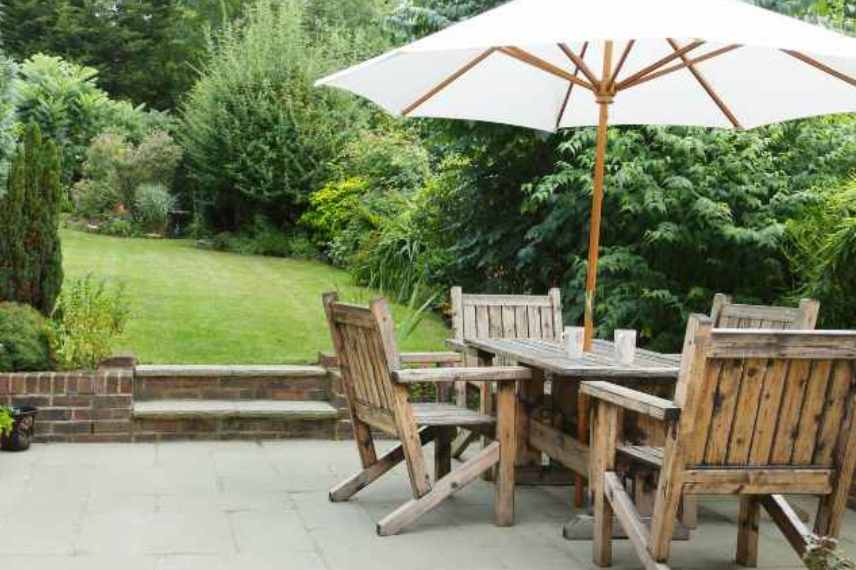
When feasible, the difference in levels creates an interesting rhythm in a rectangular garden.
Anchor the rectangle!
You can instead seek to lean into the rectangular form to emphasise it and create a long, elongated garden. This works very well in walled gardens when soft boundary lines are maintained, or, of course, in French-style gardens, where symmetry adds a classical feel and plays with perspective. Highly design-focused urban gardens will also benefit from the rectilinear plan. Below, this works perfectly in the English garden shown, bursting with generous plantings, exaggerating the massifs in favour of a path reduced to its minimum!
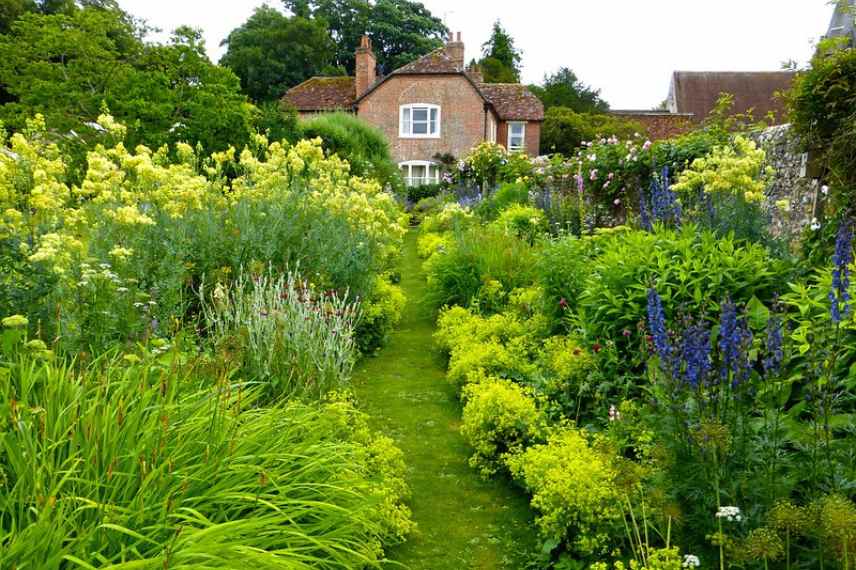
This charming garden has focused on abundant planting while relying on the rectangle’s outline (© Harry Lawford).
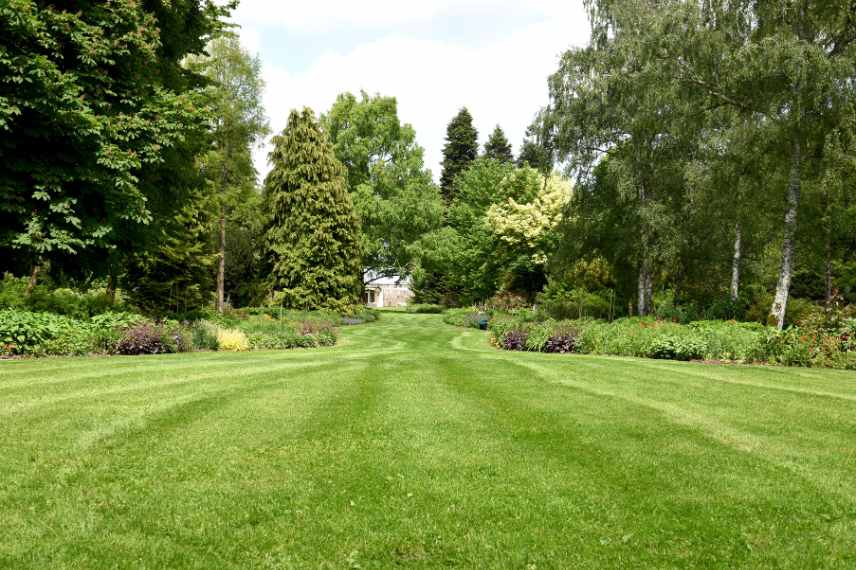
This would also be perfectly suited to parkland at castles or large estates. It allows the eye to travel far across these grand gardens, with the tree canopy and a few side massifs doing the rest…
- Subscribe!
- Contents
Comments