






























How to plant on a slope?
How to successfully plant on a slope: plants, techniques and tips?
Contents
A garden slope is a zone often neglected, as it is difficult to maintain and to know how to beautify it. Planting it up is one of the cleverest options, as it eventually requires little to no maintenance, with weeds being smothered by the carefully selected plants. In the garden, a small slope can quickly become a point of interest if planted wisely.
Planting on a slope, however, requires some precautions, as this sloped area presents specific constraints. In this article we guide you with the right practices to achieve a verdant, long-lasting slope that is easy to maintain.
→ Discover our selection of articles on slopes in our online magazine!

Slope constraints
A slope is not the easiest feature to manage in the garden. This strip that is somewhat wide and steep can sometimes be very abrupt. It’s a part of the garden that presents many drawbacks:
- its access difficulties, especially if the slope is very steep.
- an unevenly distributed drainage according to the gradient, which will need to be taken into account when planning the planting.
- erosion greater than elsewhere, as water runs off and washes away the soil.
- dry, poor soil in the vast majority of cases.
- awkward mowing, even acrobatic.
The aim of planting and vegetating this area is therefore to create a natural barrier, mainly from young plants, but also from rock armour, for example, to prevent erosion.
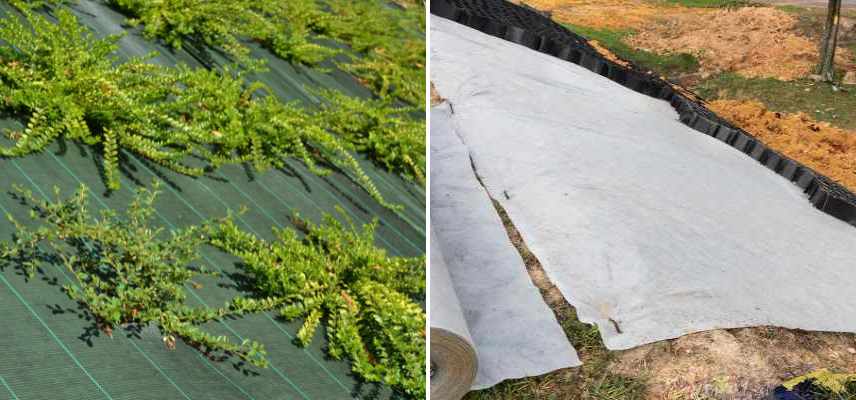
Tarpaulins are often used to combat erosion.
Which plants are best suited for a slope?
There are plenty! We often think of the classics such as ivy, Juniperus creeping, St John’s wort, but in reality many perennials or prostrate shrubs can be planted. Everything will depend on exposure (slope in woodland shade or slope in full sun), the region (mountains, plains, coastal areas), soil quality and the type of soil, the area to cover, and your preferences when it comes to flowering in particular.
In all cases, choose hardy, all-terrain plants, naturally adapted to slopes, that will cope with these conditions. We will favour plants with a spreading habit to rapidly cover the surface (they are ground-covering, much wider than tall, hugging the ground, spreading over more than 1 metre, thus quickly colonising the slope), plants with dense and/or evergreen foliage to limit the propensity of adventive weeds, but also low-water, drought-tolerant plants, and somewhat taller plants to give volume and avoid a dull slope. Ideally, these will be plants that establish quickly.
We also favour plants with a suckering root system to stabilise the slope. Some layer themselves to anchor themselves easily in the soil and stabilise the ground, reducing erosion. It will also be important that these plants require little or no pruning. Also include plants that naturally grow in cushions or with a trailing habit. Finally, consider the role of climbers used as ground cover!
♥ Some examples of ground-cover plants that are effective on slopes and meet these qualities:
- In partial shade or shade : creeping ivy, some spreading honeysuckles, notably Lonicera nitida, St John’s wort (H. calycinum for large surfaces), Pachysandra terminalis, Cotoneasters, azaleas…
- In full sun : thymes and rosemary, sedums, some grasses (fescues, stipa, small miscanthus) santolines, Iris, lavenders, bear’s ears, winter jasmine, fragrant sumac, Teucriums and Ceanothus creeping, low-growing conifers such as junipers, mounding heathers, cinerares, some arching shrubs or plants such as Lespedeza thubergi on large slopes or Japanese forest grass on small slopes, succulent plants in mild climates, ground-cover roses, Erigeron, etc.
⇒ Useful tip: at Promesse de fleurs, refine your search by selecting the item “slope” in “more filters”/”type of planting”.
→ Read also: our selection of ground-cover shrubs; Ground-covering ivy: a useful ground cover; Grevillea rampant: 5 varieties to discover ; Juniper: which varieties to choose to dress a slope?;Symphorine: which variety to choose to dress a slope ; Boxwood: which variety to choose to dress a slope? ; Lonicera: which variety to dress a slope ; Cotoneaster: the best varieties for greening a slope ; Rosemary: the best varieties for greening a slope
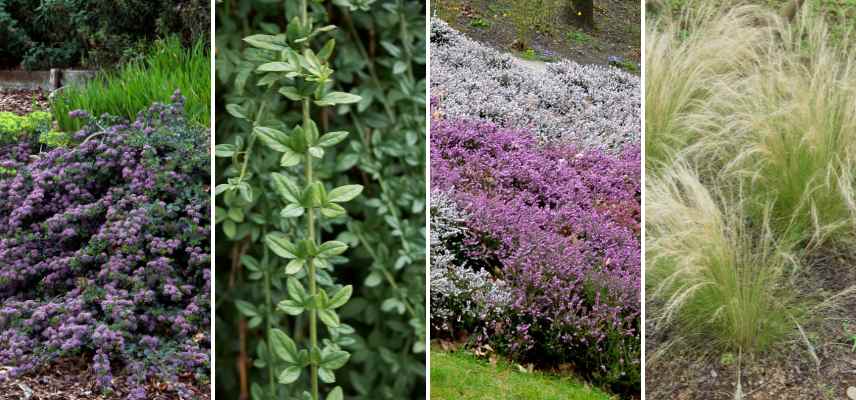
Evergreen plants will be prioritised: Ceanothus thyrsiflorus ‘Repens’, Jasminum nudiflorum, heathers, Stipa tenuissima (angel hair grass)…
Planting on slopes: the rules
To begin with, when planting on a slope, there are several rules to follow, regardless of the slope’s gradient:
- We always start by planting from the top down, and we prepare the area from top to bottom.
- We layer the plantings: the most water-loving at the bottom, the drought-tolerant at the top, since water runs downhill.
- We vary plant heights: shrubs, perennials, all have their place, depending on the area of the slope. We mix them to achieve an attractive visual (don’t have all the low-growing plants on the same side), but plant the tallest plants at the top of the slope. Be creative and include some architectural, colourful, eye-catching plants to energise the area!
- We plant fairly densely for a quick, effective result, with thinning later if needed. As with a traditional border, plant in multiples of 3 or 5 minimum for small perennials (the same plant repeated several times).
- Take time to sketch roughly a plan by noting the different plants: spread, height and distribution along the slope (plants for dry/moist soil = top/bottom placement), which saves time when you don’t know these groundcovers well.
- … and think now about whether you will plant with a tarpaulin or not.
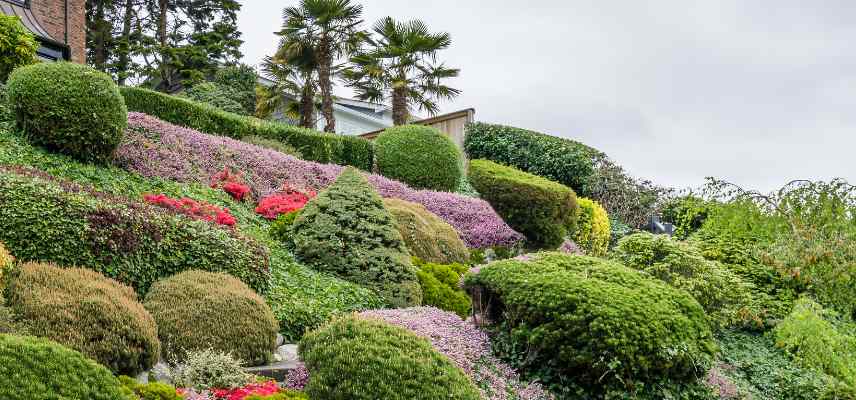
This large landscaped slope is very structured and offers volume thanks to plants that require a bit of care and pruning, but the result is stunning.
Read also
7 perennials ideal to landscape a bankPlanting on a slope: the technique
For planting on slopes, there are a few small differences from planting on flat ground, but the same basic planting principles still apply:
- Plant, if possible, in autumn.
- Prepare the ground: weed the area meticulously, loosen it, then rake the soil to level it. A fertiliser may be spread at this stage over the entire surface.
- Dig holes or planting pits for the larger specimens (with the aid of your sketch): a hole wider than deep. The hole should follow the slope, perpendicular to it, so that the soil behind the hole is higher, forming a shallow basin at the front of the planting, which will make watering easier.
- Prepare the substrate: a mix of garden soil, potting compost and leaf mould or compost in equal parts, to which a slow-release fertiliser is added.
- Soak the root balls of each plant to thoroughly moisten the roots: this is called bottom watering.
- Optionally, lay a sheet mulch (mulching fabric, geotextile): this is commonly practised in vast, less accessible areas of public spaces, which helps limit the appearance of adventive weeds. It is especially useful on slopes with a gradient of at least 20%, as it reduces erosion, and on large areas to work. favour biodegradable fabrics. I discuss it in more detail in What mulch for a slope or a sloping bed? See also our guide How to choose and lay a weed-control fabric?
- Meanwhile, tease apart the roots of the plants that need it.
- Install each plant in its hole, ensuring the root ball is level with the soil surface, and fill with the prepared soil mix. Lightly firm around the collar.
- Water generously with a watering can once all plants are in place, at the base of each plant.
- If you have not laid mulch fabric over the entire slope, spread – on gently sloping slopes – organic mulch (or mineral mulch for mainly succulent plants). Read: How to lay mulch properly?
- Now water with a jet, spraying the whole area.
- Water regularly once a week after planting, except during rainy autumns or springs.
N.B. : a drip irrigation system would be beneficial for economical irrigation on large slopes.
Learn more about installing mulch fabrics in: Flax, hemp, jute, wool… what are these new biodegradable mulching fabrics?
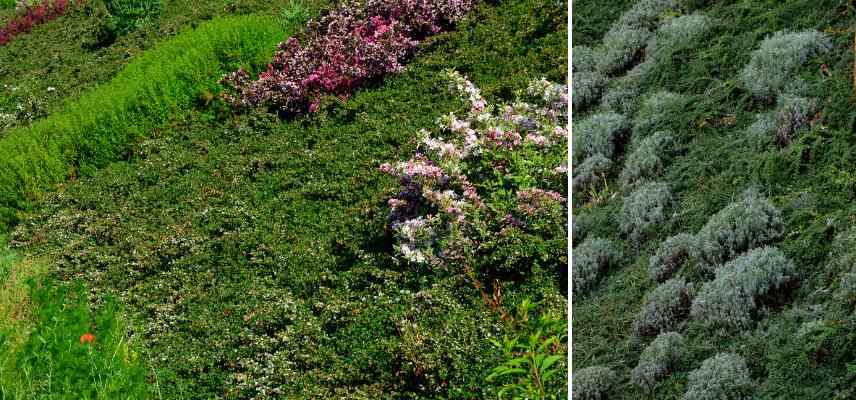
We can create very diverse plantings or choose only two types of plants as in the right-hand image (Lavender and Lonicera nitida), or low-growing flowering shrubs such as certain Weigela varieties on the left.
Landscaping around plantings
- On a large slope, if possible reserve a small access path to reach the plants and carry out some late-winter pruning.
- Rockwork (placing rocks and large stones) or laying wooden logs, for example, enhances the area and helps shape the slope with a light touch. They are also useful for filling gaps at the outset.
- Create upstream terracing: This work is labour-intensive, often done by a landscape gardener, but the result is worth the effort, transforming a large, unsightly slope into an unusual scene, somewhat easier to manage thanks to the tiering. A few steps will be placed on either side to ease movement across this area.
- In the same vein, but in a light version, fascine-based shaping allows taming the slope by shaping it with fascines and hazel hurdles…
- You can also create mini topiaries on a slope: this will require more maintenance, but it has the merit of being very original and of completely transforming the slope, if it faces the garden.
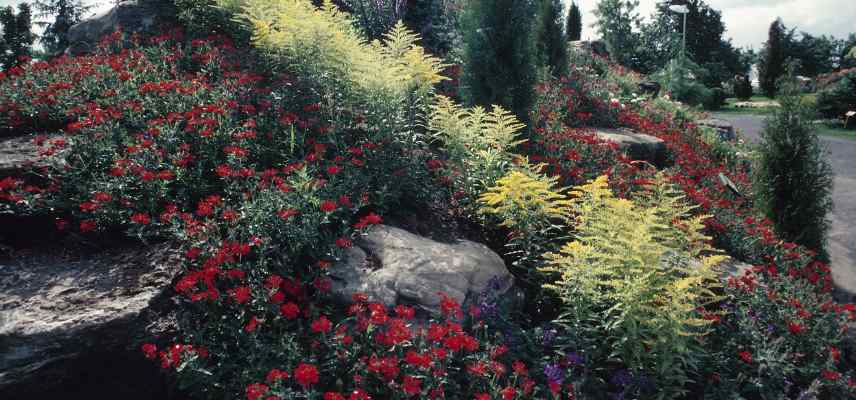
A slope that prioritises flowering, adorned with rocks.
Slope maintenance
That question comes up quite often with our clients, as weed control on a slope can be daunting. But If you plant densely and with the right groundcover plants, adventive plants should slow their progression year after year.
What you must not forget to do is prune back some of the shrubs and deciduous bushes at the end of winter. This annual pruning allows them to thicken up gradually.
We should also add organic mulch, which will gradually decompose in the soil, enriching it.
- Subscribe!
- Contents

Comments