





























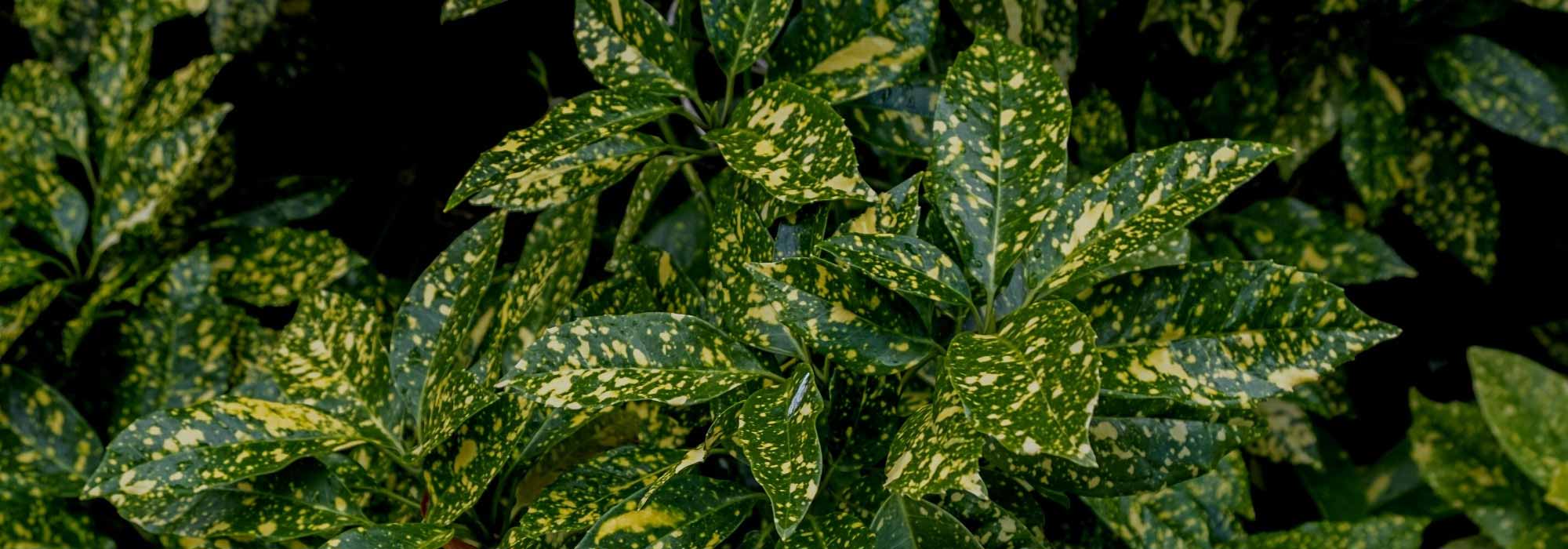
How to protect Aucuba from diseases and pests?
Identifying, treating and preventing
Contents
Aucuba is an extremely hardy bush, prized for its evergreen foliage, often variegated with yellow, and its decorative red berries. Hardy, tolerant of heat and pollution, it is one of the most planted bushes in our towns. It is perfect for bringing colour and light to shaded areas of the garden, both as a hedge and as a backdrop to borders. Although it resists most diseases and pests, Aucuba is not completely free from health problems. It can be susceptible to certain fungal and foliar diseases, as well as to pests that compromise its appearance and vigour. Let’s learn to recognise them so we can treat them naturally and prevent their spread.

My aucuba has black spots on its leaves
Aucuba anthracnose
Description
Anthracnose is a fungal disease caused by the fungus Microdochium panattonianum (syn. Marssonina panattoniana) that can attack Aucuba. This disease mainly affects the foliage and can cause premature leaf drop. It develops in conditions of high humidity combined with mild temperatures (around 20 °C).
Symptoms
Black or brown spots appear on the leaves, often surrounded by a yellow halo. As the disease progresses, these spots can multiply and cover a large part of the leaf, even affecting the entire bush which becomes black and dry.
For more information: Anthracnose.
Natural treatment
- Start by removing the affected leaves to prevent the disease from spreading.
- Make sure to space your Aucubas sufficiently when planting.
- Prune regularly to aerate the branches.
- Spray a horsetail decoction or horsetail manure as a curative or preventive every 2 to 3 weeks.
- Sprays of Bordeaux mixture also help to combat this fungal disease.
For more information, feel free to consult our article on anthracnose.
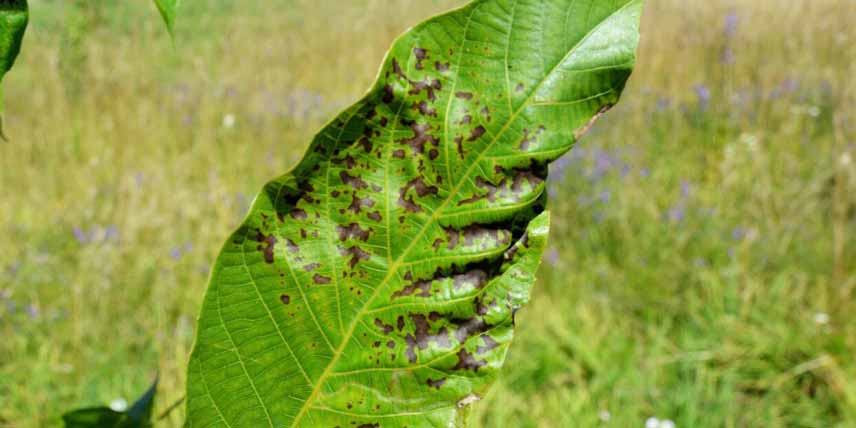
A leaf attacked by the Microdochium panattonianum fungus
Read also
Aucuba: planting, pruning and careMy aucuba's leaves are turning yellow
The beauty of an Aucuba lies in its luxuriant foliage, dark green or variegated; so when its leaves start to turn yellow, it worries us. Here are some of the most common causes of this symptom.
Aucuba chlorosis
Description
Chlorosis is rarely caused by an iron deficiency in the soil, but rather by a blockage of its uptake, often caused by too high a pH or an excess of lime in the soil. This imbalance disrupts photosynthesis, which leads to yellowing of the foliage.
Symptoms
The leaves begin to lose their green colour, becoming pale yellow. This discolouration usually starts between the veins (which remain green) and can spread to the entire leaf if not treated.
Natural treatment
- Foliar sprays of iron chelate have an anti-chlorosis effect. You can also add compost rich in organic matter at the base of your bush to rebalance the soil and improve nutrient availability.
- The nettle manure also helps to correct chlorosis problems.
Discover our article on chlorosis.
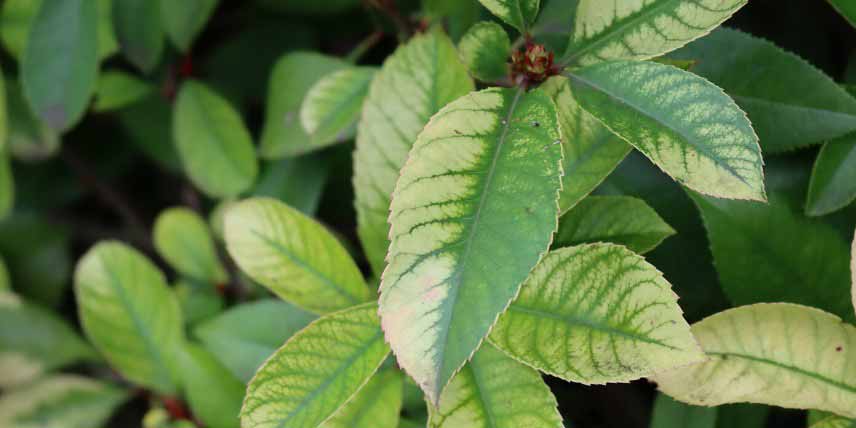
Typical foliage discolouration of chlorosis
Sun scorch
Aucuba japonica is a bush that prefers shady to slightly sunny positions. It does not tolerate full sun, and in our warmest regions it should be placed in the shade.
Description
Leaf scorch is not necessarily caused by disease, but it is a common problem, especially during the hot months. Direct exposure to sunlight or irregular watering can be the culprits.
Symptoms
Brown to pale yellow-beige spots appear on the leaves, which become dry, particularly along the edge of the lamina. Generally, if nothing is done, the leaves of the Aucuba can become entirely discoloured. These symptoms are sometimes mistaken for fungal diseases, but the pattern and location of the spots are usually key indicators.
Natural treatment
The best way to treat leaf scorch is to move your Aucuba to a partially shaded spot, especially in regions with hot summers, or to adjust watering. If it is in the sun, particularly during heatwaves, water it regularly, about twice a week in summer.
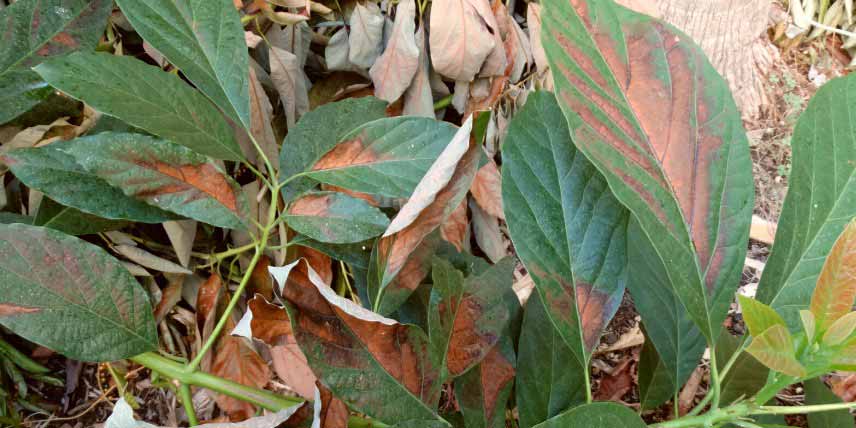
Sunburnt leaves
Pests of Aucuba
Aphids
Description
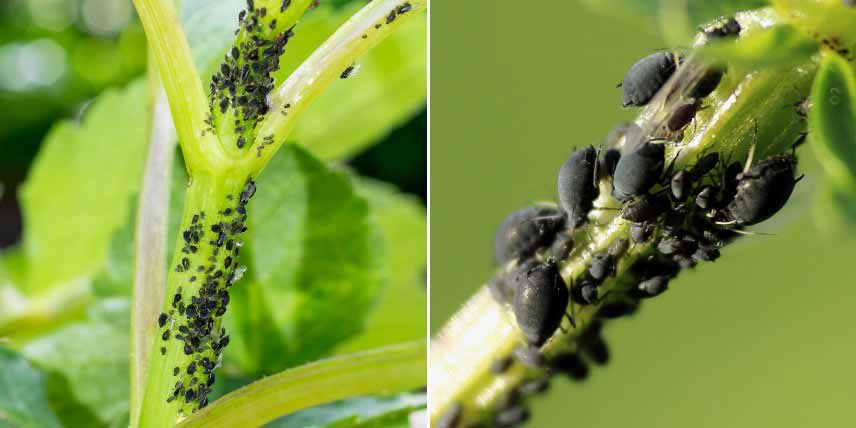
Aphids are small sap‑sucking insects that are not very harmful but can nevertheless cause damage to young plants and new shoots of the year.
Symptoms
An aphid attack usually manifests as distorted foliage, especially on young shoots, together with slowed growth. This can also lead to the appearance of sooty mould, a fungal disease characterised by a black, sticky substance on the leaves, resembling soot.
Natural treatment
- A spray of soapy water is an effective and natural way to get rid of aphids. Dilute 15 to 30 g of black soap in a litre of water and spray onto the foliage at the first signs of attack.
Feel free to consult our article “Aphids: identification and treatment”
Mealybugs
Description
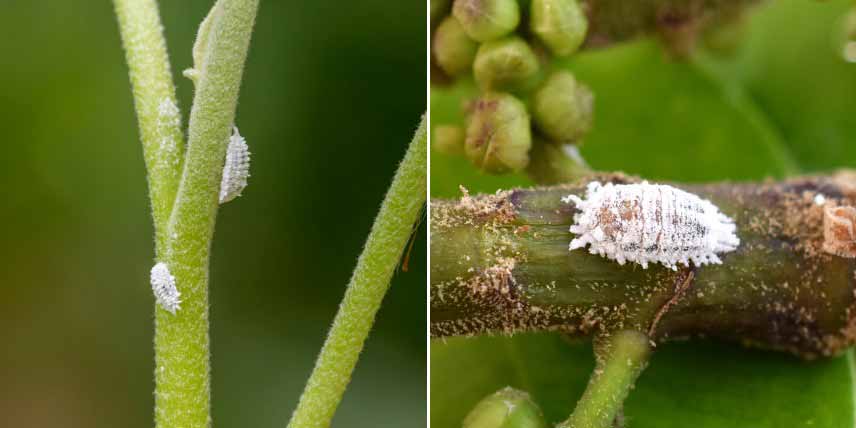
Mealybugs are other small piercing‑sucking insects that feed on plant sap, which weakens them.
Symptoms
The first signs of infestation are the appearance of small cottony balls on the leaves or stems. The foliage becomes sticky because of the honeydew they produce. They also encourage the development of sooty mould. The damage is primarily cosmetic, but it nevertheless weakens the plants and slows their growth.
Natural treatment
Good ventilation reduces the risk of attack. To combat mealybugs, where possible, remove them with a cotton bud or a cloth soaked in 90° alcohol or soapy water.
Spray twice, 30 minutes apart, a solution made from water, liquid black soap, denatured alcohol and a vegetable oil such as rapeseed oil. These sprays will suffocate the insects without harming the plant.
- Subscribe!
- Contents
Comments