





























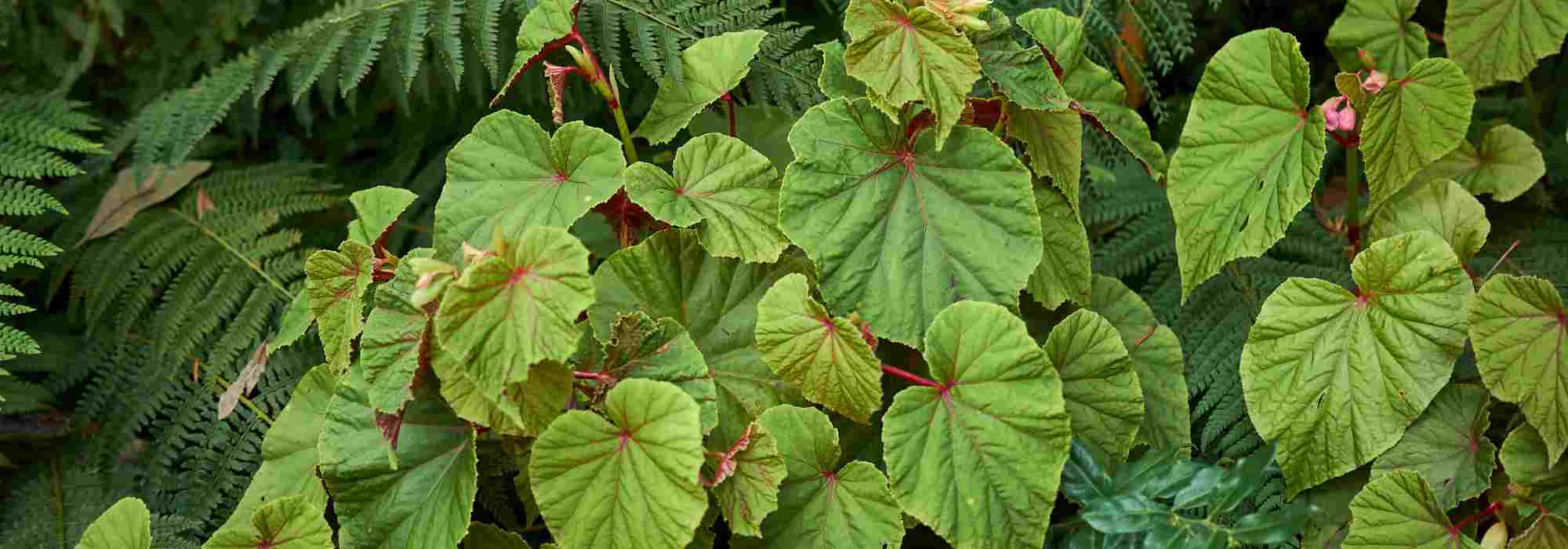
How to recognise a perennial begonia?
What are the differences between annual begonias and perennial begonias?
Contents
The world of Begonias grandiflora have very large double flowers measuring 6cm (2in).is vast, this genus comprising nearly 2,000 species worldwide, with hybridisations that have given rise to more than 10,000 varieties. They originate from Asia for the majority of the perennial species, and from South America and the Caribbean for the species designated as annual in our countries. For all these plants, they are essentially perennials in their natural habitat. So, What are the different types of begonias? Tuberous begonias have, through hybridisation, given rise to many so-called annual begonias, as they are not hardy, these are also known as indoor or house begonias. But there are many perennial begonias, increasingly used in the garden.
All of them tolerate shade or partial shade, but that is not the criterion by which you can tell them apart. So, How to reliably tell a hardy begonia from a frost-tender bedding begonia? How can you tell which ones come back year after year, true perennials, and can thus be left in place for years in the garden soil? We explain it all!

Observe foliage and stems carefully
They’ll give you a pretty good idea of the type of begonia.
Perennial begonias here also bear flowers, but they are mainly grown for their foliage and their groundcover effect, as they spread by their rootstocks or bulblets.
Unlike annual begonias, very popular for container plantings and window boxes, perennial begonias lose — like any perennial — their foliage as winter approaches. This gives them greater hardiness (the ability to withstand cold). Annual begonias, grown in pots, will keep their foliage when brought indoors, at a temperature of 10–15°C, in a conservatory for example.
Perennial begonias generally have foliage much larger than their annual cousins, and very often veined on their undersides, which adds to their appeal, especially in exotic borders.
Annual begonias have glossy leaves, unlike perennials, although some, such as the Begonia sutherlandii, have leaves that are even shinier. Their leaves can also be crinkled.
Note that both types of begonias can bear foliage speckled with white spots or in darker green shades, which does not necessarily help with the distinction…
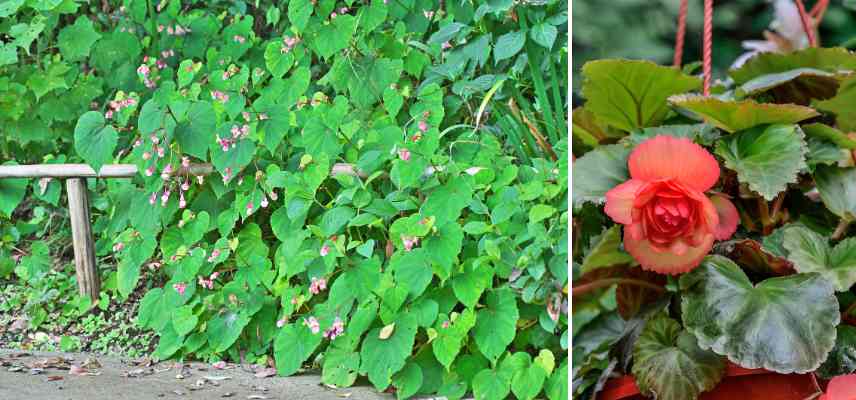
On the left, the foliage of a perennial Begonia (Begonia grandis), and on the right, the glossier foliage of a tuberhybrida begonia.
Stems are generally slightly reddish, which is noticeable in both types of begonias, and they tend to be brittle, or even woody, in tall mature specimens such as the bamboo begonia (Begonia maculata), to be grown indoors.
Finally, some perennial begonias of Asian, Taiwanese or Chinese origin have lobed or deeply cut leaves, such as Begonia palmata, or deeply cut as Begonia pedatifida.
Begonia grandis, the most popular here, is distinguished by its large leaves with red undersides.
Read also
Planting BegoniasExamine the flowers
The flowering of a begonia also provides many clues, mainly from its shape, size and colour, but also from its habit. All the flowers are recognisable by the presence of a small yellow heart.
The colour of the flowers is generally fairly pale in perennial begonias, white, cream up to powder pink, while it is often vivid, very colourful and highly varied in tuberous annual begonias (yellow, orange, bright pink, salmon-pink and red).
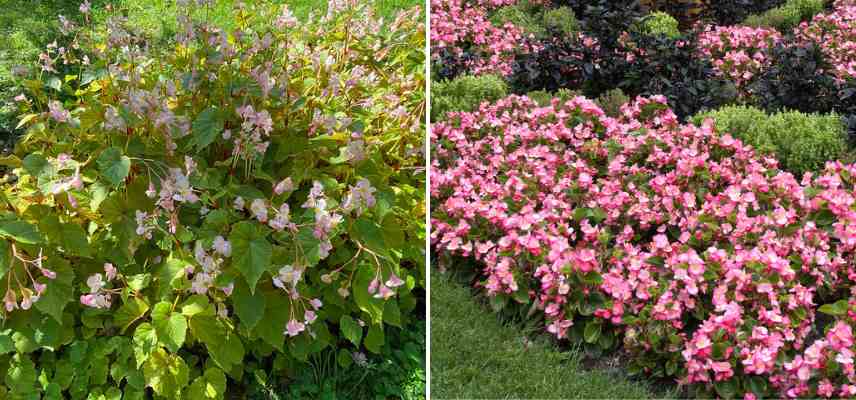 Begonia grandis envasiana on the left, and on the right massed begonias (©Tauralbus-Flickr).
Perennial begonias have flowers much smaller, 2 to 3 cm. Annual begonias sometimes bear small flowers as with Begonia sempervirens, but many hybrids (the Begonia x thuberhybrida) are chosen for their large flowers (6 to 10 cm in diameter). The smaller flowers of perennial begonias give a less vibrant colour impression than those of annual begonias, which are, moreover, sought after for their floriferous qualities.
The shape of the flowers also differs : with tuberous begonias one finds petals sometimes pleated or frilly when the flowers are doubles, which hardly ever occurs in a perennial begonia. The latter have always single flowers borne on tall petiolate stalks, in the form of small bouquets of very delicate flowers.
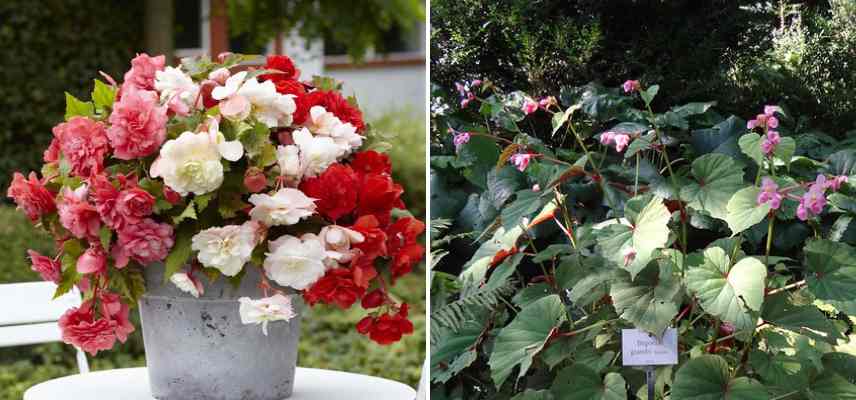 Opulent, double and large flowers of annual begonias on the left, and on the right the Begonia grandis with delicate small flowers.
The flowering period of perennial begonias is another fairly reliable criterion : it is generally later than that of tuberous begonias, starting from mid-summer and persisting into autumn. The flowering of tuberous begonias, for its part, runs from spring (June) to summer, continuing until the frosts. When brought indoors, this type of annual begonia can continue to bloom.
Observe span and habit
It is also fairly easy to recognise a perennial begonia from an annual begonia by its size. It is not uncommon to see a perennial begonia exceed 50 cm in height, up to 80 cm for certain species such as the famous Begonia envasiana or the Begonia formosana. This type of begonia bears its leaves on tall, erect, and turgid stems. Annual begonias well suited to our climate, such as Begonia semperflorens, are generally smaller and more compact.
The very trailing habit of some cultivars is also often a sign of an annual begonia: they are widely used in planters and hanging baskets for this reason.
Note that some begonias are described as bambusiform (such as the Begonia maculata, often marketed in France under the name ‘Tamaya’) or shrubby (Begonia coccinea).
N.B.: fibrous-rooted begonias in their natural habitat in Brazil readily exceed a metre in height (B. haageana, B. corallina, B. coccinea…) : they can be grown here in apartments.
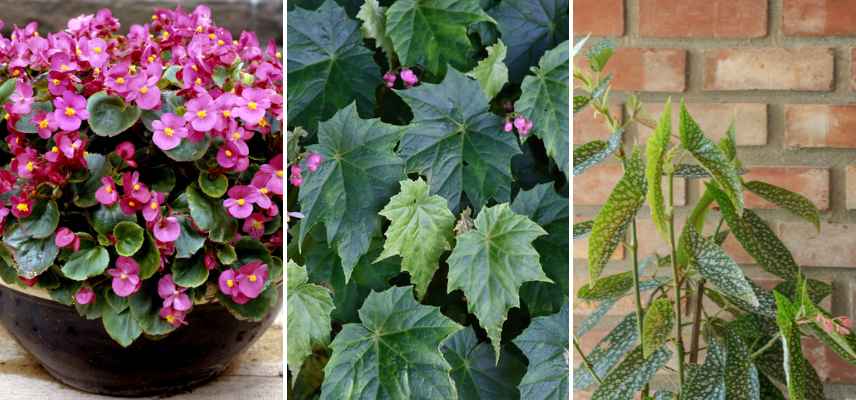
Begonia semperflorens, compact on the left. In the centre, Begonia formosana, shrubby (©LiChieh Pan-Flickr), and on the right Begonia maculata, bambusiform.
Read also
Wintering of tuberous begoniaBe sure of it with their roots
In a garden, visual identification is more challenging; the roots are an excellent way to distinguish begonias, provided you know the root system.
Begonias are indeed divided into three main groups: tuberous begonias, which go into dormancy in winter (including Begonia envasina and the Begonia x tuberhybrida), their underground stems take the form of flat tubers, unlike begonias with rhizomes and fibrous-rooted stumps which have a running root, evergreen foliage and generous flowering.
→ See also: Bulbs, corms, rhizomes, what are the differences?
Hardiness, a distinguishing criterion for begonias, worth bearing in mind
When you opt for a tuberous-rooted begonia, an annual variety, and you want to keep it beyond frosts, remember to bring it indoors from October or late September, depending on your region. All these annual begonias, native to South America, would not survive the winter outdoors.
If you enjoy creating summer borders with annual begonias, you will of course need to replant them every year…
As for perennial begonias, they are indeed hardy, but only down to −10 to −15 °C. To see them reappear in late spring, a thick layer of mulch is nevertheless necessary in many regions. Also remember that the hardiest perennial begonia is the Begonia grandis subsp. envasiana.
→ Also read: How to understand a plant’s hardiness data?
Learn more about begonias
Take a quick trip to Rochefort in Charente-Maritime, which, together with the French National Begonia Conservatory, has the world’s largest collection of begonias!
- Subscribe!
- Contents
Comments