





























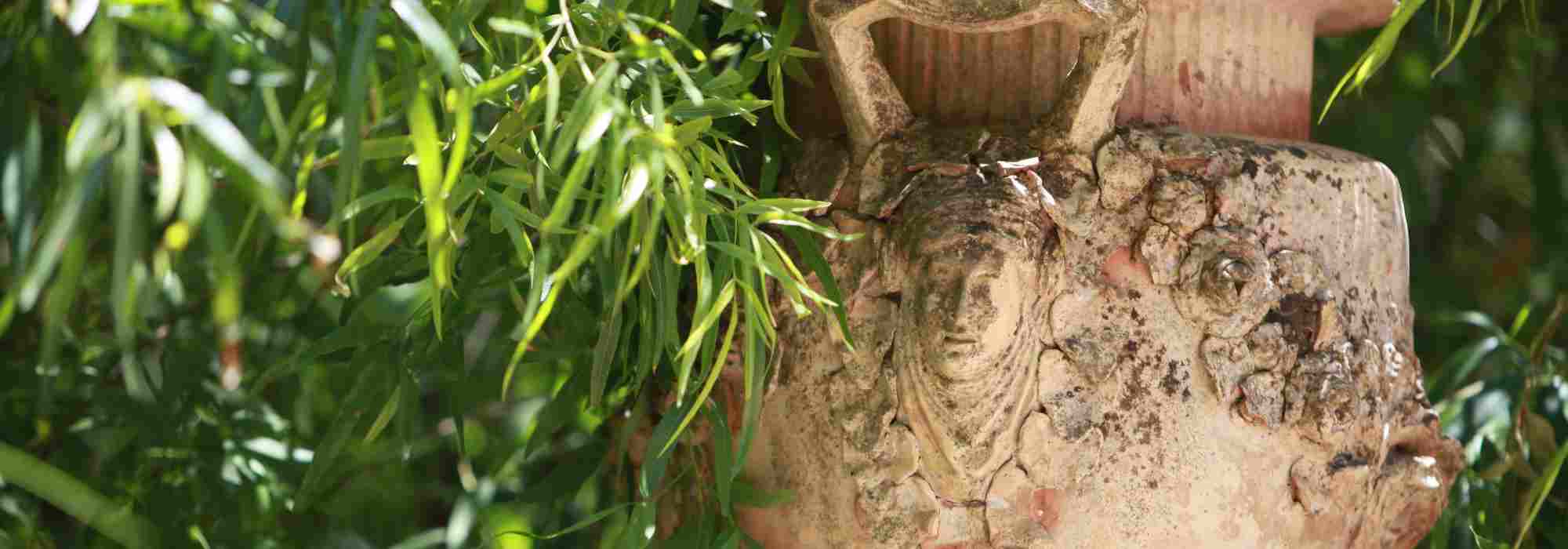
Clay and terracotta pots landscape ideas for the garden
A unique material for our gardens and vegetable plots
Contents
Terracotta is a timeless classic for decorating your garden with beautiful pot plants that shrug off trends. This natural material is, indeed, as old as the hills. Its colour, between orange and brown, and its matte finish make it suitable for many garden styles, equally at home on the terrace as in the borders, and of course in the kitchen garden where it has many uses, including oyas, which have returned to the fore in recent years. Porous, terracotta is undoubtedly the ideal material for growing a wide range of plants. Sometimes frost-prone, it should, however, be chosen with care.
From decorative terracotta pottery to small propagation pots, this article covers all aspects of terracotta in the garden. How to showcase terracotta in the garden and which styles of terracotta pots to choose to dress the space? How to protect your terracotta pots for as long as possible? Here are a few tips to understand it better and use it well.
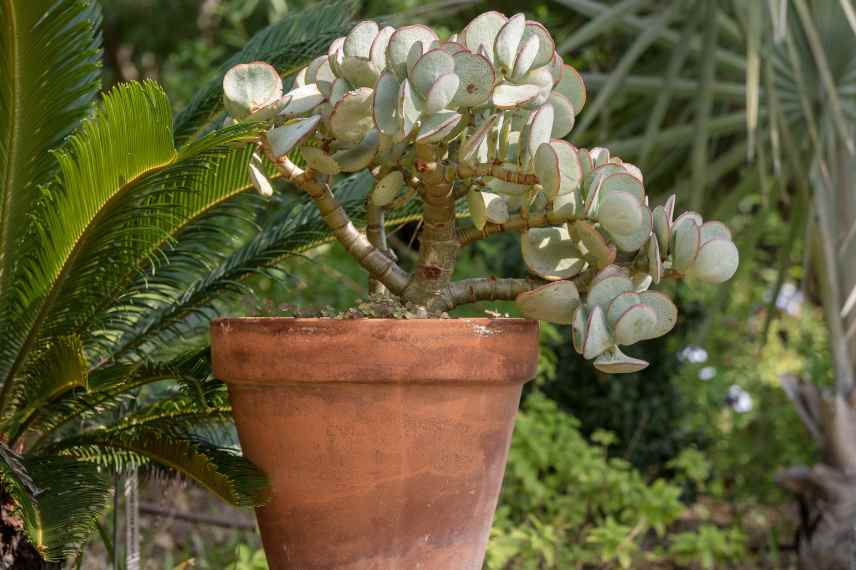
Terracotta really highlights succulent and exotic plants

Origins of Terracotta
If there is one ancient material that we commonly use in the garden today, it is terracotta. In the Neolithic era, people used it for utilitarian purposes—cooking and funeral rites—but it was the Chinese who developed the art of pottery over 10,000 years ago, before the Greeks, Mesopotamians and Egyptians integrated it into their domestic uses. Hardy pottery gradually became more refined, with the evolution of pottery made from coarse clay mixed with stone (the impasto) into a technique that gradually came to perfection.
Clay quarries are found all over, hence terracotta has developed in many regions of the world, notably in France. Today, terracotta used in landscape ornament is widely employed in the Mediterranean basin, but it is found in various forms in gardens on all continents.
In France, the glazed Anduze vases, from the village of the same name in the Gard, bring together around a dozen manufacturers who produce superb XXL containers for classical gardens, with Italian or Mediterranean inspiration. Other renowned French potteries with artisanal know-how and more than a century of tradition are to be found in the south of the country, such as the potteries Ravel, Goicoechea or the Albi potteries, often available in garden centres. But the growing interest in this unique material for garden decoration now makes it easy to find very fine local terracotta productions in every region.
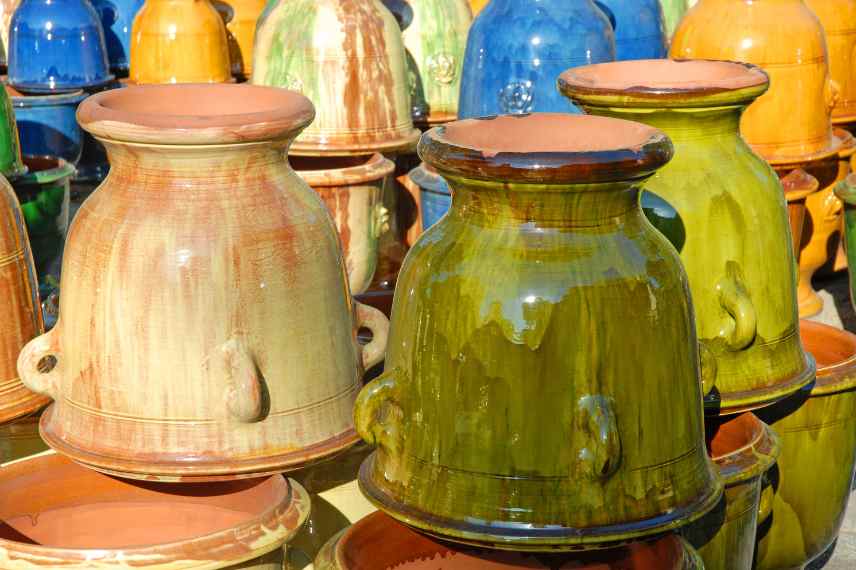
Anduze vases
Earthenware, clay and terracotta: what are the differences?
Primitive material of our civilisation, terracotta is produced by firing clay, mixed with water, sand, marl or silica, or also with chamotte for large pots, as it improves heat resistance. It can be raw, and in that case the Italian term terracotta is often used. Terracotta is also commonly found in glazed, enamelled or glaze-fired forms, which makes it less porous due to a second firing.
It is fired at between 800 and 1200°C. From a firing at 1000°C, terracotta will be more frost-resistant.
The clay types vary according to the potter and region: mainly red clay, white clay or kaolin, grey or yellow clay.
If artisanal terracotta is the most beautiful, it remains expensive. Industrial terracotta is readily available commercially, cheaper because it is produced in large batches, but more basic. For unique pieces to place in a garden, artisanal terracotta is to be preferred, for its authenticity and aesthetics as well as the benefit of local production.
Note: stoneware is a clay fired twice at high temperatures, above 1200°C. This gives it exceptional strength and frost resistance, as well as impermeability.
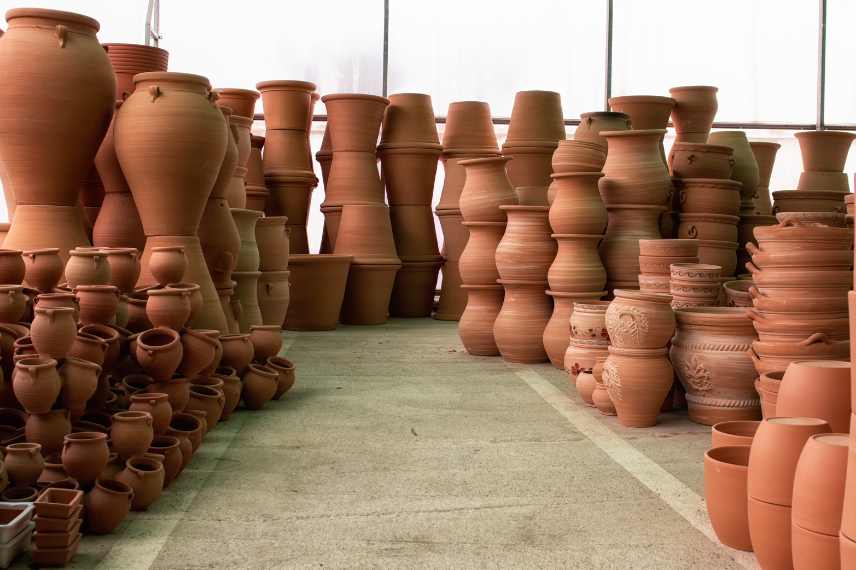
Terracotta pottery workshop
→ Also read Clay: uses and benefits in the garden.
Advantages and disadvantages of terracotta in the garden.
Terracotta has a very interesting porosity for the cultivation of plants: thanks to the clay, it is permeable to water and air, and lets the roots breathe. Gas exchange is facilitated, and it generally keeps the substrate cool. This is particularly welcome in summer. This material is a good thermal insulator and provides relatively good protection for plants against temperature fluctuations.
Varnished or glazed, it becomes waterproof and frost-resistant according to the firing degree, and it features a range of colours and patterns that help bring colour to a garden.
Terracotta wares come in a multitude of shapes (round pots, square pots, window boxes, pots on legs, basins, strawberry pots, small culture pots, amphorae…), and sizes (from mini pots for cacti of 3 cm in diameter to over 1 m in diameter, depending on manufacturing processes for large-format pottery that allow large volumes of soil for planting shrubs, citrus trees, or even small trees).
In different countries or regions, they are shaped differently: in Greece, for example, you tend to find pottery marked with circles, in Italy decorated with fruit friezes, in Provence in the form of jars, etc.
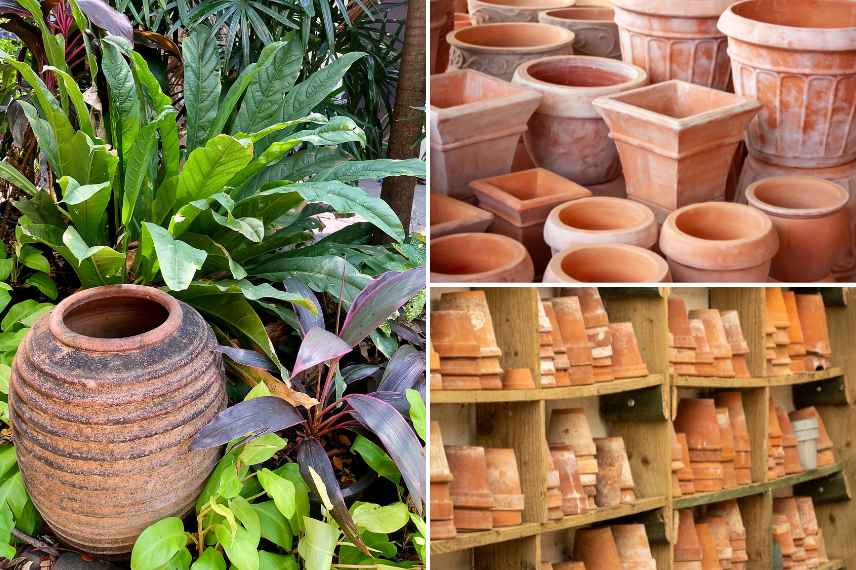 Warm colour blending into the foliage, the purity of shapes, variety of styles and dimensions: terracotta pots have many qualities!
Timeless, terracotta wares, even in the simplest shapes, are a perennial aesthetic choice. In their raw, unglazed form, the warm colour, burnt-bread brown, in a gradient from pink to orange, and finally neutral, has the great advantage of blending into diverse garden styles. Finally, there are terracotta decorative objects, such as chimney pots, fountains and other basins to refresh outdoor décor.
One of the main drawbacks of terracotta pottery is its weight, much heavier than other containers, and so they cannot be placed on small balconies in multiples. Terracotta pots are therefore often difficult to move. Placed in the sun, their substrate dries out more quickly. Their price is also a consideration, notably artisanal pottery and frost-resistant terracotta pots. Frost-prone terracotta cannot be installed outdoors year-round in many regions. Finally, terracotta is considered more fragile and must be handled with care to avoid any cracking.
→ Read also: Plastic pots, biodegradable or terracotta pots: advantages and disadvantages.
The benefits of terracotta in landscape design
Terracotta is an enduring, highly versatile decorative element in landscape design, blending seamlessly into any landscape or garden.
We find terracotta tiles sometimes used as paving (but frost-prone, they are best reserved for the south of France), or terracotta objects or large pieces (fountains, statues, sculptures, birdbaths…). But it is generally outdoor pots that will serve us in the ornamental garden: rounded planters, Mediterranean jars, basins, large saucers and Mediterranean-style pottery, old salt-boxes or sandstone ossuaries, the choice is vast!
This material sits well in gardens where natural materials take pride of place: walled gardens in ochre stone, old country houses built of local stone, or house exteriors with warm southern colours or tiled. The Italian garden gives it its nobility, while the Mediterranean garden, the scree garden and the Garrigue garden elevate it, the cottage, English or naturalist garden adore it! Terracotta works wonders in these sun-drenched gardens, with warm hues in harmony with a summery vibe and the song of cicadas.
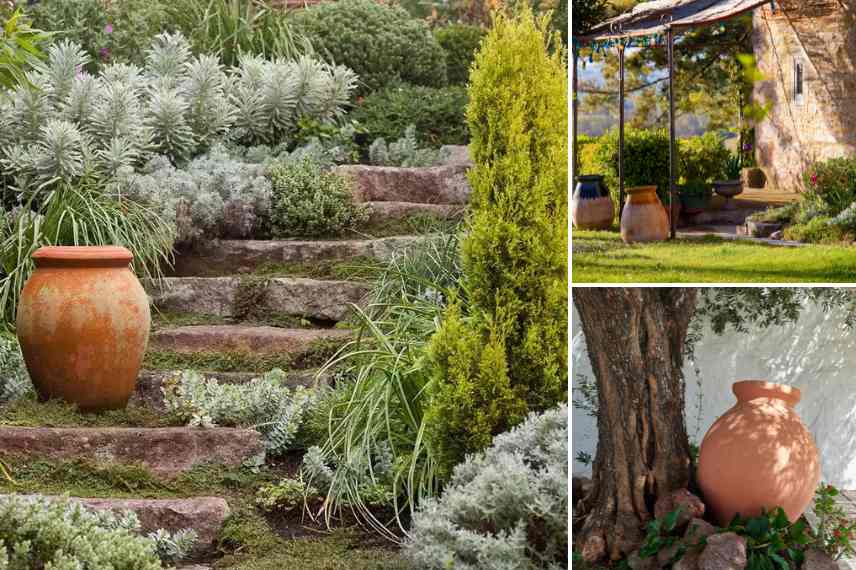
Terracotta, ideal in southern gardens (Photo on the left: Laurie Black)
Terracotta pots also fit very well into much more classic, French-style gardens, in large properties or châteaux, where one often selects very large models. They bring immense sophistication and presence there. As for the exotic garden, it also likes to incorporate all or part of terracotta containers, whether it is a jungle-type garden or an dry exotic garden.
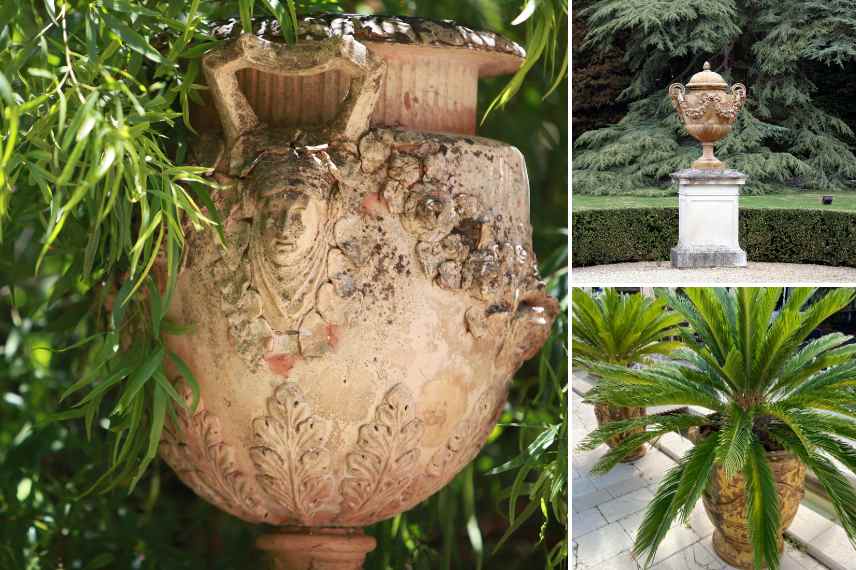
Old terracotta pottery looks splendid in French-style or Italian-style gardens. Bottom right are Anduze pots perfect for southern gardens, or in a dry exotic garden
How to use terracotta in the ornamental garden?
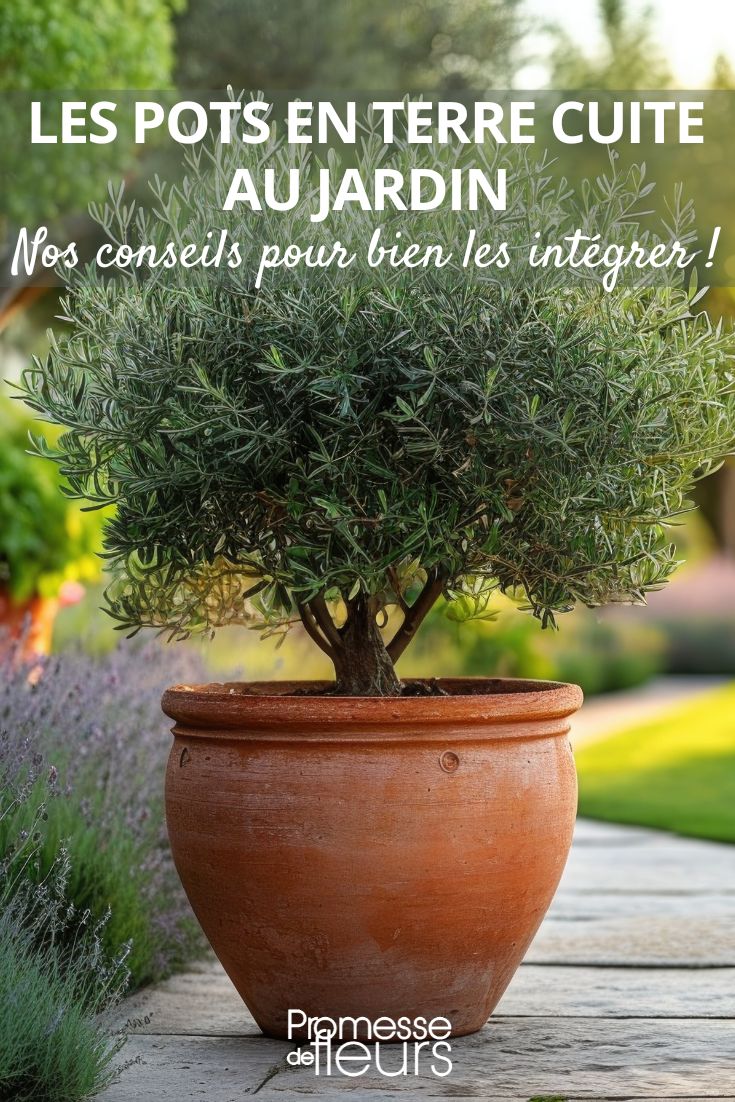
Along a driveway, to mark an entrance, around a pool, terracotta invites travel and carries us to the shores of the Mediterranean, from Corsica to Greece and Portugal, such is its popularity there. It is particularly well suited to southern French gardens to reinforce that southern vibe. It is also certainly the most aesthetic material for housing a citrus or olive tree planted in a pot.
Terracotta pots paradoxically also make perfect containers for small container gardens urban, or in patios where shade dominates: they help keep things cool in this context and allow growing plants such as Aspidistra or hostas.
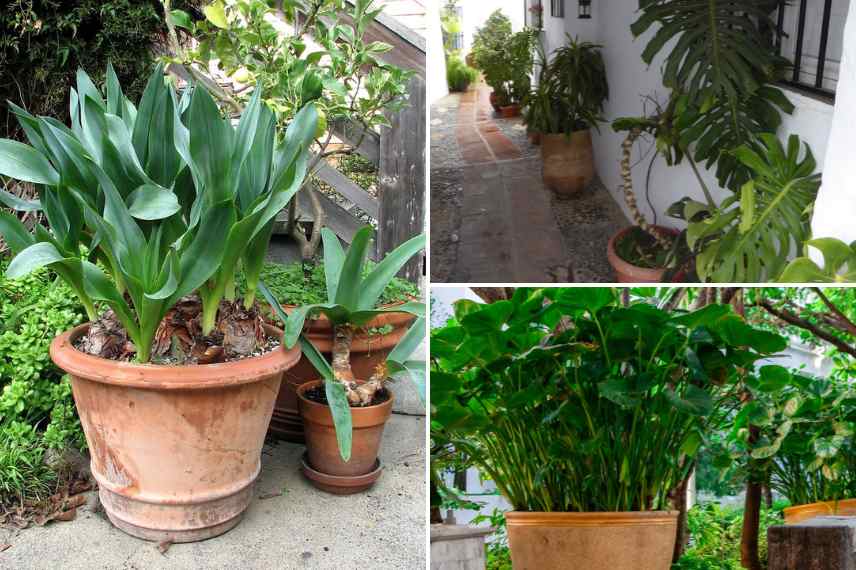
In the shade, one can indeed envisage a terracotta-decorated scheme that brings a warm colour
Three or four identical pots aligned always make a strong impact, this repetition being ideal with similar pots, but working very well with pots of different shapes, provided terracotta remains raw. The idea is to play on the accumulation of the same model in several copies in a courtyard or on a terrace, or two pretty pots to frame a door or an entrance.
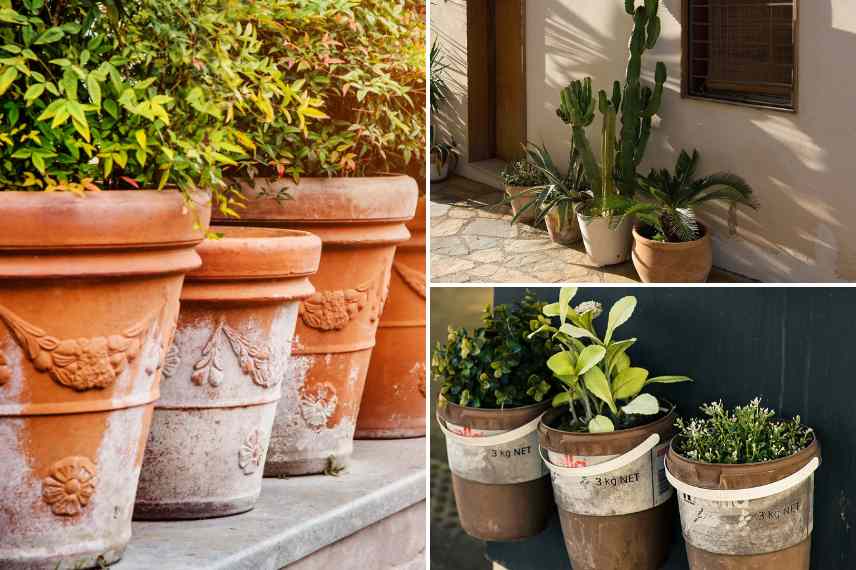
The repetition of terracotta pots: a simple, easy-to-implement idea for small or large containers
Pots aren’t limited to a terrace or hard standing. A striking terracotta vessel can also be placed directly in a border, either for its substantial size—tall enough to act as a mineral punctuation—or as a decorative feature, planted or not.
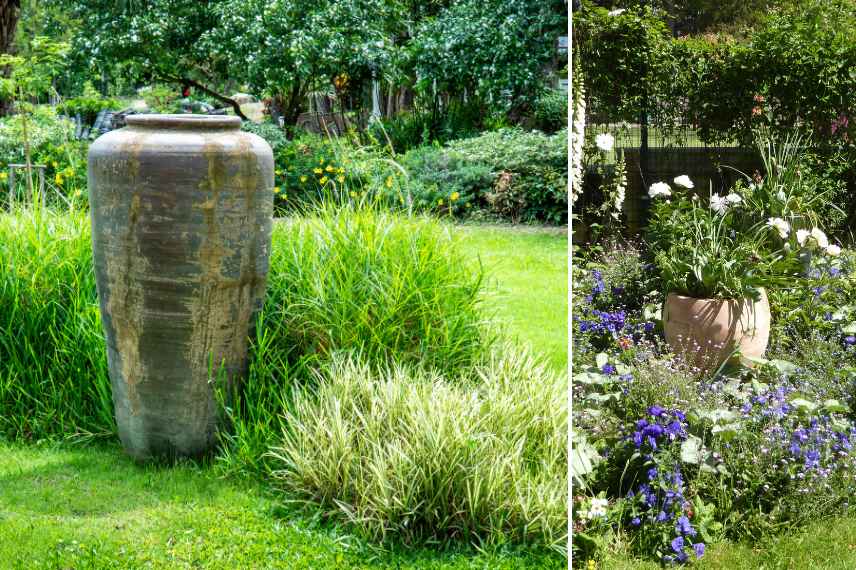
On the left, as a structural element, or on the right, a beautiful pot placed in the middle of a border (© Gwenaëlle David Authier)
To create focal points, large terracotta pots also play a role: they can single-handedly replace a statue, for example. For this purpose, place them on a small pedestal.
Finally, easy to pair, terracotta objects make very harmonious marriages with furniture that is as natural as they are, such as rattan, but they can also be combined with different materials, such as wrought iron or zinc, and with all raw materials.
→ Read also: Create a Mediterranean garden ; Create a Spanish or Andalusian garden, How to design a garden in a Garrigue area and How to create a Garrigue ambience? and Create a dry exotic garden.
Terracotta in the Kitchen Garden
In the kitchen garden too, terracotta proves to be a sensible choice in many respects. It combines practicality and aesthetics.
- For sowing : small terracotta pots are perfect, as they keep the soil cooler than plastic pots. And it’s also nicer to look at when you have plenty in your greenhouse!
- For blanching certain vegetables : terracotta’s opacity does the job (just seal the drainage hole with a cork piece or a slate), and pots placed upside down allow blanching of cardoon stalks, sea kale, etc.
- For watering with oyas (or ollas) : these terracotta pots to bury are increasingly popular, despite a somewhat higher upfront cost. Placed in the soil, water slowly seeps through the porosity, providing constant hydration to the plant roots.
- For protecting plants from the cold : terracotta cloches protect young plants from the cold, but also from inclement weather, insects and other pests.
- For forcing certain vegetables or fruits such as rhubarb : rhubarb forcing pots or terracotta cloches, commonly seen in English allotments, allow early harvesting of rhubarb stalks. They also protect the vegetables from the cold.
- For composting directly in the soil : the compostino® — a French innovation, a kind of terracotta vermicomposter with holes in its walls, lets you compost your waste by burying it directly in the soil, nourishing the plants at the source.
→ Read also: Make a homemade olla to water the garden? and How to blanch winter lettuces?
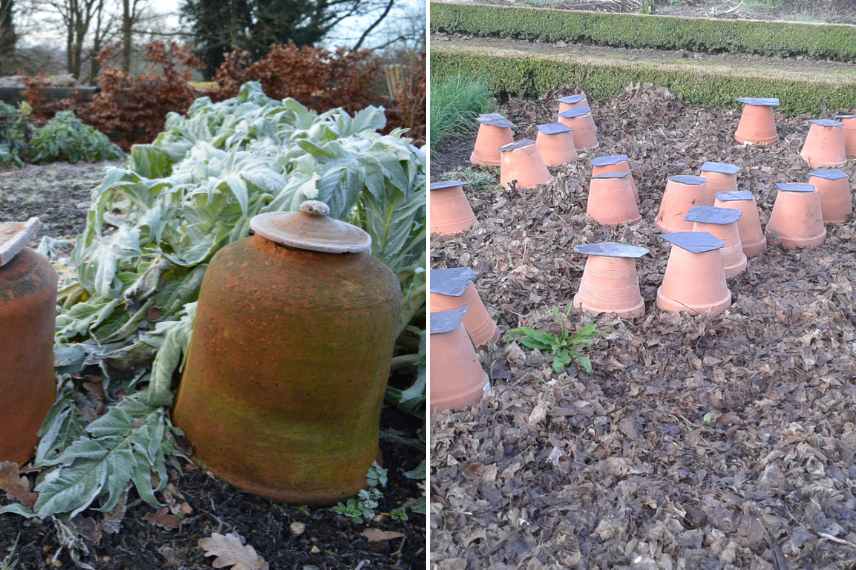
Forcing pots on the left and terracotta pots in the Le Lude kitchen garden (Sarthe) growing sea kale (© Gwenaëlle David Authier)
Other uses for terracotta
Terracotta is often repurposed in the garden, at the whim of its owner’s creativity : duct tiles assembled as a low border, lattice screens made from stacked pots, broken pots repurposed as mulch for a gravel path, chimney pots used to grow climbers, or as here at the Chaumont-sur-Loire 2023 International Garden Festival, in the Tile Garden which uses hollow clay tiles as a means of rainwater collection, i.e. for irrigation and decoration.
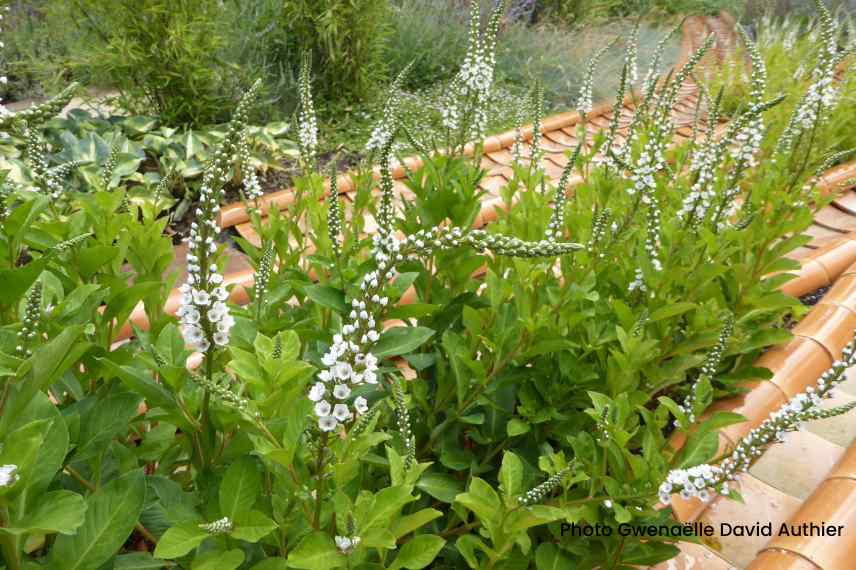
The Tile Garden at Chaumont-sur-Loire, an ephemeral garden created for the 2023 edition (© Gwenaëlle David Authier)
→ Find many more ideas in how to recycle pots in the garden? and take inspiration from our tutorials How to make a bird box using flower pots? and How to make an earwig shelter to protect your fruit?
Maintenance
Terracotta generally requires little maintenance, but you must, above all, ensure, depending on its manufacturing method, that it is protected in winter, otherwise it can crack from the cold. To reduce the risk, as soon as the first frosts arrive, raise your pots by placing them on bricks or on wooden or terracotta supports that match. In any case, check with the seller about its frost resistance. All frost-sensitive pottery should be protected if you leave them outside (rolled rug, bubble wrap, multi-layer cardboard, etc.), the best advice being to bring them indoors in a frost-free place.
Be careful when using pottery in north-facing exposures: it will quickly go green and be covered in moss.
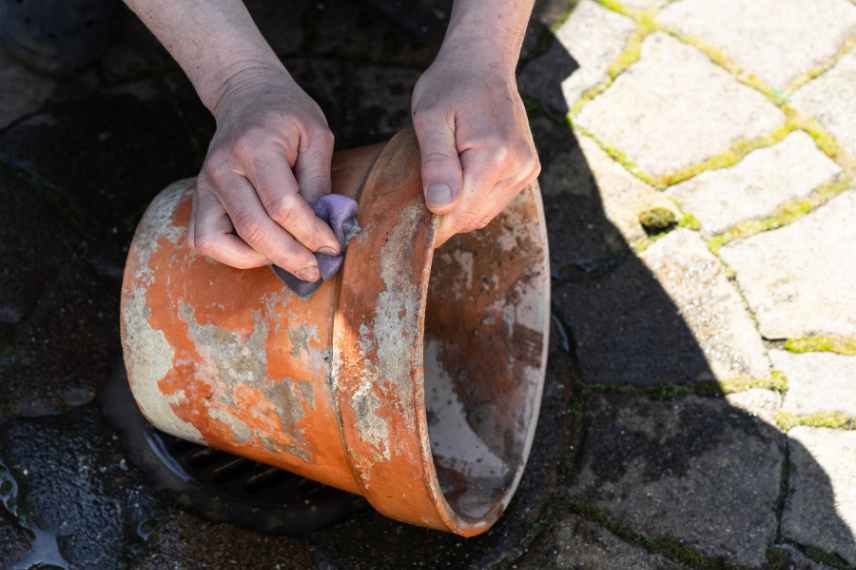
Finally, hard water used for watering also makes it whiten. To clean it, use the trusty white vinegar, but in small amounts, and rub the walls with a damp sponge. This operation will need to be repeated several times a year for pots filled with soil and planted. The best tip: do this when repotting the plant, making it easier to clean the empty pot, and use rainwater for watering your terracotta pots whenever possible!
- Subscribe!
- Contents
Comments