





























Leaf collection: what does the law say?
What obligations exist, in what contexts, and what risks arise in the event of inaction?
Contents
Autumn is well and truly here: some of our plants have donned their vibrant coats, while others have already lost a significant portion of their leaves. Their fall is a natural event, but it can pose problems in certain situations. In your garden, you can choose to either leave the dead leaves in place or collect them. However, if your trees and bushes are shedding their leaves onto public pathways, the situation may be different.
What does the law say about collecting fallen leaves? Let’s take a look at the regulations regarding leaf collection in autumn.
Additionally, feel free to check out Olivier’s article that explains how to collect fallen leaves.

Cleaning up fallen leaves: a legal obligation?
At Home
Of course, there is no law requiring you to collect the leaves that fall in your garden, in your flower beds, vegetable patch, or on your lawn. In practical terms, you are free to remove them or not.
Cleaning up fallen leaves is generally done for:
- aesthetic reasons, to have a garden that looks “clean” and well-maintained;
- to avoid any risk of suffocating the lawn;
- to prevent slipping hazards in walkways (paths, courtyards, slabs);
- to avoid blocking gutters;
- to limit the development of fungal diseases.
However, some gardeners also choose not to clean up, allowing the leaves to decompose naturally. It mainly depends on the size of your property and the area in question!
On Public Roads
But if the leaves from your plants fall onto public roads, you may be subject to a cleaning obligation.
The maintenance of public spaces is the responsibility of municipalities (Article L2212-2 of the General Code of Local Authorities). Municipalities are indeed obliged to ensure the regular maintenance of sidewalks, streets, quays, squares, and roads used for public circulation. It is therefore the responsibility of the town hall to ensure the cleaning of fallen leaves, usually carried out by green space agents. The same process applies to snow removal and de-icing in winter.
However, administrative jurisprudence allows mayors to issue municipal orders to compel residents to clean the sidewalks in front of their homes, to ensure the safety of passers-by. This can sometimes be a genuine legal obligation, but it is not systematic. Legislation is determined on a case-by-case basis, depending on your place of residence. So, do not hesitate to inquire with your town hall.
Generally, it is considered that if your plants lose their foliage on public roads (in front of your home, on the sidewalk, in the gutters, in the street, etc.) the collection of leaves is your responsibility. This applies to any occupant of a property or dwelling, whether they are an owner, tenant, or usufructuary. In the case of a building, it is often the property manager who is responsible for this maintenance.
At a Neighbour’s
Another scenario: if the leaves from one of your trees or bushes fall onto your neighbour’s property (or vice versa, if those from your neighbour fall onto yours).
The shedding of leaves is considered a normal phenomenon. However, the accumulation of leaves can sometimes become an abnormal nuisance, meaning a problem generated by the action or inaction of a neighbour. Of course, this notion can be subject to interpretation, and the nuisance must be duly justified. This is the case if the leaves:
- block a gutter, hindering the normal flow of water;
- accumulate on the roof, promoting the growth of moss that threatens waterproofing;
- form a thick layer on a terrace or private roadway, creating a notable inconvenience or danger.
In this case, it is advisable to ask your neighbour to clear the fallen leaves themselves or to hire a professional at their expense for their removal.
It is worth noting that if the trees and bushes were planted in accordance with legal distances, it will be more difficult to argue a lack of maintenance and an abnormal nuisance.
As a reminder:
- trees and hedges must be planted at least 50 cm from the boundary line when they are less than 2 metres tall;
- trees and hedges must be planted more than 2 metres away for any height above that.
For more information, we recommend our article “Planting Trees and Bushes: What Does the Law Say?”.
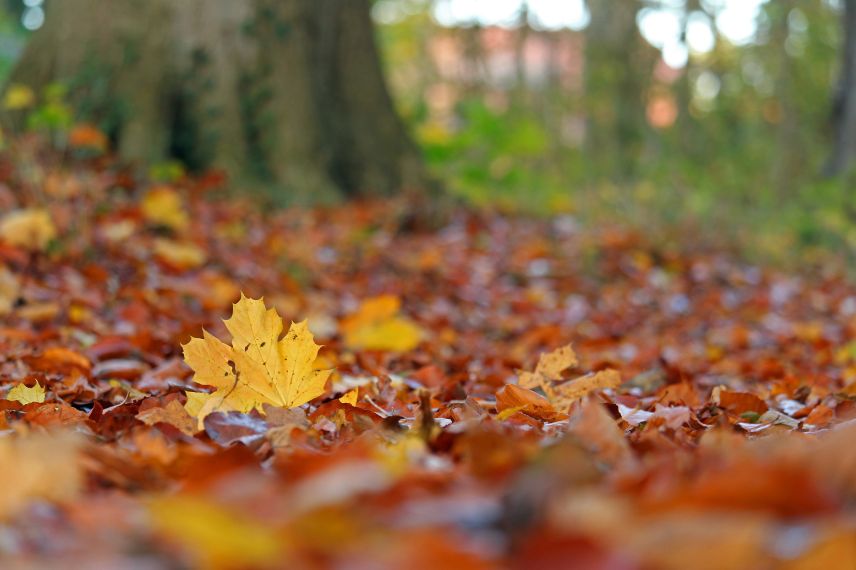
A carpet of fallen leaves in autumn
Why collect your leaves preventively?
Even without the systematic implementation of a legal obligation, neighbours are generally required to take on the task of collecting leaves that fall onto public pathways. This is a preventive safety measure.
Collecting leaves from trees is indeed primarily regarded as a precaution to prevent accidents. Once on the ground, they can quickly create a thick layer of mulch and become particularly slippery and dangerous, especially when combined with autumnal rainy weather. Therefore, it is advisable to remove them regularly to avoid any risk of falls.
Moreover, the accumulation of leaves in gutters or drains can eventually block drainage systems, leading to flow issues or even flooding. Again, this is simply a precaution.
The risks associated with not collecting leaves
But then, what risks do you face if you do not clear the leaves fallen on public pathways? Unlike some municipalities in Belgium, France does not impose a fine for failing to collect leaves. In our neighbouring country, the law states that each resident is responsible for the upkeep of the pavement in front of their property. A lack of maintenance can thus be penalised with a fine ranging from €50 to €350.
However, your liability could be directly engaged in the event of an accident caused by unremoved dead leaves. This could indeed be considered a lack of maintenance, meaning a potential victim could seek damages. They would, however, need to prove that negligence occurred. Some home insurance policies actually include this risk in the coverage they offer.

Decomposition of dead leaves
Reusing fallen leaves in the garden
Even though collecting fallen leaves is sometimes seen as a chore, let’s not forget that they can be easily reused in several ways. They are indeed generally considered a very beneficial free resource for the garden.
Use them, for example, to:
- create a protective mulch around your plants;
- make quality compost (follow Virginie’s tutorial on how to make good leaf mould);
- improve soil structure;
- rebalance compost that is too rich in nitrogen (as fallen leaves are high in carbon);
- provide a natural shelter for garden wildlife (hedgehogs, shrews, beneficial insects, etc.);
- create lovely autumn decorations.
For more ideas, head to Ingrid’s article: Dead leaves, how to use them in the garden?

Beneficial integration of fallen leaves into compost
- Subscribe!
- Contents
Comments