





























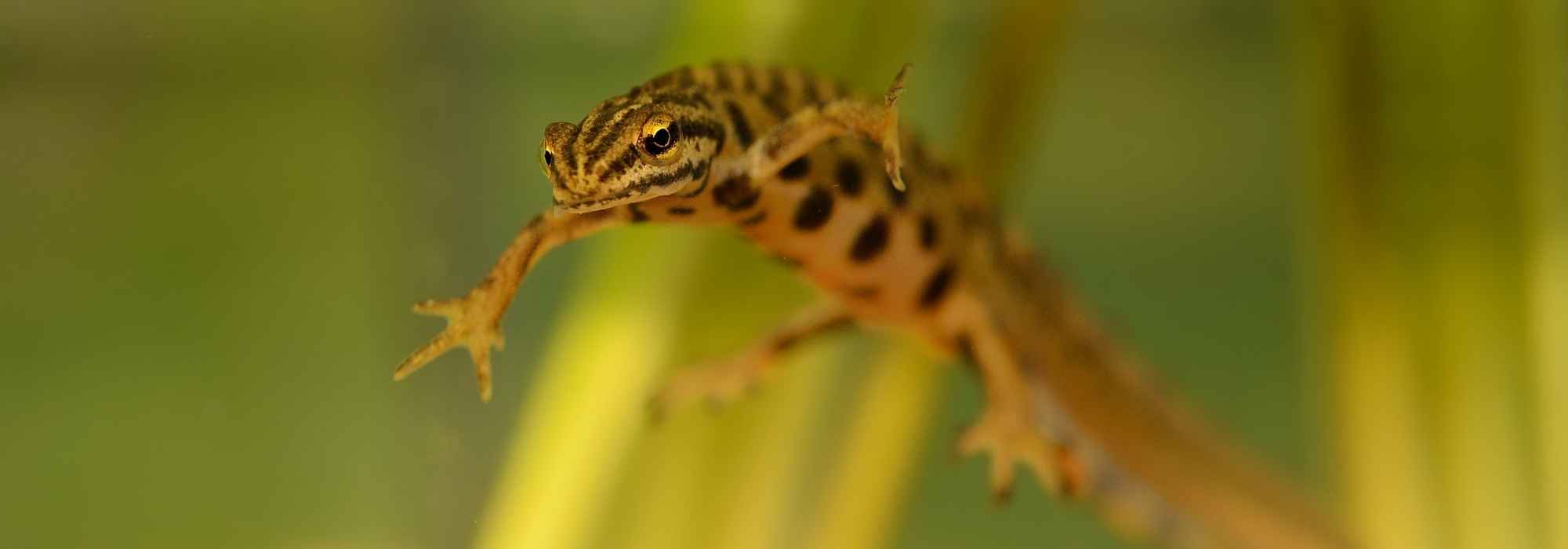
Newts
How to welcome them to the garden?
Contents
Newts are discreet amphibians that split their lives between the safety of a small pond and the surrounding vegetation. If you have a small pond in a garden that embodies respect for biodiversity, you may well find them there soon. How to recognise the different species of newts: Alpine Newt, Palmate Newt, Smooth Newt…? How and where do newts live? What should we do to best welcome them in the garden?
We’ll tell you everything in our advice sheet.

The different species of newts found in France
In mainland France, there are primarily 5 species of newts. It is difficult to generalise, especially since there are differences between male and female individuals and even among individuals themselves. However, here is a brief description with the main characteristics for each species:
- The Alpine Newt (Ichthyosaura alpestris): bright orange belly without spots. The flanks and sides of the head often have dark spots on a silver-white background. The lower edge of the tail is yellow-orange with black spots;
- The Palmate Newt or Common Newt (Lissotriton vulgaris): somewhat resembles the Alpine Newt, but the back is brown-olive with small dark spots (the spots are larger in males). The belly is whitish with a central orange to reddish band;
- The Palmate Newt (Lissotriton helveticus): Dark band across the eye. The belly is whitish with a yellow band in the centre. The back is green-olive to light brown with small spots arranged in two lines. Males have very webbed hind legs;
- The Crested Newt (Triturus cristatus): the back is often very dark and the belly is yellow or orange speckled with black. The flanks are dotted with white. Males display a large dorsal crest during the breeding season;
- The Marbled Newt (Triturus marmoratus): found only in the West of France. It is a large newt with a black back dotted with bright green spots. Both males and females have a bright orange line along the neck. This disappears in favour of a crest during the aquatic phase in males.
In Belgium, only the Marbled Newt is missing from these 5 species.
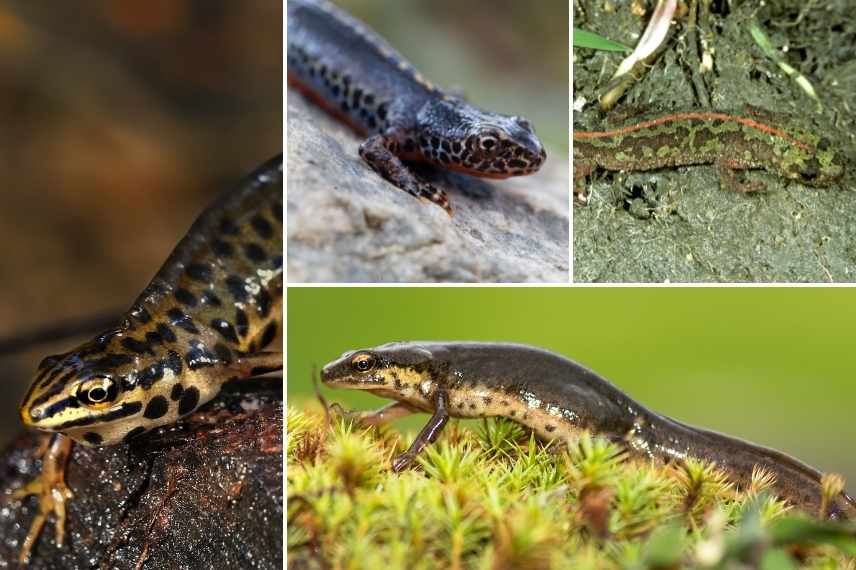 On the left: palmate newt, at the top: alpine newt and marbled newt, at the bottom: crested newt
Read also
The Swiss Grass SnakeThe life of newts
Newts are amphibians (an old term is batraciens). This means that in their life, they alternately live phases on land and underwater. They breathe through their skin, which is naked and secretes a viscous substance. Newts are classified among urodeles (like salamanders) because they have a tail, unlike anurans (frogs and toads).
Habitat
In their larval state, newts live exclusively underwater, in ponds, water holes, calm rivers… In their adult state, the life of a newt is shared between the aquatic phase, for reproduction and laying eggs, and the terrestrial phase. In winter, newts enter a so-called resting phase and take refuge under a pile of vegetation, in the heart of a stone heap… At altitude, it can happen that newts spend the winter underwater.
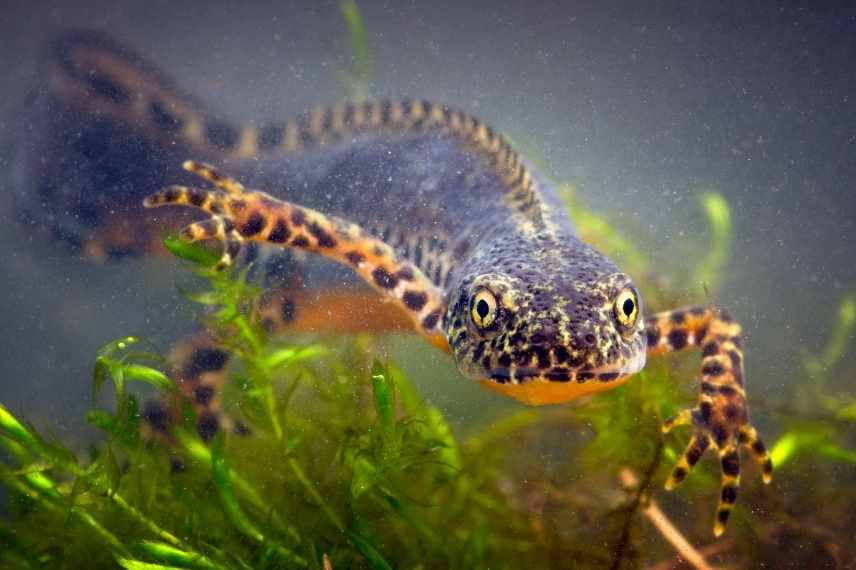 Alpine newt
Feeding
Newts feed on molluscs, mosquito larvae, aquatic insect larvae (notably dragonfly larvae), insects, worms, and even frog eggs. Underwater, they are exceptional hunters and swimmers, but on land, newts are rather slow.
Behaviour and Reproduction
Newts typically live for about ten years, around twenty for the crested newt. They reach sexual maturity after 2 to 5 years of life (depending on the species). Sexual dimorphism is significant in newts: females are different from males, especially during the breeding season when males take on more vibrant colours and grow a beautiful dorsal crest. Reproduction can occur as early as February until April-May: males deposit a spermatophore (a small sac containing sperm) on the bottom of the water, which sticks to the female’s cloaca. Once the eggs are fertilised, they are laid one by one on aquatic vegetation. The larvae remain underwater to develop, while the adults emerge from the pond around May-June.
Newts tend to move at night when on land, but swim mostly during the day when in water.
Newts are preyed upon by birds and fish. And newt larvae can also be consumed by dragonfly larvae or other aquatic insects.
Reminder: what is an amphibian? Amphibians (or batraciens) are amphibious animals, meaning they can live in and out of water. These animals undergo complete metamorphosis. Example: frog egg, then tadpole, then frog. Respiration occurs through the skin, which is riddled with glands that secrete viscous substances. As the skin is naked (without hair, feathers, or scales), amphibians should be handled with damp hands to avoid injuring them. In any case, it is better to avoid disturbing them. All amphibians are protected species.
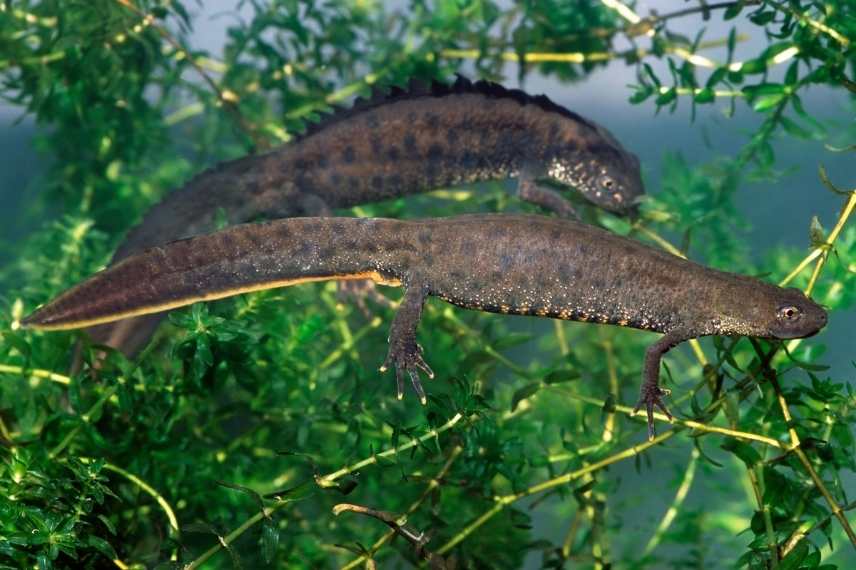 Male newt with its crest during the breeding season and the female in the foreground
What to do in the garden to welcome newts?
- Dig a small pond (or several!): a depth of one metre for the deepest part will be sufficient. It is advisable to create varying depths in the pond to establish different environments (for planting vegetation). One part of the pond should have a gentle slope so that animals can rest and exit the pond easily;
- Plant the pond with native vegetation: Water mint, Marsh marigold, Yellow flag iris… or even reeds or cattails if the pond is large enough. The vegetation helps create a protective environment and a support structure, and these plants will also filter and oxygenate the water;
- Vegetate the edges of the pond and avoid mowing around it: this will create a refuge area for amphibians and other animals of wet environments;
- Avoid introducing fish (especially carp and goldfish) into your pond: they will feed on the larvae of newts and aquatic insects;
- Create stone piles and wood stacks nearby. Newts can shelter there. The placement of an old decaying stump near the pond will be perfect for allowing newts to spend the winter in peace.
→ Find all our tips for creating a natural pond in your garden.
Please note: it is strictly forbidden to move newts from one pond to another. You will need to patiently wait for the newts to come naturally to your pond. This, in fact, happens sooner than one might think.
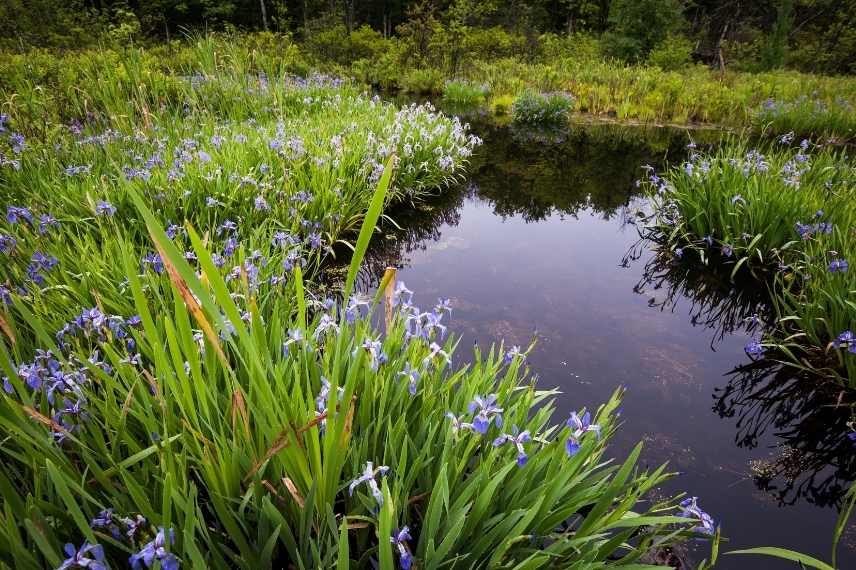 The edges of a pond should ideally be planted
Read also
The Spotted SalamanderA newt or a salamander: beware of the confusion!
Newts and salamanders are two types of urodeles amphibians. However, the similarities end there. Let’s explore the main differences between these two animals:
- The Common Salamander is yellow and black, while the Newt often has orange on its belly (notably the Alpine Newt), sometimes with dark spots or webbed feet, and a crest develops on the male’s back during the breeding season;
- The adult Salamander is terrestrial and does not swim, whereas the newt moves on land and in water and swims very well;
- The head of the salamander is large, while that of the newt is small in relation to its body;
- The tail of the salamander is round in cross-section, while the newt’s tail is flattened for swimming;
- The newt is oviparous (lays eggs), while the salamander is viviparous;
- The salamander is nocturnal, while the newt is diurnal in its aquatic phase;
- The salamander lives in forests, while the newt can more easily be found in gardens when there is a pond nearby.
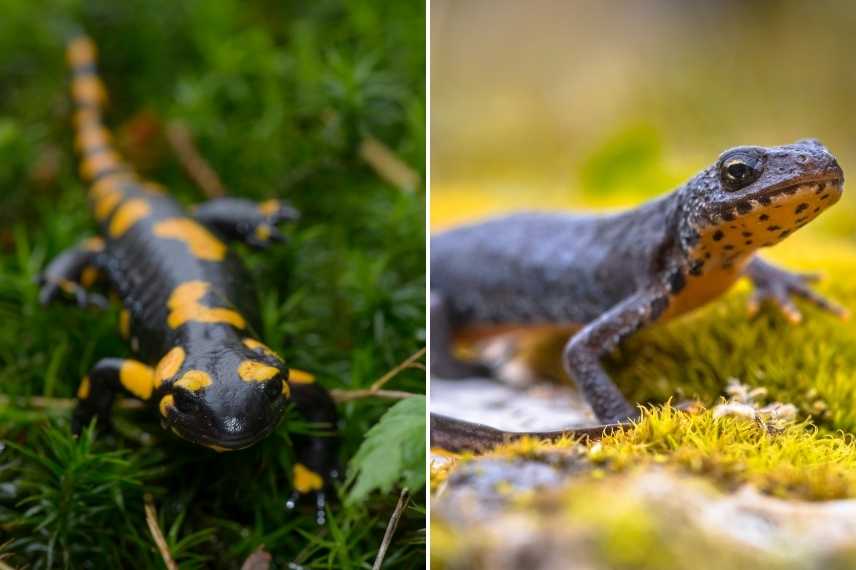 Salamander on the left and a newt on the right
- Subscribe!
- Contents
Comments