


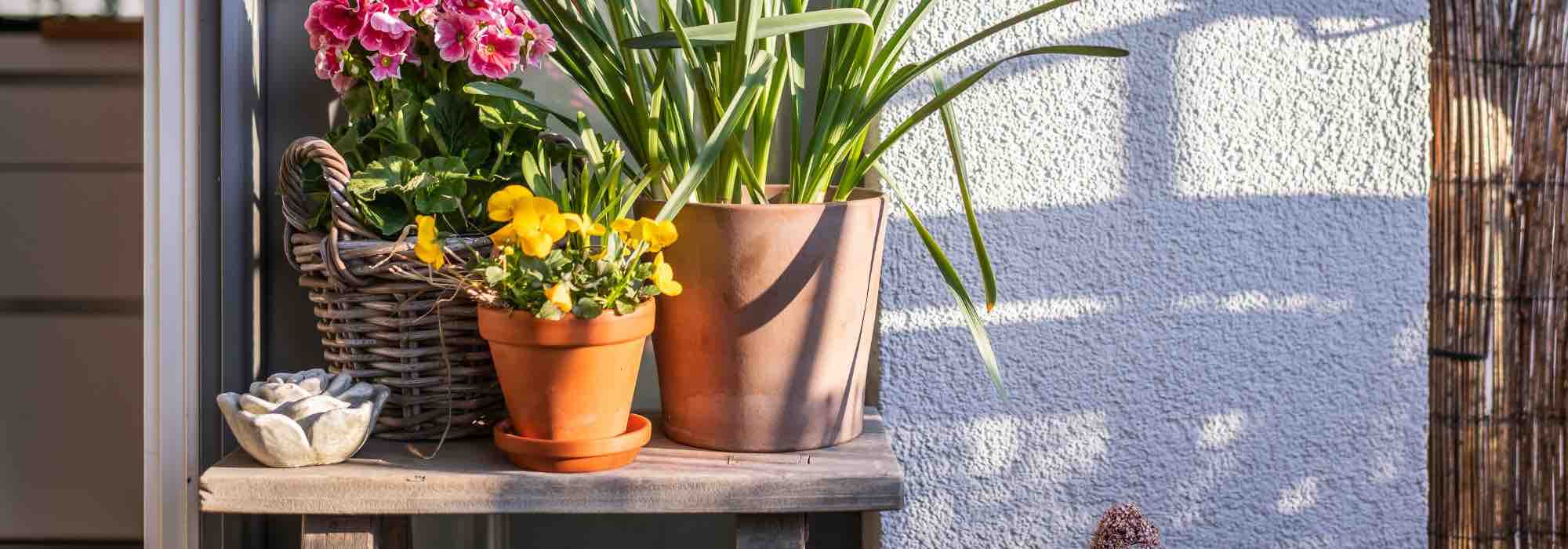
Our tips to optimise a West-facing balcony
Constraints, plant choices and layout ideas
Contents
An appropriately designed balcony layout can optimise the space and make it a pleasant and welcoming place. To make the right choices, it is necessary to consider several criteria: available space, load-bearing capacity, view, but also exposure. Indeed, a north-facing balcony is not at all laid out the same as a west-facing balcony. For this latter exposure, the space will receive the late-afternoon sun, which can sometimes bring light that lasts late into the evening and generate a lot of heat. The wind should also be taken into account.
Let’s see how to reconcile with these constraints and achieve a beautiful west-facing balcony.

The constraints of this exhibition
The west-facing exposure is the warmest exposure after the south-facing exposure. The balcony will receive light from mid-afternoon, and sometimes until sunset, if the view is clear, as the view is unobstructed. It is therefore a bright exposure, but shaded at the start of the day, thus considered semi-sunny. In summer and in southern regions, this exposure can even be scorching.
It’s the ideal exposure for hosting pre-dinner drinks and for enjoying outdoor meals in the evening.
The west-facing exposure will also bring certain prevailing winds. This is the case with the Mistral, a cold, dry wind that runs from the Rhône Valley to Provence and along the Mediterranean coast from the Camargue. It can have a north-westerly or westerly direction.
For its part, the Tramontane generates violent, cold air currents, also coming from the northwest or from the west. It traverses the foothills of the Pyrenees and the southern mountains of the Massif Central.
Also, the Libeccio, this south-westerly wind found on the Côte d’Azur and in Corsica. It is a warm and dry wind in summer, but it can be humid in winter.
Finally, in Atlantic regions, the prevailing wind is often from the West. Along the coast, it can also bring sea spray, these droplets of water carried by the wind. This orientation can therefore be fairly humid.
Gusts can be violent, giving rise to storms, as they sometimes exceed 100 km/h.
Choosing suitable plants: factors to consider
When choosing plants to grow on your balcony, there are several factors to consider.
- Climate (dry or humid, cold or mild, etc.).
- Space available.
- Time you plan to devote to the plants.
- Your budget.
Then, Therefore, plants must tolerate the particular conditions of a west-facing exposure. They will be suited to partly sunny or partly shaded exposures. Above all, they must endure both the sometimes scorching sun in summer and the wind and winter humidity. Fragile and delicate flowers, as well as plants with tall flower stalks, will therefore be excluded. Tender plants may also suffer during the cold season if they are not sheltered.
Because of the wind, the growing medium can also dry out more quickly. Therefore, it is better to favour species that are not too thirsty, especially since growing in pots, essential on a balcony, will already require more frequent watering. Let us recall that the chosen plants must tolerate container growing: trough, pot, tub or hanging basket.
Plants that fear late frosts will thrive in west-facing locations, since thaw is more gradual there than in north- or east-facing sites.
Finally, especially if space is limited, avoid thorny plants, which can cause injuries.
Some examples of plants for west-facing balconies.
Perennials
The wide range of perennials gives us plenty of choice for planting a semi-sunny balcony. Choose from columbines, bergenias, hellebores, saxifrages, sempervivums, monardas, yarrows, gauras, coreopsis, rudbeckias,spurges, Buenos Aires verbenas, hardy geraniums, heathers, gaillardias, etc.
Also consider ornamental grasses for pots (stipas, carex, miscanthus, etc.), often forgiving of growing conditions, which bring lightness and structure. Their foliage can also create a very gentle rustle in the breeze when the wind blows.
Annuals
On the annuals front, opt for sunflowers, Helianthus, annual salvias, marigolds, or Californian poppies.
Shrubs
Many shrubs can be grown on a west-facing balcony. Simply choose varieties with a small habit, compact or dwarf, that are easier to grow in pots.
Adopt a Mexican orange blossom, a Ceanothus, a Deutzia, a chaste tree, an oleaster, a strawberry tree, a Pittosporum, an Escallonia, an Abelia, a boxwood, a crape myrtle, a spindle tree, a buddleia, a mock orange or even a dwarf palm.
Also consider Mediterranean shrubs, which should be grown in very well draining soil to avoid winter damp: rosemary, thyme, broom (Cytisus), lavender, myrtle, etc.
Summer-blooming bulbs
They will thrive on a west-facing balcony if you keep the soil moist. In this case you could opt for crocosmias, cannas, ornamental alliums or California alliums.

A wide choice of plants, for example (clockwise): Choisya, strawberry tree, Vitex, crocosmias, spurges, hardy geranium, gaura
Provide shade on a west-facing balcony.
To protect against the hot summer sun, which can be fierce, it is important not to neglect shade and coolness on a west-facing balcony.
You can install a range of elements:
- windproof parasols;
- shade sails;
- a retractable awning;
- reed screens;
- an arch;
- a lattice fence;
- possibly a misting system and fans (preferably solar-powered);
- etc.
But the beneficial shade can be provided by plants, especially climbing plants that will filter the sunlight to make it less harsh. These plants will be multifunctional, as they can also act as a privacy screen and a windbreak, while adding a lush decorative touch ideal for a balcony.
For example, grow honeysuckle, whose fragrance will perfume the space. Train a passionflower along a vertical support or railing; also train a nasturtium, a grapevine, a Solanum, a Black-eyed Susan or a Dipladenia. If you wish to grow a wisteria, choose a compact and less vigorous variety, such as the Japanese wisteria Wisteria venusta.
Non-running bamboo, with their natural verticality, can also provide shade while creating an exotically styled privacy screen.

Use climbing plants such as Passionflower and Solanum, for example, to create shade
Balcony plant care
To succeed in growing your plants on a balcony, several factors must be considered.
- As mentioned earlier, the substrate will dry out more quickly, and west-facing wind can further promote evaporation. Remember to water your plants regularly. To space out watering, you can install ollas or oyas, these irrigation pots that hydrate the soil gently by capillary action. If budget allows, opt for an automatic irrigation system, possibly paired with a timer.
- We recommend mulching around the bases of your plants, both to retain moisture for longer and to protect the soil from wind. Be sure to choose mulches heavy enough not to blow away at the slightest gust (expanded clay pellets, mulching slabs…).
- If the substrate dries out faster in pot culture, it will also lose nutrients more quickly. Remember to provide regular applications of liquid, solid or organic fertilisers (compost, dried blood, bone meal…).
- In winter, if you cannot bring your pots indoors, protect frost-sensitive plants with a winter fleece and by placing a thick mulch at their base.
- Prune the most vigorous plants at the end of the season, to keep the silhouette of the strongest plants in check.
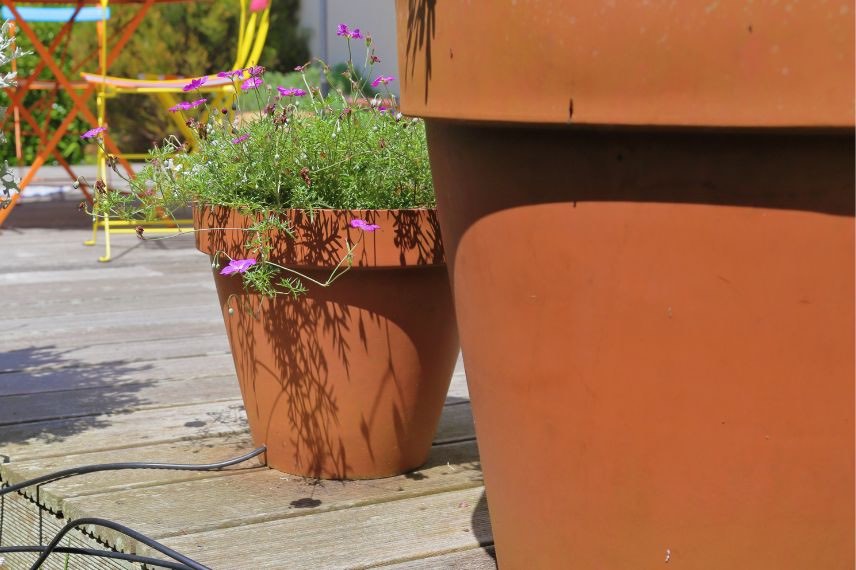
Help your plants become self-sufficient in pots, for example with drip irrigation
A few additional features for a west-facing site.
On a west-facing balcony, we recommend favouring light colours (sand, beige, pastels…) which reflect more of the sun’s rays. Conversely, avoid dark colours, particularly black, which tends to retain heat. This simple tip helps to cool the atmosphere.
Avoid mineral materials, which also increase perceived temperatures by retaining and reflecting heat, such as concrete or gravel. Metal should also be avoided. Prefer natural materials: wood, linen, jute, bamboo, rattan, terracotta, etc.
For your plant containers, opt for fairly heavy models that can withstand strong gusts of wind while remaining stable. Ban low plastic containers, or add extra ballast to the bottom of the pots. Be sure to check the maximum weight permitted on your balcony.
When it comes to furniture, choose comfortable items that invite relaxation at the end of the day: rugs, floor cushions, armchairs, etc.
As for lighting, take advantage of the daylight provided by the sun from day to night. You can rely on discreet light sources, such as tea lights, lanterns, fairy lights or small wall lights.
In addition, you can play with the presence of water, for example by installing a small fountain or a mini-pond, which will help to refresh the atmosphere in summer.
Finally, banish small, lightweight decorative items, as they can easily blow away in strong winds.
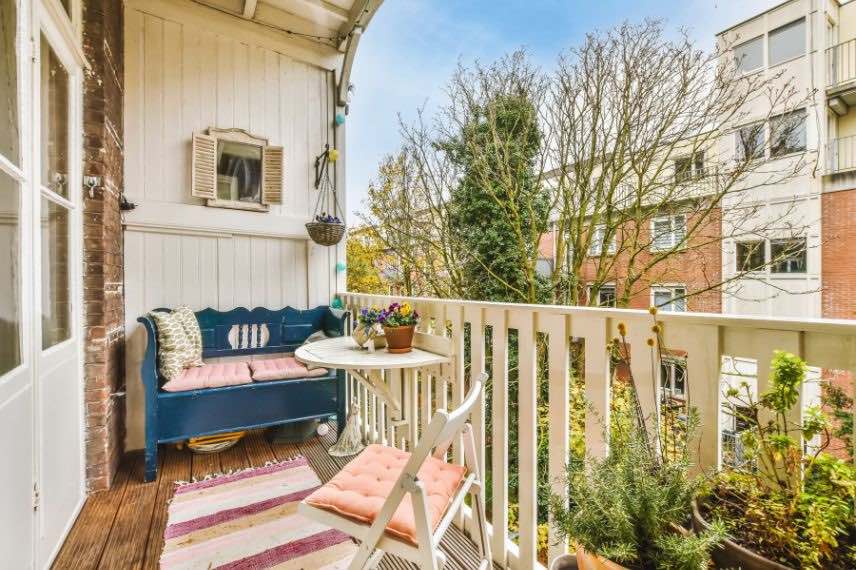
Prefer light colours and natural materials
- Subscribe!
- Contents
![[vc_row][vc_column][vc_column_text]If you have a balcony facing west, you are in luck! This orientation provides your plants with plenty of sunlight in the afternoon and evening, which is ideal for many flowering plants and vegetables. Here are some tips to make the most of your west-facing balcony:
1. **Choose the Right Plants**: Opt for sun-loving plants that thrive in the afternoon sun. Consider flowering plants like geraniums, petunias, and marigolds, as well as vegetables like tomatoes, peppers, and herbs.
2. **Watering**: West-facing balconies can get quite hot in the afternoon, so make sure to water your plants regularly to prevent them from drying out. Consider using self-watering planters to help maintain moisture levels.
3. **Provide Shade**: While sunlight is essential for plant growth, too much direct sunlight can be harmful. Consider using shade cloth or installing a trellis with climbing plants to provide some relief during the hottest part of the day.
4. **Wind Protection**: Balconies facing west may be more exposed to wind, which can dry out plants quickly. Consider using windbreaks like tall plants, screens, or trellises to protect your plants from strong winds.
5. **Container Size**: Make sure your plant containers are large enough to accommodate the root systems of your plants. Plants in small containers may dry out quickly in the hot afternoon sun.
6. **Fertilize Regularly**: With the increased sunlight, your plants will be growing more vigorously. Make sure to fertilize them regularly to provide essential nutrients for healthy growth.
7. **Rotate Plants**: To ensure even growth and prevent plants from leaning towards the sun, rotate your plant containers regularly to expose all sides to sunlight.
By following these tips, you can create a beautiful and thriving garden on your west-facing balcony![/vc_column_text][/vc_column][/vc_row]](https://en.promessedefleurs.eu/blogwp/wp-content/uploads/2024/08/Nos-astuces-pour-bien-amenager-un-balcon-oriente-a-louest.jpg "Our tips for landscaping a west-facing balcony")
Comments