





























Perennial leek: how to plant and cultivate it
All our tips for growing and caring for the perennial leek.
Contents
If you’re a permaculture enthusiast (or, more simply, someone who favours the least effort in the garden), growing perennial vegetables is an interesting option for a productive vegetable garden with minimal maintenance. All you have to do is plant it, and for many years your vegetable will reward you with its best. And, by dividing it regularly, you’ll maintain a steady rotation as the plant begins to tire.
Among perennial vegetables, the perennial leek is a prime example. Sometimes called “wild leek”, the perennial leek (Allium ampeloprasum) is easy to grow, low-maintenance and endowed with excellent flavour.
Discover all our tips on planting, cultivation and care to grow the perennial leek with ease.
For further reading: 10 perennial vegetables for a sustainable and self-sufficient kitchen garden.

What exactly is a perennial leek?
As with ‘rocambole garlic and rocambole onion, perennial leek (Allium ampeloprasum) is a perennial vegetable. It is also known as ‘rocambole leek’, or ‘garlic leek’. It is the wild ancestor of leeks commonly grown in our vegetable gardens, often found at the edge of cultivated land, near vineyards. Unlike ordinary leeks, its cultivation requires far less care. Simply thanks to its wild nature which makes it hardy in adverse weather and cultivation conditions. It is therefore an appealing alternative for gardeners who find leek sowing somewhat unpredictable, and cultivation a tad fiddly.
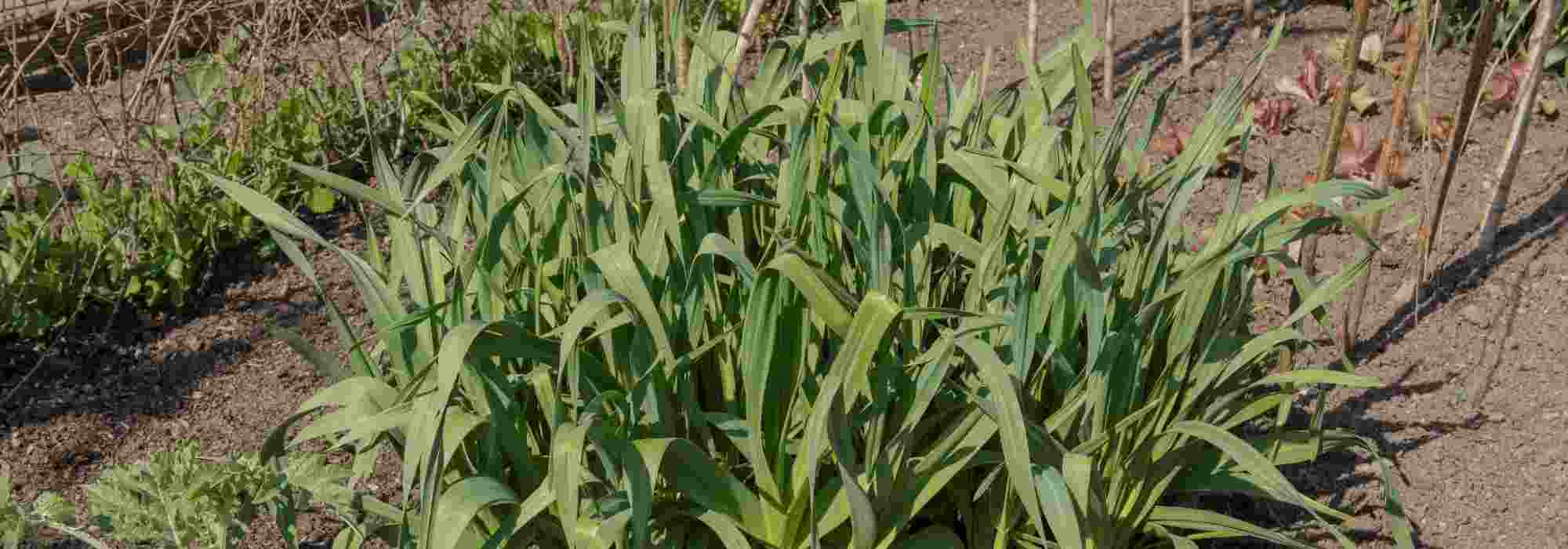
The perennial leek thus belongs to the Allium family, along with garlic, onion, chives, ramsons… It is a perennial vegetable plant, with glabrous foliage, which can reach up to 1 m in height. Its leaves are linear and flat, emitting a strong, somewhat acrid odour of common garlic. In a silvery-green colour, they seem folded in a V at their midrib. In summer, the deciduous foliage enters a vegetative state and disappears, reappearing from autumn to spring. Its root system consists of two bulbs surrounded by bulblets. The stem is thick, cylindrical and leafy to mid-height. That said, do not expect to harvest large stems as with common garden leeks. The stems of the perennial leek are slender, about the diameter of a pencil and at most the width of a finger.
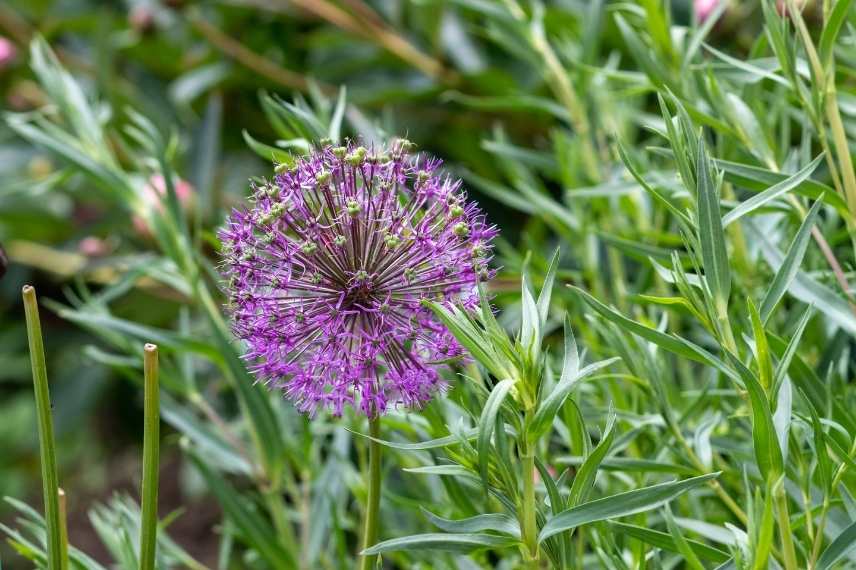
Flowering of perennial leeks is relatively rare, especially if the leaves are harvested regularly
The perennial leek is also very attractive when it flowers, which occurs in spring, between April and June depending on the region. It indeed produces flowers in large, tight umbels, perched on sturdy stems, sometimes bulbil-bearing, in a very pretty lilac pink.
Over the years, the perennial leek forms a dense, compact clump of foliage, which enlarges through the production of bulblets. This clump spreads to about 50 cm across.
Planting of the wild leek
Nothing could be simpler than planting the bulblets of the perennial leek! If you’re lucky enough to find wild leeks in the wild, you can always harvest a few bulblets in July to plant in your vegetable plot or borders. The key is to choose their location carefully. Indeed, as the foliage disappears completely in summer, the risk of forgetting them is high. Or, when the shoots reappear between late summer and autumn, a careless weeding can be disastrous! So don’t hesitate to plant your perennial leeks in a space bordered by a border, or among perennial crops such as strawberries.
As the perennial leek produces many bulblets, you should budget on around a hundred bulbs to feed a family. But after a year, it will be possible to divide the bulbs to obtain new bulblets. Likewise, it is perfectly possible to grow perennial leeks alongside common leeks.
Where to plant?
In terms of exposure, the perennial leek thrives just as well in full sun as in light shade, but likes a light. However, it requires a relatively rich, light, crumbly soil that drains well. It also prefers sandy soils, and slightly calcareous ones, as acidic soils do not suit it at all. That is why, when planting, you can add sand or a calcareous amendment if your soil tends to acidity.
To enrich the soil, it is advised to apply well-rotted compost or well-decomposed manure a few months before planting, for example in autumn. You will simply need to loosen the soil to a depth of 5 to 10 cm to incorporate the chosen amendment.
Planting the perennial leek is quite feasible in a large pot on a balcony or terrace.
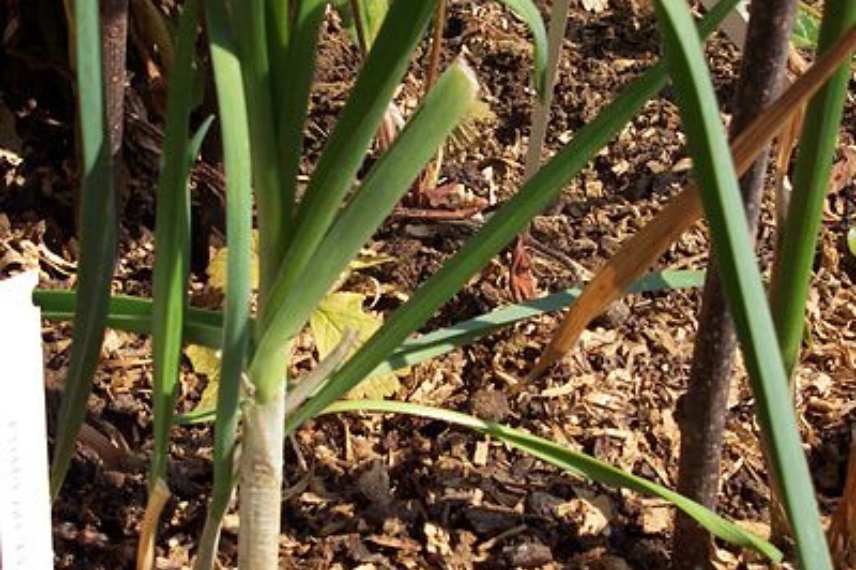
Perennial leeks prefer light, rich, well-drained soils that are slightly calcareous and sandy
When to plant?
Planting of the perennial leek takes place during the dormancy period, between mid-August and the end of September.
If you buy perennial leeks in pots, planting can be carried out over a longer period, from March to October.
How to plant?
- Loosen the soil at the chosen site with a biofork to obtain light, crumbly soil.
- Carefully remove all stones and adventives that could compete with the bulblets.
- If necessary, add a little sand or a handful of calcareous amendment.
- Make rows, 20 to 25 cm apart.
- Place the bulblets every 10 cm and press them to a depth of 5 cm, roots facing down and shoots emerging upwards.
- Cover with soil, firm lightly and water with a light shower, not excessively.
The first leaves of the perennial leek appear about ten days after planting. They can be harvested 2 to 5 months after planting.
How do you divide perennial leeks?
The perennial leek can be propagated by dividing clumps, and thus by bulblets. This operation is possible when the clumps are densely foliated. Each year, about ten bulblets develop near the main bulb. Division takes place from late June to July, when the foliage has withered to enter a vegetative rest.
All that is required is to dig up the main bulb with a garden fork and to lift the bulblets that have developed against the main bulb and that already have roots and young shoots. Plant them in the same spot as the mother plants after separating them.
Read also
Succeeding in leek cultivationWhat care does a perennial leek need?
Once planted, perennial leeks require very little care and maintenance.
- As soon as the first shoots appear, it is essential to keep the soil clean by hoeing to remove adventive weeds.
- As growth progresses, one or two hillings are needed to bring soil to the base of the perennial leeks.
- Some watering may be considered only in very hot weather or during drought.
- A small amount of well-rotted compost can be applied in summer once the foliage has died back.
The perennial leek is a hardy vegetable plant (hardy to at least -20 °C) and drought-tolerant. But it is completely resistant to to common leek diseases or pests such as leek moth.
Harvesting perennial leeks: when and how?
Depending on the region, the first leaf harvests take place 2 to 5 months after planting. Then, the harvest of the leaves extends over a period from autumn to the following spring, roughly from September to June.
To harvest, it is enough to cut leaves or the small bole 2 to 3 cm above the soil, as needed. The leaves then regrow, unless there are heavy frosts. Do not uproot the plant to allow it to produce more leaves.
Once harvested, the leaves or the small boles do not keep well and should be consumed quickly.
Clearly, the yield is nothing like that of ordinary leeks. However, these leaves benefit from a subtler, finer flavour, as they are milder. They are used more as a condiment, for example raw and finely sliced, in a salad, but if the harvest is good, these small leeks can also be cooked like the larger ones, in soups, tarts, quiches, fondues…
- Subscribe!
- Contents
Comments