





























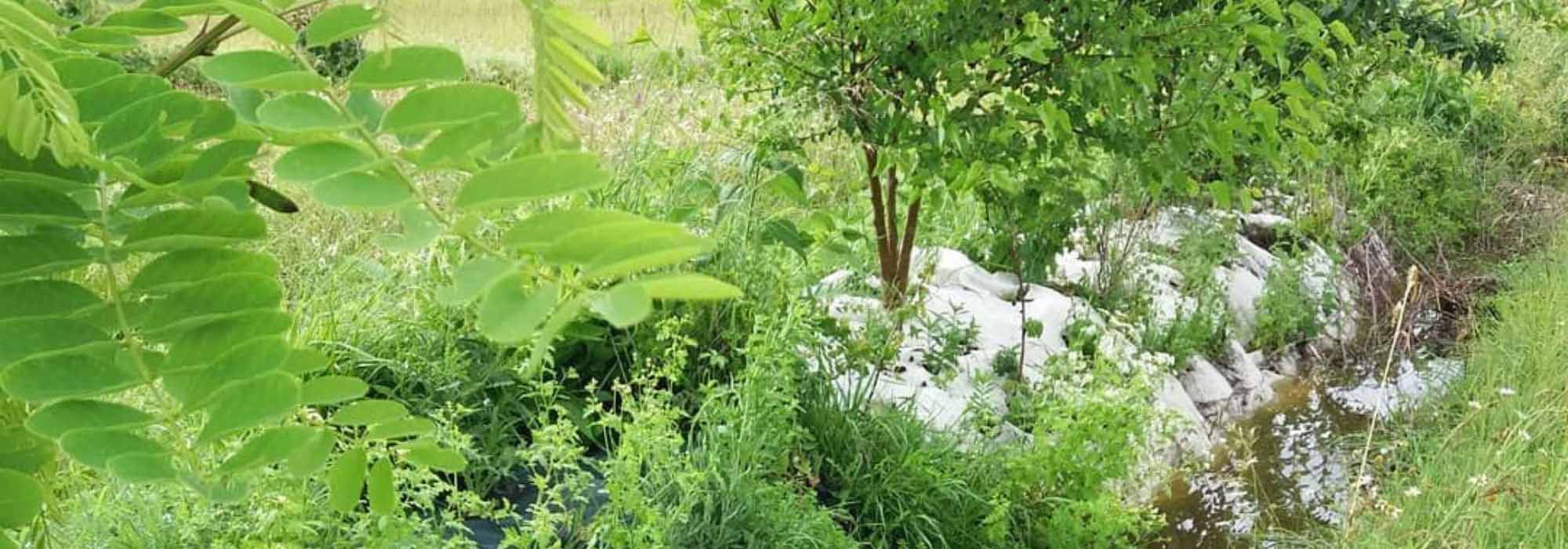
Permaculture: the technique of swales
All you need to know about swales or infiltration ditches
Contents
In permaculture, in areas where it makes sense to slow down and retain rainwater, one of the fundamental principles is to capture it to reap the best benefits. Swales, a type of ditch, are structures that allow for the optimal use of this precious resource rather than letting rainwater run off and wash away the fine layers of soil.
Also known as ditches or “swales” in English, these structures are worth considering even in gardens, especially in the face of intense rainfall episodes alternating with increasingly severe and widespread droughts. Want to discover the technique of swales? Follow our explanations and tips to better understand this promising permaculture practice.
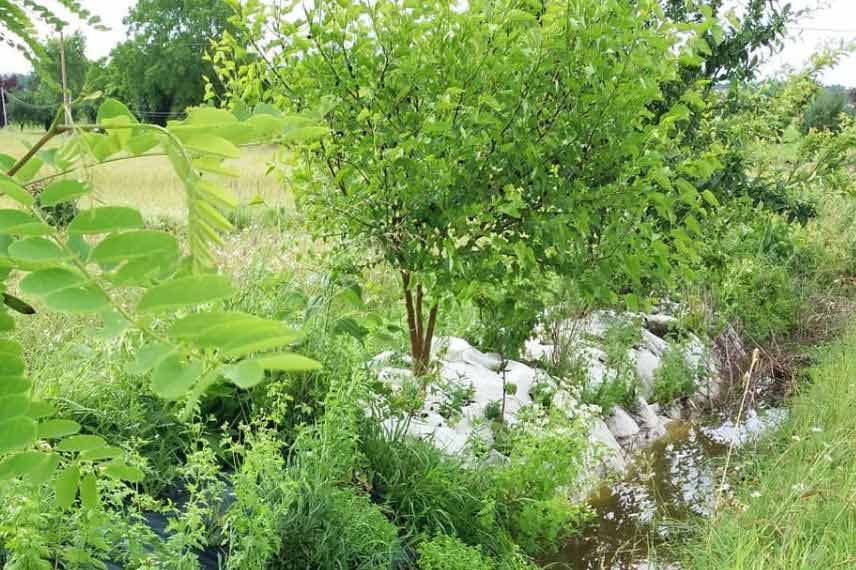
Swale, also called “swale” by Anglo-Saxons

What is a downward trend?
Designating originally a depression or a low part of a field where rainwater collects, a swale is in fact a technique for harvesting runoff water, widely promoted in permaculture, as it allows for optimal use of natural water resources.
It is an infiltration ditch paired with a berm whose function is simple:
- to collect rainwater in a ditch leaning against a berm. As it accumulates, the water will penetrate deeply into the soil, allowing plants to benefit from it for a longer period than if the water had simply run off the land,
- to protect the land or a cultivation area from potential flooding and erosion during heavy rainfall.
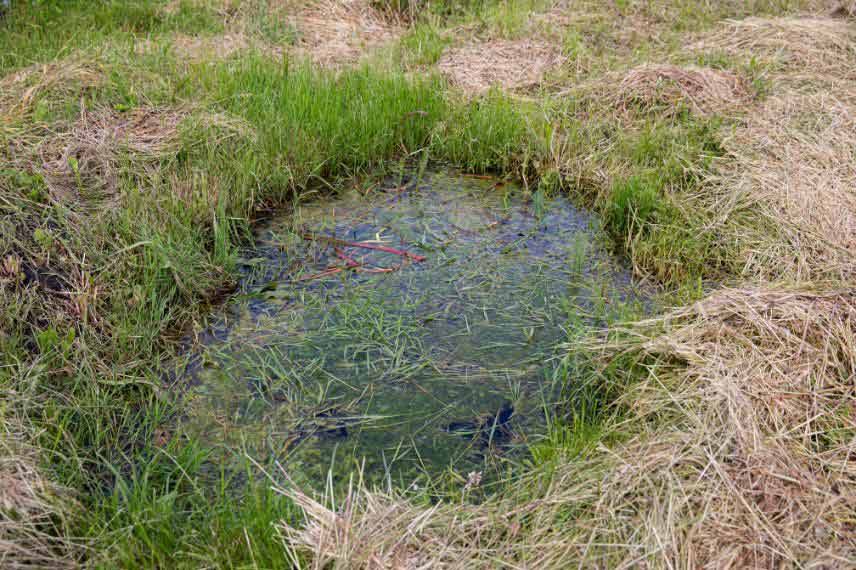
The term swale, originally designating a water stagnation area in a landscape, is a more or less accurate translation of the French term “baissière”.
Why create a sunken bed in the garden?
Thanks to their transverse positioning, swales allow for the effective management of runoff water while gently handling it. Erosion, soil leaching, and flooding are thus avoided.
The swale also acts as a natural reservoir where the captured water gradually infiltrates the soil. When the swale captures runoff water, the vegetated bank of trees and bushes absorbs and stores it, allowing plants to continue benefiting long after the swale has dried out.
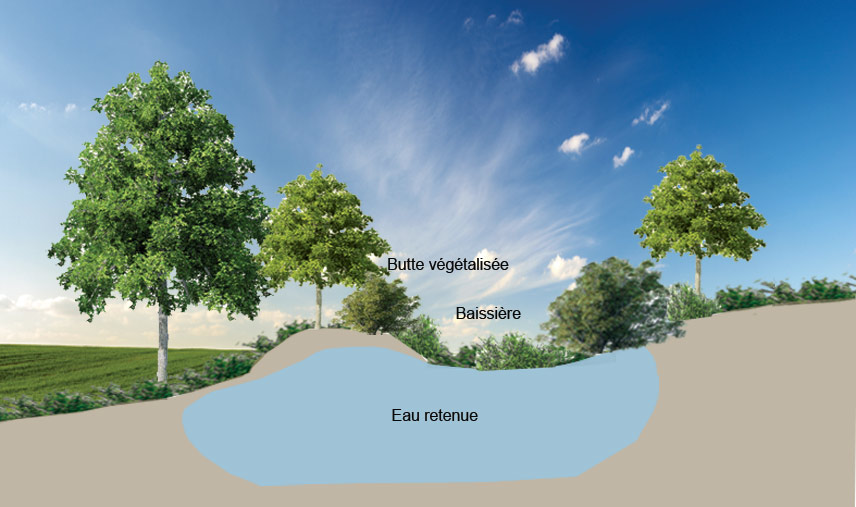 By creating a depression leaning against a vegetated bank, we capture water that benefits the vegetation.
For maximum interest in the garden, the planted species can include fruit-bearing and nitrogen-fixing varieties (Elaeagnus, Colutea, or Hippophae, etc.) accompanied by aromatic, phytopharmaceutical, and useful perennials and groundcovers (comfrey, angelica, phacelia, etc.). The swale can also be intentionally flooded to accommodate wetland plants with high biomass production (bulrush, etc.).
The organic matter that accumulates over time at the bottom of the swales (leaves and dead wood, etc.) quickly forms quality humus, which becomes the habitat for the most valuable participants in soil life, such as invertebrates, fungi, and microorganisms.
Thus, from a terrain that is mostly sloped and sometimes difficult to vegetate, one can create a rich and abundant area, providing sustenance, where birds and beneficial wildlife will soon settle, becoming a true ecological niche for the surrounding garden. In some countries, swales created in desert areas have contributed to bringing life back to extremely arid lands.
In the case of flat, clayey terrain, the swale technique can also be applied to both retain water for as long as possible before dry periods, and to manage it to prevent excess water and root asphyxiation (not to mention difficulties in soil work). Furthermore, if the bank of the swale is wide enough, it can serve as a path to keep feet dry even after heavy rainfall. Thus, the swale fully respects the great principle of “one element, multiple functions”!
Where and how to create a berm?
Where?
The technique of swales is used on clay soils, particularly when they are sloped and water – as well as organic matter – is lost quickly through runoff. To fully serve their purpose, swales must follow the contour lines of the land on which they are dug. Their location should allow for “breaking” the slope and collecting enough water during rains to hydrate the soils downstream and the adjacent mound. We have seen that these swales can also be dug on flat land that struggles to dry out.
It is possible to create a mini-swale in a small garden, keeping in mind that if positioned perpendicular to the land, it may obstruct movement around the area.
How?
- Swales are shaped somewhat like rice paddies on the side of a mountain. However, while rice is planted in the ditch, in the case of “swales,” plants are typically planted on the bank, except for wetland plants if you wish to include them.
- The ditches are dug following the contour lines of the land, and the mounds are shaped with the removed soil. To know the contour lines of your garden, you can visit www.geoportail.gouv.fr. By entering your address and using the site’s very user-friendly tools, you will get an aerial view and can determine an altimetric profile or visualise the IGN topographic map.
- If you prefer ground techniques to determine levels, you can use a water level, a laser level, or an A-frame level, which is an easy-to-make wooden frame shaped like an A, equipped with a string and a weight (small stone or piece of wood). This step is important as it allows you to materialise the water’s path on your land.
- Plant stakes along the determined contour line to mark where to implement your swale.
- Then, to create it, dig a trench about 30 centimetres deep and 60 centimetres wide. This swale (or ditch) should be level so that water does not escape at the end through runoff.
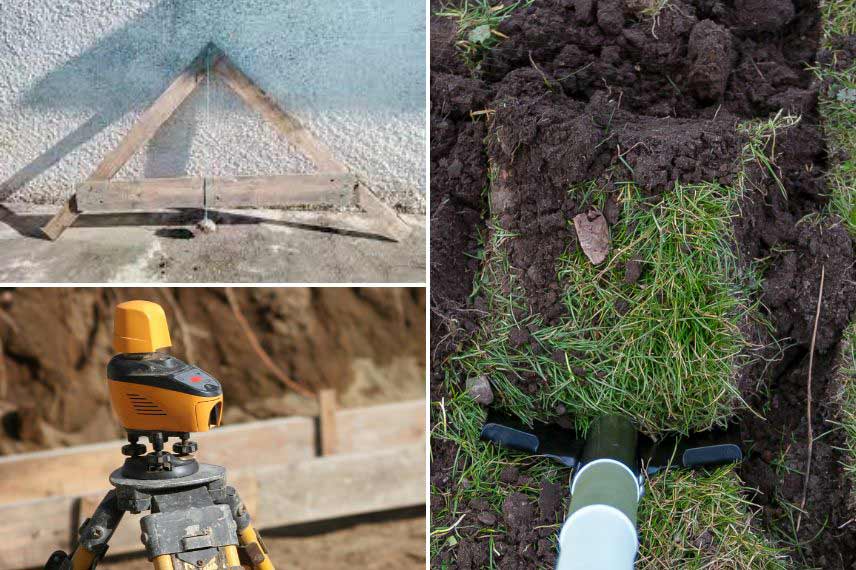
Various methods will allow you to determine the contour line(s) where to dig your swales
- The removed soil is piled up at the top along the length to create the mound.
- To avoid the appearance of a ditch, you can fill the swale with wood chips, small stones, mulch, twigs, or any other easily accessible material. This will further cool the soil and retain water. However, be careful not to fill in the ditch that you have painstakingly dug and also to allow sediments to fill it during the next rain!
- As the swale is a structure designed to infiltrate water, it should not be waterproofed, as that would go against its primary function.
- Being positioned lengthwise, the swale may obstruct movement on the land it segments, especially in a small garden. It is then possible to create crossing passages using permeable materials such as pieces of wood of various sizes.
→ Note: The steeper the slope, the greater the volumes of water to manage can be. Swales must therefore be correctly sized to prevent heavy rains from destroying them and causing landslides. Several swales can be alternately placed following the slopes if the land is truly steep. In this case, at the end of the swale, a spill zone allows water to join the next swale.
Read also
Can you compost "weeds"?The maintenance of a low-growing plant
Despite the requested work, once this “swale” system is in place, it requires very little intervention and functions for many years. Like ditches, the baissières do require maintenance to prevent them from becoming clogged. Depending on conditions such as the proximity of trees, the nature of the soil, rainfall, or their depth, it will be necessary to clean them out from time to time. You can take this opportunity to recover the organic matter deposited at the bottom.
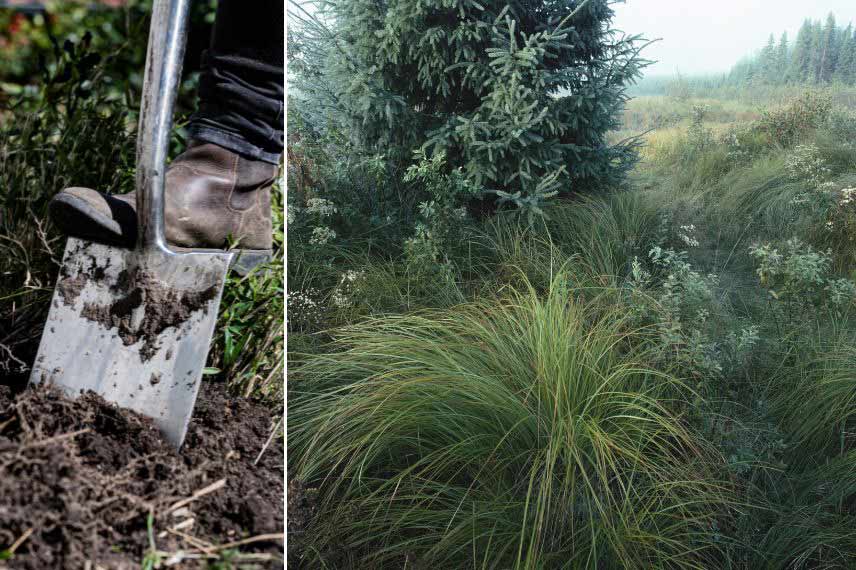 Occasional maintenance will ensure the proper functioning of the baissières and prevent their natural clogging[/caption>
Despite all the listed advantages, we must also acknowledge a few disadvantages of this technique:
- the banks most exposed to the sun can be quite drying, so the plant palette to be installed should be adapted accordingly
- Rodents may take advantage of the opportunity to settle there… so be cautious if planting near a vegetable garden!

- Subscribe!
- Contents
Comments