






























Rocambole garlic and Rocambole onion: how to grow them?
Original and perennial vegetables, rocambole onion and rocambole garlic are easy to grow
Contents
All gardeners strive to limit their efforts in the garden and the veg patch, while achieving good harvests. The solution lies in perpetual vegetables that are planted and renew themselves not endlessly, but for a few years. Garlic and Rocambole onion fall into this category of perennial vegetables. In particular, these are Alliaceae family vegetable crops that are at once tasty, distinctive and easy to grow. And above all decorative with their aerial bulblets, colourfully coloured.
Find out how to consistently grow Rocambole garlic and Rocambole onion, which share the same soil, sun exposure and maintenance requirements.
Further reading :
- 10 perpetual or perennial vegetables for a sustainable and self-sufficient vegetable garden
- How to create a perpetual vegetable garden?

Rocambole onion and rocambole garlic: what exactly are these bulbous plants?
With rocambole garlic (Allium scorodoprasum) and its companion rocambole onion (Allium cepa proliferum), originality is assured. Both are members of the Alliaceae family; these two vegetable and bulbous plants are close cousins of our garlic and common onions. However, they stand out for their ability to renew themselves. Indeed, rocambole garlic and rocambole onion are perennial plants, regarded as perpetual vegetables. Note that the term “perpetual” does not mean “eternal”. Indeed, these two bulbous plants settle in the garden for about five years. After that, they exhaust themselves and must be propagated. But during this period, garlic and onion will produce without much maintenance.
Let’s start with a quick zoom on rocambole garlic. A bulblet-bearing perennial plant, 30 to 80 cm tall, rocambole garlic produces a sturdy, thick stem that is upright and spiralled, with foliage up to mid-height. Its linear, long, flat leaves emerge from the bulb and display a pale green colour. It produces a spathe (a large scaly bract) with two oval valves and purplish flowers in umbels. Following the flowers, purplish clusters appear, comprising 4 to 10 aerial bulblets, ovate and slightly curved.
As for rocambole onion, sometimes called ‘Egyptian onion’, it is just as curious as rocambole garlic. It also produces erect, straight, hollow, persistent stems of bluish-green colour, bearing at their tips pink inflorescences, followed by aerial bulblets, pointed outward and arranged in a tousled bouquet on one to two tiers, green then coppery-red. At maturity, rocambole onion can reach 80 cm to 1 m in height.
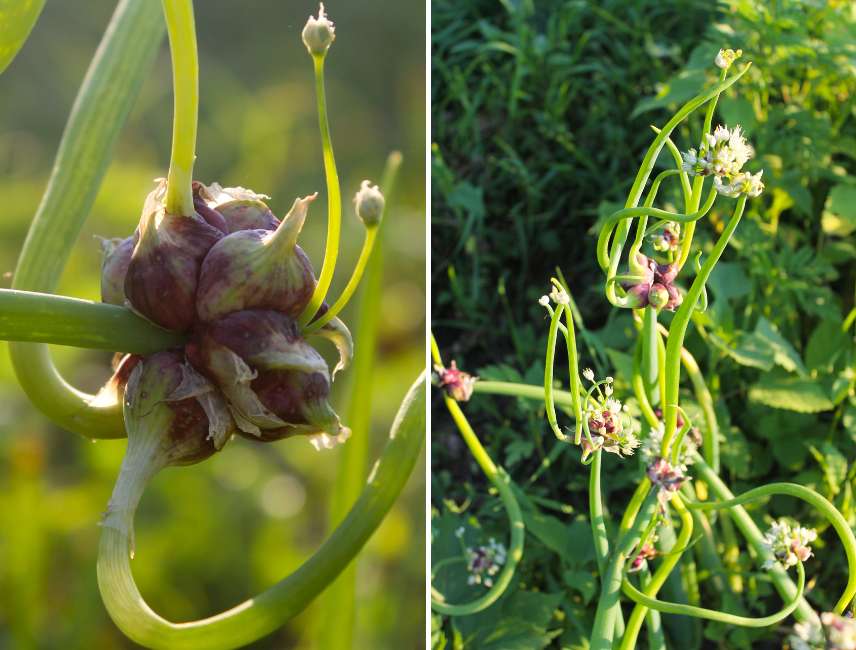
Rocambole onion is a bulbous perennial plant
In these two perennial vegetable plants, unlike garlic and common onions, it is the aerial parts that are edible. Beginning with bulblets, milder in flavour and less pungent than their cousins, as well as the leaves and stalks with the respective flavours of chives for rocambole garlic and shallot for rocambole onion.
If the small aerial bulbs are not harvested, they fall to the ground when the stem withers. They germinate to form additional plants.
Very hardy, the stems and foliage of rocambole garlic and rocambole onion die back in winter to reappear in spring. They can be grown across France, in any climate.
For successful planting of rocambole garlic and rocambole onions.
If sowing rocambole garlic and rocambole onion is possible, it’s rather hit-or-miss. It is preferable, by far, to plant bulbils. And above all, you are more likely to have a successful crop!
When to plant?
Rocambole garlic planting takes place in spring, ideally in March, but it can continue through to May.
Rocambole onion is planted from the end of February to March, extending through to May, or in autumn, between September and October.
Where to plant?
In terms of exposure, both rocambole garlic and rocambole onion enjoy full sun.
In terms of soil, their needs are identical: the soil must be well-drained, fairly light and tending to sandy. Rocambole garlic and rocambole onions prefer cool soils, but not too humic or waterlogged, as this leads to bulb rot. Thus, if the garden soil is too heavy or too clayey, adding sand is recommended. Similarly, growing on raised beds at least 15–20 cm high improves water drainage. In any case, ordinary garden soil is more than enough for them, even if it is stony.
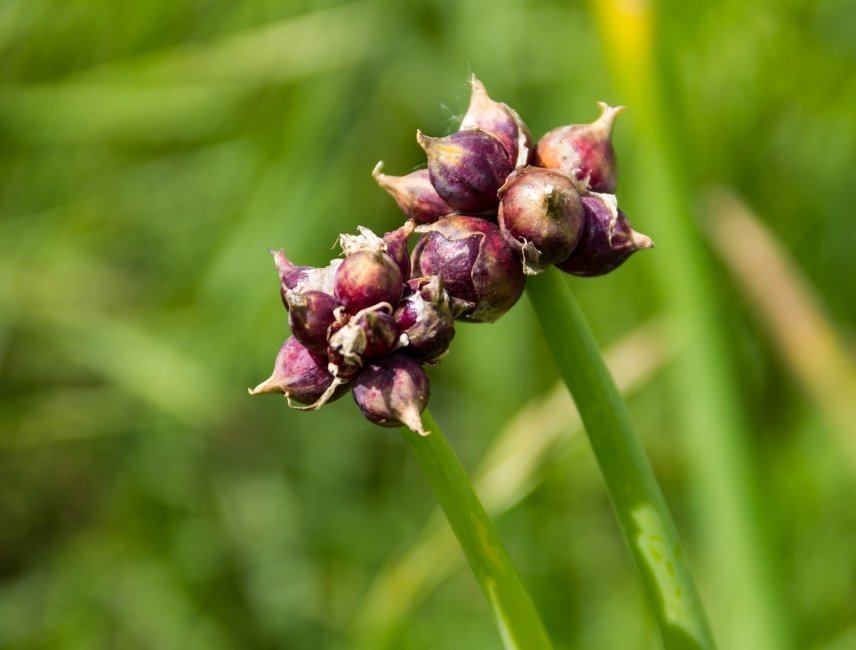
Rocambole onion bulbils
Another factor that promotes bulb rot is manuring. That is why rocambole garlic and rocambole onions must be planted in soil free from any recent manuring. Thus, the soil should not have been amended for at least a year, whether with manure or compost.
They also dislike being planted in soil that has hosted other alliums in the previous year. Crop rotation must be strictly observed.
After 4–5 years, it is best to renew the stock. Either you plant bulbils, or you divide the bulbs in place.
In terms of companion planting, rocambole garlic and rocambole onions are interesting because they contain numerous sulphur compounds, used as fungicides, bactericides and nematicides. You can plant them not far from small fruit bushes such as the gooseberry bush, the strawberry plant, the blackcurrant bush… Their presence beside potatoes and tomatoes can be beneficial against blight. Finally, they pair well with lettuces and carrots. However, avoid growing them near Fabaceae (peas, broad beans, beans, …)
How to plant?
- Loosen the soil to about ten centimetres.
- Make furrows about 5 cm deep, spaced 30 cm apart.
- Plant the bulbils, tips upwards, 20–25 cm apart.
- Cover with a layer of soil.
- Firm gently and water very lightly.
What care do these two bulbous perennials require?
Not much to do with Rocambole garlic and Rocambole onion. Indeed, maintenance is kept to the bare minimum!
- Water sparingly, only during prolonged spells of hot weather or drought.
- Hoe and weed with care, especially at the very start of planting, to remove adventive weeds and to break up the surface crust to improve rainwater penetration.
- Mulching is not necessary.
- Watch for any signs of disease or parasitic pests, noting that these two bulbous plants are very hardy.
Ultimately, the only thing to do will be to renew the clumps every five years. It is possible to plant new bulbils, or to divide the underground bulb. Simply dig up the bulb with a garden fork, then lift the bulbils formed around the bulb.
When and how to harvest Rocambole onions and Rocambole garlic?
The harvest of bulblets takes place during the summer, between July and September. They are ready to be picked when they detach easily from the stem. They often emit quite a strong scent. In addition, the foliage begins to yellow and wilt.
Harvest must be carried out before the bulblets fall to the ground. Indeed, at that moment they trigger their germination process and become unsuitable for storage. To preserve these bulblets of Rocambole garlic, you can air-dry them in the shade, in a warm and well-ventilated room. They will then be stored in small filaments in a dark, cool cellar. They can be preserved in vinegar to keep them.
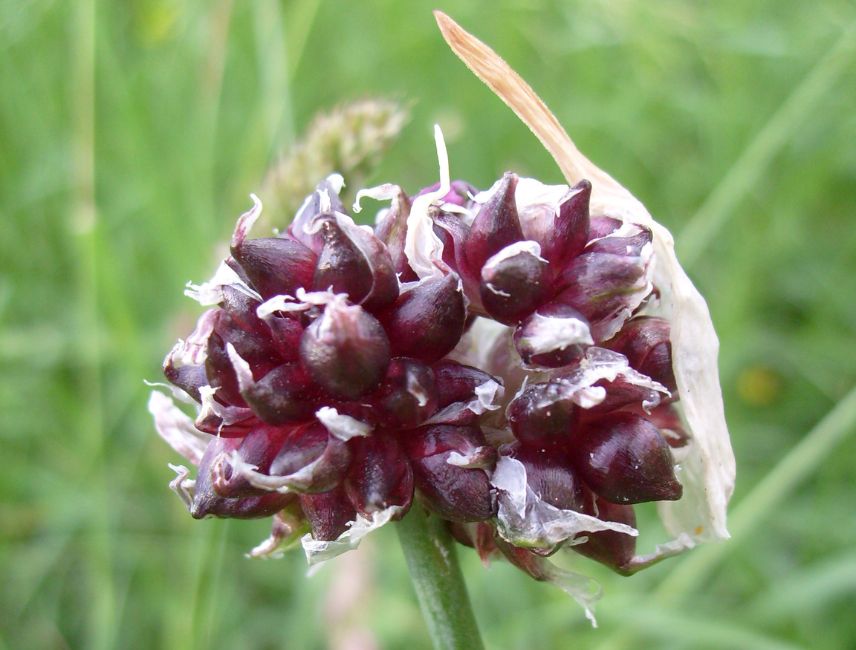
Rocambole garlic bulblets ready to be harvested (©Sarang Wikimedia Commons)
The stems that do not bear bulblets and the foliage are also edible, finely chopped in a salad.
Then it is time to prune the clump to 5 cm above the soil.
- Subscribe!
- Contents
Comments