


Roses: the best varieties for dry soils
Those that withstand water shortages and droughts best
Contents
Most roses prefer moist soils, i.e., staying damp but not waterlogged. But with climate change, drought and water shortages are affecting more and more regions, even outside the Mediterranean.
But that doesn’t mean you should give up on growing roses to enjoy their flowers and fragrance! Some varieties are indeed better suited to the drier conditions. Here is our selection of roses that will cope best with dry soils.

Growing roses in dry soil
In the event of drought, a few simple steps will help you optimise how you water your rose bushes.
- Prepare the soil well: at the moment of planting your rose bush, ensure it receives the best growing conditions so that it becomes hardy. Provide a soil mix rich in organic matter, which will help retain water and maintain soil moisture. Amend it every spring thereafter.
- Install a organic mulch at the base of your rose bush, to limit evaporation and keep the substrate moisture for longer. This mulch should be renewed every year or every two years, depending on its rate of decomposition.
- Water your rose bushes in the early or late part of the day, to reduce evaporation and water loss.
Rose bushes will always cope better with drought if grown in the ground rather than in pots, where the soil dries out all too quickly.
For reminder, all drought-tolerant plants still need an adaptation period to develop a root system that makes them more resistant to water shortage. Regular watering will therefore generally be essential during the first two years of growth.
Old garden roses and botanical roses
‘Complicata’
The old-fashioned rose ‘Complicata’ graces us in June with an adorable eglantine-flowered display. Its single flowers measure 11 cm in diameter. They bear a vivid, bright pink colour, set off by a white centre, and a heart of golden stamens. Delicately scented, this flowering exudes fruity notes.
Its graceful habit forms a handsome, dense shrub 1.5 m high by 1.8 m wide, which makes it suitable for small spaces.
Resistant to rose diseases and very hardy, it tolerates all climates and all soils, even poor and dry.
‘Ispahan’
This Damask rose ‘Ispahan’ delights us with its generous early-summer flowering, which lasts up to six weeks between June and July. It produces fully double flowers of about ten centimetres in diameter, like clusters of little pom-poms. In terms of colour, the flowers show a range of vivid pinks. To top it off, they give off a sweet, strong fragrance, which will perfume the garden, especially in dry weather.
Its upright habit reaches 1.8 m in height by 1.3 m in width.
‘Ispahan’ will grow best in deep, well-drained soil, which will allow it to draw water and resist drought once established.
Dog rose
The dog rose or Rosa canina is a native species of rose that one can easily encounter on a stroll in France. Robust and vigorous, it is perfectly suited to our climates. In terms of substrate, it is a plant that will tolerate soils even poor, dry, stony and chalky.
This wild-charm rose produces small single flowers of about 4 cm in diameter, whose colour ranges from pink to white. The heart reveals numerous golden stamens. The flowering gives way to edible red fruits (cynorhodons) and decorative.
Its spiny and arched habit will quickly reach 3 m in height by 2.5 m in width.
‘Mutabilis’
This China rose (Rosa chinensis) blooms for a long time, almost without interruption from spring to the first frosts of winter. It is a remontant variety, ancestor of many modern varieties. Its flowers measure 5 to 6 cm in diameter. They offer us a true little multicoloured display, with changing hues blending yellow, orange, pink, and even purple.
At maturity, this rose will reach 1.7 m in height by 1.5 m in width.
‘Mutabilis’ tolerates sunny exposures and drought quite well, once it has found its footing. It is a perfect rose for coastal gardens.
Hardy and not overly prone to diseases, it is, however, less hardy than other kin (down to -12°C).
‘Old Blush’
Old Blush is one of the oldest roses. Just like the China rose with which it is closely related, it blooms steadily from spring to the first frosts. In mild climates, it can even bloom almost all year round. Its small semi-double flowers display a pale pink that becomes progressively darker with age.
This compact rose does not exceed 1.2 m in height and width, making it suitable for anywhere.
Easy to grow and low maintenance, it will thrive even in poor, calcareous and dry soils.
Other drought-tolerant old roses
Discover also other roses that tolerate dry soils, such as the scented dog rose (Rosa rubiginosa), Rosa omeiensis ‘Pteracantha’, the old garden rose ‘Joseph’s Coat’ or the Scottish rose ‘Stanwell Perpetual’.
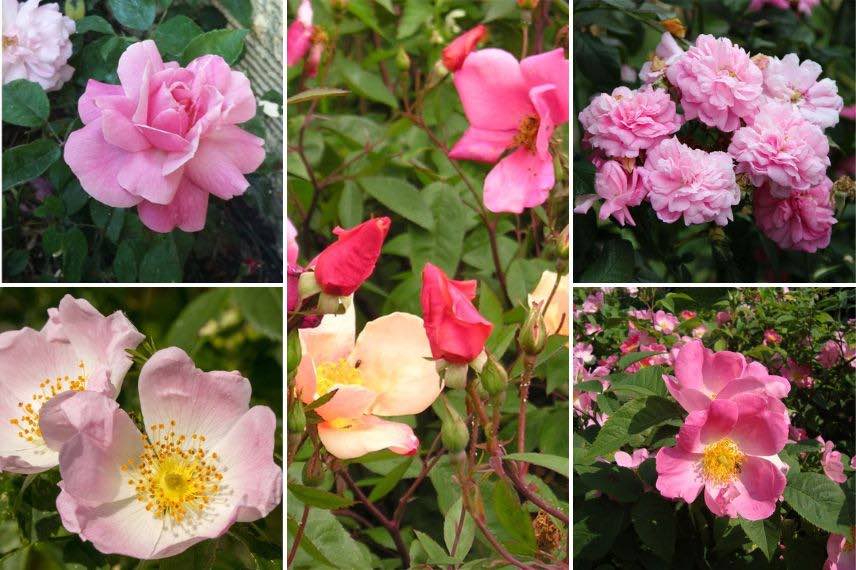
Clockwise from the top left: Old garden rose ‘Old Blush’, Rosa chinensis ‘Mutabilis’, Damask rose ‘Ispahan’, old garden rose ‘Complicata’, Rosa canina
Modern Hybrid Roses
‘Blue Eyes’
The cluster-flowered rose bush ‘Blue Eyes’ charms us with its semi-double flowers, the petals delicately crinkled. In contrast, they reveal a white-lavender background enhanced by a heart of purple, violet or bright pink, which changes colour over time. These exotically charming flowers recall hibiscus. Repeat flowering, this bloom recurs from mid-spring until the first frosts. It emits a pleasant lemon fragrance.
This compact shrub with healthy foliage will reach about 60 cm across in all directions at maturity.
‘Blue Eyes’ is an ideal rose in hot, dry climates.
‘Plaisanterie’
The shrub rose ‘Plaisanterie’ produces small simple flowers of 4 cm, but with great decorative value. They effectively have the advantage of almost continuous colour-change, for multicoloured flowering. The tones range from yellow to violet, as well as to orange, pink and purple. Repeat flowering, this rose blooms from late spring, then again in late summer.
Reaching 1.75 metres in height with a 1.5-metre spread, it can make a handsome shrub or be trained as a climber.
Vigorous and hardy, this rose will be an excellent choice for regions with dry summers. Its only drawback lies in its medium hardiness (−12°C to −15°C),
‘Sir Walter Scott’
The David Austin rose ‘Sir Walter Scott’ is a compact shrub measuring 1 metre in height and 75 cm in width. But do not underestimate it! It offers repeat flowering throughout the summer, consisting of small semi-double roses with a tousled appearance. They reveal an intense pink, becoming lighter as the days go by. Fragrant, the flowers retain the characteristic scent of old roses.
This English rose proves perfectly resistant to diseases, maintenance-free and forgiving even in difficult conditions. It will tolerate thus poor, dry and unforgiving soils.
Other modern hybrid roses tolerating drought
Also try the large-flowered shrub rose ‘Alissar Princess of Phoenicia’, the Rosa rugosa ‘Hansa’, as well as the cluster-flowered roses ‘Peace and Love’ or ‘Cyrus’.
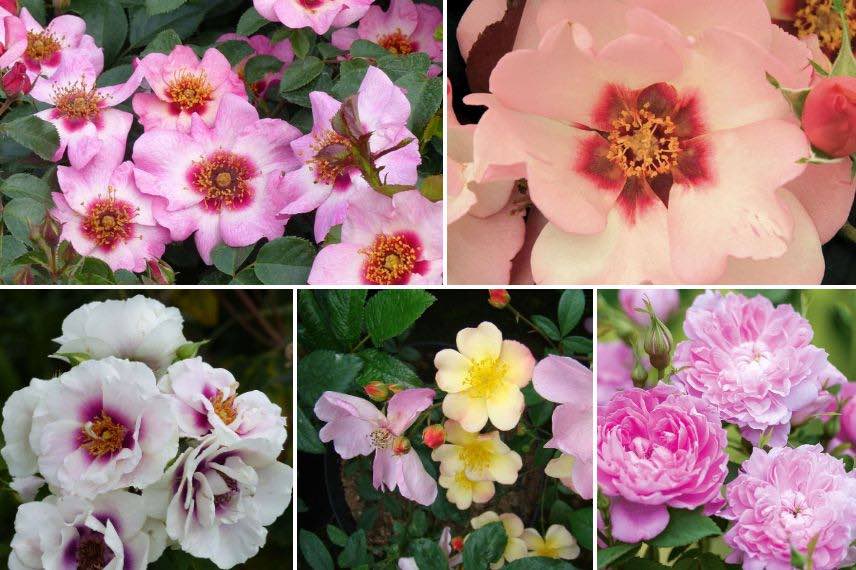
Rose ‘Peace and Love’, Rose ‘Alissar Princess of Phoenicia’, Rose ‘Sir Walter Scott’, Rose ‘Plaisanterie’, Rose ‘Blue Eyes’
Climbing and rambling roses
Banksiae Roses
Banksiae roses are large, luxuriant lianas that will reach over 10 metres in height and 4 to 6 metres across. They are ideal candidates for Mediterranean gardens, as they love sun, tolerate heat and drought. However, their hardiness will be found wanting in cold regions (frosts above -12°C).
Their flowering occurs only once in spring, lasting about three weeks, but with a generous display. It consists of double flowers, turning the liana into a true cascade of blooms.
There are several varieties: ‘Lutea’ which flowers in yellow, ‘Rosea’ which produces bright pink flowers, or ‘Alba Plena’ with its delicate cream-white blossoms.
These roses are almost thornless, making them suitable to grow close to living areas or paths.
‘Blush Noisette’
‘Blush Noisette’ is an old climbing rose with generous summer flowering. Repeat-flowering, this variety flowers from July until the first frosts almost without stopping. It produces small double roses of about 5 cm, in a delicate pale pink colour close to white. It is also a scented rose, exhaling spicy clove notes, particularly noticeable on sunny days.
A quintessential romantic rose that will suit anywhere thanks to its compact habit, reaching 1.8 metres in height by 1 metre across. When trained to climb with a trellis, it can reach 3–4 metres in height. It also has the advantage of being fairly thornless.
Once established, this rose will tolerate heat and drought, but will prefer a partially shaded exposure.
‘Albertine’
The rambling rose ‘Albertine’ only flowers once in June or July, but this single flowering is worth admiring. It reveals an abundance of double flowers about 8 cm in size, with a subtly changing colour from coppery pink to salmon pink. On the scent front, these are light sweet notes that drift through the garden.
Being tolerant of difficult conditions, ‘Albertine’ resists equally well to cold, as well as to shaded exposures or drought once well established.
Allow space for this rose, capable of reaching 5–6 metres in height for 3 metres of spread.
Other drought-tolerant rambling and climbing roses
Pensez aussi au David Austin rambling rose ‘Albrighton Rambler’, to the rambling roses ‘Albéric Barbier’, ‘Félicité et Perpétue’, ‘Purezza’ or ‘François Juranville’
[img class=”wp-image-216295 size-full” src=”https://www.promessedefleurs.com/blogwp/wp-content/uploads/2023/08/rosiers-sol-sec-banks.jpg” alt=”Banksiae roses” width=”856″ height=”570″ /> Rambling roses ‘Blush Noisette’, Banksia rose ‘Rosea’, Banksia rose ‘Lutea’, Rambling rose ‘Albertine’, Rambling rose ‘Albrighton Rambler’
Dwarf and miniature roses
The Babylon Eyes collection
The roses in this collection are beautifully colourful and offer repeat flowering. They are even suitable for small gardens, thanks to their compact habit, which does not exceed 1 metre in height and a 60–75 cm spread.
The long flowering occurs in summer. The simple or semi-double flowers are invariably multicoloured and ever-changing, with a well-contrasting centre. They can be yellow, then white with a red centre in ‘Cream Babylon Eyes’. In ‘Coral Babylon Eyes’, they blend pink and yellow around a red centre.
They are sturdy, hardy roses, disease-resistant, and, of course, highly tolerant of dry soils.
The Fairy
The Fairy is a small groundcover rose, measuring 80 cm in height by 90 cm in spread. It is one of the reliable favourites, flowering a little late but abundantly from July until the first frosts. You can admire its lovely bouquets of double pink flowers, which fade to paler tones as the season progresses.
Easy to grow, it’s a fail-safe rose that tolerates frost and even poor, dry soils.
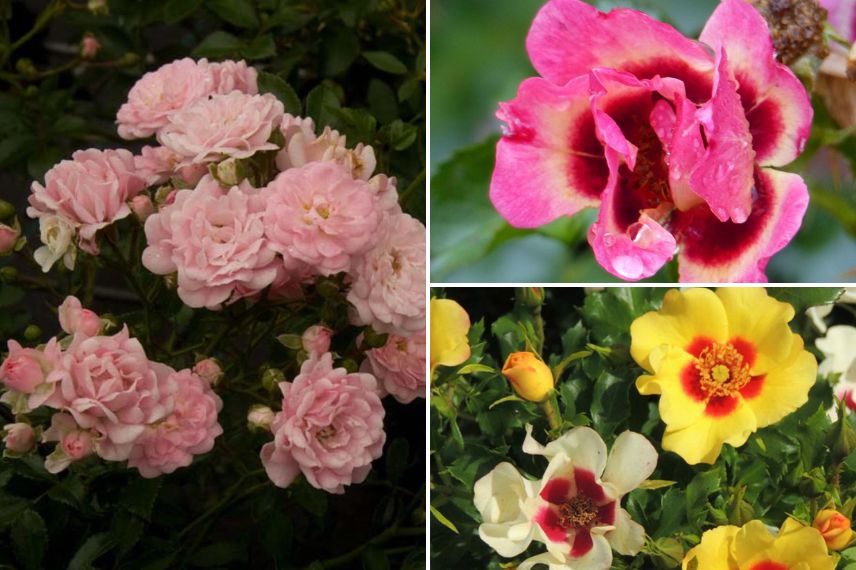
Rose ‘The Fairy’, Rose ‘Coral Babylon Eyes’, Rose ‘Cream Babylon Eyes’
- Subscribe!
- Contents

Comments