





























Snowberry: which variety to plant on a bank?
A selection of varieties with a dense, bushy, ground-covering habit to spruce up drab areas
Contents
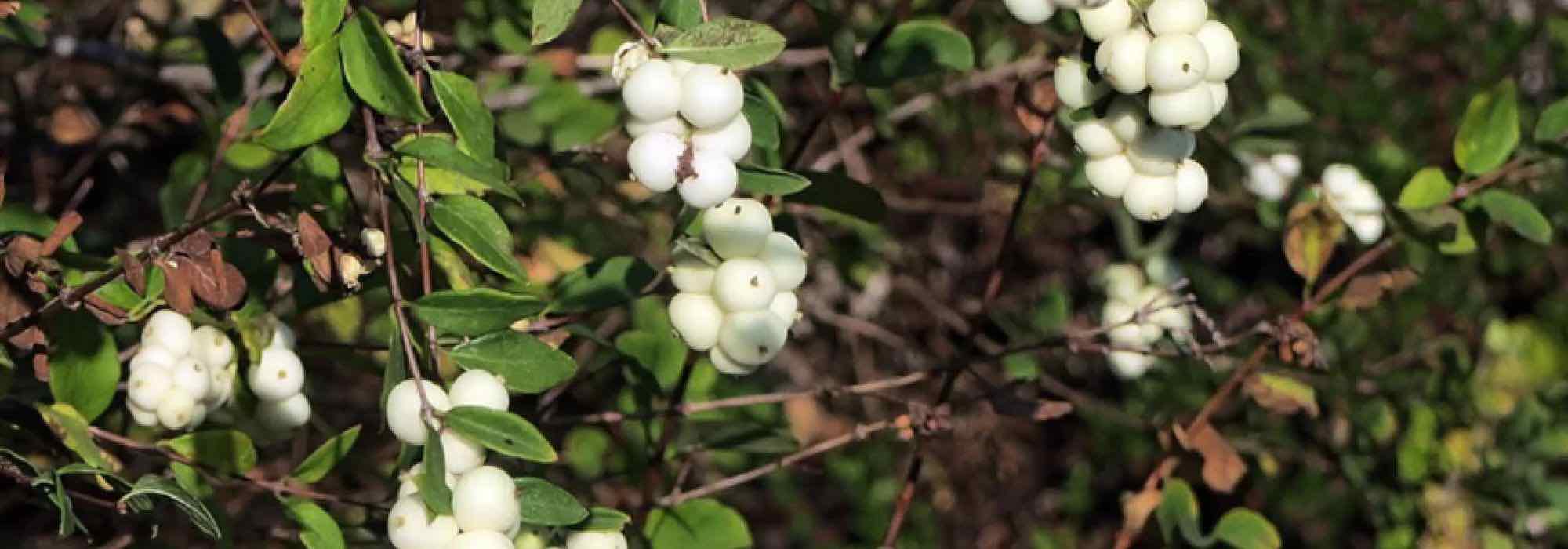
Symphoricarpos are appreciated in the garden for their berries that are particularly decorative in winter, due to their candy-coloured hues recalling real little sweets (though they are not edible for humans).
Naturally hardy, easy to grow, not particularly susceptible to diseases and tolerant of cold, these shrubs are perfect for filling the more difficult areas of the garden. Varieties wider than tall, with a spreading habit, will be ideal for dressing a bank. Discover our selection of varieties best suited to this type of area.
And to learn everything about growing symphorines, discover our comprehensive guide: Symphorine: planting, pruning and care

Symphoricarpos chenaultii 'Hancock' - Chenault's snowberry
The variety Symphoricarpos x chenaultii ‘Hancock’ has a spreading habit that naturally lends itself to use as a groundcover, particularly for covering a slope. It is indeed only 60 cm tall, but it can spread to nearly 2.5 metres.
Its mat-forming habit is highly ramified, making it dense and effective at covering, ideal for competing with adventive weeds.
The foliage is borne on nicely arched branches, which have the advantage of readily layering (they root on contact with the soil). It consists of small round bluish-green leaves. In summer, this Symphoricarpos rewards us with a fairly discreet flowering, in the form of small pink funnel-shaped flowers, which will nonetheless attract pollinating insects.
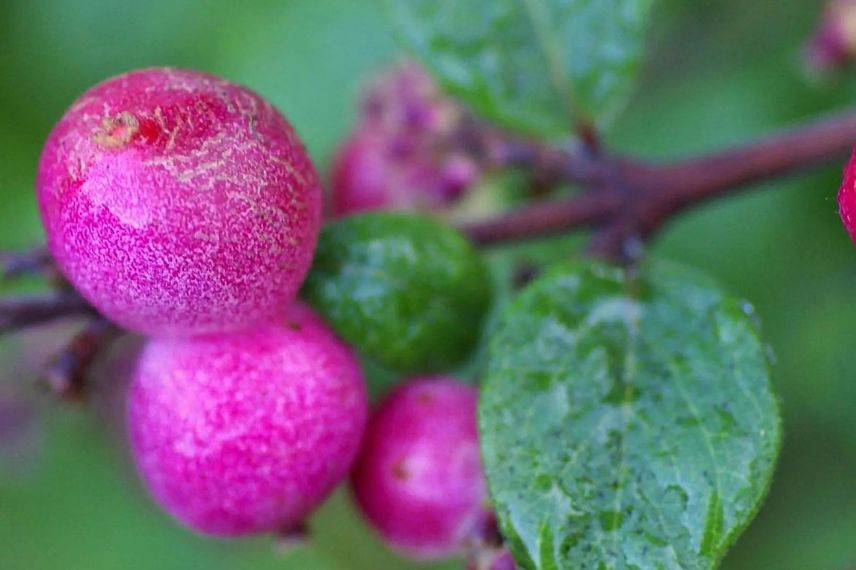
Symphoricarpos have deciduous foliage, but remain ornamental in all seasons thanks to their berries, which brighten the garden during winter. They will also delight birds, which feed on them at a time when food is scarcer. On ‘Hancock’, the 8 mm diameter berries display a deep, vivid pink and stay on the shrub for a long time.
Easy to grow and low maintenance, this ornamental shrub suits all exposures, even under a tree. Simply provide well-drained soil (where water does not stagnate).
Read also
5 mountain shrubs to revegetate a slopeSymphoricarpos ‘Arvid’
‘Arvid’ is a low-growing variety of snowberry, reaching 50 cm tall and 1.50 metres wide. Its broad silhouette makes it easy to cover even the most challenging corners of the garden: worth trying to plant up a slope with it!
It has small oval leaves, a slightly blue-green colour. Towards the end of the season they develop pretty yellow hues before dropping.
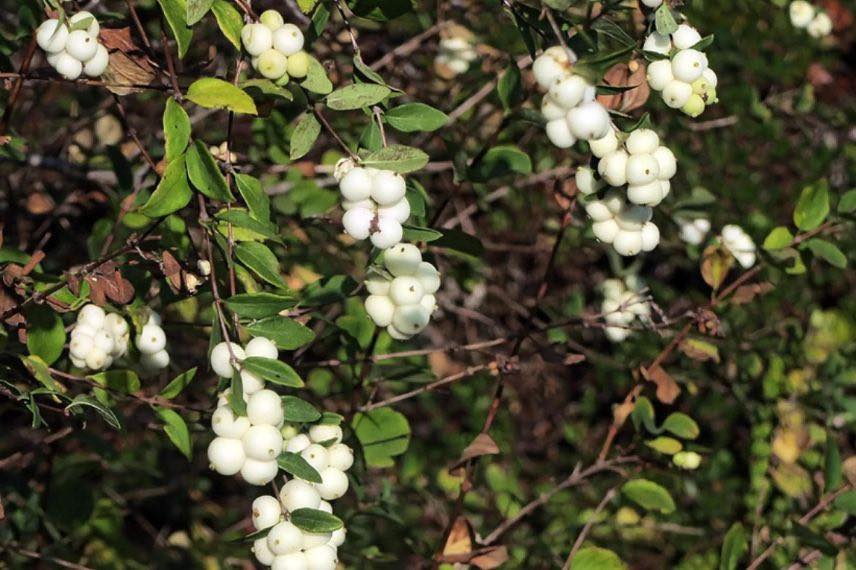
The summer flowering isn’t very conspicuous, but it will please visiting pollinators. It comprises small flowers in a pink so pale that it appears almost white. They will give rise to very ornamental fruiting, in the form of globose white fruits like numerous tiny immaculate pearls.
It is tolerant and suitable for gardeners, even beginners; it will grow in full sun or in a less sunny area, in soil that can be damp or dry.
It tolerates cold (hardiness down to -25°C), pests, diseases and neglect.
Symphoricarpos chenaultii 'Brain de Soleil' - Chenault's Snowberry
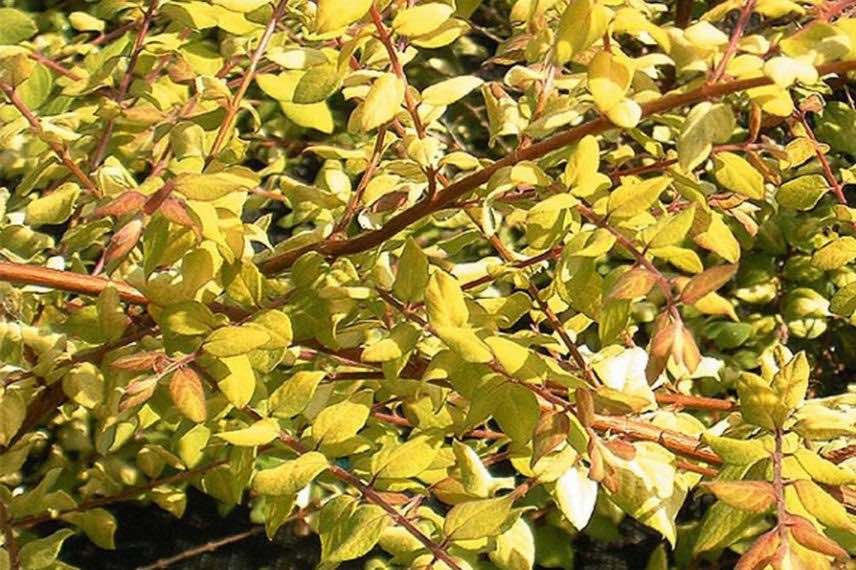
The Symphoricarpos chenaultii ‘Brain de Soleil’ is hard to miss, thanks to its particularly luminous foliage, which gives it its name. It is in fact made up of young shoots that are orange-coloured in spring, which then unfold into leaves of a lovely brilliant gold. In autumn, they take on reddish-orange hues before dropping. A foliage that is particularly warm-toned and also notably dense and ground-covering.
With a height of 60 cm and a spread of 1.50 m, this variety makes an excellent groundcover. Nothing seems to scare it: neither the unwelcoming slopes, nor shaded, dry areas, nor soils already full of tree roots. A true all-terrain plant!
Like its Congeners, this Symphoricarpos is a bush that will promote biodiversity: its flowering nourishes insects and its fruiting provides food for birds. The fruiting consists of white berries, somewhat more discreet than those of other varieties, but which can also remain on the branches for many weeks.
Read also
7 perennials ideal to landscape a bankSymphoricarpos albus 'Laevigatus' - White Snowberry
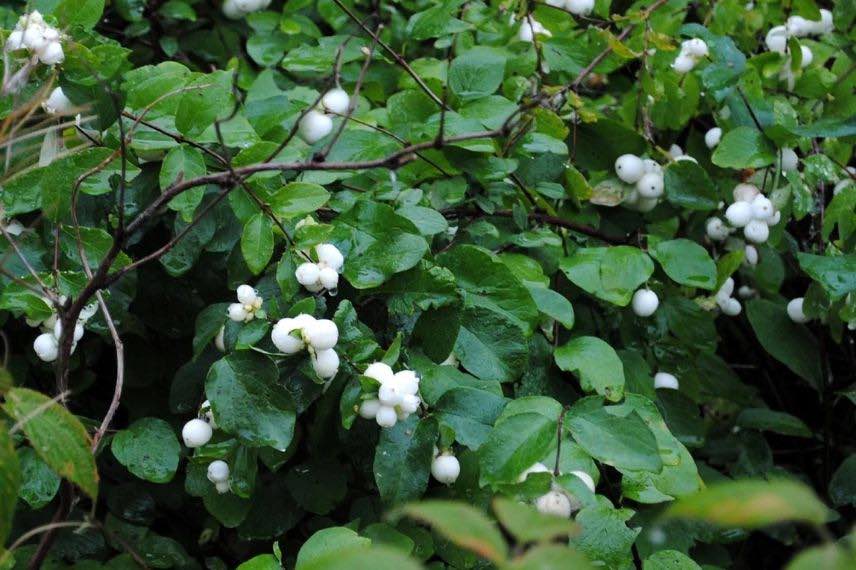
White snowberry ‘Laevigatus’ is one of those bushes regarded as foolproof. The species has readily naturalised in Europe and will therefore cope well with the cultivation conditions of most of our gardens. It is not afraid of the cold, even down to -25°C. Salt spray and pollution are not a problem for it either.
Its habit is a little less spreading than other snowberries, reaching an average height of around 2 metres with a comparable spread. Nevertheless it is an interesting variety to use as a ground cover: it is already prized for stabilising embankments along roads in urban development. Thanks to its suckers, it does indeed spread rapidly to colonise even inhospitable areas.
It forms a pretty shrub with dark green, slightly bluish leaves. Flowering in pale pink bell-shaped blossoms occurs from July to September. It precedes the formation of round, pearly-white fruits, which are among its decorative assets. They can persist until January, if the birds have not made them their buffet.
‘Laevigatus’ will require only to be protected from overly arid conditions. Cultivate it in any soil, even calcareous, clayey or poor.
Symphoricarpos doorenbosii 'Magic Berry'
If this Symphoricarpos doorenbosii is considered magical, it’s thanks to its lovely colourful berries, which really resemble tiny tangy sweets. Generous, this variety rewards us with an abundance of small two-tone berries, blending red, purple-tinged, pink and pale pink. Their colour varies with light. These berries will provide a display right through to the heart of winter. Please note that, despite their attractive appearance, these fruits are toxic to humans and must not be consumed.
The green foliage takes on bright yellow hues in autumn.
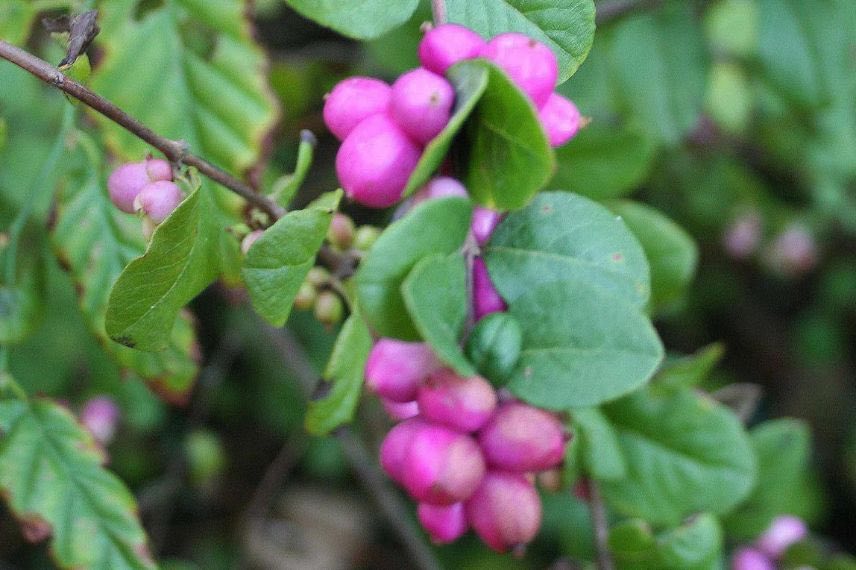
The compact habit of ‘Magic Berry’ reaches 1.2 metres in all directions. Dense and compact, it lends itself to all kinds of uses: in a border, in a bed, in a pot, on the terrace or balcony, in a rock garden, but also on a bank. Note that it can tolerate the relatively dry conditions of Mediterranean gardens.
Fast-growing, it spreads via suckers, which you can easily remove if you need to curb its growth.
- Subscribe!
- Contents
Comments