





























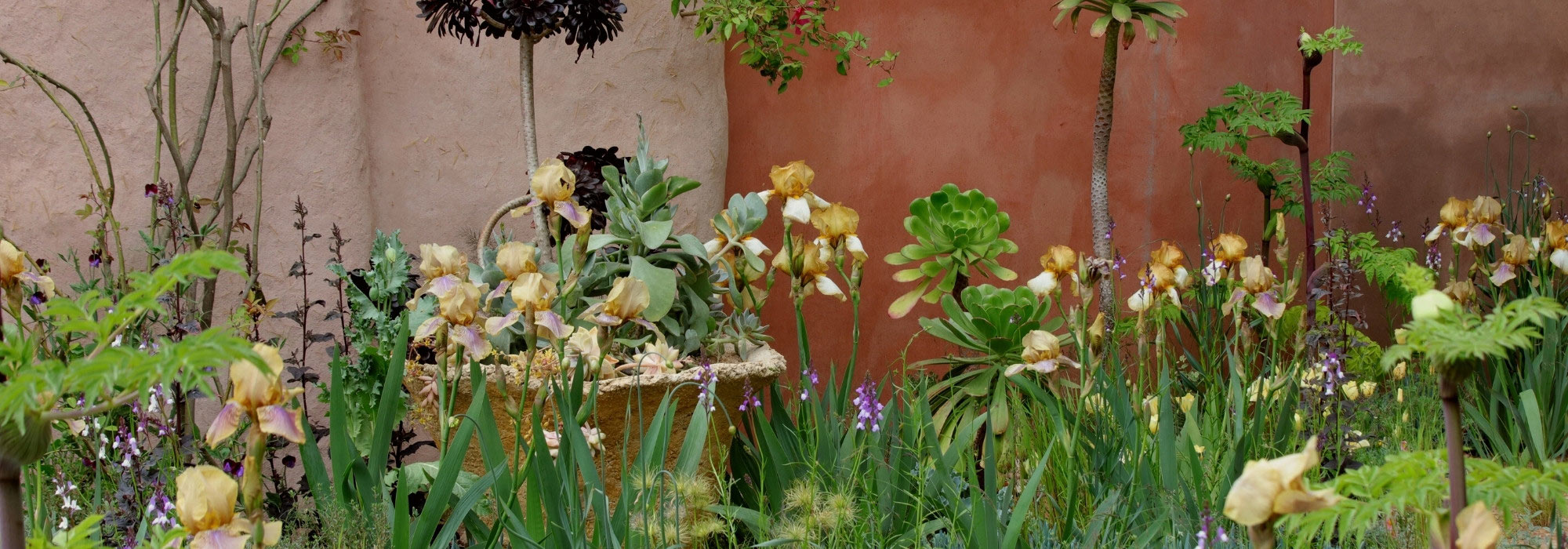
Soil & sand: the garden trend embracing desert plants
Our ideas and tips for creating an arid garden
Contents
The Summer 2024 garden is a low-maintenance, no-irrigation garden. With its drought-tolerant, water-saving plants and mineral accents, the ‘desert garden’ fits this trend. The clean or fleshy forms of succulents, combined with the rough texture of gravel or rock, form an arid setting inspired by the Great Plains of the American West. The colour palette draws on earthy tones, from sand to terracotta, contrasted with bluish foliage, purplish highlights and enriched with flowering displays in warm and soft tones. Plants to favour, mistakes to avoid…Here are our tips to help you transform a corner of the garden into an arid Far West-style landscape!
→ Explore our inspiration From Earth and Sand on pages 6–7 of our Spring-Summer 2024 catalogue, as well as our selection of must-have plants to recreate this ambiance.

Desert garden characteristics
Today, many gardens are affected by periods of drought that are becoming more frequent. The trend is toward creating dry gardens, with little or no irrigation. The desert garden is designed to mimic the arid environment of deserts, favouring resilience and low maintenance. Hardy, low-maintenance plants make up the garden, adapted to withstand extreme conditions, such as drought, full sun and poor soils. It is an environmentally friendly landscaping choice, as it reduces water and fertiliser needs, without sacrificing aesthetics.
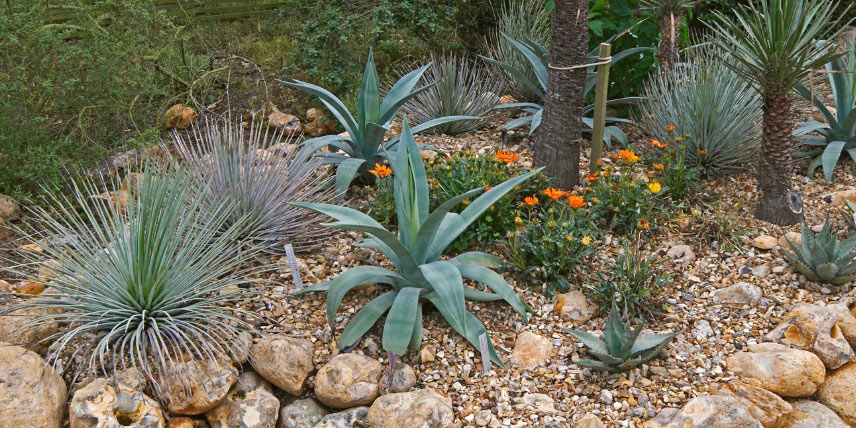
Read also
15 plants for a sunny rockeryPlanting palette
The desert garden evokes the vast wild frontiers of the American West and its lunar desert panoramas, the mythical Grand Canyon, Monument Valley and Yosemite. The atmosphere breathes in warm earth tones and the ochre dust, an arid land punctuated by plants that are remarkably graphic and well adapted to drought and heat, standing out against a blue sky. Rock, earth and pale sand become integral elements of the setting and are staged there. Some spectacular flowering displays reinforce the impression of heat and light. This harmony of colours recalls the raw beauty of deserts and is characterised by:
- Earthy tones : Browns, beiges, terracotta and ochres predominate, recalling the sandy soil and the desert rock formations typical of deserts. These natural colours provide a neutral backdrop, highlighting the vegetation.
- Yellow and orange : These warm colours evoke sunrises and sunsets that bathe the desert landscape and the hues of the rocks. They bring bright, joyful and energising touches to the garden.
- Bluish-grey and violet : The bluish or purplish hues add a dimension of coolness and mystery to the colour palette. They contrast pleasantly with the warm tones.
- Silvery : it reflects the sunlight, brings brightness and offers a refreshing contrast to earthy tones.
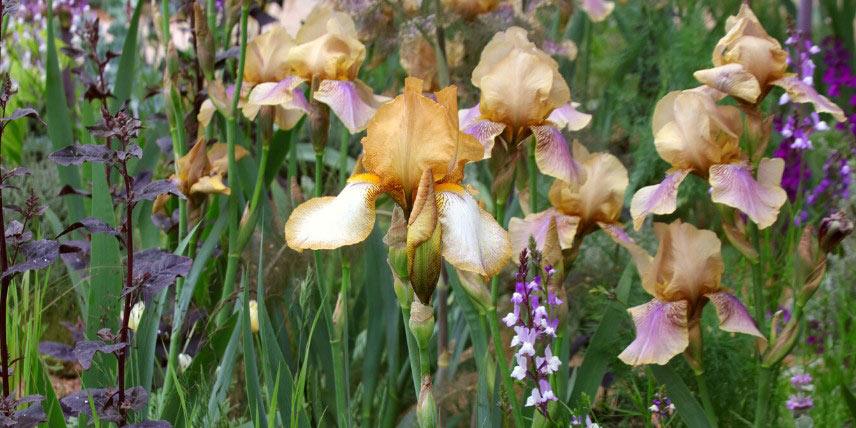
Iris germanica ‘Evolution’ and Linaria ‘Licilia Azure’
Good growing conditions
Is it possible to create a small desert corner if you don’t have a south-facing garden, and you live north of the Loire or in colder regions? In fact, many regions can lend themselves to it. Climate disruption is redefining the plant landscape and planting conditions in France. More and more regions are affected by long, hot and dry spells. Some Mediterranean species such as the olive tree are already migrating north to find a bit of cooler air. In the coldest regions, you will need to tailor plantings using a base of plants with reliable hardiness. In northern France gardens, the frost-prone plants will need to be placed in large pots, carefully choosing the most sheltered and sunniest spot to recreate a Far West-inspired scene, while others can be planted directly in the soil. Some will simply require protection against frost in winter. Be sure to check the hardiness of the chosen plants according to your climate zone before you start. To determine which plants are suitable for your garden, use our Plantfit app!
To design a desert garden, it is essential to recreate the conditions that allow desert plants to thrive. This involves recreating as closely as possible the ecosystems of these regions. You need to provide the optimal growing conditions:
- Appropriate soil type : ideally, it should be sandy or gravelly to allow water to drain away quickly. Unlike traditional gardens, a desert garden requires soil with little organic matter. Desert plants are adapted to nutrient-poor growing conditions and can struggle if the soil is too rich.
- Good drainage : Most plants that tolerate heat and extreme drought require excellent drainage. They will adapt to ordinary soil as long as it does not retain water. Excess moisture in the soil is detrimental to plants adapted to arid conditions. In heavy or clay soils, it will be essential to add drainage materials consisting of river sand and gravel. Rocks and pebbles can also be added to the surface to imitate desert soil and help retain heat. To learn more, discover our advice sheets: How can I make my soil more free-draining? and Gardening in dry or free-draining soil
- Good exposure: Desert plants require very sunny exposure for most of the day. Choose a position that receives at least six to eight hours of direct sun each day.
Which plants for a desert garden?
In their own gardens, gardeners must therefore rethink their plant choices to adapt to the new climate reality. From now on, we’re looking for camel plants. This type of garden favours a xerophytic flora, i.e. able to survive without water for long periods, thus suited to dry conditions. Among the champions perfectly equipped to withstand drought and long, hot summers are cacti and succulent plants also known as succulents, which possess the ability to store water in their tissues. They will stay unfazed in the sun, in the heat, and if rain deserts them! Plants with glaucous or silvery foliage also form part of the repertoire. They feature a defence mechanism to reflect solar radiation and even morphological adaptations (small leaves, hairs, spines…) contributing to counteract transpiration and to better withstand drought periods. A few annuals or flowering perennials that are forgiving will bring a refreshing splash of colour. Among these beauties with resilient temperaments:
-
- Agave americana : Unmissable! Very architectural, it forms monumental rosettes up to 1.5 m tall with large succulent leaves edged with spines, in grey-blue colour. Hardy to around -8°C in well-drained soil, it can be grown in the ground in mild climates, or in large pots to overwinter indoors elsewhere. L’Agave montana is another species, equally graphic, hardy to -20°C, easier to acclimatise to in almost all of our regions.
- Dasylirion wheeleri : this semi-desert climate plant develops large blue-grey spiny rosettes 80 cm to 1 m across. Hardy to -15°C, it can be planted in most of our gardens and stands up fairly well to the cold.
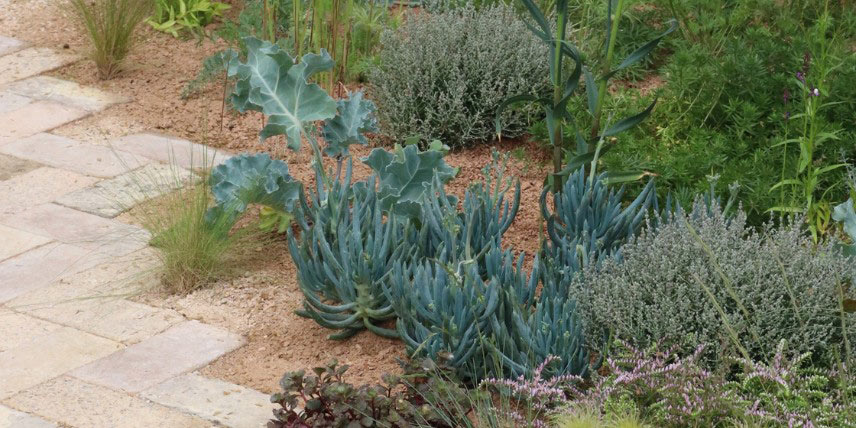
- Senecio mandraliscae : a pretty evergreen succulent valued for its beautiful blue-silver foliage that carpets the ground forming a low shrub up to 1 m high and over 2 m wide with time. Frost-tender (-5°C in perfectly dry soil in winter), it is easily grown in a pot, which allows shelter from frost in winter outside of the orange grove area.
- Santolina chamaecyparissus : another evergreen shrub hardy to drought and suited to stone soils. It forms clumps of silver-grey foliage, very fragrant when crushed, reminiscent of a cypress, and it becomes covered with small golden-yellow buttons in summer. Hardy to -20°C, it thrives in full sun in any substrate that does not retain moisture.
- Aeonium arboreum ‘Schwarzkopf’ : this curious shrub, reminiscent of desert plants, bears at the ends of its branches rosettes of succulent leaves, deep red-brown, almost black. Not very hardy (-4°C), it is easily grown in a pot, which allows protection from winter cold.
- Iris germanica ‘Evolution’ : a garden perennial iris, hardy, drought-tolerant and preferring well-drained, rather dry soils. In April–May, it bears small flowers with copper-sand petals and grey sepals touched by golden-yellow beards.
- Linaria marrocana ‘Licilia Azure’ : an annual that flowers all summer in various shades of refreshing blue. Naturalised in the south-eastern United States, this Californian beauty enjoys sun, heat, and well-drained rocky or sandy soils.
- Aloe ‘Safari Sunrise’ : this succulent in soft, warm tones forms a spiky rosette of grey-green leaves, evergreen and dentate, crowned, in late winter, by flower spikes in cream, then coral tones. Not very hardy, it should be kept to milder climates, but it also grows very well in pots.
- Eschscholzia californica ‘Alba’ : with its cream-white to pastel-yellow corollas, it adds a soft touch to the décor and self-seeds easily in light soils.
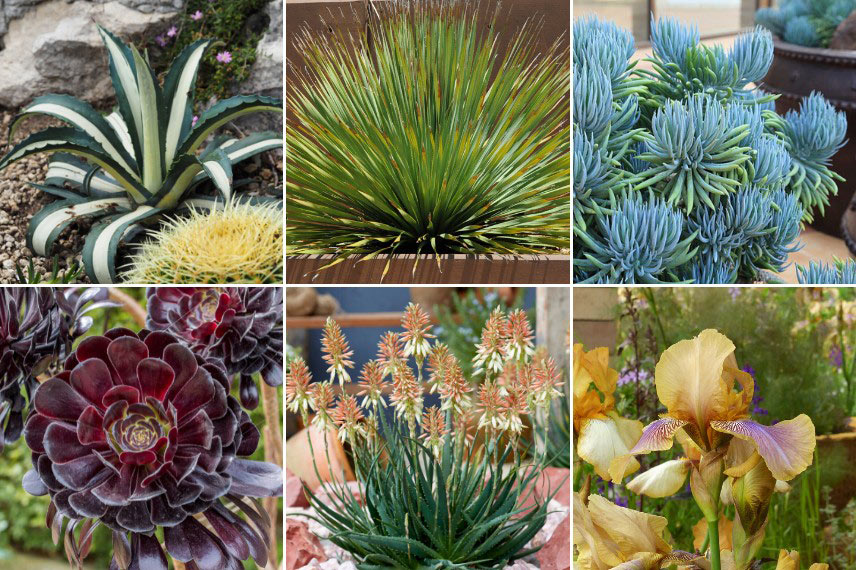 Agave americana ‘Mediopicta’, Dasylirion wheeleri, Senecio mandraliscae, Aeonium arboreum ‘Schwarzkopf’, Aloe ‘Safari Sunrise’ and Iris germanica ‘Evolution'</caption]
→ Read also: Adenium, desert rose: growing and care guide.
Perfect the decor
To perfect the earth-and-sand colour palette, prioritise natural materials. Earth material appears in pottery, brick, and we create an authentic decor that prioritises natural and raw materials in line with environmental considerations. They will blend perfectly into this type of decor and contribute to this exotic ambience. These sandy and earthy tones can be staged through pottery or large terracotta jars.
Rocks and gravels draw winding paths, borders, or simulate beds of dried-up rivers. Also an opportunity to use rock armour or mineral mulches based on mineral mulches based on pozzolana or basalt gravels to reduce water evaporation, control weeds and reinforce the rugged appearance. Gravel, particularly in light colours, imitates the appearance of desert soil and makes maintenance easier. Ochre or terracotta paint could cover a wall, for example, or some pots. These colours enhance the other tones, providing contrast or harmony with the warm blooms and the surrounding vegetation.
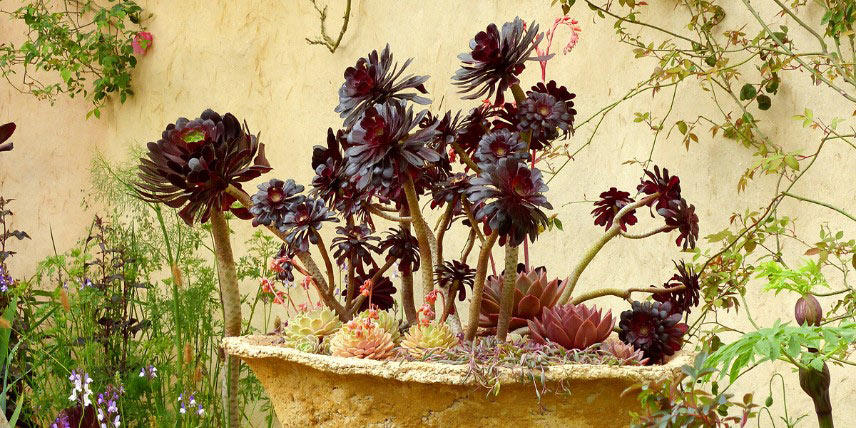
Aeonium arboreum ‘Schwarzkopf’
- Subscribe!
- Contents
Comments