


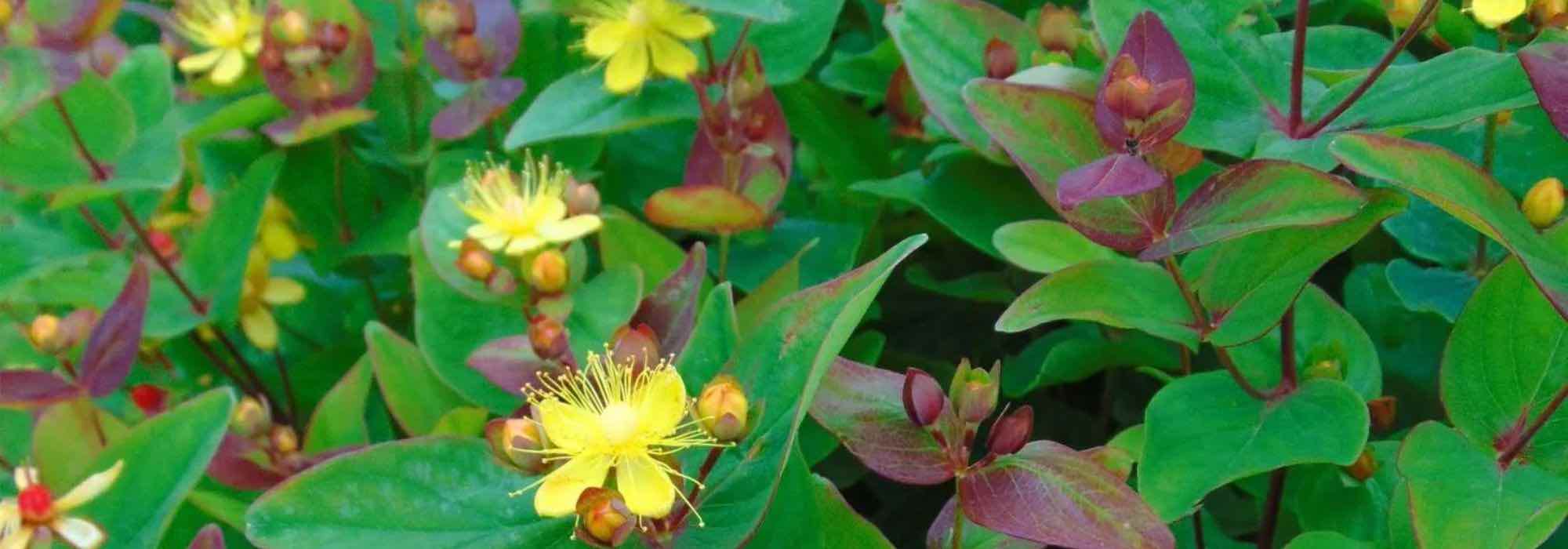
St John's wort: which varieties to choose to cover a slope?
Selection of groundcover varieties with a spreading habit
Contents
St John’s worts are these hardy all-terrain perennials, almost indestructible, capable of thriving in the harshest conditions and relatively resistant to diseases or pests. They are ideal for low-maintenance gardens, but also for beginner gardeners.
Beyond this natural resilience, they reward us with a sunny flowering, in the form of yellow-to-orange blooms with prominent stamens. Some varieties add decorative fruit to their ornamental qualities. Their dense foliage is often evergreen for much of the year.
Easy to live with, low maintenance, tolerating harsh soils, even calcareous, poor and dry, groundcover varieties are perfect candidates for brightening a slope. We have selected several varieties, highlighting their strengths to help you choose the ideal variety for your garden.
To learn all about growing St John’s wort, discover our comprehensive guide: Hypericum, St John’s wort: planting, pruning, maintenance.

Greek St John's wort (Hypericum olympicum): for its early flowering from spring
This Greek St John’s-wort or Mount Olympus St John’s-wort is an undershrub with a spreading habit, forming a perfect groundcover. Its silhouette does not exceed 35 cm in height, but it spreads to almost 50 cm.
The flowering occurs from the end of spring, in May (depending on the mildness of the climate) and lasts until the middle of summer. It can be repeat-flowering in September-October. It consists of flowers measuring 4 cm, revealing five petals of a bright yellow, which open to reveal a tuft of clearly visible stamens. This plant undoubtedly brings a natural, countryside feel to the garden, but also a warm touch. The flowers are carried on slender stems that rise above bluish-green foliage. This foliage persists for most of the year, especially if winters are not too harsh.
Liking sun and drought-tolerance, this St John’s-wort also proves hardy down to -15 °C and requires no special maintenance. It can flourish in partial shade, though it will be less floriferous. This suckering plant will be ideal for covering an unattractive and difficult-to-vegetate slope.
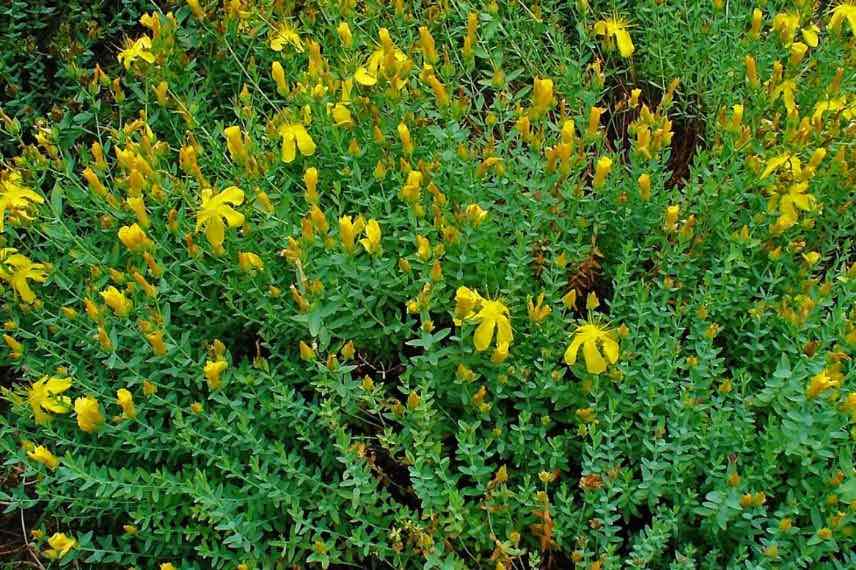
Great-flowered St. John's wort (Hypericum calycinum): for its exceptional hardiness
Hypericum calycinum is truly a hardy St John’s wort species, able to thrive in conditions that would deter most other plants. Once established, it will happily colonise the area, spreading to form large groundcover. If its height does not exceed 40 cm, its spread easily reaches 2 metres: perfect for covering a large bank. Note that this species can even be invasive, spreading easily thanks to its stolons (secondary stems that will take root on site). If you need to limit its spread, simply remove these peripheral stems regularly. This St John’s wort has the advantage of smothering nearby weeds, thus avoiding the chore of weeding.
All summer, from June to the first frosts, Hypericum calycinum treats us to large bright yellow flowers about 7 cm across, with a shaggy appearance and long central stamens. They brighten the clump of green foliage, partly evergreen, decorative in every season. This flowering also has the peculiarity of being slightly scented, releasing soft, sweet and resinous herbal notes. These flowers are a boon to pollinators.
Particularly tolerant, it grows as well in full sun as in shade, though flowering will be less generous then. With remarkable cold resistance, it will tolerate frosts below -25°C, even in waterlogged clay soil in winter. A plant regarded as truly hardy!
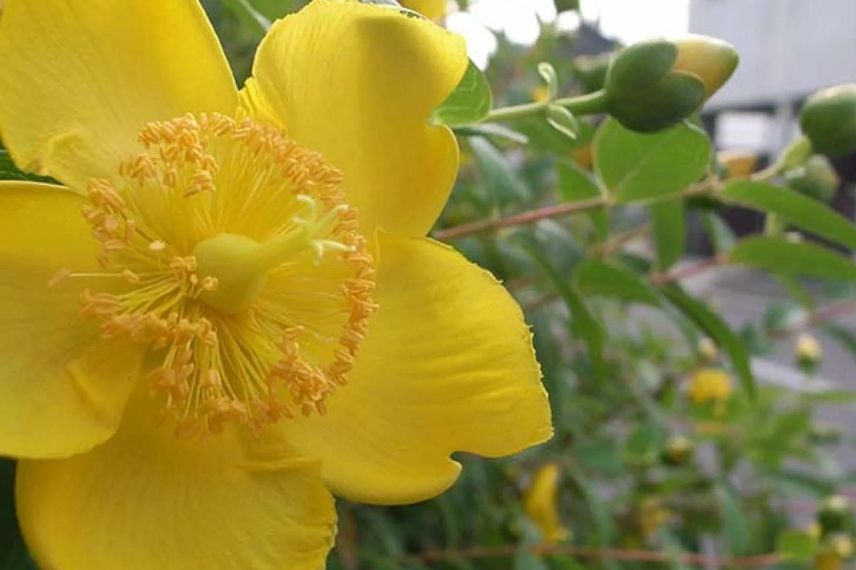
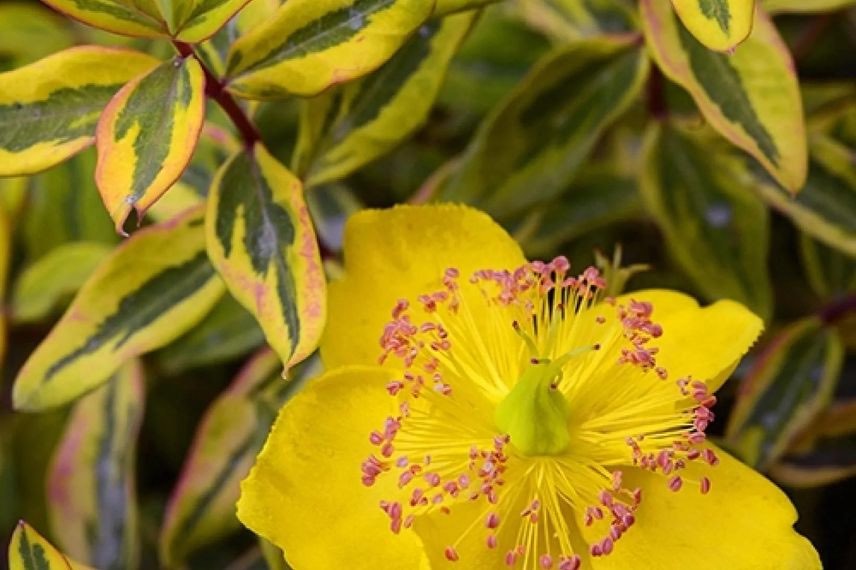
Moser's St John's wort (Hypericum (x) moserianum 'Little Misstery'): for its distinctive variegated foliage
The St John’s wort ‘Little Misstery’ stands out with its variegated foliage, which adds a touch of colour and light. It consists of pointed, leathery leaves, displaying a bluish-green hue, edged in golden yellow and subtly maculated with red. This foliage is semi-evergreen: the plant partially retains its leaves for a good part of the year, except in cases of intense and lasting frosts.
It forms a spreading, bushy and dense shrub, about 50 cm tall and 1 metre in breadth.
Its generous summer flowering lasts from June to October. This St John’s wort then rewards us with 6 cm flowers in sunny yellow, whose petals reveal yellow stamens with red anthers that contrast.
After this flowering, small decorative conical berries take over. Initially red, they then turn blue over time.
Resistant to sun and drought, it can be grown on a slope, as well as in a rockery. It will also appreciate partial shade, particularly in regions with hot climates, where the scorching rays could damage its pretty foliage. Hardy down to −15 °C and easy to live with, it is an easy-to-grow variety that adds a touch of originality with its colourful foliage.
Read also
Pairing ideas with St. John's WortSt John's wort 'Hidcote' (Hypericum patulum 'Hidcote'): a small bush with flowering into autumn
The St John’s wort ‘Hidcote’ forms a small, very dense bush with a spreading habit. It will therefore quite suit the space on a slope. It reaches around 1–2 metres across, which will help to add a touch of volume to a wild and neglected area.
From summer to autumn, in successive waves, this St John’s wort produces cup-shaped flowers in a solar yellow, further brightened by orange stamens. The flowering only stops during very hot temperatures. Then, decorative cone-shaped fruits, red at first, then blue when ripe, which will continue to brighten the garden for several weeks.
The foliage is dark green, with a slight bluish tint, or even red in cold weather. It remains partly evergreen, especially in regions that do not experience winters too harsh. It is nevertheless hardy to -20°C, which allows it to be grown across most of our territory.
A very adaptable bush, it will readily dress harsh, dry areas, notably on a slope. It will grow in full sun or partial shade in our warmest southern regions of France. Easy to grow, it will suit even beginner gardeners and requires little maintenance.
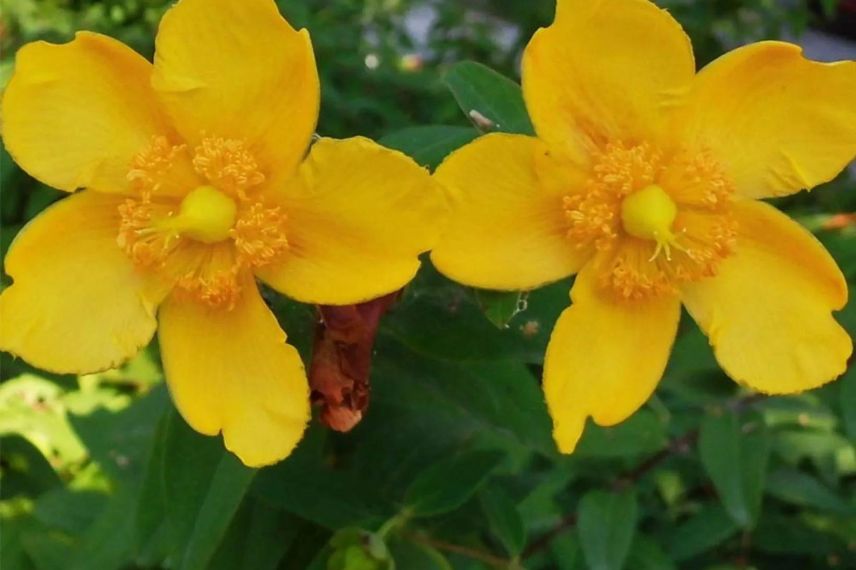
St. John's wort 'Buttercup' (Hypericum densiflorum 'Buttercup'): for its aromaticbeautiful autumn colours
St John’s wort ‘Buttercup’ truly lives up to its name, rewarding us with cup-shaped flowers in vivid butter-yellow, contrasting with long orange stamens that protrude. Flowering occurs in summer and lasts until October, delighting pollinators. It gives way to colourful fruiting. The deciduous foliage is dense and lush, fragrant when crushed. It is initially dark green, slightly blue-tinged. In autumn, it changes colour and takes on vivid yellow hues, contrasting well with the cinnamon-coloured branches.
This compact shrub with a rapid growth habit reaches about 80 cm in height and a 1 metre spread. It is ideal for dressing an unattractive slope and preventing adventives from establishing themselves.
Hardy (to -20°C) and robust, this St John’s wort can be grown in full sun or partial shade if the garden is heavily exposed. In moist soil (that never fully dries out), flowering can be uninterrupted throughout the summer, guaranteeing a sunny display for almost four months.
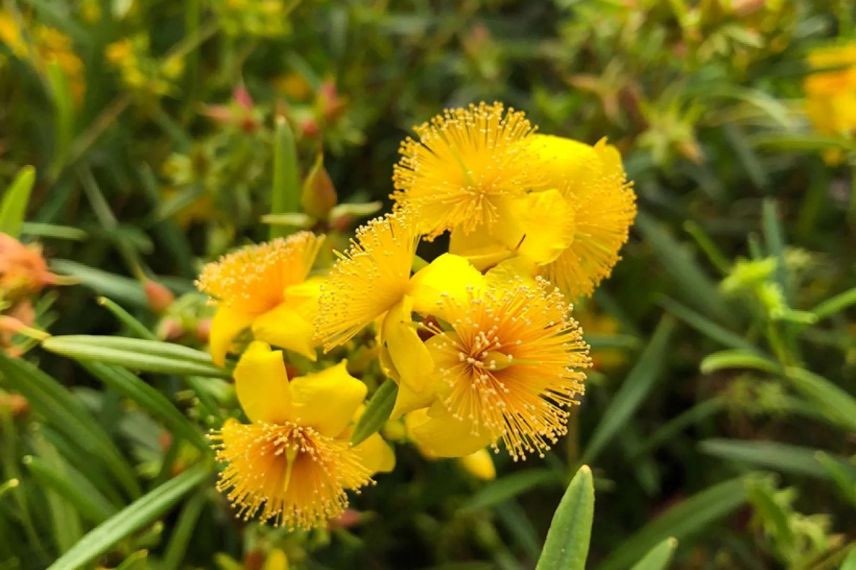
Shrubby St John's wort (Hypericum inodorum 'Rheingold') for its ornamental fruit
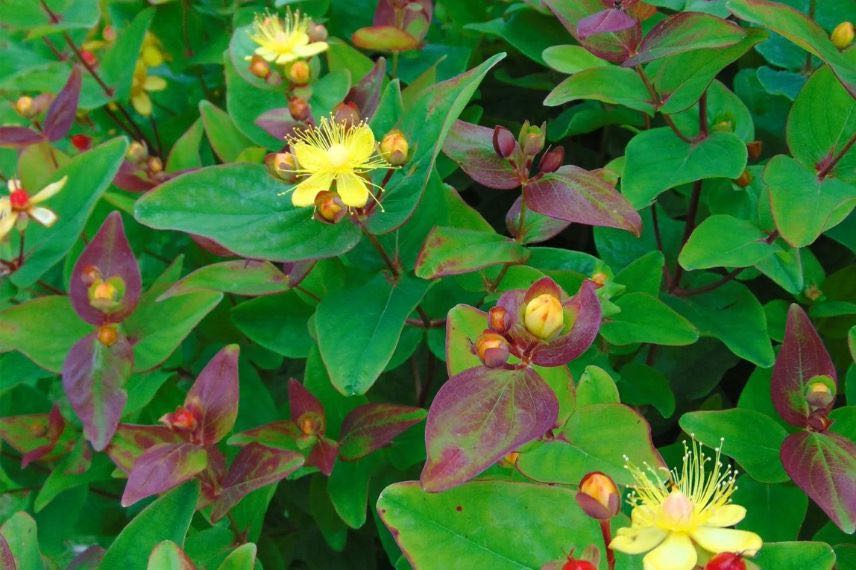
Odorless St John’s wort (Hypericum inodorum) has an extra decorative asset: as well as flowering, you can witness fruiting. From late spring to the end of summer, the St John’s wort ‘Rheingold’ produces early cup-shaped flowers in a bright, vivid yellow, consisting of five well-opened petals around a centre of equally bright protruding stamens. Beside its flowers, the fruits sit in a casing of persistent green sepals. These fleshy, decorative and colourful berries measure between 8 and 13 mm in diameter. They display a cherry-red colour, before taking on glossy chocolate hues. The shoots bearing clusters of fruit are perfect for composing summer bouquets with a rustic look. The fruits stay in place until the end of autumn, further extending the plant’s aesthetic appeal.
The foliage is initially red at the bud burst period, before taking on a blue-green colour, and sometimes purple-violaceous in autumn. It is semi-evergreen.
In terms of silhouette, this St John’s wort reaches 1 metre in height and about 1.2 metres in spread, presenting a very graceful dome-shaped habit.
Hardy beyond -20°C, tolerating both full sun (not scorching) and shade, this fail-safe St John’s wort will prove to be an ideal choice for occupying neglected spaces, such as slopes that can be difficult to dress, provided the soil is well-drained. It will be better suited to dry-climate regions, as too much humidity can promote rust, a fungal disease.
For its upkeep, simply prune in late winter, to prevent the plant from thinning at its centre.
- Subscribe!
- Contents

Comments