





























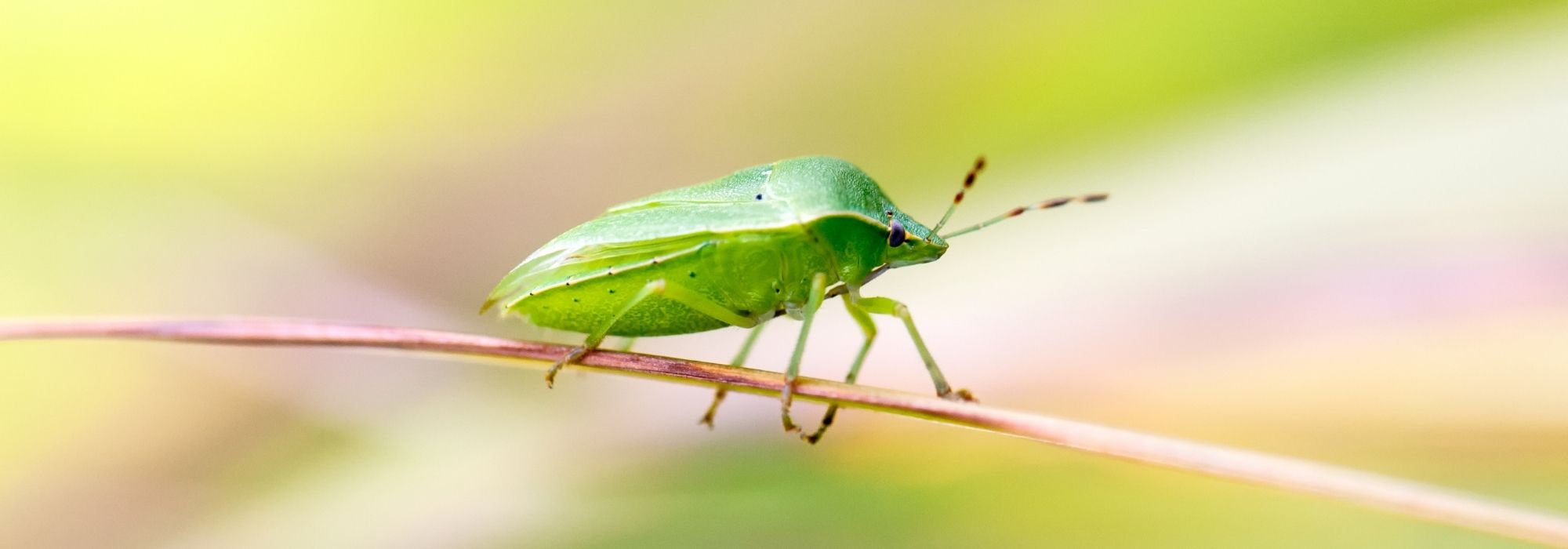
Stink bugs in the garden
To get to know them better...
Contents
Stink bugs are common insects in our gardens. There is a wide variety of species: Green Stink Bug, Brown Stink Bug, Soldier Bug, Berry Stink Bug, Vegetable Stink Bug, Harlequin Bug… It’s difficult to name them all. Terrestrial stink bugs are generally phytophagous and consume the sap of plants. Although rarely problematic, stink bugs or heteropterans can sometimes cause damage in crops, in the vegetable garden, orchard, or ornamental garden. How can we coexist with stink bugs? Is intervention really necessary? Is there a way to temporarily keep them at bay? Find out everything you need to know about garden stink bugs in our advice sheet.
Stink bugs
The order Hemiptera is divided into 2 suborders: the Homoptera (mainly aphids, scale insects, leafhoppers, and cicadas) and the Heteroptera, which include the true bugs. These famous true bugs represent over 45,000 species worldwide. We will try to be concise and attempt to generalise…
Heteroptera, or true bugs, are distinguished from other insects by their pair of forewings or hemelytra: these have a rigid part (the corium) and a thin, membranous part. The pair of hindwings is entirely membranous. This is where the name of this suborder comes from: hetero (different) and ptera (wing).
The French name “punaise” comes from the Old French “punais”: which means to smell bad.
True bugs are insects, therefore they have 6 legs, 2 antennae, 4 wings, and a jointed body divided into 3 parts: head, thorax, and abdomen. Here are the characteristics of true bugs or Heteroptera:
- a piercing-sucking rostrum inserted at the front of the head;
- forewings or hemelytra composed of a rigid part and a membranous part;
- antennae with 4 or 5 segments;
- a well-developed scutellum or shield: the scutellum is the part of the thorax located at the junction of the forewings (this is also found in Coleoptera);
- the presence of an odorous gland located beneath the thorax.
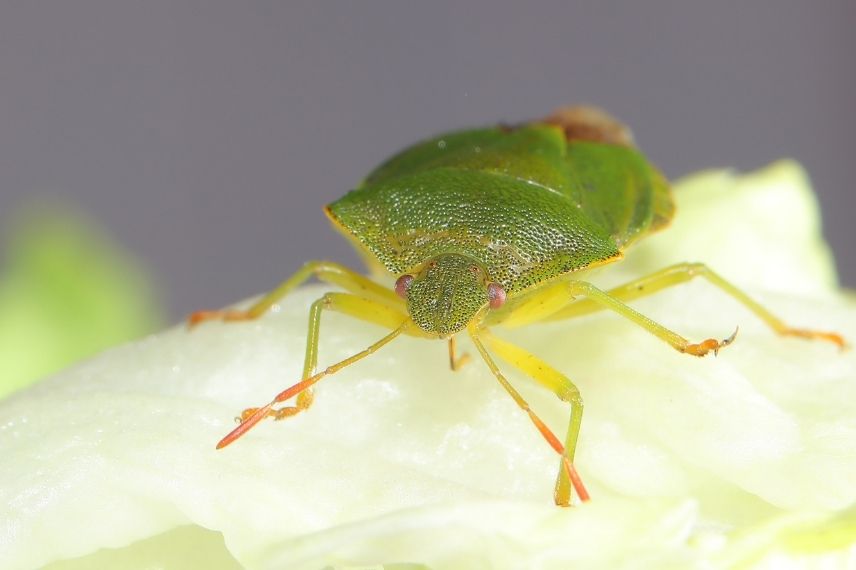
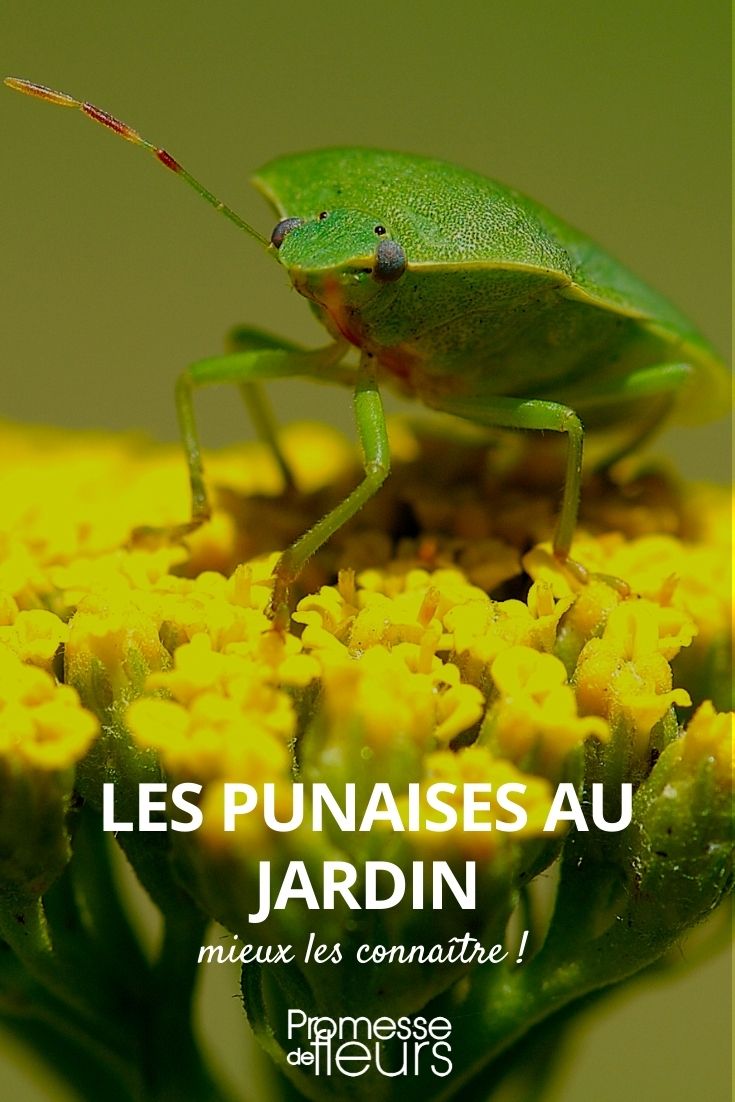
Green bug
What do bugs do in our gardens?
Habitat of Bugs
The habitat of bugs is varied. Some are aquatic (Notonectes, Corises, Naucores, Nèpes…) or subaquatic (Gerris, water striders…), but the majority of bugs are terrestrial. These are the ones you will predominantly find in the garden. However, if you are fortunate enough to have a pond in your garden, you will also observe aquatic and subaquatic bugs.
Feeding of Bugs
Bugs are sometimes predatory or ectoparasitic (external parasites that feed on the blood of their host), but the vast majority are phytophagous. Thanks to their piercing-sucking rostrum, phytophagous bugs, such as the Brown Bug (Coreus marginatus), the Harlequin Bug (Graphosoma lineatum), or the Green Bug (Palomena prasina), feed on sap by piercing stems, leaves, fruits, or seeds.
These phytophagous bugs can potentially cause direct damage (growth retardation, desiccation…) or indirect damage when the bug transmits diseases. Bugs are often considered pests in crops, even regarded as nuisances. However, this is extremely rare, and bugs are almost never present in sufficient numbers to cause real damage.
Even though climate change is causing an increase in some bugs that damage crops, such as the Cabbage Bug or the Berry Bug (Dolycoris baccarum), we have also recently experienced an invasion of the Brown Marmorated Stink Bug, an invasive species from Asia, considered a pest of crops. The Brown Marmorated Stink Bug has no natural predators here.
Reproduction
Reproduction in bugs is characterised by sometimes surprising positions: notably the “tail-to-tail” position in many pentatomids or the Firebug (Pyrrhocoris apterus). The female and male remain attached even after mating. Bugs lay small white or translucent eggs on the underside of leaves. The eggs hatch within one to three weeks depending on the species. The insect does not undergo a true metamorphosis: the young bug already resembles an adult, but smaller. The “larva” and the adult also live in the same medium (paurometaboly). Five moults will be necessary for the young bug before it becomes an adult.
Defence Mechanisms
Bugs defend themselves in various ways, such as adopting bright colours (“don’t touch me, I’m not good to eat!“), as seen in the Striped Bug or the Firebug (Pyrrhocoris apterus), for example, or secreting foul-smelling substances through their scent glands.
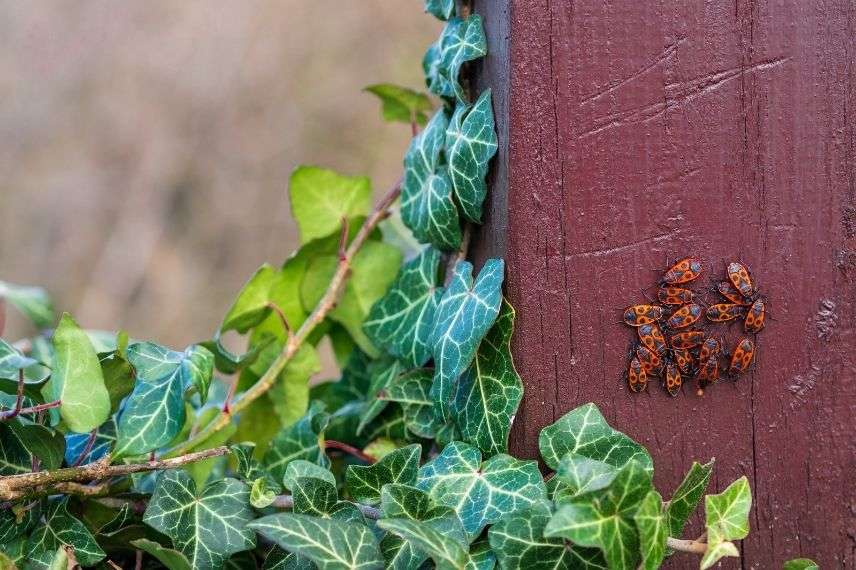
The Firebug
Did you know?: terrestrial and phytophagous bugs in the garden do not sting. However, predatory aquatic bugs, such as Nèpes or Notonectes, can sting you. The sting is harmless, but… quite painful. Don’t bother them!
Some of the most common species of bugs in the garden
- Green Shield Bug or Field Bug or Wood Bug (Palomena prasina): green in colour. It attacks solanaceous plants in the vegetable garden, such as tomatoes, aubergines, or chillies;
- Garden Bug (Eurydema oleracea): small and black, with white or red spots (one on the scutellum and three others at the base of the abdomen). It feeds on the sap of brassicas (cabbages, turnips, radishes…), causing no real damage, and also consumes aphid larvae;
- Berry Bug (Dolycoris baccarum): a beautiful bug with a green-brown and wine-red colour. It feeds on berries and seeds, but… also on aphid larvae and insect eggs;
- Harlequin Bug (Graphosoma lineatum): a stunning bug, striped in red and black. It is found on apiaceae (umbellifers);
- Fire Bug (Pyrrhocoris apterus): a bug whose pattern resembles a sort of red and black African mask. It feeds on the seeds of linden trees, mallows, lavateras… and sometimes on dead insects;
- Brown Shield Bug (Coreus marginatus): a large bug that appears to be covered in brown leather. It feeds on the sap of sorrel, dock, and persicaria.
Of course, these are just a few common species. There are a large number of heteropteran species (bugs) in France: around 2000 terrestrial or aquatic species.
How to get rid of bugs?
Should we really “get rid of” them?
Bugs are rarely present in sufficient numbers to cause damage. However, it is in the vegetable garden, and even more so in the orchard, that one will be most concerned about the presence of bugs. Fruits and vegetables that are punctured will necrose, develop poorly, or fall prematurely. Moreover, some fruits consumed directly can sometimes taste awful due to a bug using its preferred defence mechanism: releasing a foul-smelling and unappetising substance. This is often the case with raspberries. In short, in these specific cases, it may be necessary to intervene, but always gently. Let’s categorically forget about insecticides, such as diatomaceous earth or other such delights!
Some solutions to temporarily ward off bugs
- spray a garlic decoction: garlic repels bugs (and vampires!). Prepare some garlic powder in water with a bit of diluted black soap and spray this mixture on the plants. The bugs will go elsewhere. This “treatment” is only temporary; you will need to repeat the operation;
- peppermint essential oil: bugs also dislike the smell of mint. Growing mint (and/or lemon balm) in the vegetable garden and planting it at the base of fruit trees is already a good idea. You can also prepare a mint infusion: 3 large handfuls of mint leaves in 1 litre of boiling water. You can spray your “mint tea” once cooled on the plants;
- plant Nepeta or Catnip: the smell of the leaves attracts cats but repels bugs. Feel free to plant it directly around the vegetable garden and at the edges of flower beds.
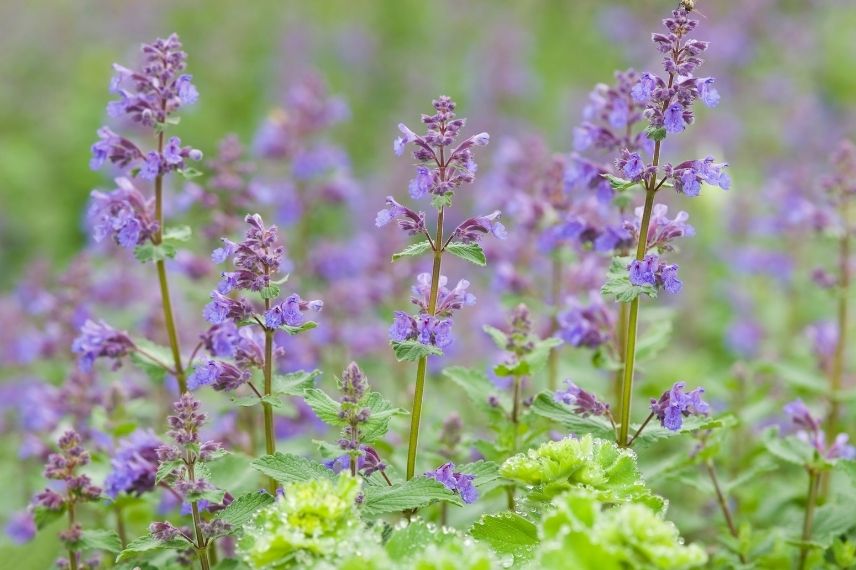 Nepeta
Natural predators of bugs
To help you regulate bug populations, the wildlife in your garden can assist. In a garden where nature is respected, bugs are preyed upon by spiders, some insectivorous birds, and toads. They are also parasitised by larvae of certain species of wasps. However, be cautious, the Brown Marmorated Stink Bug (Halyomorpha halys) is an invasive species from Asia and, therefore, has no natural predators here.
- Subscribe!
- Contents
Comments